
Channel Strategy
A channel is where an optimization action tells you to publish — and the guiding principle is simple: your brand should show up wherever AI answers pull their sources from.
Why channel choice decides whether optimization works
Section titled “Why channel choice decides whether optimization works”When someone asks ChatGPT, Gemini, Claude, or Perplexity “what’s the best tool for X,” the AI doesn’t invent an answer — it retrieves and cites content that already exists: a Reddit thread, a comparison page on a vendor site, a listicle on Medium. The same article published where AI actually looks and published where it doesn’t will have completely different effects on your Mention Rate.
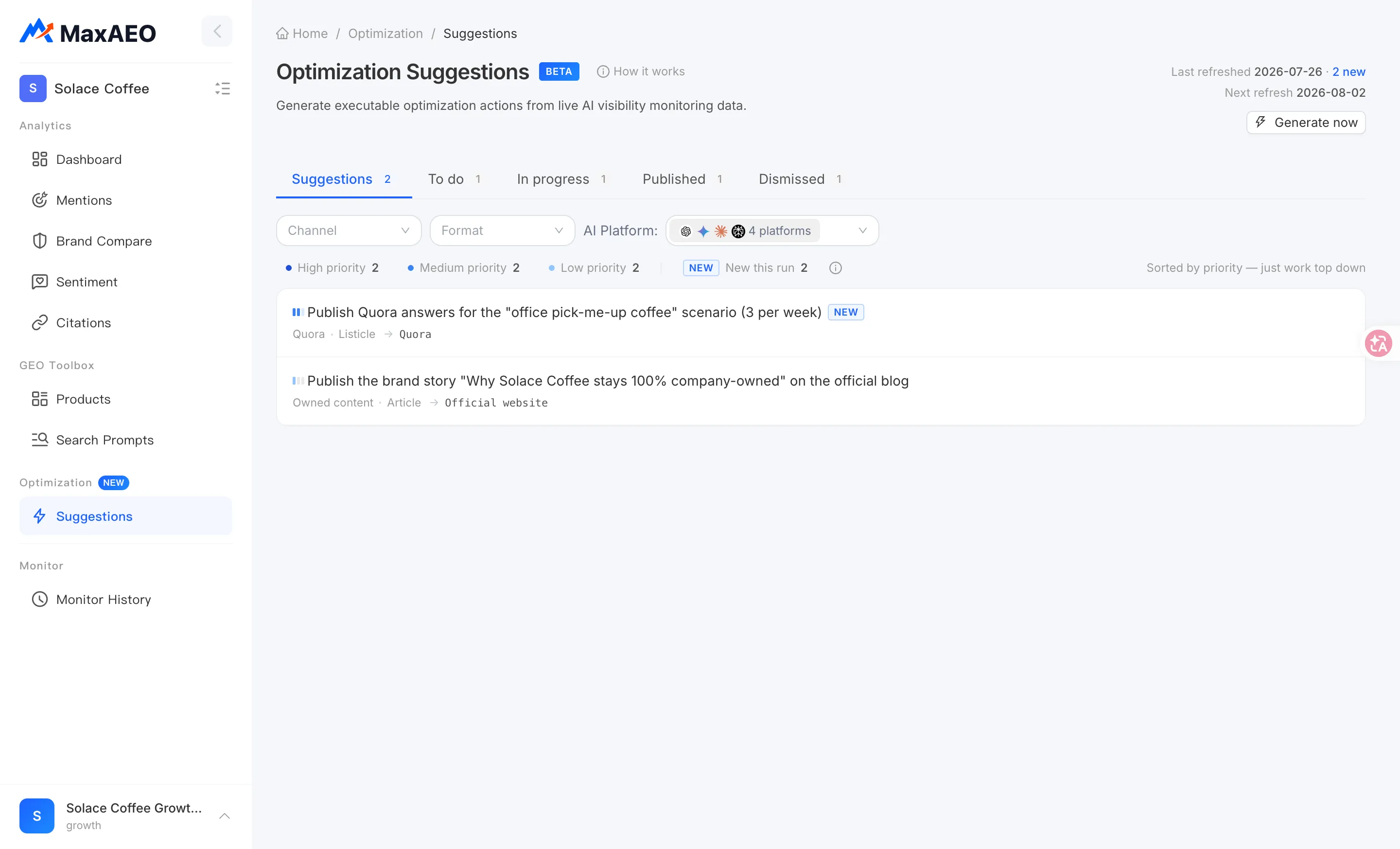
MaxAEO doesn’t guess. Every week the engine scans the latest AI answers to your monitored prompts and identifies which sources the AI actually cited, then recommends channels based on that evidence. In each action’s detail drawer, the evidence section lists “What AI actually cites — this is where you need to show up,” with your own content tagged Owned.
Where the channels come from
Section titled “Where the channels come from”The Channel filter on the Suggestions page covers every channel the engine can recommend. Grouped by type:
| Channel type | Channels |
|---|---|
| Owned | Owned content (your website, blog, and other properties you control) |
| Communities & Q&A | Reddit, Quora, Discord, Zhihu, Baidu Tieba, V2EX |
| Publishing & media | Medium, WeChat, Xiaohongshu, Baijiahao, Toutiao, Sohu, Jianshu |
| Developer & technical | GitHub, Stack Overflow, CSDN, SegmentFault, InfoQ |
| Video | YouTube, Bilibili |
| Shopping research | SMZDM |
If you’re optimizing for Western AI platforms, Reddit, Quora, Medium, GitHub, and Stack Overflow are usually the main arenas; the Chinese-language channels mostly matter when your prompts target Chinese-speaking markets. You don’t have to work this out yourself — each action recommends a specific channel based on the AI platforms it covers and the citation evidence behind it.
Content formats
Section titled “Content formats”Alongside a channel, every action specifies a format — on the same channel, different formats answer different kinds of questions:
- Comparison page: a head-to-head “A vs B” breakdown of features, pricing, and use cases.
- Listicle: a “Top 10 tools for X” style roundup — the format AI cites most often for recommendation questions.
- Guide: how-to content that teaches readers to do or choose something.
- Review: an in-depth look at a single product, pros and cons included.
- Q&A: a direct answer to a specific question in a community.
- Article: general-purpose content that doesn’t fit the types above.
How to choose: two matching principles
Section titled “How to choose: two matching principles”Owned vs third-party channels
Section titled “Owned vs third-party channels”- Owned content gives you maximum control: publish and update any time, no platform rules, and the content compounds into a long-term brand asset. Comparison pages and guides that need ongoing maintenance belong on your own site first.
- Third-party channels like Reddit and Quora are what AI treats as independent, authoritative sources — a recommendation there carries more weight than your own marketing copy. If AI heavily cites a community when answering a category of questions, that community is exactly where your absence hurts.
It’s not either/or. A healthy setup uses your own site to host the canonical facts (for AI to verify against) and third-party channels to host social proof and recommendations (for AI to cite).
Matching format to prompt intent
Section titled “Matching format to prompt intent”Optimization actions target mention gaps on your monitored prompts, and prompts with different intents get answered from different content formats. A practical mapping:
| Format | Prompt intents it serves | Example channels |
|---|---|---|
| Comparison page | Product Compare | Owned content, Medium |
| Listicle | Product Recommend, Category Consult | Medium, Reddit |
| Guide | Feature Learn, Category Consult | Owned content, Medium, GitHub |
| Review | Brand Evaluate, Word of Mouth | YouTube, Medium |
| Q&A | Word of Mouth, Price Consult, After Sales | Reddit, Quora, Stack Overflow |
| Article | Broad awareness-stage topics | Medium, Owned content |
A concrete example: if you’re never mentioned on “A vs B” comparison prompts, and the AI is citing someone else’s comparison page in those answers, the most direct move is to publish your own — which is exactly the reasoning the action’s “Why” section spells out (“what’s missing is your own comparison page”).
Validate your channel picks with Citations
Section titled “Validate your channel picks with Citations”Before committing to a channel, check what’s already feeding the AI on the Citations page:
-
Open Citations and read the Source Analysis treemap: each block is a source AI cited, and the bigger the block, the more often it’s cited. This is the current map of who’s feeding the AI.
-
In the Responses list, check the top cited media and top cited articles per prompt to confirm exactly whose content the AI leans on for the prompts you care about most.
-
Go back to Suggestions and work top-down through the actions, cross-referencing each one’s evidence section (“What AI actually cites”).
-
After publishing, use Mark published on the action and add the published URL — MaxAEO will use it to track how AI cites that content (citation impact tracking is coming soon).
Publishing is not the finish line. It takes time for AI systems to pick up and cite new content — watch your Mention Rate and Citations data in weekly trends, and don’t draw conclusions because nothing moved a few days after publishing.