
An AI search visibility benchmarking tool measures how often, where, and how accurately your brand appears in AI-generated answers compared with competitors. The best tools do not just return a score. They define a repeatable prompt set, query multiple answer engines, track citations, normalize results by intent, and show whether movement is statistically meaningful.
That matters because AI search is not a single ranking page. ChatGPT, Perplexity, Gemini, Claude, Copilot, Google AI Overviews, and other answer surfaces can produce different brand lists for the same buyer question. A one-time “visibility score” may be useful for a quick audit, but it is not enough for budgeting, executive reporting, or competitive strategy.
What is an AI search visibility benchmark?
An AI search visibility benchmark is a baseline that compares your brand’s presence in answer engines against a fixed set of competitors, prompts, engines, and dates. It turns scattered AI answers into measurable performance: mentions, citations, ranking position, recommendation quality, and sentiment.
A benchmark should answer five practical questions:
- Are we mentioned?
- Are we recommended or merely named?
- Are we cited with our own site, a marketplace, a review site, or a competitor’s content?
- How do we compare with direct competitors?
- Did our visibility actually improve, or did the model simply vary between runs?
This is where AI visibility differs from traditional rank tracking. In classic SEO, a query often maps to a visible results page. In AI search, the output is generated, summarized, and sometimes personalized. A useful benchmark treats visibility as a pattern over time, not a single screenshot.
For a deeper measurement framework, see maxaeo.ai’s guide to AI search visibility benchmarking.
Why one visibility score is not enough
A single score is easy to present, but it often hides the reasons behind the number. Two brands can both score 42/100 while facing completely different problems: one may be cited often but described inaccurately; the other may be absent from commercial prompts but strong in educational prompts.
AI search also varies by engine and run. A 2026 research paper, “Don’t Measure Once: Measuring Visibility in AI Search,” argues that AI search visibility should be measured through repeated observations because answers vary across runs, prompts, and time. That finding matches what practitioners see in day-to-day monitoring: single-prompt checks are too noisy for serious decisions.
A better benchmark separates:
- Coverage: how many relevant prompts include your brand.
- Prominence: how high or early your brand appears.
- Preference: whether the answer recommends you, not just mentions you.
- Citation ownership: whether the source is your site or a third party.
- Accuracy: whether product, pricing, category, and positioning details are correct.
- Stability: whether results hold across repeated runs.
The score can still exist. It should be the headline, not the whole report.
The five metrics a benchmarking tool should report
A reliable AI search visibility benchmarking tool should expose its core metrics clearly enough that your team can reproduce the logic. Black-box scores are risky because they make it hard to diagnose what changed.
| Metric | What it measures | Why it matters | Simple formula |
|---|---|---|---|
| Mention rate | Prompts where your brand appears | Basic visibility | Brand mentions ÷ total prompts |
| Recommendation rate | Prompts where your brand is endorsed | Commercial influence | Recommended mentions ÷ total prompts |
| AI share of voice | Your presence versus competitors | Competitive position | Your weighted mentions ÷ category mentions |
| Citation rate | Answers citing your domain or owned assets | Source authority | Owned citations ÷ total cited answers |
| Accuracy rate | Answers with correct brand facts | Trust and conversion risk | Accurate answers ÷ brand mentions |
| Rank-weighted visibility | Position-adjusted exposure | First-mentioned brands get more attention | Sum of position weights ÷ possible score |
The most useful metric for executives is usually AI share of voice, because it frames visibility as a competitive market, not an isolated score. For formulas and reporting examples, maxaeo.ai’s guide to AI visibility metrics and its breakdown of AI share of voice are natural next reads.
How to build a benchmark prompt set
A benchmark prompt set is the foundation of the whole measurement system. It should represent how real buyers, researchers, or evaluators ask AI systems for help. If the prompts are biased, the benchmark will be biased.
Use four prompt groups:
-
Category discovery prompts
Example: “What are the best customer support platforms for mid-market SaaS companies?” -
Use-case prompts
Example: “Which tools help B2B marketers monitor brand visibility in AI answers?” -
Comparison prompts
Example: “Compare Brand A, Brand B, and Brand C for enterprise teams.” -
Problem-led prompts
Example: “How can a company find out why AI search recommends competitors instead of its own product?”
A good starter benchmark uses 40–80 prompts per category. For high-value categories, use 100+ prompts grouped by funnel stage, persona, geography, and language. Each prompt should be frozen before analysis begins so teams do not unconsciously add prompts that favor the brand.
Avoid prompts that include your brand name unless you are measuring branded answer accuracy. Non-branded prompts reveal whether AI systems independently surface your brand when users ask category-level questions.
How many AI engines should be included?
A practical benchmark should cover at least three types of AI answer surfaces: conversational assistants, search-grounded answer engines, and AI-enhanced traditional search. Each surface uses different retrieval, summarization, and citation behavior.
A balanced tracking mix may include:
- ChatGPT-style assistants for recommendation and explanation prompts.
- Perplexity-style answer engines for citation-heavy research prompts.
- Gemini or Copilot-style assistants for ecosystem-specific behavior.
- Google AI Overviews or AI Mode surfaces where available for search-integrated visibility.
Do not assume one engine represents the whole market. A brand can be strong in Perplexity because third-party reviews cite it frequently, weak in ChatGPT because category pages are unclear, and absent from AI Overviews because crawlability or source authority is poor.
For tool selection across engines, see maxaeo.ai’s practical AI search engine monitoring tools buyer’s guide.
A practical scoring model for competitive benchmarking
The most actionable benchmark is not a raw count. It is a weighted model that reflects how people interpret AI answers. First-position recommendations usually matter more than passive mentions near the bottom.
Here is a simple scoring model teams can adapt:
| Answer event | Suggested weight |
|---|---|
| Brand is recommended as top option | 5 |
| Brand appears in top 3 | 4 |
| Brand is mentioned but not recommended | 2 |
| Brand is cited through owned domain | +2 |
| Brand is cited through high-authority third party | +1 |
| Brand fact is materially inaccurate | -3 |
| Competitor is recommended and brand is absent | 0 |
Then calculate:
Weighted AI Visibility Score = earned points ÷ maximum possible points × 100
This framework creates information gain beyond a generic score because it distinguishes presence, preference, position, source quality, and accuracy. A brand mentioned 50 times with outdated facts should not be treated as healthier than a brand mentioned 35 times with strong recommendations and owned citations.
Use the score for trend reporting, but keep the underlying components visible. When a score rises, your team should know whether it improved because citations increased, competitors dropped, or accuracy issues were fixed.
What “good” AI visibility looks like by maturity stage
There is no universal good score because categories vary. A niche B2B product with five competitors should not be benchmarked against consumer travel, ecommerce, or software marketplaces. A useful benchmark compares you with the brands that appear in the same answer set.
Use this maturity model as a starting point:
| Stage | Typical pattern | What to do next |
|---|---|---|
| Invisible | Brand appears in fewer than 10% of non-branded prompts | Fix crawlability, entity clarity, and category pages |
| Recognized | Brand appears in 10–30% of relevant prompts | Build comparison content and third-party evidence |
| Competitive | Brand appears in 30–60% of prompts and sometimes ranks top 3 | Improve owned citations and recommendation triggers |
| Preferred | Brand appears in 60%+ of relevant prompts with strong sentiment | Defend accuracy, monitor competitors, expand prompt coverage |
| Category source | Brand content is cited even when competitors are discussed | Treat AI visibility as an owned media advantage |
The most important insight is relative movement. If your visibility rises from 18% to 31% while the category leader falls from 52% to 45%, your competitive position changed meaningfully even if you are not yet the top brand.
Technical checks that affect benchmark results
AI visibility is partly a content problem, but technical access can distort every benchmark. If answer engines cannot fetch or interpret your pages, your benchmark may show low visibility even when your content is strong.
Check these areas before trusting results:
- Robots.txt rules for AI and search crawlers.
- WAF and bot protection that block legitimate crawlers.
- Consent banners that hide key page content.
- JavaScript rendering that delays core facts.
- Schema markup that does not match visible content.
- Canonical tags that point to the wrong page.
- Outdated product pages that conflict with third-party descriptions.
Google’s structured data guidance says markup should represent visible page content and should not be blocked by access controls; its general structured data guidelines are a useful baseline for technical hygiene. Google also recommends descriptive, concise title text in its title link documentation, which matters because answer systems often rely on clear page-level signals.
For AEO-specific workflows, maxaeo.ai’s guide to AEO performance monitoring tools explains how to connect monitoring, fixes, and reporting.
How to evaluate an AI visibility benchmarking vendor
Choose a vendor by methodology, not dashboard polish. The right platform should make its measurement choices transparent enough that your SEO, content, and analytics teams can trust the output.
Ask these questions before buying:
- Prompt design: Who creates the prompt set, and can we edit it?
- Competitor set: Can competitors be fixed, discovered automatically, or both?
- Engine coverage: Which AI systems are tested, and how often?
- Repeatability: Are prompts run multiple times to reduce noise?
- Citation extraction: Does the tool capture URLs, domains, and source types?
- Sentiment and accuracy: Can it flag incorrect or negative brand claims?
- Segmentation: Can results be broken down by persona, funnel stage, location, or product line?
- Exports and API: Can the raw data be reviewed outside the dashboard?
- Change detection: Does it explain why a score moved?
- Actionability: Does it connect findings to content, technical, and authority fixes?
A strong vendor will explain the calculation. A weak vendor will hide behind a proprietary number and offer vague recommendations like “improve authority” without showing the prompts, sources, or competitors behind the diagnosis.
A 30-day workflow for creating your first benchmark
A first benchmark does not need to be perfect. It needs to be consistent, repeatable, and tied to business decisions.
-
Define the category.
Pick one product line, geography, and buyer segment. Avoid benchmarking the entire company at once. -
Select 5–10 competitors.
Include direct competitors, marketplace alternatives, review sites, and “do nothing” substitutes if they appear in AI answers. -
Create 40–80 prompts.
Split them across discovery, use case, comparison, and problem-led intent. -
Run across 3–5 engines.
Repeat runs on a schedule instead of relying on a single snapshot. -
Score mentions, recommendations, citations, and accuracy.
Keep raw answers for auditability. -
Identify the top three gaps.
Common gaps include missing comparison pages, weak category definitions, poor third-party validation, or blocked crawlers. -
Publish fixes and remeasure.
Wait long enough for crawling, indexing, and answer systems to refresh before declaring success.
This workflow turns benchmarking into an operating rhythm. The goal is not to admire the dashboard. The goal is to decide what to fix next.
Common mistakes to avoid
The biggest mistake is treating AI visibility as a vanity metric. A high score is useful only if it reflects the prompts that influence real buyers.
Avoid these traps:
- Testing only branded prompts. They overstate visibility.
- Ignoring competitors. Absolute visibility is less useful than relative share.
- Measuring once. AI answers vary; repeated measurement is safer.
- Counting every mention equally. A top recommendation is more valuable than a passing mention.
- Ignoring accuracy. Wrong facts can create conversion risk.
- Treating citations as always positive. A citation to an outdated review page may reinforce the wrong positioning.
- Separating SEO and AEO teams. Traditional crawlability, titles, internal links, and structured data still influence discoverability.
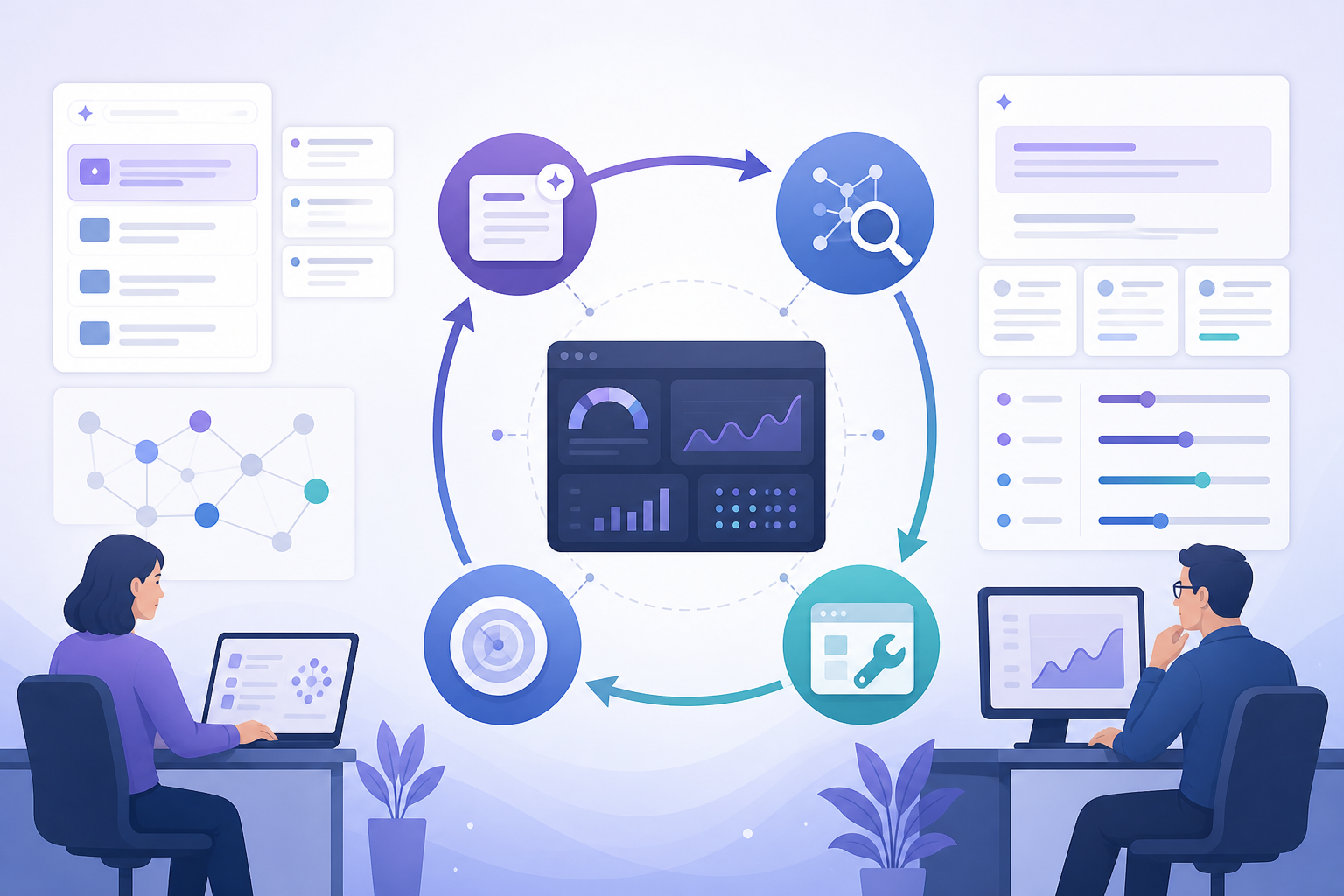
The most mature teams combine search analytics, AI answer monitoring, content operations, and technical diagnostics into one feedback loop.
FAQ
What is the difference between AI search visibility and AI share of voice?
AI search visibility measures whether and how your brand appears in AI-generated answers. AI share of voice compares your brand’s presence with competitors across the same prompt set, making it better for competitive benchmarking and executive reporting.
How often should an AI visibility benchmark be updated?
Most teams should update benchmarks weekly or biweekly. Fast-moving categories, product launches, and reputation-sensitive markets may need daily monitoring. The key is consistency: use the same prompt set, competitors, and scoring model so changes are comparable.
Can a free AI visibility checker replace a benchmarking platform?
A free checker can provide a useful snapshot, but it rarely replaces a full benchmark. Serious measurement needs repeated runs, competitor normalization, prompt segmentation, citation tracking, accuracy review, and historical reporting.
Which teams should use an AI search visibility benchmarking tool?
SEO, content, product marketing, PR, analytics, and demand generation teams all benefit. SEO teams diagnose discoverability, content teams close topic gaps, PR teams influence authoritative third-party sources, and executives track category position.
What is the first thing to fix when AI search visibility is low?
Start with entity clarity and crawlability. Make sure your site clearly explains who you serve, what your product does, how it compares with alternatives, and why it is credible. Then check whether answer engines can access the pages that contain those facts.