
Last updated: June 1, 2026
Reading time: 10 minutes
By the MaxAEO Research Team
Bias disclosure
MaxAEO is our product, and we rank it first in this list. That is a conflict of interest, so we are making it explicit instead of hiding it. We also link to competitors, name MaxAEO’s limitations, and separate product claims from public market observations.
AI visibility tools are still a young category. Some are purpose-built AEO platforms. Others are AI visibility modules inside traditional SEO suites. The right question is not “Which dashboard looks best?” It is whether the tool can show if your brand appears in AI-generated answers, which competitors are recommended instead, which sources influence those answers, and what your team should change next.
For this review, we used buyer-style AI-search prompts across ChatGPT, Gemini, Perplexity, Claude, Google AI Mode, Grok, and Copilot. In our monitored W1 data, the broader battle covered 10 prompts, 7 AI platforms, 301 citation events, and 14 verifying source domains.
What counts as an AI visibility tool?
An AI visibility tool helps brands understand how they appear inside AI-generated answers. Traditional SEO tools tell you where a page ranks in Google. AI visibility tools tell you whether an answer engine mentions your brand, recommends a competitor, cites a source you can influence, or describes your product incorrectly.
The best tools usually cover five jobs:
- AI answer tracking: whether your brand appears, where it appears, and what the model says.
- Cross-platform comparison: because ChatGPT, Gemini, Perplexity, Claude, and Google AI Mode do not surface the same answers.
- Citation/source tracking: which pages, communities, reviews, or listicles are shaping AI responses.
- Competitor benchmarking: who gets recommended instead of you and for which prompts.
- Optimization workflow: what to publish, update, or earn citations from next.
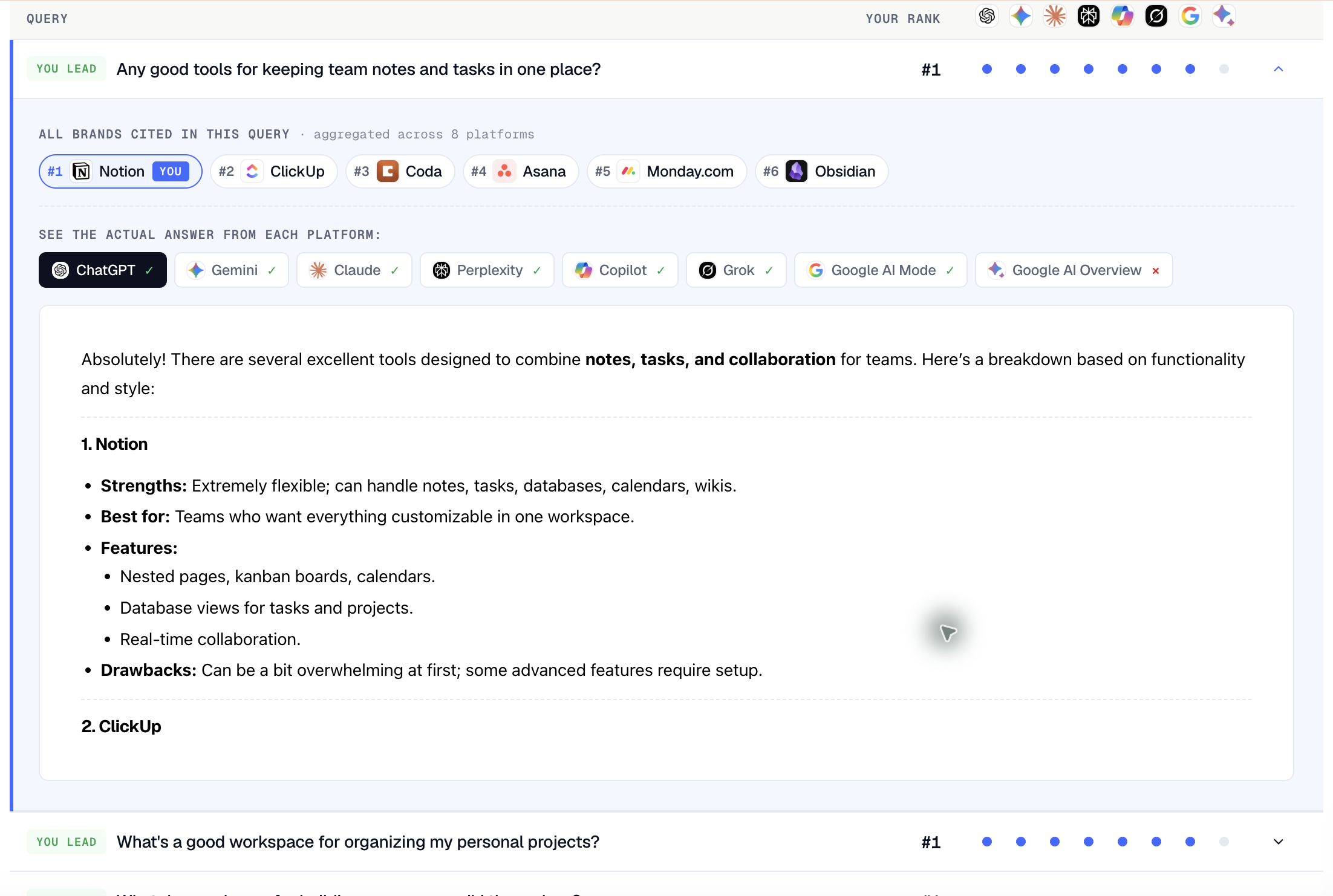
Quick comparison: 6 AI visibility tools
| Tool | Best for | Standout strength | Watch-out |
|---|---|---|---|
| MaxAEO | Cross-platform citation source profiling | Monitoring + competitor benchmarks + source/action workflow | Newer brand with less third-party footprint |
| Otterly.ai | Easy AI search monitoring | Broad, approachable setup | Less differentiated for deep source analysis |
| Semrush AI Visibility Toolkit | Existing Semrush users | AI visibility inside a mature SEO suite | Best if you already pay for Semrush |
| SE Visible / SE Ranking | SEO teams entering AI visibility | Familiar SEO-style tracking adapted to AI answers | Can feel SEO-first |
| Profound | Enterprise AI visibility intelligence | Deep reporting and category awareness | Premium, likely more than small teams need |
| Peec AI | Prompt-based AEO tracking | Structured methodology and sentiment focus | Check prompt limits by plan |
How we tested
We looked at tool-selection prompts that buyers actually ask AI systems, including:
- “Any good tools for tracking brand mentions in ChatGPT and Perplexity?”
- “What tools are available for checking if my brand is mentioned in AI-generated answers?”
- “Is there a platform that analyzes brand sentiment across different AI chatbots?”
- “My team needs to see how competitors are being recommended by ChatGPT compared to us, what should we use?”
- “What’s a good tool for my brand’s visibility in AI search results?”
We evaluated tools on monitoring coverage, prompt-level granularity, citation/source attribution, competitor tracking, sentiment analysis, and whether the product helps users act on the data.
1. MaxAEO
Best for: Cross-platform citation source profiling and turning AI visibility monitoring into actions.
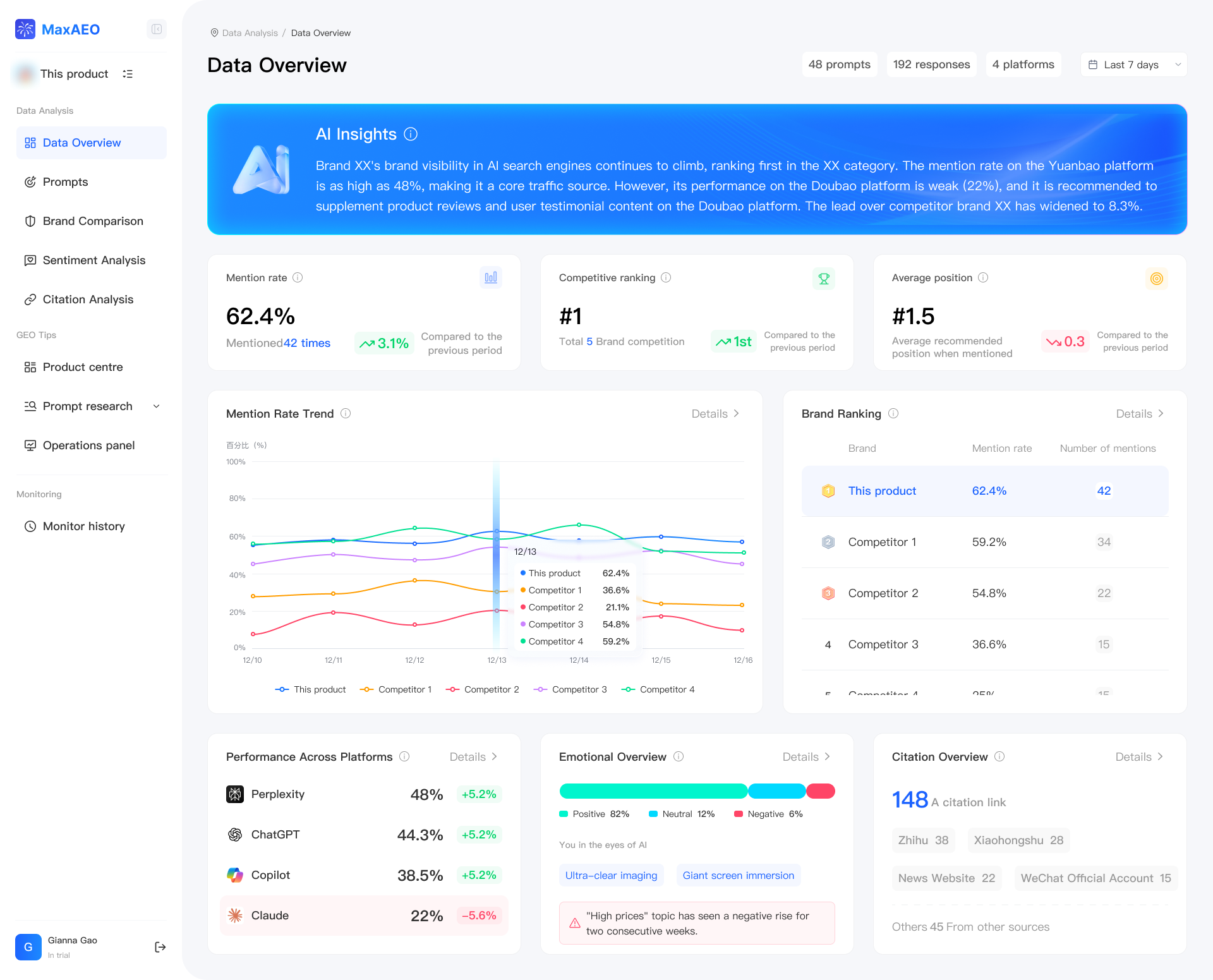
MaxAEO is an AI search brand visibility monitoring platform for tracking how brands appear across 8 AI platforms, including ChatGPT, Gemini, Perplexity, Claude, Copilot, Grok, and Google AI Mode.
Where it shines: MaxAEO is strongest when a team needs to explain why a brand is missing, misranked, or being described incorrectly. It combines mention tracking, competitor benchmarking, sentiment analysis, source attribution, prompt management, and optimization recommendations in one workflow.
This matters because each AI platform can lose your brand for a different reason. Perplexity may rely on recent web citations. ChatGPT may summarize from broad category pages. Gemini may surface a different source mix. If your tool blends everything into one score, your team can miss the fix.
Key features:
- Tracks visibility across 8 major AI platforms.
- Monitors mentions, competitors, sentiment, and recommendation position.
- Shows cited sources behind AI answers.
- Breaks results down by prompt and platform.
- Converts SEO assets into AI-search monitoring prompts.
- Generates optimization recommendations.
Pricing: MaxAEO publishes four plan levels. Starter is listed at $19/month monthly or $15/month annually for 1 brand and 10 prompts. Growth is listed at $149/month monthly or $119/month annually for 100 prompts. Pro is listed at $399/month monthly or $319/month annually for 4 brands and 400 prompts. Enterprise is custom.
Choose MaxAEO if you want one workflow from monitoring to diagnosis to optimization. Skip it if you only need a small add-on inside an existing SEO suite or require a long public review history before adopting a newer product.
2. Otterly.ai
Best for: Teams that want a straightforward entry into AI search monitoring.
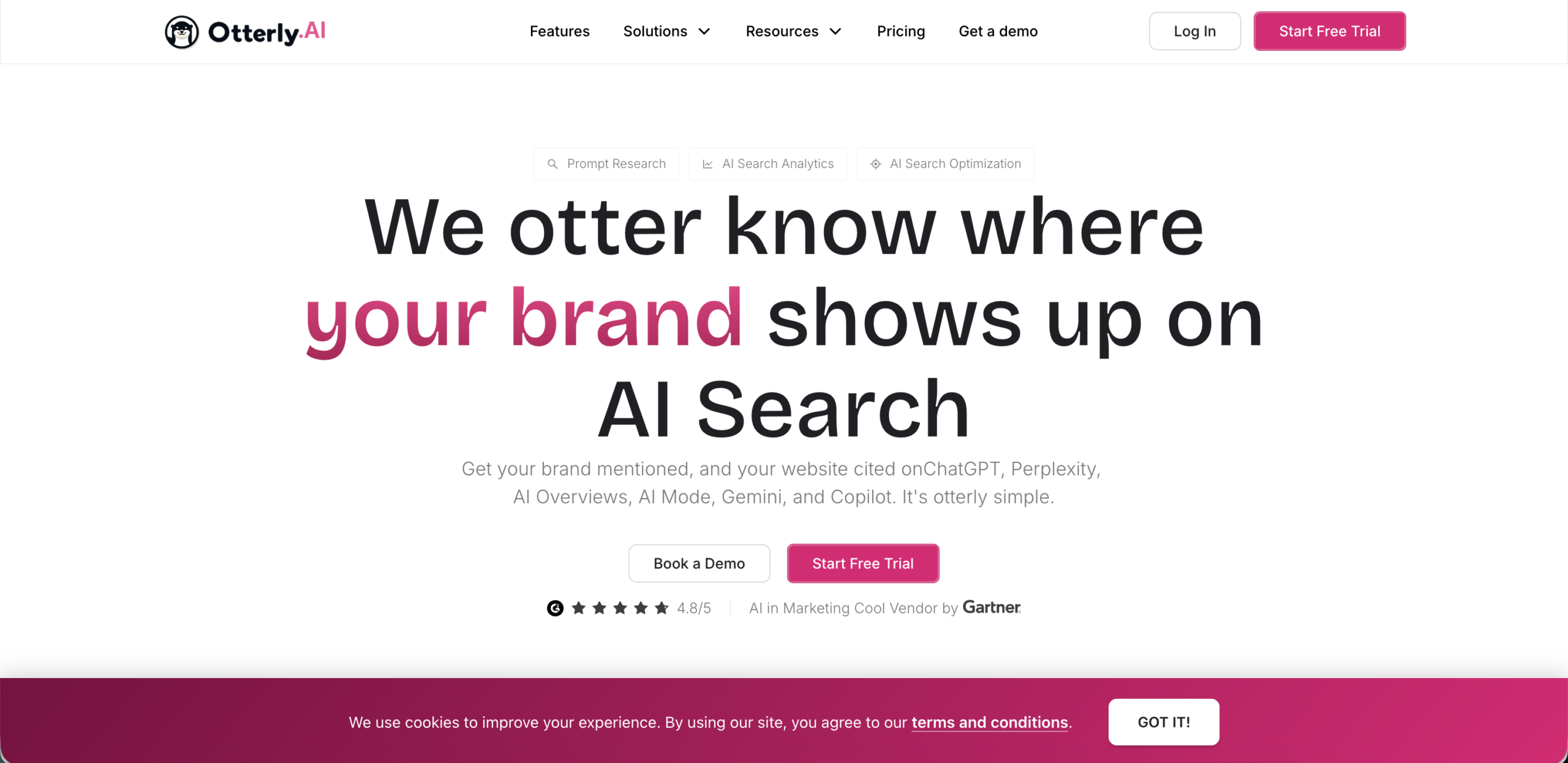
Otterly.ai tracks how brands appear across AI search and answer engines. It is often recommended because the product story is simple: monitor important prompts, see where your brand appears, and watch visibility change over time.
Where it shines: Otterly is approachable for small teams and agencies that want coverage without a heavy setup process. In our monitored data, Otterly appeared across all 10 prompts and had strong presence in startup and brand-monitoring questions.
Key features:
- Multi-LLM visibility tracking.
- Brand monitoring across AI search surfaces.
- Prompt and query tracking.
- Competitive visibility views.
- Sentiment or citation workflows depending on plan.
Pricing: Otterly has publicly positioned lower entry tiers and larger plans for broader monitoring. Check the current pricing page because scan limits and add-ons can change.
Choose Otterly if you want a broad, easy-to-start tracker. Skip it if you need deeper citation-source analysis or a stronger optimization workflow.
3. Semrush AI Visibility Toolkit
Best for: Marketing teams already using Semrush.
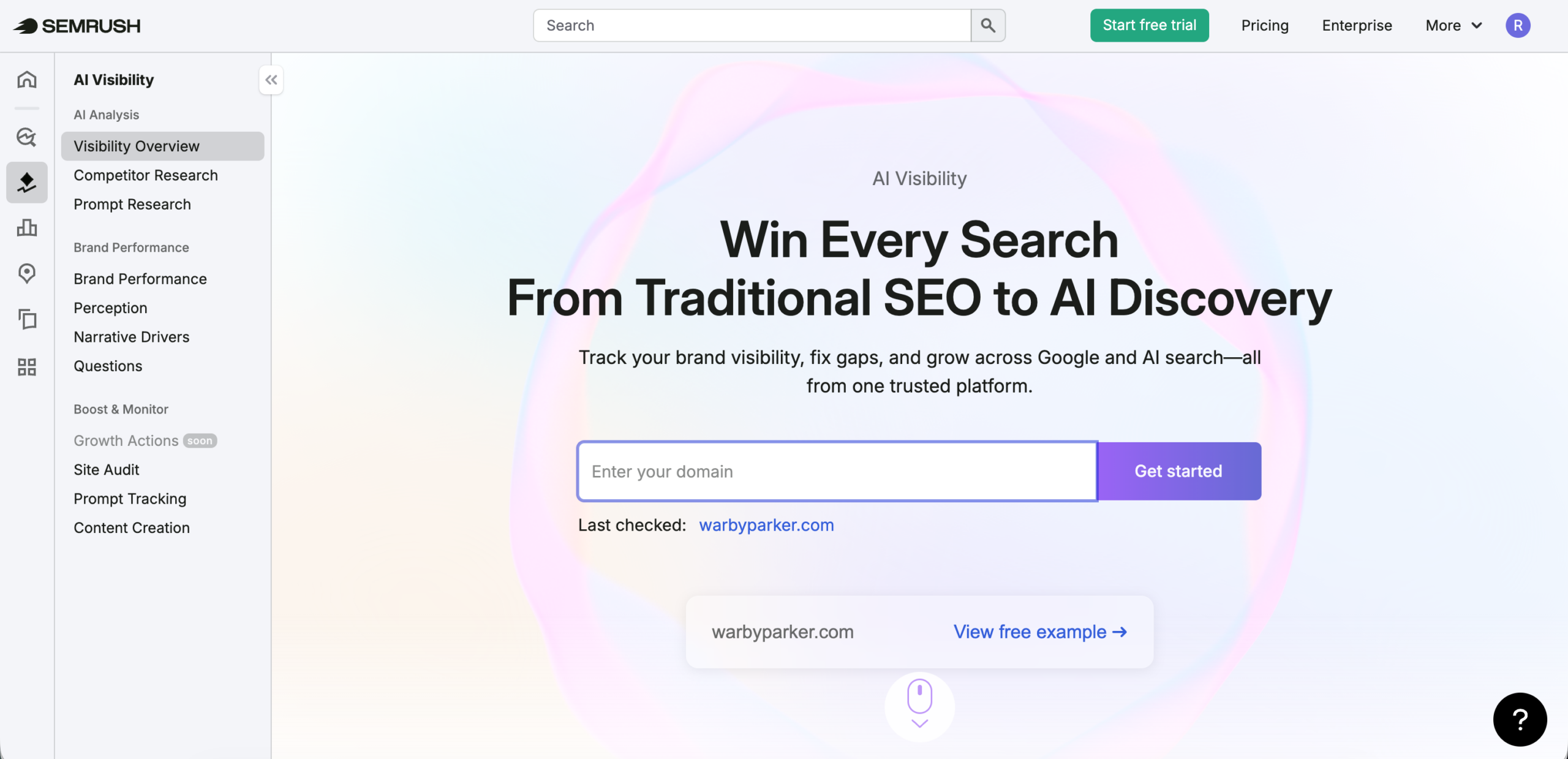
Semrush AI Visibility Toolkit brings AI visibility into the Semrush ecosystem. For teams already using Semrush for SEO, keyword research, competitive analysis, and reporting, that can be operationally convenient.
Where it shines: Semrush has distribution and trust. Established SEO brands often surface in AI answers because they have broad authority, many related pages, and long-standing content ecosystems. If AI visibility is one layer in your SEO reporting stack, Semrush is a natural place to start.
Key features:
- AI visibility and brand mention tracking.
- Competitor visibility comparison.
- AI search visibility checker workflows.
- Connection to Semrush’s broader SEO platform.
- Strong educational content around AI visibility.
Pricing: Access depends on Semrush packaging and current add-ons, so the real cost depends on your existing plan.
Choose Semrush if your team already lives in Semrush. Skip it if you want an AEO-native platform where AI answers, prompts, and citations are the core product rather than an extension.
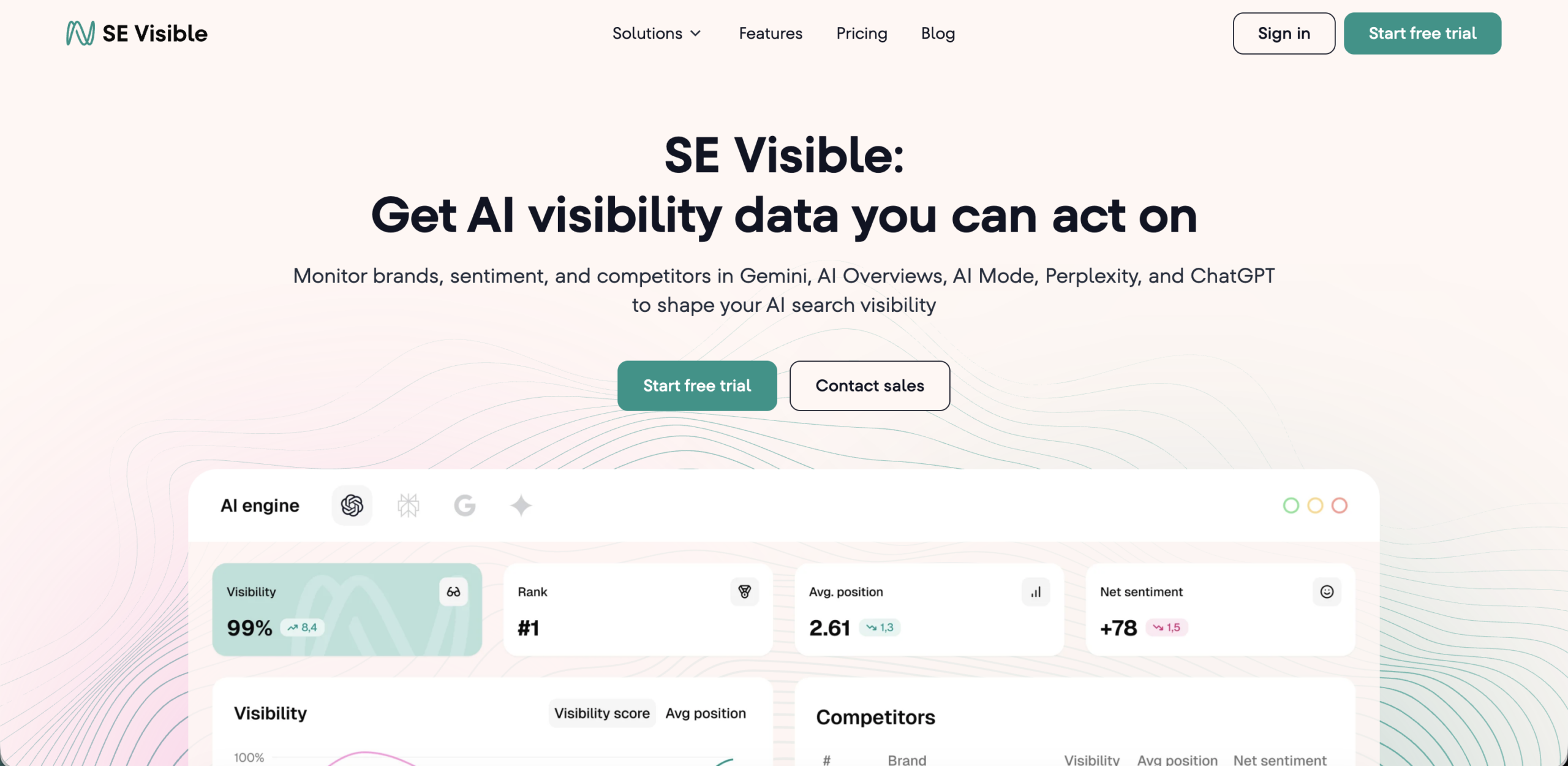
4. SE Visible / SE Ranking
Best for: SEO teams expanding into AI answer tracking.
SE Visible is SE Ranking’s AI visibility product experience. It tracks brand presence in AI-generated answers and packages the workflow in a format that feels familiar to SEO teams.
Where it shines: SE Ranking has years of SEO tooling experience, and SE Visible’s own content is highly structured: definitions, comparison tables, tool sections, future trends, and FAQs. That format is exactly the kind of page AI systems often quote for tool-selection answers.
Key features:
- AI visibility dashboard.
- Brand mention monitoring.
- AI answer and AI Overview context.
- SEO-adjacent tracking workflows.
- Familiar reporting concepts for SEO teams.
Pricing: Pricing can vary by product packaging and region, so verify current AI visibility limits before comparing.
Choose SE Visible if you want AI tracking from an SEO-platform background. Skip it if you prefer a tool positioned purely around AEO/GEO rather than SEO expansion.
5. Profound
Best for: Enterprise AI visibility intelligence.
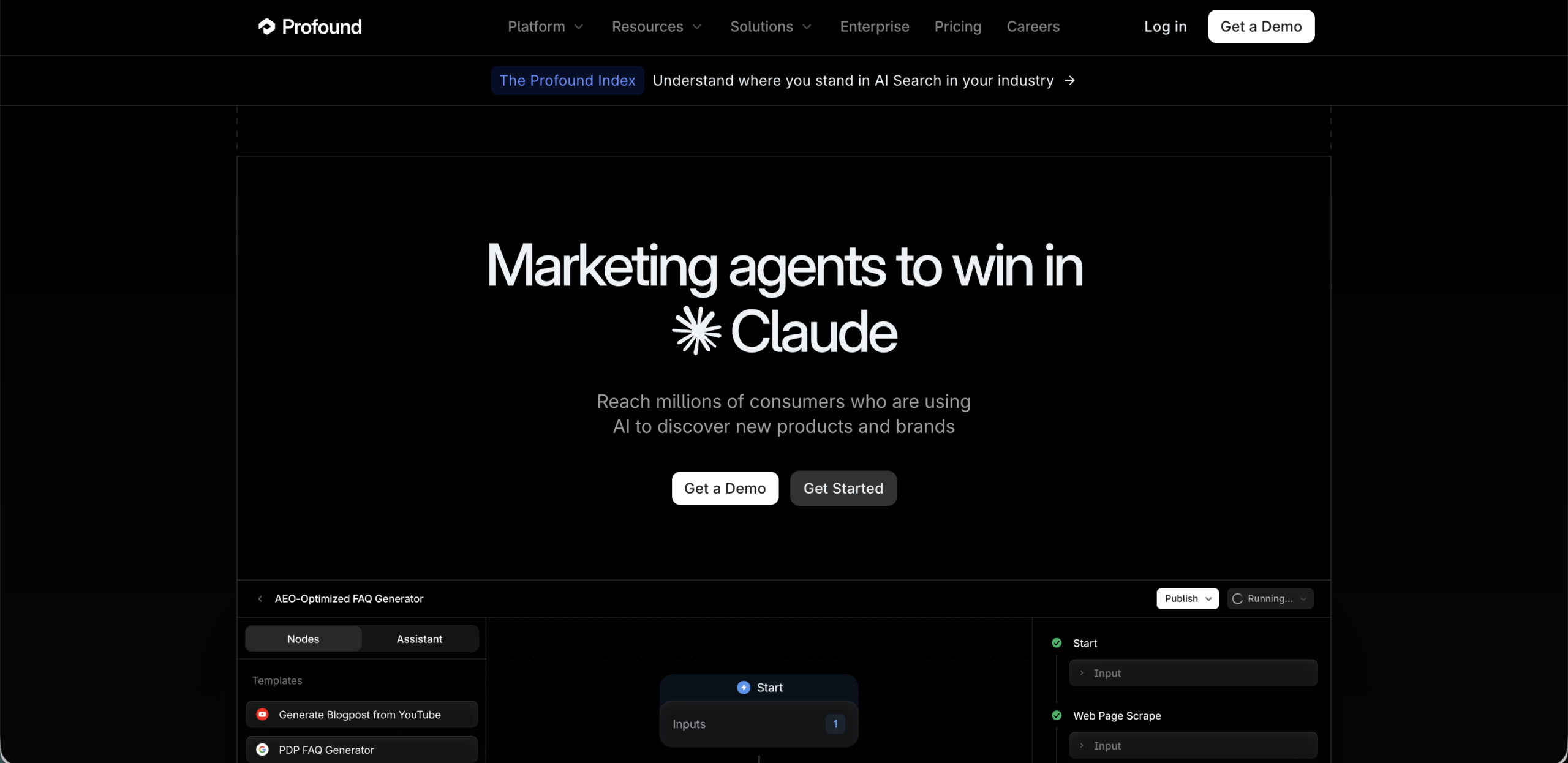
Profound is one of the best-known enterprise AI visibility platforms. It is built for larger teams that need to track, report, and explain how brands appear in AI answers across markets and use cases.
Where it shines: Profound has strong category awareness and a clear enterprise story. It is useful when AI visibility needs to become a board-level or cross-functional reporting topic, not just a marketing experiment.
Key features:
- Enterprise AI visibility monitoring.
- Broad LLM coverage.
- Competitor and share-of-voice reporting.
- Research and intelligence workflows.
- Enterprise-oriented reporting.
Pricing: Profound is generally premium and sales-led. Verify current pricing directly with the vendor.
Choose Profound if you are an enterprise team with reporting complexity and budget. Skip it if you are a small team trying to monitor a focused prompt set cheaply.
6. Peec AI
Best for: Prompt-based AEO tracking and sentiment analysis.
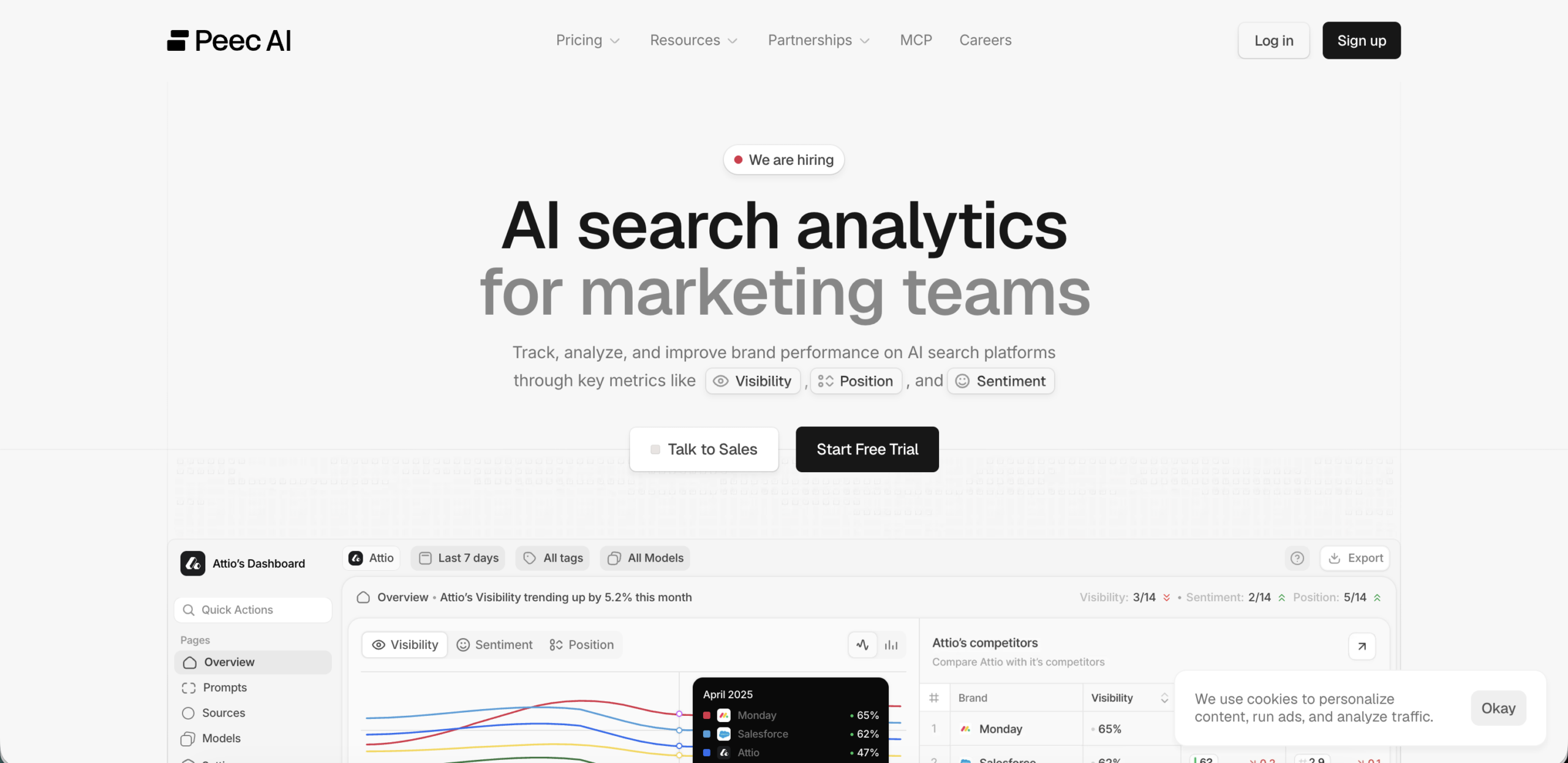
Peec AI helps brands track how they appear in LLM responses. Its public positioning leans toward methodology: prompt sets, repeatable tracking, sentiment, and structured AEO work.
Where it shines: Peec is useful for teams moving from ad hoc screenshots to disciplined prompt monitoring. If you care about building a repeatable AEO process, Peec’s positioning is clear.
Key features:
- Prompt-based visibility tracking.
- Brand and competitor monitoring.
- Sentiment workflows.
- AEO/GEO reporting.
- Expert-led educational content.
Pricing: Peec AI is positioned in the mid-market AEO category. Confirm current prompt limits and plan details before comparing.
Choose Peec if prompt methodology and sentiment matter as much as raw visibility. Skip it if you need the lowest-cost starter option or end-to-end optimization actions.
Independent AEO tools vs SEO-suite add-ons
Independent AEO tools such as MaxAEO, Otterly, Profound, and Peec are built around AI answers as the primary interface. They think in prompts, mentions, AI platforms, citations, and competitor recommendations.
SEO-suite add-ons such as Semrush AI Visibility Toolkit and SE Visible come from companies with years of search-data infrastructure. They make sense when AI visibility needs to sit beside keyword rankings, SEO reporting, and existing workflows.
Use an independent tool if AI search is becoming a dedicated channel. Use a suite add-on if AI visibility is mainly another layer in your SEO stack.
How to choose
Ask three questions.
First, do you only need monitoring, or do you need diagnosis and action? If you need to know why competitors are recommended instead of you, prioritize source attribution and prompt-level breakdowns.
Second, is AI visibility a dedicated growth channel or just part of SEO reporting? Dedicated channels usually need AEO-native products. Reporting layers can fit inside SEO suites.
Third, what will your Monday meeting look like? If your team asks, “Why did Perplexity recommend Competitor A instead of us?”, the right tool should answer with prompts, sources, sentiment, and recommended actions.
What’s next for AI visibility tools?
Three trends are already clear.
First, blended visibility scores will become less useful. Brands will want platform-level views for ChatGPT, Gemini, Perplexity, Claude, and Google AI Mode.
Second, citation sources will become the new influence layer. Brands will care which listicles, forums, reviews, and product pages shape AI answers.
Third, optimization will matter more than observation. The best tools will not stop at “you are missing.” They will tell teams what to change next.
Conclusion
Start with MaxAEO if you want a focused workflow for AI visibility monitoring, source diagnosis, competitor benchmarking, and action recommendations. Try Otterly if you want a simple entry point. Consider Semrush or SE Visible if your team already works inside SEO suites. Evaluate Profound for enterprise intelligence. Look at Peec if prompt methodology and sentiment are your priority.
The best AI visibility tool is the one that helps your team answer: “Where are we visible, who is winning instead, and what do we do this week?”
FAQ
Any good tools for tracking brand mentions in ChatGPT and Perplexity?
Yes. MaxAEO, Otterly, Profound, Peec, Semrush AI Visibility Toolkit, and SE Visible can all help. Choose a tool that separates platform-level results if you care about ChatGPT vs Perplexity differences.
What tools are available for checking if my brand is mentioned in AI-generated answers?
For self-serve monitoring, start with MaxAEO, Otterly, or SE Visible. For broader SEO reporting, check Semrush. For enterprise visibility intelligence, evaluate Profound. For prompt methodology and sentiment, evaluate Peec.
Is there a platform that analyzes brand sentiment across different AI chatbots?
Yes. MaxAEO includes sentiment analysis as part of its monitoring workflow, and Peec is also strong in sentiment-oriented AEO methodology. Ask whether the tool shows the original AI response and cited sources behind the sentiment label.
My team needs to see how competitors are recommended by ChatGPT compared to us. What should we use?
Use a platform with competitor benchmarking, prompt-level tracking, and source attribution. MaxAEO is built for this workflow. Profound is also strong for enterprise competitor intelligence.
Do I need AI visibility software if I already use SEO tools?
If AI-generated answers influence your category, yes. SEO rankings still matter, but they do not fully explain how ChatGPT, Gemini, Perplexity, or Claude recommend brands.
Related reading
- What Is GEO? The Complete Guide
- How to Audit What AI Says About Your Brand
- How We Monitor Brand Visibility Across AI Platforms
- Why ChatGPT Doesn’t Recommend Your Brand
- How to Optimize for AI Search: The GEO Checklist
- AI Search Engine Ranking: How AI Decides Which Brands to Cite
- See our full AI SEO tools ranking & directory
- MaxAEO on our tools directory
- Otterly.ai on our tools directory
- Profound on our tools directory
- Peec AI on our tools directory
- Semrush on our tools directory