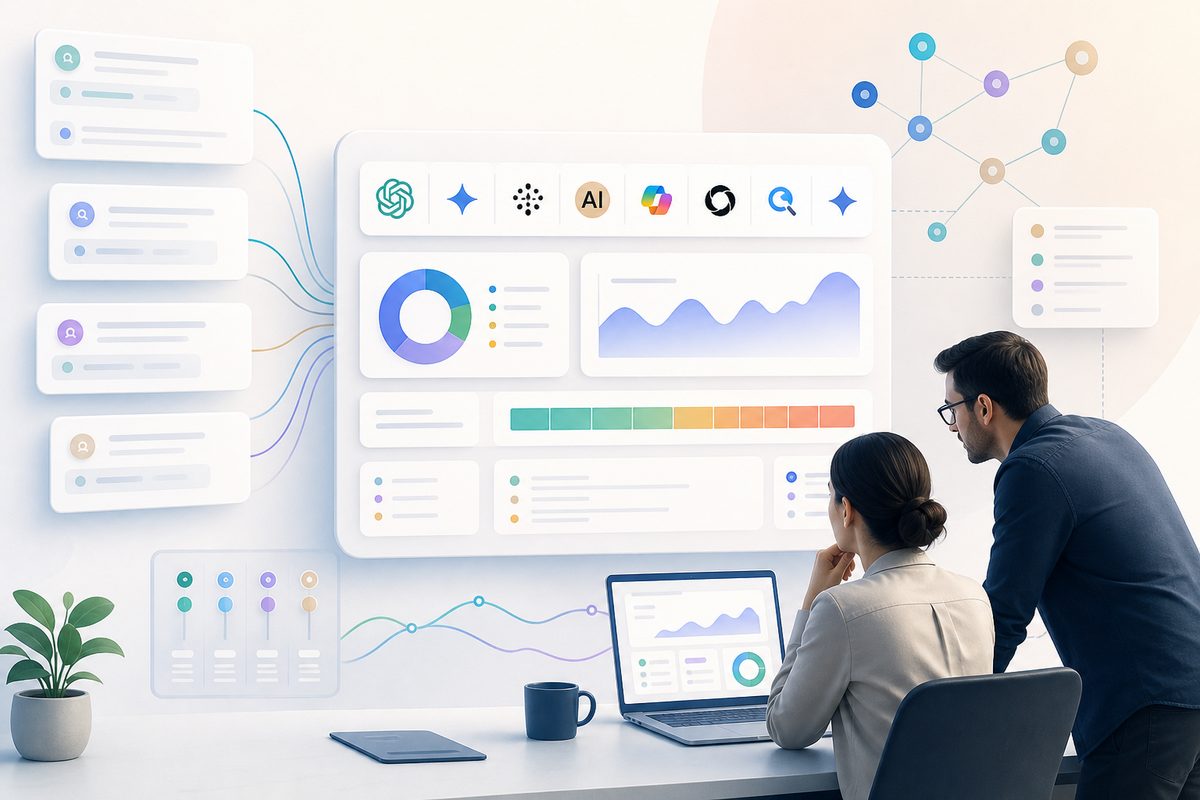
To track your brand mentions across AI, run the same neutral buyer questions through ChatGPT, Gemini, Perplexity, and Claude on a regular schedule and record whether you appear, how you’re described, which competitors show up, and which sources the AI cited. A one-time check tells you where you stand today; continuous monitoring catches the changes that happen every time a model updates.
The same brand looks different on every platform
Ask ChatGPT about a SaaS product and it might call it “a marketing automation platform.” Ask Perplexity and it says “an email marketing tool.” Ask Gemini and it doesn’t mention the brand at all. This isn’t an edge case — it’s the default. AirOps found that only 30% of brands maintain consistent visibility between consecutive AI answers, and that’s on the same platform. Across six platforms, the picture fragments further. Checking ChatGPT alone is like judging your reputation from a single review.
Which AI platforms to monitor (and why each matters)
Most monitoring focuses only on ChatGPT. Track all the major engines instead — not because more is better, but because each reaches a different audience through different citation logic.
| Platform | Reach | Why it matters / citation logic |
|---|---|---|
| ChatGPT | ~900M weekly users | Largest base; ~87% of citations match Bing’s top results (Seer Interactive) |
| Perplexity | 100M+ monthly | Most citation-transparent; leans on Reddit (40.1%) & Wikipedia (26.3%) |
| Google AI Overviews | Billions (Google Search) | Sits above results; favors content already ranking in Google |
| Gemini | Google ecosystem | Embedded in Search, Maps, YouTube, Workspace |
| Microsoft Copilot | 400M+ M365 users | Reaches knowledge workers in their daily tools |
| Claude | Growing technical base | Preferred by researchers and technical buyers |
The key difference isn’t audience size — it’s citation logic. ChatGPT pulls heavily from Bing’s index; Perplexity leans on Reddit and Wikipedia; Google AI Overviews favor pages already ranking in Google. A brand can be confidently recommended by one and absent from another. Monitor only ChatGPT and you’re seeing roughly one-sixth of the picture — and the same brand is described differently on each.
What to track: 7 monitoring signals
Knowing whether AI mentions you is only the start. You also need to know how. Track these seven signals across every platform:
- Visibility score — do you appear at all for category prompts? Most brands are shocked by their first score; Loamly’s 2026 report found 85.7% of companies score near zero on AI visibility.
- Mention rate — how often you’re named across prompts, per platform. AI answers are volatile, so track it over time to see if visibility is stable, growing, or declining.
- Competitor benchmarking — AI answers are zero-sum: if it names three brands and you’re not one, a competitor took that slot. Track your rate alongside rivals’.
- Sentiment — being mentioned isn’t always good. Is AI framing you as the premium pick or a budget alternative? Surfacing strengths or old complaints?
- Citation tracing — where the AI’s claims about you originate: your site, a G2 review, an old Reddit thread? This shows which sources actually drive recommendations.
- Prompt intelligence — different prompts trigger different answers. Some brands appear for broad category queries but vanish for the specific use-case questions that drive purchases.
- Optimization signals — what to change next, based on the six signals above. This is where monitoring becomes action.
One-time check vs continuous monitoring
A one-time audit answers “where do I stand right now?” — useful, but it goes stale fast. AI answers shift whenever a model is retrained or re-crawls the web, so a brand recommended this week can vanish next week. Continuous monitoring tracks those shifts so you catch a drop in mention rate or a turn toward negative sentiment before it costs you customers. If you only do one, start with an audit; to protect visibility, you need monitoring.
How to track brand mentions across AI platforms
- Build a prompt set — 5–20 neutral buyer questions in your category, without naming your brand.
- Run them on every platform — ChatGPT, Gemini, Perplexity, Claude, Copilot.
- Log the signals — mention rate, position, sentiment, share of voice, and cited sources, per platform.
- Repeat on a schedule — weekly in competitive categories, monthly otherwise.
- Alert on change — flag a mention-rate drop of 20%+, new negative sentiment, or a competitor overtaking you.
Doing this by hand across platforms and prompts gets unmanageable fast. MaxAEO automates it — running your prompts across every major AI platform, tracing cited sources, and trending mention rate, sentiment, and share of voice over time, with alerts when something moves.
What to do about negative or outdated mentions
When monitoring surfaces a wrong or negative mention, use citation tracing to find the sources the AI relied on, then fix them at the root — your own pages first, then third-party sources like review sites and articles. Because each model cites different sources, correct the one feeding the specific platform that’s wrong. For a full diagnostic first, run an AI brand audit.
Common mistakes when monitoring AI mentions
- Naming your brand in the prompt — that primes the model; use neutral buyer questions.
- Watching one platform — coverage on ChatGPT says nothing about Gemini or Perplexity.
- Blending everything into one score — you lose the per-platform signal that tells you what to fix.
- Checking once — answers change with every model update.
- Tracking but never acting — monitoring only pays off when a drop triggers a fix at the source.
Frequently asked questions
How do I track my brand mentions in ChatGPT?
Ask neutral buyer questions in your category in fresh ChatGPT sessions (without naming your brand) and record whether you appear, how you’re described, and which competitors are named. Repeat on a schedule to track change, or use a tool that monitors it automatically across platforms.
Is there a tool to monitor AI brand mentions?
Yes. MaxAEO monitors your brand mentions across ChatGPT, Gemini, Perplexity, Claude, and more, tracking mention rate, sentiment, share of voice, and cited sources over time with change alerts — so you don’t have to check each platform manually.
How often should I monitor AI brand mentions?
Weekly if you’re in a competitive category, monthly at minimum otherwise. AI answers change as models update and re-crawl the web, so infrequent checks miss the shifts that matter.
Why does my brand appear on one AI platform but not another?
Because each platform uses different citation logic and sources. ChatGPT pulls from Bing’s index, Perplexity from live web (heavy on Reddit and Wikipedia), Gemini from Google’s index. Strong presence in one platform’s preferred sources doesn’t carry to another — which is why cross-platform monitoring matters.