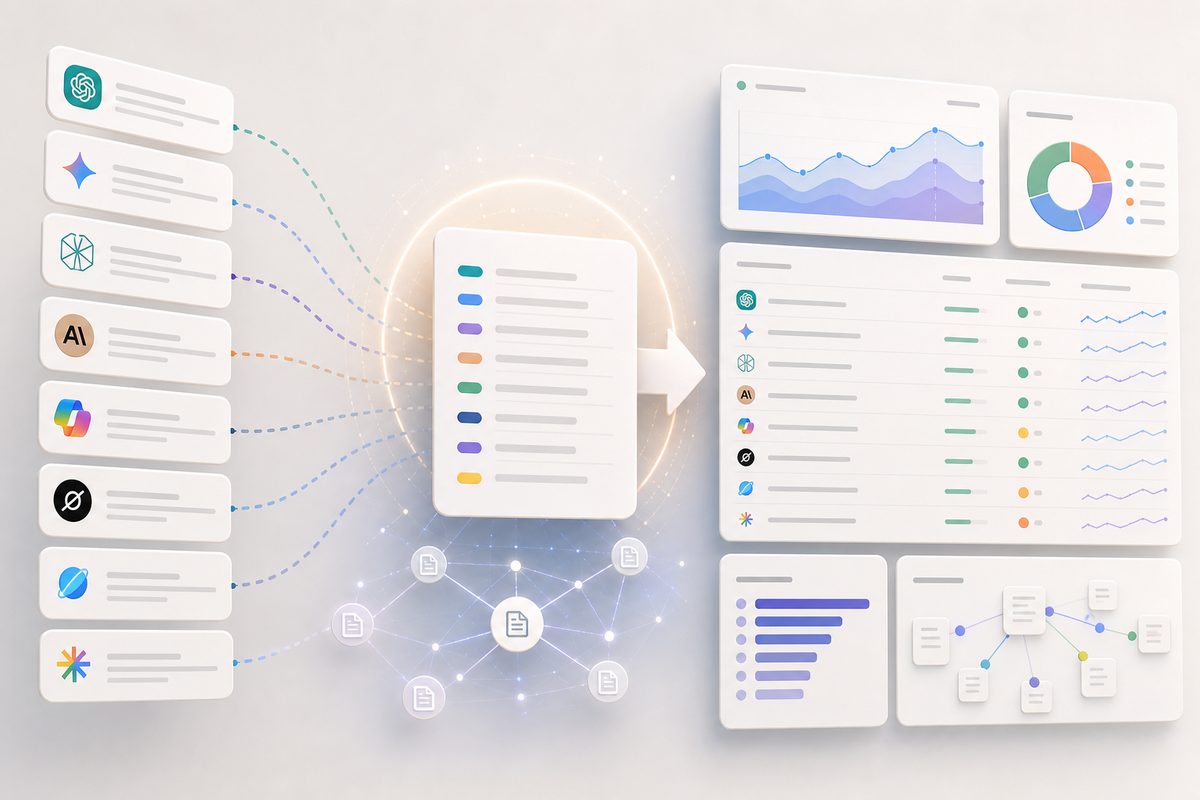
To convert SEO keywords to AI prompts, do not rewrite every keyword as a question. Cluster keywords by buyer intent, remove low-value variants, write one neutral prompt per decision, add a few tested paraphrases, and track whether AI systems mention, cite, compare, or misdescribe your brand.
That difference matters because AI search does not behave like a traditional ranked results page. A keyword list shows what people search. A prompt set shows what buyers may ask ChatGPT, Gemini, Perplexity, Claude, Copilot, Grok, Google AI Mode, or AI Overviews when they want advice, comparisons, sources, or vendor recommendations.

What Does It Mean to Convert SEO Keywords to AI Prompts?
To convert SEO keywords to AI prompts is to translate keyword demand into natural-language buyer questions that an AI answer engine can respond to. The output is a deduplicated prompt set, grouped by intent, audience, market category, decision stage, and monitoring metric rather than by individual keyword variants.
For example, the keyword AI visibility tool is a compact demand signal. A monitoring prompt is closer to how a buyer asks for help:
"What are the best AI visibility tools for a B2B SaaS marketing team that needs weekly executive reporting?"
That prompt includes a category, audience, use case, and expected answer type. Those fields help a team measure whether a brand appears, which competitors appear nearby, how the brand is described, and which sources the answer cites.
Traditional SEO asks, "Where do we rank?" AI search monitoring asks, "Are we mentioned, recommended, cited, and described accurately when buyers ask for help?"
SEO Keywords vs AI Prompts
A keyword is a demand signal. A prompt is a measurement question. Treating them as the same thing creates noisy tracking.
| Dimension | SEO keyword | AI monitoring prompt |
|---|---|---|
| Format | Short phrase | Natural-language question or task |
| Main use | Search demand, content planning, rankings | AI visibility, recommendations, citations, sentiment |
| Example | best AI visibility tools |
"What are the best AI visibility tools for B2B SaaS marketing teams?" |
| Intent detail | Often implied | Explicit audience, problem, context, and answer type |
| Reporting unit | Keyword or keyword cluster | Buyer decision or prompt cluster |
| Main risk | Ranking for the wrong intent | Measuring duplicate or biased prompts |
The cleanest operating rule is simple: one buyer decision should become one canonical prompt, not ten near-identical prompts.
Why One Keyword Should Not Become One Prompt
The fastest way to convert SEO keywords to AI prompts is also the least useful: turn every row in a keyword export into a separate question. That inflates prompt counts, exaggerates volatility, and makes AI share of voice harder to explain.
These five keywords often describe one buying job:
| SEO keyword | Likely buyer intent |
|---|---|
| AI visibility tool | Find software options |
| best AI visibility tools | Compare recommended vendors |
| AI visibility platform | Understand category options |
| AI search monitoring tool | Track brand presence in AI answers |
| LLM brand tracking software | Monitor mentions across LLMs |
If each keyword becomes a separate prompt, a report may show five movements when only one market question changed. A better approach is to merge them into one intent cluster, choose one canonical prompt, and add variants only when wording changes the buyer context.
Prompt wording matters. A 2026 arXiv preprint on commercial recommendation prompts reported that recommendation-set overlap was much lower for paraphrased prompts than for same-prompt reruns: 14-29% Jaccard overlap for natural paraphrases versus 50-61% for reruns. The practical takeaway from the paraphrase brittleness study is not "track every paraphrase." It is group prompts by buyer intent and treat paraphrases as controlled variants.
Which SEO Keywords Should Become AI Prompts?
Convert keywords that reveal a buyer question, evaluation task, reputation risk, or source-seeking behavior. Do not convert keywords that only represent navigation, support, or vague awareness.
| Keyword type | Convert? | Reason | Example |
|---|---|---|---|
| Category discovery | Yes | Shows shortlist demand | best AI visibility tools |
| Problem-led | Yes | Reveals pain and use case | track brand mentions in ChatGPT |
| Comparison | Yes | Maps to vendor evaluation | brand monitoring tools vs AI visibility tools |
| Branded reputation | Yes | Checks factual description | maxaeo AI visibility |
| Citation/source | Yes | Shows authority pathways | AI citations tracking sources |
| Glossary-only | Sometimes | Useful if it supports category education | what is generative engine optimization |
| Navigational | Usually no | Buyer already wants a known destination | maxaeo login |
| Support | Usually no | Better handled by help docs | reset dashboard password |
| Misspellings | No | Adds reporting noise | ai visibilty tool |
| Internal jargon | No | Rarely matches buyer language | LLM SERP delta module |
When in doubt, ask: Would a buyer, analyst, journalist, or executive ask an AI assistant this question before making a decision? If not, keep it in SEO research but leave it out of the monitored prompt set.
The Prompt Conversion Matrix
Use this matrix to turn keyword data into prompt fields without losing the original search intent.
| Keyword signal | Convert into prompt field | Why it matters | Example |
|---|---|---|---|
| Head term | Market category | Defines the answer space | "AI visibility tools" |
| Modifier | Decision task | Shows what the buyer wants | "best", "compare", "alternatives" |
| Audience term | Buyer role or company type | Prevents generic answers | "B2B SaaS marketing team" |
| Use case | Operational constraint | Makes the answer realistic | "weekly executive reporting" |
| Brand term | Reputation check | Tests factual accuracy | "What is maxaeo known for?" |
| Competitor term | Comparison frame | Reveals shortlist dynamics | "Compare [brand] and [competitor]" |
| Source term | Citation target | Tracks evidence pathways | "Which sources explain…" |
The prompt should add context, not invent a new agenda. If the keyword cluster does not contain evidence of an audience, use case, region, budget level, or company size, do not force that detail into the canonical prompt.
For deeper discovery before monitoring, use a buyer prompt research for AEO workflow to find the questions buyers are likely to ask AI systems, not just the phrases they type into Google.
How to Convert SEO Keywords to AI Prompts Step by Step
To convert SEO keywords to AI prompts cleanly, start with intent clustering. Export the keyword set, remove weak candidates, merge synonyms by buyer decision, write one neutral canonical prompt, add controlled variants for important intents, assign metrics, and version every change.
-
Export keyword research with useful fields. Include keyword, volume, ranking URL, SERP intent, funnel stage, target persona, page owner, and source.
-
Remove terms that should not become prompts. Exclude navigational searches, support queries, misspellings, vague head terms, and internal language that buyers would not use.
-
Cluster by buyer decision. Merge synonyms such as
AI search monitoring,LLM brand tracking, andAI visibility trackingwhen they point to the same job. -
Choose one canonical prompt per cluster. Write the most natural neutral version of the buyer question. Do not insert your brand into a non-branded category prompt.
-
Add context only when keyword evidence supports it. If keywords include
for SaaS,enterprise,agency, orB2B, include that segment. If not, keep the prompt broader. -
Assign a monitoring purpose. Tag each prompt as category discovery, competitor shortlist, branded reputation, citation analysis, problem solving, or implementation guidance.
-
Add limited paraphrases for high-value intents. Use two or three variants where wording could change the answer. Avoid ten cosmetic rewrites.
-
Record the prompt as measurement infrastructure. Store prompt ID, cluster, owner, platform, creation date, change reason, and retired versions.
A good prompt set for AI brand monitoring is small enough to explain and broad enough to cover the buyer journey.
Prompt Formula: Build Questions from Five Fields
Use this formula for most monitoring prompts:
decision task + market category + audience + use case or constraint + answer format
| Field | Question to ask | Example |
|---|---|---|
| Decision task | What does the buyer want the AI system to do? | Recommend, compare, explain, shortlist |
| Market category | What category should the answer cover? | AI visibility tools |
| Audience | Who is asking? | B2B SaaS marketing team |
| Constraint | What changes the answer? | Weekly reporting, competitor tracking, agency clients |
| Answer format | What answer shape is useful? | List, comparison, criteria, sources |
Example conversion:
| Raw keyword cluster | Weak prompt | Better monitoring prompt |
|---|---|---|
AI visibility tool, best AI visibility tools, AI search monitoring software |
"What is an AI visibility tool?" | "What are the best AI visibility tools for B2B SaaS teams that need competitor tracking and executive reporting?" |
brand mentions in ChatGPT, ChatGPT brand monitoring |
"Brand mentions in ChatGPT" | "How can a marketing team monitor whether ChatGPT mentions and describes its brand accurately?" |
AI citations, track AI citations |
"What are AI citations?" | "Which sources are most often cited when AI systems answer questions about AI visibility tracking?" |
The better prompts are specific enough to produce measurable answers, but neutral enough to avoid steering the model toward the brand.
A Worked Example: 72 SEO Keywords Become 28 Monitoring Prompts
To make the method concrete, maxaeo built a controlled worksheet using 72 B2B SaaS keyword patterns across four groups: category, problem, comparison, and implementation. This is not a universal benchmark. It is a reproducible editorial exercise that shows how deduplication changes the monitoring base.
| Conversion stage | Count | What changed |
|---|---|---|
| Raw SEO keywords | 72 | Exported from a typical SaaS keyword map |
| Removed keywords | 11 | Navigational, support, glossary-only, or too vague |
| Candidate prompt ideas | 61 | Remaining terms rewritten as buyer questions |
| Intent clusters | 28 | Synonyms and duplicate jobs merged |
| Final monitored prompts | 28 | One canonical prompt per buyer decision |
The duplicate-noise rate was calculated as:
1 - (final monitored prompts / raw keywords)
That produced:
1 - (28 / 72) = 61.1% duplicate noise removed
The final 28 prompts broke down like this:
| Prompt type | Count | Example monitoring question |
|---|---|---|
| Non-branded category prompts | 10 | "What are the best AI visibility tools for B2B SaaS teams?" |
| Problem-led prompts | 6 | "How can a marketing team find out whether AI search engines mention its brand?" |
| Competitor shortlist prompts | 5 | "Which AI search monitoring platforms are most often recommended for agencies?" |
| Citation and source prompts | 3 | "Which sources explain how to track AI citations for SaaS brands?" |
| Branded reputation prompts | 4 | "What is [brand] known for in AI search visibility?" |
The main lesson: the final set preserved every meaningful buyer job while cutting the reporting surface by more than half.
Prompt Patterns by Search Intent
Use prompt patterns that match the job behind the keyword cluster.
| Search intent | Prompt pattern | Example |
|---|---|---|
| Category discovery | "What are the best [category] for [audience]?" | "What are the best AI visibility tools for B2B SaaS marketing teams?" |
| Problem solving | "How can [role] solve [problem]?" | "How can a PR team monitor inaccurate brand descriptions in AI answers?" |
| Comparison | "Compare [option type] for [use case]." | "Compare AI search monitoring tools for multi-client agency reporting." |
| Shortlist | "Which [category] should [audience] consider for [constraint]?" | "Which LLM brand tracking platforms should a startup consider before launch?" |
| Evaluation criteria | "What should [audience] look for in [category]?" | "What should a marketing team look for in an AI visibility reporting platform?" |
| Reputation | "How does AI describe [brand/category]?" | "How do AI assistants describe companies in the AI reputation management market?" |
| Citation | "Which sources does AI cite when answering [topic]?" | "Which sources are cited for generative engine optimization best practices?" |
Good prompts are neutral. "Why is our product the best AI visibility tool?" is not a useful monitoring prompt. A better version is: "Which AI visibility tools are recommended for B2B SaaS teams that need competitor tracking?"
How Many Prompt Variants Should You Track?
Most teams need one canonical prompt per buyer intent, plus two or three variants for high-value decisions where wording may change recommendations. The goal is stable measurement, not exhaustive coverage of every possible phrasing.
Google says AI Overviews and AI Mode may use query fan-out, issuing multiple related searches across subtopics and sources to build a response. Google also states in its AI features documentation that there are no additional technical requirements or special schema needed to appear in AI Overviews or AI Mode.
That means prompt monitoring should measure how answer engines interpret buyer intent. It should not chase artificial prompt tricks.
| Market importance | Recommended setup |
|---|---|
| Core revenue category | 1 canonical prompt + 2-3 variants |
| Important comparison topic | 1 canonical prompt + 1-2 variants |
| Long-tail informational topic | 1 canonical prompt |
| Low-intent or support topic | Do not monitor unless reputation-sensitive |
| Branded factual query | 1 direct prompt + 1 natural variant |
For budget planning, pair the prompt set with a volume model such as how many AI search prompts to track, then expand only where business value or answer variance justifies it.
Branded vs Non-Branded Prompts
You need both. Non-branded prompts show whether AI systems discover and recommend the company in category answers. Branded prompts show whether AI systems describe the company accurately when someone asks directly.
| Prompt type | What it reveals | Example |
|---|---|---|
| Non-branded category | Discovery and shortlist presence | "What are the best AI visibility tools for B2B SaaS teams?" |
| Non-branded problem | Association with a pain point | "How can a marketing team track brand mentions in ChatGPT?" |
| Competitor comparison | Market positioning | "Compare AI search monitoring tools for agencies." |
| Branded factual | Entity clarity | "What is maxaeo used for?" |
| Branded reputation | Risk and narrative | "What are the strengths and weaknesses of maxaeo?" |
| Citation-led | Authority sources | "Which sources explain maxaeo's approach to AI search monitoring?" |
Do not average all prompt types into one unqualified visibility score. A brand can perform well on branded prompts and poorly on non-branded category prompts, or appear in shortlists but be described inaccurately.
For a deeper split, use branded vs non-branded AI prompts as the reporting distinction.
What Metrics Should Each Prompt Capture?
Each prompt should capture more than whether the brand appeared. AI search monitoring is most useful when every prompt records visibility, position, competitor context, citations, sentiment, and factual accuracy.
| Metric | What it answers | Why it matters |
|---|---|---|
| Mention presence | Did the brand appear? | Basic AI visibility |
| First mention or order | Where did the brand appear? | Shortlist strength |
| AI share of voice | What share of relevant answers mention the brand? | Market-level reporting |
| Competitor co-mentions | Which competitors appear nearby? | Positioning and PR strategy |
| Citation presence | Which sources support the answer? | Content and authority building |
| Source type | Are citations from blogs, docs, reviews, forums, or media? | Fix prioritization |
| Description accuracy | Is the brand described correctly? | AI reputation management |
| Sentiment or framing | Is the answer favorable, neutral, or negative? | Communications risk |
| Exclusion reason | Why was the brand omitted? | Roadmap and content strategy |
A reporting template should group metrics by intent cluster, not by raw prompt count. That prevents a team from reporting gains caused by prompt wording changes instead of real market movement. For executive reporting, use an AI visibility report template that separates discovery, citations, competitors, and reputation risk.
How to Turn Prompt Data Into Fixes
Prompt tracking matters only when it leads to action. Every monitored answer should point to one of four fix paths: content, citations, positioning, or entity clarity.
| What the AI answer shows | Likely issue | Practical fix |
|---|---|---|
| Competitors appear, but your brand does not | Weak category association | Build category pages, comparison pages, and third-party proof |
| Your brand appears below smaller competitors | Weak differentiation | Clarify use cases, ICP, proof points, and evaluation criteria |
| AI cites outdated sources | Evidence gap | Publish updated research, documentation, case studies, and PR assets |
| AI describes the brand incorrectly | Entity clarity problem | Update About pages, product copy, schema, profiles, and high-authority mentions |
| AI recommends competitors for your strongest use case | Positioning gap | Create use-case pages and proof that match that prompt cluster |
| AI gives generic answers with no citations | Source availability problem | Create quotable, structured, source-backed content |
The original GEO: Generative Engine Optimization paper framed generative engine optimization as a measurable visibility problem and reported that GEO methods could boost visibility by up to 40% in generative engine responses, with results varying by domain. That supports a practical rule: optimize for clear, source-backed answers, then measure whether visibility changes.
A 2026 study, How Generative AI Disrupts Search, compared Google Search, AI Overviews, and Gemini across an 11,500-query benchmark. It found that source sets differed substantially across systems, with less than 0.2 average Jaccard similarity. Do not assume Google rankings, AI Overview citations, and chatbot recommendations are the same measurement problem.
How to Keep Prompt Sets Clean Over Time
A prompt set is analytics infrastructure. Treat it like a governed measurement asset, not a brainstorming document.
| Cadence | Action |
|---|---|
| Weekly | Review volatile prompts, competitor changes, and factual errors |
| Monthly | Merge duplicates and flag prompts with low decision value |
| Quarterly | Re-map prompts to keyword clusters, pipeline priorities, and new competitors |
| After product launches | Add or revise prompts for new features, categories, and use cases |
| After major market news | Add temporary reputation prompts, then retire them when the issue stabilizes |
Each prompt should have a stable ID. If wording changes, create a new version rather than overwriting the old one. This protects trend data and makes executive reporting easier to defend.
A basic prompt record should include:
| Field | Example |
|---|---|
| Prompt ID | CAT-001 |
| Cluster | AI visibility tools |
| Prompt type | Non-branded category |
| Canonical prompt | "What are the best AI visibility tools for B2B SaaS teams?" |
| Variants | 2 |
| Platforms | ChatGPT, Gemini, Perplexity, Google AI Mode |
| Owner | SEO or growth team |
| Created | 2026-06-22 |
| Change reason | Initial keyword-to-prompt conversion |
| Status | Active |
Common Mistakes When Converting Keywords Into Prompts
The first mistake is over-literal rewriting. AI visibility tool should not become "What is AI visibility tool?" unless the keyword intent is definitional. Most valuable AI prompts ask for recommendations, comparisons, workflows, evaluation criteria, or sources.
The second mistake is mixing funnel stages. A glossary keyword, an alternatives keyword, and a pricing keyword should not be averaged into one score. They answer different business questions.
The third mistake is tracking only non-branded prompts. Non-branded prompts show discovery. Branded prompts show factual accuracy and reputation risk.
The fourth mistake is ignoring sources. If AI systems recommend a competitor because third-party reviews, documentation, analyst mentions, or media coverage support that answer, publishing one more generic blog post may not fix the gap.
The final mistake is treating prompt count as progress. More prompts do not create better AI search monitoring. Cleaner prompts create better decisions.
Frequently Asked Questions
Can every SEO team convert SEO keywords to AI prompts?
Yes, but the work should be selective. Start with keywords that represent buying decisions, comparison research, category discovery, source-seeking behavior, or reputation risk. Do not convert every glossary term, support query, navigational search, or low-intent synonym into a monitored prompt.
How many prompts should a B2B SaaS company start with?
A focused B2B SaaS company can usually start with 25-50 prompts across category discovery, competitor comparison, branded reputation, citations, and implementation questions. Larger companies or agencies may need more, but only after intent clustering is clean.
Should prompts include the brand name?
Use both branded and non-branded prompts. Non-branded prompts show whether AI systems recommend the company in market shortlists. Branded prompts show how AI systems describe the company when a buyer, journalist, analyst, investor, or customer asks directly.
Do AI prompts replace SEO keywords?
No. SEO keywords remain the demand map. AI prompts are the monitoring layer that tests how answer engines respond to that demand. The strongest workflow connects keyword clusters, content assets, AI citations, brand mentions, competitor visibility, and factual accuracy.
Do prompts need exact keyword wording?
No. Prompts should preserve the buyer intent behind the keyword cluster, not repeat exact-match keyword syntax. Use natural language, but keep the category, audience, task, and constraint tied to the original keyword evidence.
What is the biggest risk when teams convert SEO keywords to AI prompts?
The biggest risk is duplicate monitoring noise. If ten keywords express one buyer decision, tracking ten near-identical prompts can exaggerate volatility and confuse budget conversations. Cluster first, then monitor.