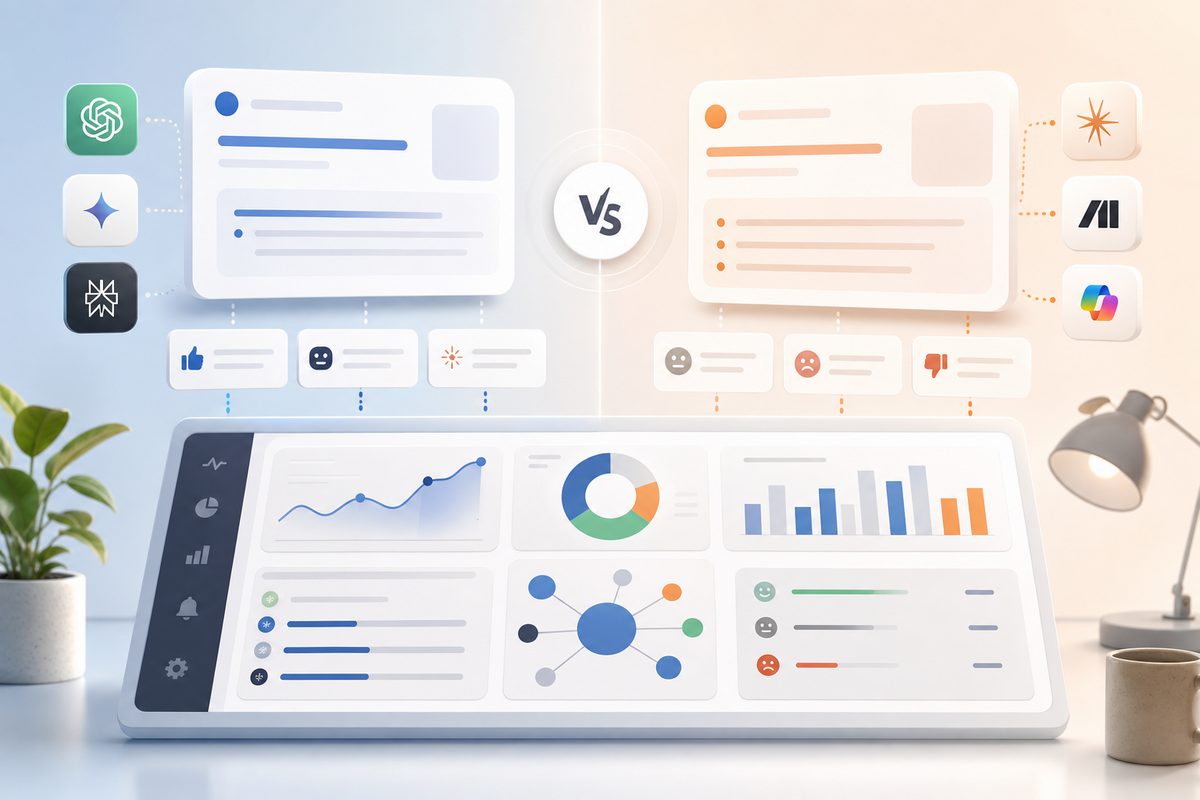
Branded vs non-branded prompts separate two AI search questions: what an AI system says when someone already names your brand, and whether it recommends you when the buyer asks for category, problem, comparison, or shortlist advice without naming you.
That distinction matters because AI visibility is not one metric. A company can look strong in direct brand checks and still be absent from non-branded discovery prompts. Another company may appear in category recommendations while AI describes its product, pricing, ideal customer, or proof points incorrectly.
Use branded prompts to audit entity accuracy and reputation. Use non-branded prompts to audit market discovery and competitive inclusion. Use citations to understand the evidence behind both.
What Are Branded and Non-Branded Prompts?
Branded prompts include your company, product, domain, or executive name. Non-branded prompts do not name you; they ask for recommendations, comparisons, advice, tools, vendors, or solutions around a category, problem, persona, or buying situation.
Examples of branded prompts:
- "What is Acme CRM best for?"
- "Is Acme CRM good for B2B SaaS companies?"
- "Compare Acme CRM with HubSpot."
- "What are the main complaints about Acme CRM?"
- "Does Acme CRM integrate with Salesforce?"
- "Is Acme CRM secure enough for enterprise teams?"
Examples of non-branded prompts:
- "Best CRM tools for a 50-person SaaS company."
- "Which sales pipeline software is easiest to implement?"
- "Recommend a CRM for a startup with a small sales team."
- "What tools should a RevOps lead evaluate before buying CRM software?"
- "How should a B2B SaaS company track expansion revenue?"
- "What are good HubSpot alternatives for product-led growth teams?"
A prompt can also be competitor-branded. "HubSpot alternatives for startups" is branded for HubSpot, but non-branded for every other CRM vendor trying to appear in that answer.
Branded vs Non-Branded Prompts: The Core Difference
The practical difference is user awareness. Branded prompts test what happens after someone already knows you. Non-branded prompts test whether AI introduces you before the buyer knows you exist.
| Prompt type | User intent | What it reveals | Typical owner | Common failure mode |
|---|---|---|---|---|
| Branded prompt | "Tell me about this company." | Entity accuracy, positioning, sentiment, trust signals, outdated claims | Brand, PR, product marketing | AI knows you but describes you incorrectly |
| Non-branded prompt | "Who should I consider?" | Category inclusion, recommendation rank, competitor set, buyer-fit associations | SEO, growth, demand gen | AI answers the buyer but omits you |
| Competitor-branded prompt | "Alternatives to X" or "X vs Y" | Whether you appear when a competitor frames the market | Product marketing, sales enablement | AI treats the competitor as the safer default |
| Problem prompt | "How do I solve this?" | Whether AI connects a pain point to your category or product | Content, SEO, demand gen | AI recommends generic tactics or another category |
| Evidence prompt | "Why is X recommended?" | Which sources support or weaken the answer | SEO, digital PR, analyst relations | AI cites weak, old, or competitor-controlled sources |
In classic SEO, branded and non-branded keywords were often separated for attribution. In AI search, the split is more diagnostic. It tells you whether the problem is knowledge, positioning, authority, competitive proof, or demand capture.

Why This Split Matters in AI Search
AI systems do not behave like a single search results page. The same buyer intent can produce different answers when the wording, persona, constraint, or engine changes.
Google's guide to optimizing for generative AI features on Google Search, updated June 15, 2026, explains that AI features such as AI Overviews and AI Mode rely on core Search systems, retrieval-augmented generation, and query fan-out. In practice, one visible prompt is not the whole market. A buyer's question may trigger related searches, retrieved passages, and citations that vary by wording.
Independent research points in the same direction. A 2026 arXiv preprint on paraphrase brittleness in commercial AI recommendations found that cosmetic rewordings of the same buying intent produced recommendation sets with only 0.288 Jaccard similarity, while constraint-adding rewordings fell to 0.135. Same-prompt reruns were more stable at 0.50 to 0.61.
Another 2026 arXiv preprint on persona conditioning of AI brand recommendations reported that adding buyer persona context reduced recommendation-set similarity by 0.12 to 0.20, with mid-market brands seeing the largest swings.
These are preprints, not final industry law. But they support a practical rule: do not measure branded vs non-branded prompts as one flat list. Group them by intent, persona, category, competitor, and use case.
The MaxAEO BDER Framework
A useful audit should answer four questions: Is the brand known, recommended, evidenced, and competitive? We use the BDER framework to separate those signals.
| Dimension | What it measures | Best prompt type | Score 0 | Score 1 | Score 2 | Score 3 |
|---|---|---|---|---|---|---|
| Brand accuracy | Whether AI describes the entity correctly | Branded | Not mentioned or wrong | Thin or outdated | Mostly accurate | Accurate, specific, current |
| Discovery inclusion | Whether AI includes the brand without being named | Non-branded | Omitted | Incidental mention | Included in shortlist | Recommended for the right use case |
| Evidence support | Whether citations or source patterns support the answer | Both | No evidence | Weak or stale sources | Some relevant sources | Strong, current, independent proof |
| Relative position | How the brand compares with competitors | Non-branded and competitor | Competitors dominate | Appears below weak-fit brands | Competitive in some segments | Consistently strong in target segments |
This is more useful than a single "AI visibility score." A brand with high branded accuracy and low discovery inclusion needs category and proof work. A brand with discovery inclusion but weak evidence support may be at risk of losing visibility when retrieval changes.
Four Common States and What They Mean
| State | Branded prompt result | Non-branded prompt result | Diagnosis | Best next action |
|---|---|---|---|---|
| Known and accurate | AI describes you correctly | AI recommends you for the right buyers | Strong entity and category fit | Defend citations, monitor drift, expand prompt coverage |
| Known but mispositioned | AI mentions you but gets ICP, features, pricing, or category wrong | AI may recommend you for weak-fit use cases | Reputation and messaging gap | Fix entity sources, product pages, review profiles, and third-party descriptions |
| Unknown but category-relevant | AI has little to say when named | AI sometimes recommends you | Discovery is ahead of reputation | Build authoritative brand pages, comparison pages, customer proof, and cited facts |
| Invisible | AI gives thin or wrong branded answers | AI omits you from category shortlists | Weak entity and weak market association | Start with crawlable foundations, clear positioning, and external validation |
The first state is a maintenance problem. The second and third are prioritization problems. The fourth is a foundation problem.
How to Classify Ambiguous Prompts
Some prompts do not fit cleanly into "branded" or "non-branded." Classify by the brand being audited.
| Prompt | Classification for Acme CRM | Why |
|---|---|---|
| "What is Acme CRM?" | Branded | The audited brand is named |
| "Best CRM for B2B SaaS" | Non-branded | No vendor is named |
| "HubSpot alternatives for startups" | Competitor-branded discovery | A competitor is named, but Acme is not |
| "Acme CRM vs HubSpot" | Branded comparison | Acme is named directly |
| "CRM with Salesforce integration and SOC 2" | Non-branded constraint prompt | The buyer defines requirements, not vendors |
| "Is Acme CRM better than Salesforce?" | Branded comparison | Direct brand validation |
This classification prevents reporting errors. If you mix competitor-branded prompts with pure category prompts, your AI share of voice will be hard to interpret.
How to Build a Balanced Prompt Set
A balanced prompt set should include direct brand checks, category discovery prompts, competitor alternatives, problem-led prompts, and evidence prompts. For many B2B SaaS teams, a practical starting set is 40 to 80 prompts.
A 48-prompt starter portfolio can look like this:
| Prompt group | Count | Example |
|---|---|---|
| Entity and positioning prompts | 8 | "What does [brand] do?" |
| Reputation and risk prompts | 6 | "What are common complaints about [brand]?" |
| Product and feature prompts | 6 | "Does [brand] support [integration]?" |
| Category recommendation prompts | 10 | "Best [category] tools for [persona]." |
| Problem and workflow prompts | 8 | "How should [persona] solve [pain point]?" |
| Competitor alternatives | 6 | "[Competitor] alternatives for [use case]." |
| Evidence and citation prompts | 4 | "Why is [brand] recommended for [use case]?" |
Do not expand the set with near-duplicate wording just to increase volume. Add prompts when they represent a real difference in buyer language, market, segment, constraint, or decision stage.
If you already have SEO keyword clusters, convert them into buyer questions instead of copying them into AI tools as keywords. The workflow in AI Search Prompts: How to Turn SEO Keywords Into Buyer Questions is a useful starting point. For governance, document each prompt's owner, intent, persona, market, priority, and last review date. The guide to building an AI search prompt set for brand monitoring goes deeper on that operating process.
What to Measure for Branded Prompts
Branded prompts should measure whether AI understands the brand accurately and defensibly.
Track these fields:
- Presence: Is the brand mentioned when named?
- Entity accuracy: Are company name, product name, category, use case, audience, and capabilities correct?
- Positioning alignment: Does the answer match current messaging?
- Sentiment: Is the stance positive, neutral, negative, mixed, or cautionary?
- Freshness: Does AI mention old product names, old pricing, discontinued features, or outdated market focus?
- Citation quality: Which sources support the answer?
- Risk claims: Are complaints, limitations, or security claims accurate and sourced?
- Conversion risk: Would this answer help or hurt a buyer who is validating the brand?
A branded prompt is not successful just because the brand appears. The question is whether the answer is accurate enough to trust and specific enough to convert.
What to Measure for Non-Branded Prompts
Non-branded prompts should measure whether AI includes the brand in buyer consideration before the user names it.
Track these fields:
- Inclusion rate: How often does the brand appear across a defined prompt group?
- Recommendation rate: Is the brand actively recommended or merely mentioned?
- Position/order: Where does it appear in ranked or semi-ranked shortlists?
- Use-case fit: Is the recommendation tied to the buyer segment you want?
- Competitor overlap: Which brands appear more often and in which prompt groups?
- Citation coverage: Which sources support competitors but not you?
- Constraint match: Does AI associate the brand with the right integrations, pricing tier, geography, compliance need, or workflow?
- Engine variance: Does performance differ across ChatGPT, Gemini, Perplexity, Claude, Copilot, Grok, Google AI Mode, and AI Overviews?
For reporting, separate a mention from a recommendation. A neutral sentence like "Other tools include Acme" is weaker than "Acme is a strong option for mid-market SaaS teams because…" A cited recommendation is stronger still.
The AI search visibility metrics that matter most are the ones that show what to fix next, not the ones that make a dashboard look full.
How to Run a Branded vs Non-Branded Prompt Audit
Use a repeatable process so the findings are not just screenshots and anecdotes.
- Define the market. Name the category, target personas, regions, use cases, and competitors.
- Build prompt groups. Separate branded, non-branded, competitor-branded, problem, and evidence prompts.
- Choose engines. Track the AI surfaces your buyers actually use.
- Run controlled tests. Keep core prompts stable, then add paraphrases and persona variants.
- Score answers. Use presence, recommendation, position, sentiment, citation, and accuracy fields.
- Cluster findings by intent. Do not overreact to one odd answer.
- Map causes. Identify whether the issue is entity confusion, weak proof, content gaps, competitor authority, or outdated sources.
- Assign fixes. Route issues to SEO, product marketing, PR, content, sales enablement, or web teams.
The output should be a decision document, not a dump of AI responses.
Common Finding 1: AI Knows You but Gets You Wrong
When branded prompts return outdated positioning, the issue is usually source consensus. AI systems may be drawing from old pages, stale review profiles, old press coverage, marketplace listings, partner pages, or comparison articles that describe an earlier version of the company.
Fix this before chasing more discovery prompts.
Prioritize:
- Canonical brand facts: Align company name, product names, category, audience, integrations, headquarters, security posture, and pricing model.
- Current positioning: Replace vague "AI-powered platform" language with precise category and use-case language.
- Crawlable proof: Publish customer stories, integration pages, comparison pages, documentation, changelogs, and product screenshots where appropriate.
- Third-party consistency: Update review profiles, directories, marketplace listings, analyst descriptions, PR boilerplates, and partner pages.
- Reputation response: Address negative or outdated claims with evidence, not spin.
For high-risk branded answers, treat this as an AI reputation issue. The practical workflow in AI Reputation Management: Control What AI Says About Your Brand is most relevant when the answer is inaccurate, negative, outdated, or unsupported.
Common Finding 2: AI Recommends Competitors Instead of You
When non-branded prompts recommend competitors, the problem is not always "AI bias." Often, competitors have clearer third-party proof, better comparison content, stronger category pages, fresher reviews, more specific use-case pages, or more crawlable documentation.
Diagnose competitor wins by prompt intent:
| If competitors win for… | Audit this first |
|---|---|
| "Best for enterprise" | Enterprise case studies, security pages, compliance proof, implementation documentation |
| "Easy to implement" | Onboarding pages, migration guides, review themes, customer time-to-value evidence |
| "Best HubSpot alternative" | Comparison pages, switching guides, pricing clarity, integration proof |
| "Best for startups" | Pricing page, startup use cases, founder-focused examples, lightweight setup content |
| "Best with Salesforce" | Integration page depth, marketplace listing, docs, partner proof |
The article on what to do when AI recommends your competitor instead of you is useful when the gap is competitive positioning rather than basic entity accuracy.
Common Finding 3: AI Mentions You Without Citing You
A mention without a citation is weaker than a recommendation supported by sources. It may come from model memory, unstated retrieval, or generalized market knowledge. That makes it harder to influence and harder to defend.
Run citation gap analysis:
- Which sources are cited for competitors?
- Are those sources review platforms, analyst pages, partner directories, blogs, docs, or media?
- Do you have an equivalent source?
- Is your equivalent source crawlable, current, specific, and internally linked?
- Does it state the exact claim AI needs to support?
Google's helpful content guidance asks site owners to evaluate originality, completeness, expertise, sourcing, and value beyond what other pages provide. That applies directly to AI citation work. Thin category copy gives retrieval systems little to use.
How to Fix Branded Prompt Problems
Fix branded prompt problems by making the entity clearer, more current, and easier to verify.
Start with these assets:
- Homepage positioning
- About page
- Product pages
- Pricing page
- Integration pages
- Security and compliance pages
- Customer stories
- Help center and docs
- Review profiles
- Marketplace listings
- Partner directories
- Press boilerplate
- Comparison pages
The goal is not to repeat the same slogan everywhere. The goal is to make public evidence consistent on the facts that AI systems need: what you are, who you serve, what you replace, where you are strongest, and what proof supports that claim.
Avoid inauthentic mention-building. Google's generative AI guidance says site owners should prioritize foundational SEO, unique content, technical accessibility, and real value over AEO/GEO hacks such as inauthentic mentions.
How to Fix Non-Branded Prompt Problems
Fix non-branded prompt problems by proving category fit for specific buyers. Non-branded prompts are not asking "Who are you?" They are asking, "Who should I consider for this situation?"
Build content and proof around the way buyers ask:
- "Best [category] for [persona]."
- "[Competitor] alternatives for [constraint]."
- "[Category] tools with [integration]."
- "How to solve [problem] without [common tradeoff]."
- "What should a [role] use for [workflow]?"
- "Which [category] tools are best for [company size]?"
Do not create doorway pages for every wording. Create consolidated assets that answer real buying questions with evidence: decision criteria, use cases, limitations, screenshots, implementation details, customer examples, integrations, migration steps, and tradeoffs.
A 2026 arXiv preprint on AI brand recommendations and downstream web behavior found that when an assistant recommended a brand to users with no recent observed engagement, same-name Google searches rose by 4.3 percentage points and visits to the brand's site rose by 2.4 percentage points. The study is observational, but it supports a practical point: AI recommendations can create demand that last-click analytics may miss.
That is why non-branded AI visibility needs its own measurement lane.
Reporting Template for Marketing Leaders
A useful report should separate reputation, discovery, and evidence. Executives should be able to see whether the brand is known, recommended, and cited.
| Reporting field | Branded prompt view | Non-branded prompt view | Decision it supports |
|---|---|---|---|
| Presence rate | How often AI names the brand when asked directly | How often AI includes the brand without being named | Entity strength vs discovery strength |
| Recommendation rate | Whether AI endorses the brand | Whether AI puts the brand in a shortlist | Demand capture potential |
| Position/order | Usually secondary | Critical for shortlists | Competitive priority |
| Sentiment | Critical | Useful but secondary | Reputation risk |
| Citation coverage | Which sources support brand claims | Which sources support category recommendations | Content, PR, and proof priorities |
| Competitor overlap | Who appears in comparisons | Who dominates category answers | Positioning and budget focus |
| Accuracy defects | Wrong facts, stale claims, weak descriptions | Wrong use-case fit or missing constraints | Website and third-party source cleanup |
A CFO does not need 200 screenshots. They need to know whether AI visibility is improving, which competitors are winning, which prompt groups matter commercially, and which fixes plausibly caused movement.
Report prompt groups, not isolated anecdotes. Show baseline, trend, top winning prompts, top losing prompts, citation gaps, competitor movement, and the next three fixes.
How Often Should You Refresh Branded and Non-Branded Prompts?
Refresh branded prompts when brand facts change, product positioning changes, pricing changes, acquisitions happen, or negative narratives appear. Refresh non-branded prompts when buyer language, competitors, categories, integrations, or use cases change.
For many B2B SaaS teams:
- Daily monitoring is useful for detection.
- Weekly reviews are useful for tactical fixes.
- Monthly analysis is better for budget and strategy decisions.
- Quarterly prompt-set reviews keep the portfolio aligned with market language.
Use weekly reviews when:
- A new competitor appears repeatedly.
- AI cites an outdated page.
- A prompt group drops across multiple engines.
- A new use case starts producing recommendations.
- AI Overviews or AI Mode begins citing a new source class.
Use monthly reviews when:
- A topic cluster needs investment.
- A competitor gains AI share of voice.
- A citation source repeatedly shapes answers.
- A PR narrative changes AI reputation.
- A prompt group should be retired, merged, or expanded.
Mistakes to Avoid
The most common mistakes are measurement mistakes, not content mistakes.
Avoid these:
- Mixing prompt types into one score. Branded reputation and non-branded discovery are different jobs.
- Counting mentions as recommendations. A passing mention is not the same as a buyer-facing endorsement.
- Ignoring citations. Unsupported answers are harder to influence and less defensible.
- Using only exact prompts. Fixed prompts help trend analysis, but paraphrases reveal fragility.
- Creating pages for every prompt variation. This can produce thin, repetitive content.
- Overreacting to one response. Group findings by prompt family, engine, and time period.
- Measuring engines your buyers do not use. Coverage should reflect real buying behavior.
- Forgetting competitor-branded discovery. "Alternatives to [competitor]" prompts often reveal high-intent opportunities.
Common Questions
Are branded prompts less important because the user already knows us?
No. Branded prompts are the fastest way to find AI reputation issues. If AI gives the wrong category, outdated features, weak proof, or a confusing explanation when the user names you, non-branded discovery wins may still convert poorly.
Branded prompts also matter for sales. Buyers often ask AI to validate a vendor after a demo, referral, ad click, analyst mention, podcast, webinar, or peer recommendation.
How many non-branded prompts should a B2B SaaS team track?
Track enough to cover personas, use cases, competitors, and buying constraints. For many teams, 40 to 80 total prompts is a practical starting range, with non-branded prompts making up most of the set.
The exact number matters less than coverage quality. Ten well-chosen buyer prompts are more useful than 100 near-duplicate phrasings.
Should we track the exact same prompt every day?
Yes, but do not rely only on exact prompts. Fixed prompts create trend continuity. Paraphrases and persona variants reveal how fragile that trend is.
A good system tracks a stable core set, then adds controlled variants for buyer language, market, and use-case depth.
Is AI share of voice the same as brand mentions?
No. Brand mentions count whether a brand appears. AI share of voice compares how often and how prominently your brand appears against competitors across a defined prompt set.
A mention can be neutral, negative, incidental, or unsupported. A recommendation is stronger than a mention, and a cited recommendation is stronger than an uncited recommendation.
Can content alone fix weak non-branded visibility?
Sometimes, but not always. Content can fix missing use-case coverage, weak comparison assets, unclear positioning, and poor answerability. It cannot fully replace third-party proof, reviews, partner mentions, PR, customer evidence, or product-market awareness.
Generative engine optimization works best when content, product marketing, comms, customer proof, and digital PR reinforce the same market story.
What is the best ratio of branded to non-branded prompts?
If the goal is reputation monitoring, use more branded prompts. If the goal is new demand and category discovery, non-branded prompts should be the majority.
A practical starting mix is 30% branded, 50% non-branded, and 20% competitor-branded or evidence prompts. Adjust after the first audit shows where the risk is.
Which team should own branded vs non-branded prompt monitoring?
SEO or growth usually owns the measurement system, but the fixes are cross-functional. Brand and PR should own reputation issues. Product marketing should own positioning and comparison gaps. Content should own answerable assets. Digital PR should own third-party proof and citations.
The owner of the dashboard should not become the owner of every fix.
The Practical Bottom Line
Branded vs non-branded prompts are not a reporting detail. They are the difference between knowing whether AI understands your brand and knowing whether AI recommends your brand when buyers ask for help.
Use branded prompts to protect reputation. Use non-branded prompts to measure discovery. Use citations to find the evidence gaps that explain both.
The teams that win in AI search will not be the teams with the longest prompt list. They will be the teams that can say, with evidence: AI knows who we are, recommends us for the right buyers, cites defensible sources, and shows us gaining ground against the competitors that matter.