
An AI answer accuracy audit checks whether answer engines describe your brand, product, pricing, competitors, integrations, and proof points correctly. It turns AI answers into a claim ledger, verifies each claim against trusted sources, scores business risk, and creates a backlog of source fixes.
This matters because buyers now ask ChatGPT, Gemini, Perplexity, Claude, Copilot, Grok, Google AI Mode, and AI Overviews to explain categories, compare vendors, shortlist tools, and summarize sentiment. A stale pricing claim, missing security capability, or unsupported competitor comparison can appear before the buyer reaches your website.
The practical goal is not to chase every prompt. It is to separate harmless wording differences from material brand risk, then repair the evidence pool that answer engines use.
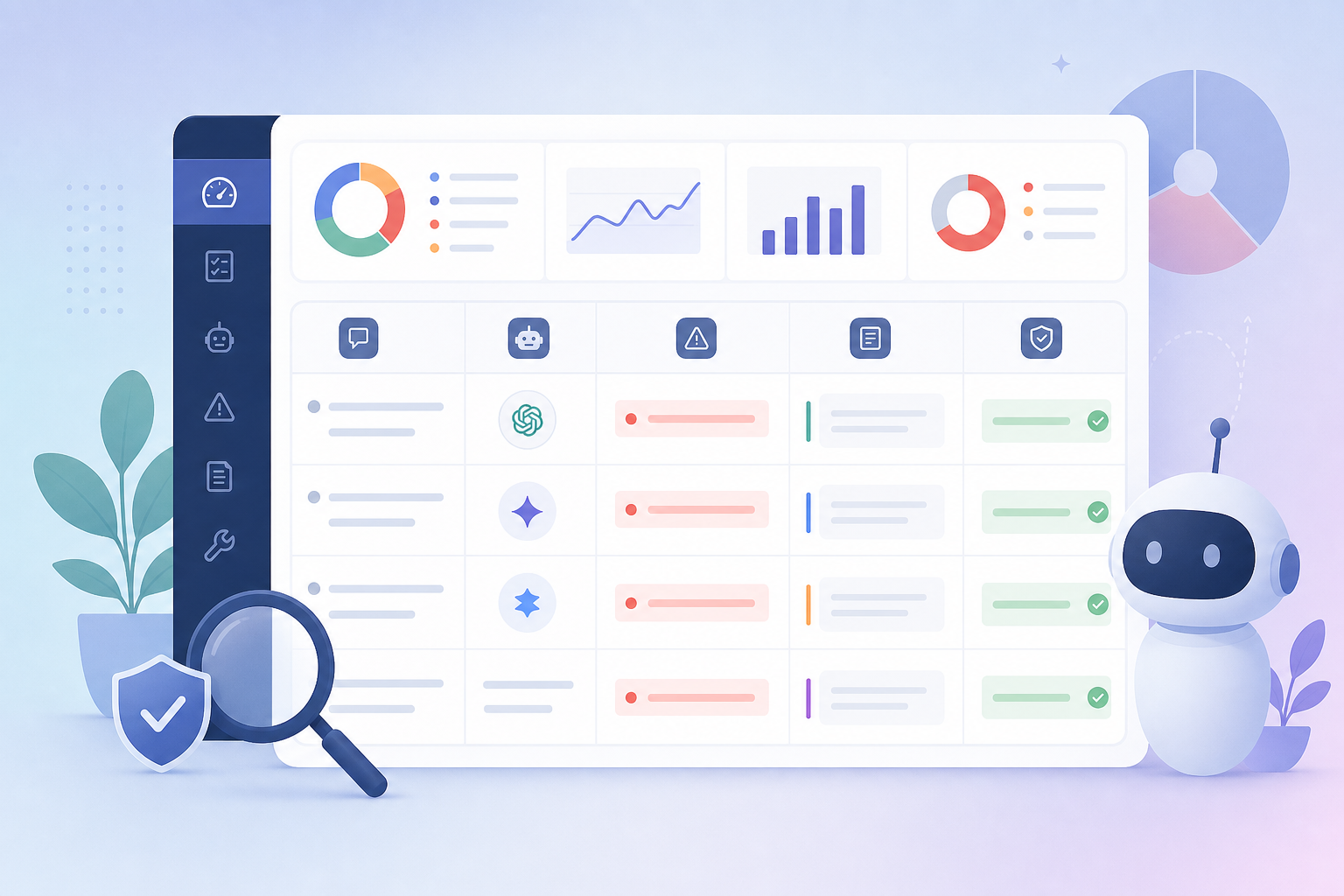
What Is an AI Answer Accuracy Audit?
An AI answer accuracy audit is a structured review of AI-generated answers about a brand. It checks whether each material claim is factually correct, current, supported by a reliable source, and not misleading in context. The output is a claim-level workflow for fixing wrong or unsupported answers.
A useful audit reviews claims, not screenshots. For example, “Company X is an enterprise analytics platform founded in 2018 with native Salesforce integration” contains at least three claims: category, founding year, and integration support. Each claim needs a source of truth.
The audit should answer five questions:
- What did the AI system say?
- Which exact claim is true, stale, unsupported, or false?
- Did the cited source support the claim?
- How risky is the error for the buyer journey?
- Which owned or third-party source should be fixed?
That operating model turns AI search monitoring into a repeatable workflow instead of a folder of surprising screenshots.
AI Answer Accuracy Audit vs. AI Visibility Audit
An AI visibility audit asks whether your brand appears. An AI answer accuracy audit asks whether what appears is true.
| Audit type | Main question | Primary output | Risk if ignored |
|---|---|---|---|
| AI visibility audit | Does the brand appear in AI answers, citations, and shortlists? | Visibility baseline, share of voice, citation list | Buyers may not discover the brand |
| AI answer accuracy audit | Are the claims inside those answers correct and supported? | Claim ledger, severity scores, source repair backlog | Buyers may discover the brand with the wrong facts |
| Citation audit | Which sources influence the answer? | Source map and support check | Teams may fix the wrong page |
| Reputation audit | Are AI answers creating trust or sentiment risk? | Issue log for PR, content, legal, and product marketing | False claims may persist across high-intent prompts |
If you do not yet know where your brand appears, start with an AI search visibility baseline. If you already see wrong claims, move directly into claim-level accuracy work.
Why AI Engines Get Brand Facts Wrong
AI engines get brand facts wrong when the public evidence pool is incomplete, outdated, ambiguous, contradictory, or dominated by third-party pages that describe the company differently from its current positioning.
The issue is not always a “hallucination.” Many wrong answers are plausible summaries of messy sources.
Common causes include:
- Old review-site profiles that still show former pricing or positioning
- Partner pages that describe only one product line
- Comparison pages that omit a new integration or security feature
- Funding databases with stale leadership or headquarters information
- Product pages that use vague copy instead of extractable facts
- Docs that mention a capability but are not internally linked from commercial pages
- Citations that exist but do not support the sentence they are attached to
Research supports the need for claim-level checking. Zuccon, Koopman, and Shaik found that ChatGPT answers were correct or partially correct in 50.6% of tested cases, while suggested references existed only 14% of the time in their study of generated references (arXiv). Liu, Zhang, and Liang found that, across four generative search engines, only 51.5% of generated sentences were fully supported by citations on average, and 74.5% of citations supported the sentence they were attached to (arXiv).
For brand teams, the lesson is direct: a confident answer and a visible citation are not enough. The claim still needs to be checked.
Build the Claim Ledger First
A claim ledger is the control sheet for an AI answer accuracy audit. It defines what is true before reviewers judge AI outputs. Without it, teams argue over tone, preference, or positioning instead of verifiable facts.
Start with a source-of-truth packet:
- Current boilerplate and one-sentence category definition
- Product pages, pricing pages, plan names, and packaging rules
- Integration directory and API documentation
- Security, compliance, privacy, and trust pages
- Support docs for high-value features
- Analyst, marketplace, partner, and review-site profiles
- Press kit, leadership facts, funding notes, and acquisition history
- Approved competitor and alternative positioning
- Recent changelog entries for material product changes
If stale product facts are already spreading, run a freshness pass before broad prompt testing. This is especially important after pricing changes, rebrands, acquisitions, feature launches, or changes in target customer. For a dedicated workflow, see How to Fix Stale Brand Information in AI Answers.
Claim Ledger Template
Use one row per atomic claim.
| Field | What to capture | Example |
|---|---|---|
| Prompt | Exact prompt tested | “Is [brand] good for enterprise teams?” |
| Engine | Surface and model if visible | ChatGPT, Perplexity, Gemini, AI Overview |
| Date and location | Collection timestamp and market | 2026-06-23, US |
| AI claim | The exact claim being reviewed | “The product is mainly for small businesses.” |
| Claim type | Identity, product, commercial, comparative, trust | Comparative |
| Accuracy label | Accurate, partially accurate, stale, unsupported, false | Partially accurate |
| Approved source | Page or document that defines truth | Enterprise product page |
| Cited source | Source shown by the answer engine | Review profile |
| Citation support | Supports, partially supports, contradicts, unrelated, no citation | Partially supports |
| Severity | 1-5 | 4 |
| Fix owner | SEO, product marketing, docs, PR, legal, partnerships | Product marketing |
| Fix action | What needs to change | Add enterprise use-case block and update review profile |
The ledger should be boring and precise. “Bad answer” is not a useful issue. “Three engines repeat a stale pricing claim from an outdated marketplace page” is actionable.
What Claims Should You Audit?
Audit claims that can change buyer understanding, trust, eligibility, or shortlist decisions.
| Claim type | Examples | Source of truth |
|---|---|---|
| Identity | Company name, category, founding year, headquarters, leadership | About page, press kit, Organization schema |
| Product facts | Features, integrations, workflows, API support, deployment options | Product pages, docs, changelog |
| Commercial facts | Pricing model, plan names, free trial, contract terms, target customer size | Pricing page, sales-approved FAQ |
| Trust facts | SOC 2, HIPAA, GDPR, SSO, data retention, uptime, security controls | Trust center, security docs, compliance pages |
| Comparative facts | “Best for,” “unlike,” “alternative to,” competitor strengths and weaknesses | Comparison pages, public reviews, analyst notes |
| Sentiment claims | “Poor support,” “hard to implement,” “popular with enterprises” | Review sources, customer proof, support metrics |
| Market claims | Category leadership, use-case fit, customer segment | Category pages, case studies, third-party profiles |
Do not rely on a brand manifesto as the only source. Answer engines need concise, extractable facts. If your site uses vague phrases such as “built for modern teams,” publish AI-ready source pages with direct answer blocks, clear definitions, and visible evidence.
Run the AI Answer Accuracy Audit in Seven Steps
A dependable first audit should be broad enough to reveal patterns but small enough to review manually. For a B2B SaaS or tech brand, start with 8 engines or surfaces x 12 prompt themes = 96 responses, then repeat the highest-risk prompts over time.
-
Choose the surfaces buyers use. Include ChatGPT, Gemini, Perplexity, Claude, Copilot, Grok, Google AI Mode, and AI Overviews where relevant. Add vertical copilots, review-site summaries, or marketplace AI assistants if they influence your category.
-
Create prompt families. Cover branded, category, comparison, alternative, pricing, integration, trust, support-risk, “best tools,” implementation, migration, and objection prompts.
-
Collect answers with timestamps. Save the exact prompt, answer, citations, engine, visible model if available, account state if relevant, geography, language, and date. One answer is a sample, not a trend.
-
Extract atomic claims. Break each answer into specific statements. “The product lacks enterprise reporting” and “the product is best for SMBs” should be reviewed separately.
-
Grade each claim. Use six labels: accurate, partially accurate, stale, unsupported, false, or unverifiable. “Partially accurate” means the answer contains a true element but frames it in a way that could mislead a buyer.
-
Check citation support. Do not stop at whether a cited page exists. Ask whether the cited page directly supports the exact claim. For deeper source analysis, use AI answer citation tracking.
-
Assign a fix owner. Every material issue should become a backlog item for content, product marketing, PR, documentation, partner marketing, sales enablement, or legal review.
Schulte, Bleeker, and Kaufmann argue that AI search visibility should be measured with repeated observations because answers vary across runs, prompts, and time (arXiv). That same principle applies to accuracy. Do not declare victory after one clean answer.
Prompt Set for a First Audit
Use natural buyer language, not only brand-approved wording.
| Prompt family | Example prompts | What it tests |
|---|---|---|
| Branded definition | “What does [brand] do?” “Who uses [brand]?” | Category, positioning, target customer |
| Category discovery | “Best tools for [use case]” “Top [category] platforms for enterprise teams” | Inclusion, category relevance, shortlist accuracy |
| Alternatives | “Best alternatives to [competitor]” “Is [brand] an alternative to [competitor]?” | Competitive framing |
| Comparison | “[brand] vs [competitor]” “Which is better for [use case]?” | Unsupported comparisons |
| Pricing | “How much does [brand] cost?” “Does [brand] have a free plan?” | Stale commercial facts |
| Integrations | “Does [brand] integrate with Salesforce?” “Does [brand] support [tool]?” | Feature discoverability |
| Security and compliance | “Is [brand] SOC 2 compliant?” “Can regulated teams use [brand]?” | Trust blockers |
| Implementation | “How hard is [brand] to implement?” “Does [brand] require engineering?” | Sales friction |
| Sentiment | “What do customers dislike about [brand]?” | Reputation and review-source risk |
| Recommendation | “Should I choose [brand] for [scenario]?” | Buyer-stage decision risk |
For high-value prompts, collect multiple runs. If an error appears once, log it. If it appears across engines, prompt families, or dates, prioritize it.
Score Each Error by Business Risk
Not every incorrect answer deserves the same response. A severity score keeps the audit focused on revenue, reputation, compliance, and competitive risk.
Use this formula:
Priority score = severity x exposure x buyer impact x fix confidence
Score each factor from 1 to 5.
| Factor | Score 1 | Score 5 |
|---|---|---|
| Severity | Minor wording issue | False or damaging claim |
| Exposure | One low-intent answer | Repeated across engines or high-intent prompts |
| Buyer impact | Unlikely to affect evaluation | Could remove the brand from a shortlist |
| Fix confidence | Cause is unclear | Clear source or content fix exists |
A wrong founding year may score low unless trust history matters in your market. A false claim that your platform lacks SOC 2, HIPAA support, Salesforce integration, SSO, enterprise deployment controls, or an API should score high because it can block evaluation.
Use this threshold for action:
| Priority score | Action |
|---|---|
| 1-50 | Log and recheck in the next cycle |
| 51-150 | Fix when related content is updated |
| 151-300 | Assign an owner this month |
| 301-625 | Escalate to content, PR, product marketing, or legal immediately |
The goal is not to make every answer flattering. The goal is to correct material inaccuracies, reduce unsupported comparisons, and make the public evidence pool more reliable.
Error Taxonomy for Reviewers
A taxonomy keeps reviewers consistent and helps leadership see whether the issue is stale content, weak positioning, missing evidence, or third-party misinformation.
| Error type | What it looks like | Common cause | Best fix |
|---|---|---|---|
| Wrong entity | AI confuses your company with another brand | Similar names, weak entity signals | Strengthen About page, Organization schema, profiles |
| Stale fact | Old pricing, old product tier, former positioning | Outdated owned or third-party pages | Refresh source pages and high-authority profiles |
| Missing capability | AI omits an important feature or integration | Feature buried in docs or not linked | Publish a clear feature or integration page |
| Unsupported comparison | AI says one vendor is “better for” a use case without evidence | Review snippets, weak comparison content | Publish fair comparison pages with explicit criteria |
| Generic positioning | AI calls the brand “software” or “AI tool” with no category clarity | Vague owned copy | Add concise category definitions and use-case pages |
| Citation mismatch | Citation exists but does not support the claim | Retrieval or summarization error | Add quoteable passages and monitor recurring sources |
| Sentiment drift | Neutral facts become negative framing | Reviews, forums, news, social snippets | Address the source issue and publish balanced evidence |
| Shortlist omission | Brand absent from category recommendations | Weak category relevance or low evidence density | Improve category pages, third-party mentions, and source coverage |
| Compliance error | AI says a required control is missing | Trust content is inaccessible, vague, or stale | Update trust center, docs, and structured evidence |
| Market-fit error | AI says the brand is only for SMBs or only for enterprises | Old positioning or skewed customer examples | Add current customer segment and use-case proof |
The most common audit mistake is labeling every problem a hallucination. In practice, many errors are summaries of confusing source material.
Check Whether Citations Actually Support the Claim
Citation support is a separate review step from answer accuracy.
| Citation status | Meaning | Example |
|---|---|---|
| Supports | The cited page directly proves the claim | Pricing page lists the current plan |
| Partially supports | The page supports part of the claim but not the full wording | Docs show Salesforce sync, but not “native bi-directional sync” |
| Contradicts | The page says the opposite | Cited page says feature is beta, answer says it is generally available |
| Adjacent only | The page is about the topic but not the claim | Security page exists but does not mention HIPAA |
| No citation | The claim appears without a supporting source | “Best for enterprise” with no cited evidence |
| Unavailable | The cited page is blocked, removed, or inaccessible | 404, paywall, blocked profile |
This distinction matters because a cited answer can still be wrong. The fix may be to improve the cited page, create a better source page, or correct a third-party profile that answer engines keep retrieving.
Fix the Sources, Not Only the Output
The durable fix for incorrect AI answers is to improve the sources that answer engines can retrieve, quote, and reconcile. Correcting one chatbot session does not repair the evidence pool.
Start with owned sources. Google’s guidance for AI features says the same SEO fundamentals apply to AI Overviews and AI Mode: allow crawling, use internal links, make important content available in textual form, and ensure structured data matches visible text (Google Search Central).
Then review third-party sources. AI engines often rely on review sites, partner pages, funding databases, app marketplaces, podcast notes, analyst writeups, media articles, and public profiles. If those pages repeat old positioning, your owned site may not be enough.
Use this repair sequence:
- Update the canonical owned page first.
- Add a direct answer block near the top.
- Link to the page from related product, category, docs, and comparison pages.
- Update structured data only where it matches visible content.
- Refresh high-authority third-party profiles and partner listings.
- Request corrections on cited media, marketplace, or directory pages when possible.
- Re-run the same prompt set and track whether the error declines.
This approach also aligns with Google’s people-first content guidance, which asks whether content provides original information, comprehensive coverage, clear sourcing, and substantial value compared with other results (Google Search Central).
What to Publish When AI Describes the Brand Incorrectly
Publish the page the answer engine appears to need but cannot find.
| Wrong AI answer pattern | Publish or improve this source |
|---|---|
| Wrong category | “What is [brand]?” page with a concise category definition |
| Stale pricing | Pricing explainer with plan names, update date, and FAQ |
| Missing integration | Integration page or integration hub with supported workflows |
| Unsupported “best for” claim | Use-case page with customer fit, limits, and proof |
| Bad competitor comparison | Fair comparison page with criteria, not exaggerated claims |
| Compliance uncertainty | Trust center page with current certifications and controls |
| Entity confusion | About page, press kit, Organization schema, and profile cleanup |
| Shortlist omission | Category hub with use cases, customer segments, and proof points |
A strong corrective source page usually contains:
- A direct answer in the first 40-60 words
- Current product facts with dates where freshness matters
- Clear feature, integration, and limitation statements
- Evidence such as docs, customer proof, certifications, or changelog links
- Comparison criteria that avoid unsupported superiority claims
- Internal links from high-authority pages
- Structured data that reflects visible text
Avoid burying corrections in isolated blog posts. If an answer engine is confused about pricing, the pricing page must become clearer. If it is confused about integrations, the integration architecture must become easier to crawl and quote.
For broader brand framing issues, connect the audit to AI-ready brand content so corrections improve both accuracy and differentiation.
Metrics to Report After the Audit
Report risk reduction, not vanity screenshots.
| Metric | What it tells you |
|---|---|
| Reviewed claim count | Size of the evidence set |
| Incorrect claim rate | Share of claims labeled stale, unsupported, false, or misleading |
| High-severity issue count | Number of issues above your action threshold |
| Engine spread | How many engines repeat the same issue |
| Prompt family spread | Whether the issue appears in branded, category, comparison, or pricing prompts |
| Citation support rate | Share of cited claims directly supported by cited pages |
| Source correction rate | Share of completed fixes across owned and third-party sources |
| Recovery rate | Share of previously wrong claims that become accurate in later checks |
| Time to correction | Days from issue detection to source fix |
| Recurrence rate | Share of fixed issues that reappear later |
For LLM brand tracking and AI share of voice, report uncertainty. Sielinski argues that single-run citation metrics can be misleading because repeated samples can produce different citation distributions and rankings (arXiv). Treat AI answer accuracy as a monitored system, not a one-time report.
How Often Should You Run the Audit?
Run a baseline audit before major GEO or AI reputation work. Then adjust cadence by business risk.
| Situation | Recommended cadence |
|---|---|
| Stable B2B brand with low reputational risk | Quarterly full audit, monthly high-priority prompts |
| Competitive SaaS category | Monthly full audit, weekly comparison and category prompts |
| Pricing, packaging, or product launch | Before launch, one week after launch, then weekly for one month |
| Rebrand, acquisition, or leadership change | Weekly until entity facts stabilize |
| Regulated, enterprise, or reputation-sensitive category | Weekly high-risk prompts, monthly full audit |
| Active misinformation or PR issue | Daily monitoring for critical prompts until recovery trend is visible |
A good cadence balances coverage and review quality. Testing 500 prompts badly is less useful than testing 100 prompts with clean claim extraction, source checking, and owner assignment.
Common Mistakes That Weaken the Audit
The most common failure is auditing answers without a source-of-truth ledger. Teams collect outputs, debate whether wording “feels right,” and never convert findings into fixes.
Avoid these mistakes:
- Testing only branded prompts while buyers ask category and comparison questions
- Treating a citation as proof without checking claim support
- Ignoring stale third-party profiles that answer engines cite repeatedly
- Updating schema with facts that are not visible on the page
- Reporting one screenshot as evidence of a trend
- Chasing positive sentiment while false factual claims remain unresolved
- Publishing corrections on weak pages that are not linked from product or category hubs
- Mixing visibility and accuracy metrics without separating “appeared” from “appeared correctly”
- Failing to record dates, locations, account state, or prompt variants
- Assigning every issue to SEO when the real owner is product marketing, docs, PR, or partnerships
The audit should stay operational: define truth, collect answers, extract claims, check sources, score risk, fix sources, measure again.
FAQ
How often should a brand run an AI answer accuracy audit?
Run a baseline audit before starting answer engine optimization, then monitor high-priority prompts at least monthly. Fast-changing companies should check weekly when pricing, packaging, integrations, leadership, funding, compliance status, or positioning changes.
Is this different from a normal AI visibility audit?
Yes. An AI visibility audit asks whether your brand appears, ranks, gets cited, or earns share of voice. An AI answer accuracy audit asks whether the claims inside those appearances are true, current, supported, and commercially fair.
Who should own the audit?
One team should own the ledger, but fixes should go to the team that controls the source. SEO usually owns crawlability and content architecture. Product marketing owns positioning and comparisons. Documentation owns technical facts. PR owns media corrections. Legal should review high-risk compliance or reputation claims.
Can structured data fix incorrect AI answers?
Structured data can help systems understand a page, but it is not a correction layer for hidden claims. Google’s Article structured data guidance says markup can help Google understand article pages and should be validated and implemented according to guidelines (Google Search Central). Use schema to reinforce visible facts.
What is the fastest way to reduce wrong AI answers?
Fix the highest-confidence source problem first. If three engines cite an outdated profile, update that profile. If they miss a product capability because it is buried in docs, publish a clear source page and link to it from relevant hubs. The fastest win is usually a fresher, clearer, more quoteable source.