By maxaeo
Branded vs non-branded AI prompts measure different stages of AI visibility. Branded prompts reveal whether an AI system describes a known company accurately. Non-branded prompts test whether it discovers and recommends that company when a buyer asks about a category, problem, use case, or requirement.
The distinction matters because a company can perform well in one group and poorly in the other. An AI assistant may describe a brand perfectly when named yet omit it from every category shortlist. Conversely, it may recommend a product while repeating obsolete features or incorrect positioning.
A controlled prompt panel measures AI answer behavior, not market demand. Demand estimates require separate evidence, such as Google Search Console queries, site-search logs, CRM records, sales-call language, or category search volume.
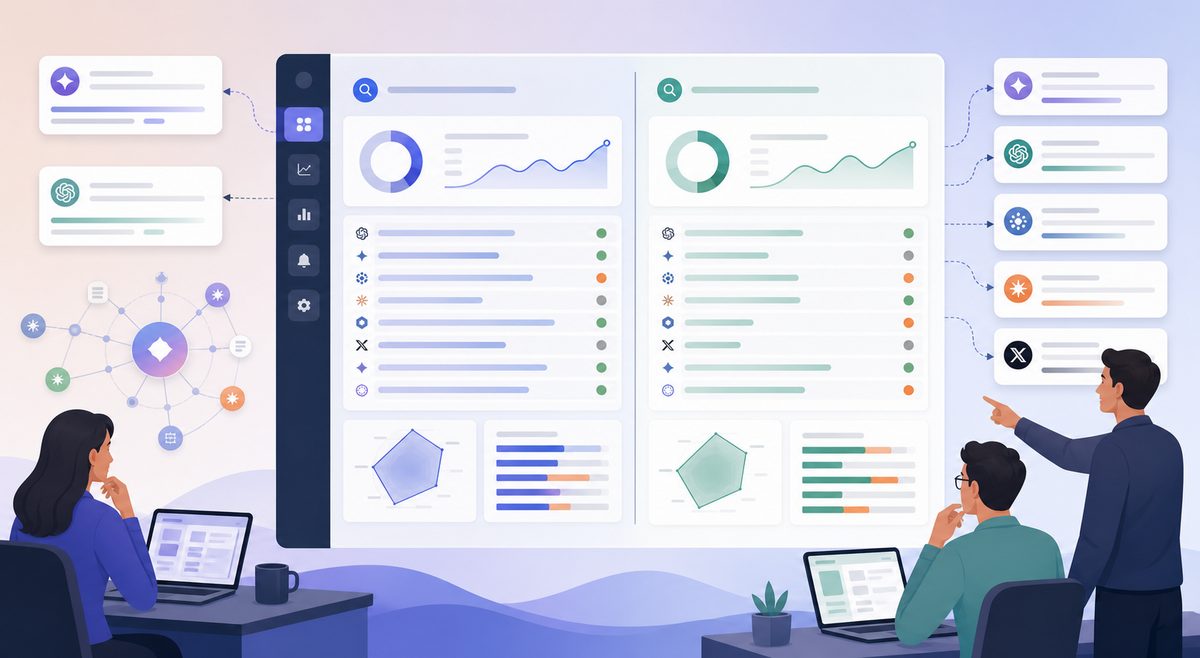
What are branded and non-branded AI prompts?
Branded AI prompts explicitly name the company, product, or domain being evaluated. Non-branded AI prompts omit the target brand and describe a category, problem, use case, role, or buying requirement. The split distinguishes aided narrative accuracy from unaided discovery, so the two prompt types require different metrics and denominators.
| Prompt type | Example | What it tests | Primary success signal |
|---|---|---|---|
| Branded identity | “What is AcmeCloud?” | Entity and category understanding | Accurate description |
| Branded capability | “Does AcmeCloud support AWS budget alerts?” | Product-fact accuracy | Current, supported answer |
| Branded comparison | “AcmeCloud vs NimbusOps for a SaaS company” | Competitive narrative | Accurate, balanced trade-offs |
| Non-branded category | “Best cloud cost governance platforms for SaaS” | Category discovery | Relevant shortlist inclusion |
| Non-branded problem | “How can finance teams reduce unexplained cloud spend?” | Problem-to-brand association | Credible recommendation |
| Non-branded requirement | “Cloud cost tools with SSO, AWS support, and budget alerts” | Constraint-based qualification | Inclusion only when all requirements are met |
The practical rule is simple:
- Use branded prompts to measure description, accuracy, sentiment, and demand capture.
- Use non-branded prompts to measure discovery, recommendation, prominence, and competitive presence.
- Use external business data to estimate demand.
- Never average branded and non-branded rates into one undifferentiated visibility score.
How should ambiguous prompts be classified?
A prompt is not genuinely non-branded merely because the target name is absent from its final sentence. The target must also be absent from conversation history, system instructions, uploaded context, examples, and other text supplied to the AI system.
| Prompt or context | Classification | Reason |
|---|---|---|
| “What are alternatives to AcmeCloud?” | Branded | The target identity is supplied |
| “What is cheaper than AcmeCloud?” | Branded | Discovery is anchored to the target |
| “AcmeCloud vs NimbusOps” | Branded comparison | Both entities are explicitly named |
| “Alternatives to NimbusOps” when AcmeCloud is the target | Competitor-seeded | The target is unaided, but discovery is anchored to a competitor |
| “Best FinOps software for a 200-person SaaS company” | Non-branded | No target or competitor is supplied |
| A category prompt after discussing AcmeCloud earlier in the chat | Context-contaminated | Conversation memory may influence retrieval |
Competitor-seeded prompts deserve their own segment. They can show whether a target appears during competitor evaluation, but they should not be blended with unseeded category or problem prompts.
What do branded prompts actually measure?
Branded prompts primarily measure narrative accuracy and demand capture, not demand size. The user has already supplied the identity, so the AI system does not need to discover the company.
A branded prompt panel should answer:
- Does the AI place the company in the correct category?
- Does it identify the intended customer accurately?
- Are product capabilities, integrations, prices, and limitations current?
- Are comparisons supported rather than invented?
- Which sources appear to shape the answer?
- Do material claims differ across platforms or collection dates?
- Are obsolete or risky claims repeated consistently?
A useful claim-level metric is:
Material claim accuracy = correct material claims ÷ all material claims reviewed
A material claim is one that could affect evaluation or purchase: category, audience, price, integration, security certification, availability, or core capability. Stylistic differences should not count as errors when the underlying meaning is correct.
Branded prompts can reveal how existing interest is handled. They cannot show how many people have that interest. For that, pair the panel with observed search and customer data, keeping AI search measurement distinct from traditional SEO demand signals.
What do non-branded prompts measure?
Non-branded prompts measure whether an AI system can retrieve, qualify, and recommend a company without being given its name. They are the stronger test of category discovery and buyer-problem association.
Three outcomes must be separated:
- Mention: The answer names the brand.
- Recommendation: The answer positively presents the brand as a suitable option.
- Qualified recommendation: The recommendation satisfies every explicit requirement in the prompt.
A mention is not automatically a recommendation. “AcmeCloud does not support this requirement” contains the brand name but indicates exclusion. A citation to the company website also does not prove endorsement.
Teams conducting manual reviews should use stable labels and retain the full evidence behind each classification. A practical coding workflow is covered in this guide to tracking brand mentions in ChatGPT and other AI answers.
What counts as an eligible non-branded answer?
The discovery denominator should include only prompts for which the target product is objectively eligible.
If a prompt requires HIPAA support and the product does not provide it, exclusion is correct—not a visibility failure. Eligibility must therefore be decided before answers are collected, using documented product facts.
Use two denominators for different questions:
- Target discovery denominator: Answers to prequalified prompts for which the target is eligible.
- Market share-of-voice denominator: All tracked brand mentions in a fixed market panel applied consistently to every competitor.
Do not remove unfavorable prompts after reviewing the results. Predeclared eligibility prevents both false penalties and convenient denominator changes.
Which metrics should be tracked?
The correct metrics depend on whether the identity was supplied.
Metrics for branded prompts
| Metric | Calculation | What it reveals |
|---|---|---|
| Category accuracy | Correctly categorized answers ÷ branded answers | Entity classification |
| Fully accurate answer rate | Answers without material errors ÷ branded answers | Overall narrative reliability |
| Material claim accuracy | Correct claims ÷ reviewed material claims | Fact-level reliability |
| Stale-claim rate | Answers containing obsolete claims ÷ branded answers | Knowledge lag |
| Citation coverage | Supported material claims ÷ material claims | Evidence strength |
| Unsupported comparison rate | Unsupported comparative claims ÷ comparative claims | Competitive risk |
| Sentiment distribution | Positive, neutral, and negative answers ÷ branded answers | Reputation pattern |
Narrative consistency should be scored by meaning, not verbatim conformity with approved copy.
Metrics for non-branded prompts
| Metric | Calculation | What it reveals |
|---|---|---|
| Mention rate | Answers naming the target ÷ eligible answers | Basic discovery |
| Recommendation rate | Answers endorsing the target ÷ eligible answers | Positive consideration |
| Qualified inclusion rate | Constraint-valid recommendations ÷ eligible answers | Commercial relevance |
| Top-three presence | Top-three placements ÷ eligible ranked answers | Shortlist prominence |
| Citation-backed recommendation rate | Supported recommendations ÷ target recommendations | Evidential strength |
| AI share of voice | Target mentions ÷ all tracked brand mentions | Competitive attention |
| Persistent recommendation coverage | Prompt-platform pairs recommended in most collection windows ÷ all eligible pairs | Repeatability |
Metrics that apply to both groups
| Metric | Calculation | Why it matters |
|---|---|---|
| Outcome volatility | Classification changes between consecutive runs ÷ possible changes | Shows whether one snapshot is dependable |
| Platform variance | Highest platform rate − lowest platform rate | Identifies platform-specific gaps |
| Citation concentration | Answers relying on the top source ÷ cited answers | Reveals dependence on one source |
| Reviewer agreement | Identical reviewer labels ÷ double-coded answers | Tests coding reliability |
Always report the numerator and denominator alongside the percentage. “31 recommendations from 224 eligible answers” is more informative than “13.8% visibility.”
Why is a blended visibility score misleading?
Branded and non-branded results begin from incompatible conditions. Branded prompts supply the identity and test description. Non-branded prompts withhold it and test discovery.
Suppose branded answers achieve 86% category accuracy while non-branded answers have a 25% mention rate. Reporting a 55.5% average is mathematically possible but operationally meaningless. The events, denominators, and corrective actions differ.
| Dimension | Input condition | Core question | Typical owner |
|---|---|---|---|
| Description | Target brand supplied | Is the brand represented accurately? | Brand, communications, product marketing |
| Discovery | Target brand withheld | Is the brand retrieved and recommended? | SEO, GEO, content, PR |
| Demand | Observed buyer behavior | Which prompt clusters matter commercially? | Analytics, growth, revenue operations |
Executives can receive one scorecard without receiving one blended score. The three dimensions should remain visible side by side.
What is the Description–Discovery–Demand framework?
The Description–Discovery–Demand framework connects AI monitoring to business priorities while preserving diagnostic clarity.
1. Description: Is the brand represented correctly?
Use branded identity, capability, comparison, pricing, audience, and reputation prompts. Measure factual accuracy, stale claims, sentiment, and evidence quality.
2. Discovery: Is the brand retrieved for relevant needs?
Use non-branded category, problem, requirement, role, industry, and use-case prompts. Measure mentions, recommendations, qualification, prominence, citations, and competitive presence.
3. Demand: Which prompt clusters matter most?
Apply weights from independent evidence such as qualified pipeline, Search Console data, site search, customer interviews, paid-search data, or strategic-account priorities.
Demand-weighted discovery = Σ(cluster discovery rate × predeclared cluster weight) ÷ Σ(cluster weights)
Keep the raw and weighted values together. For example, report “18% raw discovery and 27% demand-weighted discovery.” The weighted figure indicates commercial priority; it does not replace the observed panel result.
Weights must be documented before results are reviewed. Otherwise, a team can unintentionally give more importance to clusters where the brand already performs well.
What does a 320-answer example reveal?
The following synthetic example demonstrates the calculations. It is a reproducible measurement model—not customer data or an industry benchmark.
Test design
The panel contains:
- 6 branded prompts and 14 eligible non-branded prompts;
- 4 AI answer engines;
- 4 weekly collection windows;
- 96 branded answer records;
- 224 non-branded answer records;
- 320 answer records in total.
Prompt wording remains frozen throughout the four weeks. Each collection uses a fresh conversation with the same locale and account configuration.
Every answer is coded for brand mention, explicit recommendation, list position, citation, category accuracy, material claim accuracy, stale claims, and eligibility. Ten percent of records are double-coded to check whether another reviewer reaches the same classification.
Calculated results
| Signal | Result | Denominator | Interpretation |
|---|---|---|---|
| Correct category in branded answers | 83/96, or 86.5% | Branded answers | Category understanding is strong but incomplete |
| Fully accurate branded answers | 68/96, or 70.8% | Branded answers | Nearly three in ten contain a material problem |
| Branded answers with a stale claim | 17/96, or 17.7% | Branded answers | Source maintenance is required |
| Non-branded mentions | 55/224, or 24.6% | Eligible non-branded answers | Unaided discovery is limited |
| Explicit recommendations | 31/224, or 13.8% | Eligible non-branded answers | Only 56.4% of mentions become recommendations |
| Top-three inclusions | 23/224, or 10.3% | Eligible non-branded answers | Prominent shortlist visibility is weaker |
| Citation-backed recommendations | 13/31, or 41.9% | Target recommendations | Most recommendations lack direct evidence |
| AI share of voice | 55/256, or 21.5% | All tracked brand mentions | Competitors receive 201 of 256 mentions |
| Outcome changes between weekly runs | 49/168, or 29.2% | Possible non-branded run-to-run changes | A single snapshot would be unreliable |
| Persistent recommendations | 6/56, or 10.7% | Non-branded prompt-platform pairs | Few recommendations recur in at least three weeks |
The 10.8-percentage-point gap between mention rate and recommendation rate shows that recognition is not the main constraint. The AI systems often retrieve the company but do not present it as a preferred option.
Category prompts generate 34 mentions from 112 answers, or 30.4%. Problem-led prompts generate 21 from 112, or 18.8%. The brand is therefore associated more strongly with its product category than with the buyer problem it claims to solve.
That diagnosis changes the content brief. Another generic category-definition article is unlikely to address the weakest signal. More useful assets would include problem-led implementation evidence, customer examples, constraint-specific comparisons, and third-party validation.
How should a reliable prompt panel be built?
A defensible panel begins with decisions and eligibility rules, not a large collection of convenient questions.
-
Define the decisions. State whether the program must correct brand facts, improve category discovery, enter shortlists, monitor reputation, or support a launch.
-
Create distinct intent clusters. Cover branded identity, capability, comparison, category, problem, requirement, role, industry, and use case. The 60-prompt framework for AI brand monitoring provides a larger taxonomy that can be adapted to the business.
-
Run a brand-leakage check. Remove the target name from the current prompt, conversation history, instructions, examples, and uploaded context before labeling a test non-branded.
-
Write eligibility rules in advance. Record product requirements, regions, integrations, customer sizes, and compliance constraints before collecting answers.
-
Separate the frozen core from experiments. Use stable prompts for trend reporting. Keep new messaging, emerging categories, and wording tests in an experimental panel.
-
Control collection conditions. Where possible, hold locale, language, account state, conversation history, platform, and collection window constant.
-
Preserve complete evidence. Store the full response, citations, timestamp, model label, platform settings, and screenshot—not merely a mention flag.
-
Use a coding handbook. Define mention, recommendation, rank, citation, material error, stale claim, and eligibility with examples.
-
Audit reviewer agreement. Have a second reviewer recode a sample. Resolve recurring disagreements by updating the handbook rather than silently changing past labels.
-
Add demand weights last. Establish stable raw results before introducing business weights.
How many prompts are enough?
A practical first panel usually contains 30–50 prompts, including roughly 8–12 branded prompts and a larger non-branded set across distinct buyer intents. This is an operational starting point, not a statistical guarantee.
A balanced 40-prompt panel might contain:
| Cluster | Suggested prompts |
|---|---|
| Branded identity and category | 4 |
| Branded facts and capabilities | 4 |
| Branded comparisons and alternatives | 4 |
| Non-branded category | 8 |
| Non-branded problem | 8 |
| Non-branded requirements | 6 |
| Non-branded role, industry, and use case | 6 |
Add a prompt only when it represents a different decision, audience, constraint, or market. Twenty paraphrases of one category query do not provide the same coverage as twenty distinct buyer situations.
Why can the same prompt produce different answers?
AI answers can vary because prompt wording, model version, retrieval behavior, source freshness, locale, conversation context, and platform configuration can all affect the result. A recommendation should therefore be treated as an observed outcome—not a permanent search ranking.
| Source of variation | Measurement control |
|---|---|
| Prompt wording | Freeze one canonical phrasing per intent |
| Conversation memory | Start a fresh session |
| Locale and language | Record and hold them constant |
| Model or platform updates | Store the displayed model label and timestamp |
| Retrieval and source changes | Preserve citations and full answers |
| Personalization | Use a consistent account state |
| Prompt order | Run prompts independently when possible |
| Response randomness | Repeat collection across comparable windows |
Wording variants belong in a sensitivity test. The canonical trend panel should not change simply because one paraphrase performs better. Maxaeo’s analysis of prompt wording sensitivity explains how apparently similar questions can change constraints and brand inclusion.
Some systems may also decompose one request into several hidden retrieval steps. Understanding query fan-out in AI search helps explain why evidence written for only one obvious keyword may not support every sub-question the system investigates.
How should four common result patterns be interpreted?
| Branded accuracy | Non-branded discovery | Diagnosis | Priority |
|---|---|---|---|
| High | High | The brand is understood and discovered | Protect strong sources and monitor drift |
| High | Low | The brand is known when named but rarely retrieved | Build category, problem, and comparison evidence |
| Low | High | The brand is discovered but described inaccurately | Correct material facts and source conflicts |
| Low | Low | Entity understanding and retrieval are both weak | Clarify the category, audience, proof, and authoritative references |
High branded accuracy with low discovery often means the entity is understandable but insufficiently associated with the needs expressed in non-branded prompts.
Low branded accuracy with high discovery can be more commercially damaging. The brand earns exposure, but incorrect pricing, integrations, positioning, or limitations may disqualify it before a buyer visits the website.
What should teams fix after finding a gap?
The response should follow the failed metric. Publishing more generic content is not a universal remedy.
| Observed failure | Likely evidence gap | Practical action | Verification metric |
|---|---|---|---|
| Wrong category in branded answers | Conflicting entity descriptions | Align homepage, product pages, profiles, and influential third-party descriptions | Category accuracy |
| Obsolete feature or price | Old documentation or syndicated copy | Update canonical facts and request corrections from cited sources | Stale-claim rate |
| Mention without recommendation | Weak differentiation or proof | Publish verified use cases and constraint-specific comparisons | Recommendation rate |
| Strong category discovery but weak problem discovery | Product label is clearer than buyer outcome | Add problem-led evidence using customer language | Problem-cluster discovery |
| Recommendation without citation | Unsupported association | Publish quotable evidence and earn corroborating coverage | Citation-backed recommendation rate |
| Low qualified inclusion | Missing proof for explicit requirements | Create authoritative integration, compliance, and capability documentation | Qualified inclusion rate |
| One platform underperforms | Different source selection or retrieval behavior | Compare cited and omitted sources before changing sitewide strategy | Platform variance |
| High run-to-run volatility | Weak or inconsistent evidence | Strengthen corroboration across independent sources | Persistent recommendation coverage |
Google states that its AI search features do not require special AI markup or a separate AI text file. Pages must meet normal Search technical requirements and remain eligible for indexing and snippets, according to Google Search Central’s guidance for AI features.
No page change can guarantee a recommendation from ChatGPT, Gemini, Perplexity, Claude, Copilot, or another AI system. The defensible objective is to improve the clarity, relevance, consistency, and support of the evidence those systems may retrieve.
How should results be reported?
Stakeholders need one view, but not one blended percentage. A useful monthly scorecard should include:
- branded category accuracy and material-error count;
- non-branded mention, recommendation, and qualified inclusion rates;
- top-three presence and AI share of voice;
- citation-backed recommendation rate;
- results by intent cluster, market, and platform;
- four-week and twelve-week movement from the frozen panel;
- outcome volatility and persistent recommendation coverage;
- raw and demand-weighted discovery;
- three evidence-backed actions with owners and review dates.
Report changes in percentage points and counts. “Recommendation rate increased from 13.8% to 18.3%, or from 31 to 41 of 224 eligible answers” is clearer than “visibility improved by 33%.”
Do not claim pipeline attribution from prompt-panel movement alone. Connect monitoring to revenue only when CRM, referral, survey, or customer-interview evidence establishes that relationship.
Which mistakes invalidate the comparison?
- Treating “alternatives to our brand” as non-branded. The target identity is supplied.
- Ignoring brand leakage from prior context. A name in conversation history can contaminate an unaided test.
- Counting every mention as a recommendation. Negative and incidental mentions require separate labels.
- Penalizing valid exclusion. Products should not be recommended when they fail explicit requirements.
- Changing eligibility after seeing results. This creates a movable denominator.
- Mixing competitor-seeded and unseeded prompts. They represent different discovery conditions.
- Silently changing the prompt set. Frozen-panel trends and experimental results must remain separate.
- Overweighting paraphrases. Similar wording creates false sample size and distorted share of voice.
- Comparing platforms with different panels. Platform comparisons require equivalent prompts and windows.
- Treating citations as proof of accuracy. An answer can cite a source and still misinterpret it.
- Discarding answer evidence. A percentage without responses, timestamps, and citations cannot be audited.
- Treating collection frequency as user volume. Daily monitoring produces more observations, not proof of higher demand.
- Calling one appearance a stable ranking. AI recommendations can change between otherwise comparable runs.
The strongest quality check is reproducibility: a second reviewer should be able to inspect the saved evidence, apply the documented definitions, and reach the same classification.
Frequently asked questions
Is an “alternatives to our brand” prompt branded or non-branded?
It is branded because the target company appears in the question. It can measure comparative associations and potential switching intent, but it cannot demonstrate unaided discovery. Track it as a branded alternatives or comparison prompt.
Is “alternatives to a competitor” a non-branded prompt?
It is non-branded relative to the target, but it is not an unseeded category prompt. Classify it as competitor-seeded discovery because the named competitor influences the candidate set and buyer context.
How many prompts should a company monitor?
Start with 30–50 prompts covering distinct decisions and buyer intents. Include roughly 8–12 branded prompts, then distribute the remainder across category, problem, requirement, role, industry, and use-case clusters. Add prompts for meaningful differences, not cosmetic paraphrases.
Should wording variants be counted separately?
Count variants separately only when they represent a different role, region, requirement, company size, or evaluation stage. Pure paraphrases should remain in a sensitivity test and should not receive separate demand weights.
Can strong branded performance predict non-branded recommendations?
No. Branded accuracy shows that an AI system can describe the company after receiving its identity. Non-branded recommendation requires the system to retrieve the brand, compare it with alternatives, and judge it relevant to an unstated or explicit buyer need.
How often should AI visibility be monitored?
Weekly collection is often sufficient for a stable market. Daily monitoring can be appropriate during launches, incidents, or rapid category changes. In both cases, use a frozen prompt core and compare equivalent windows. Frequency does not make repeated answers statistically independent or convert them into demand volume.
The measurement rule to remember
Use branded prompts to protect narrative accuracy. Use non-branded prompts to measure genuine discovery and recommendation. Use independent customer and search data to estimate demand.
Keep the three views separate, preserve the full evidence behind every result, and apply eligibility and weighting rules before reviewing outcomes. That produces a measurement system teams can diagnose and act on—not an opaque AI visibility score.