To track brand mentions in ChatGPT, build a stable set of buyer prompts, run them repeatedly, record whether your brand is named, recommended, ranked, cited, or misdescribed, and compare the result against competitors over time. The output should be a dataset, not a folder of screenshots.
Most teams searching this topic are trying to answer a practical question: “When prospects ask ChatGPT who to consider, do we show up?” The defensible answer requires prompt design, repeat sampling, scoring rules, citation tracking, and a fix loop that turns missing mentions into better evidence on the web.
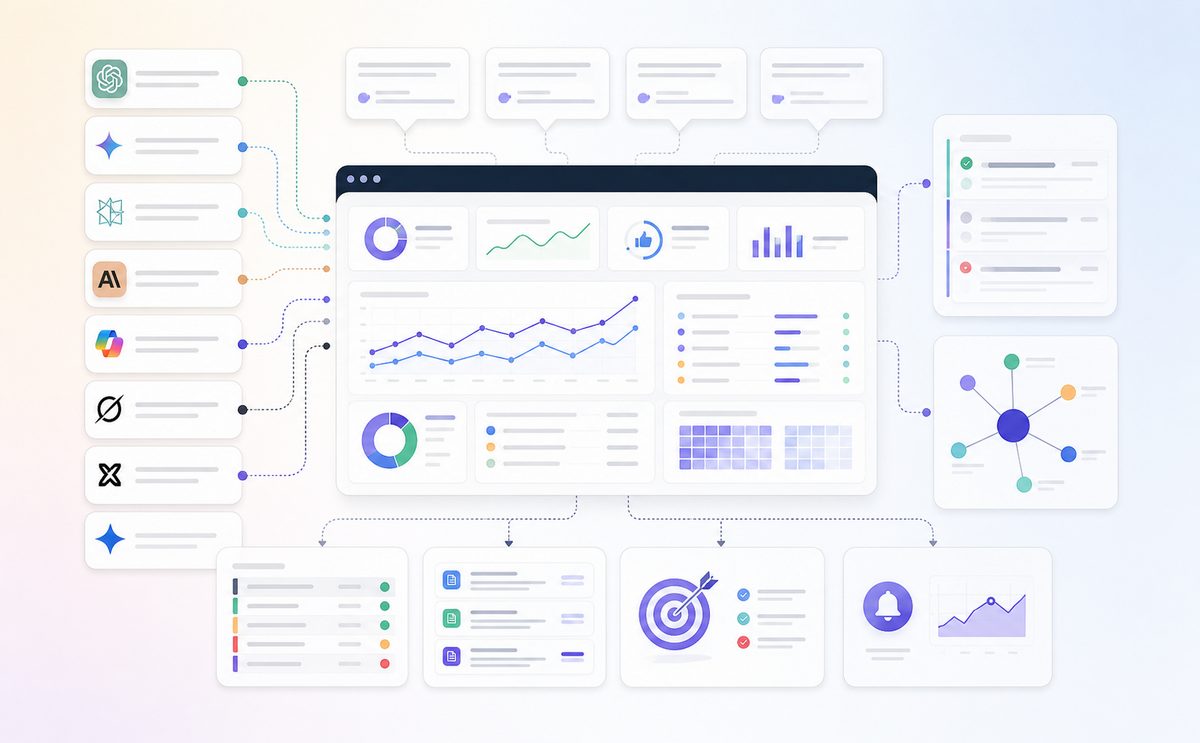
This guide gives you the operating model: what to track, which prompts to use, how many runs are enough, how to interpret citations, and how to report AI visibility without overstating noisy results.
What does tracking brand mentions in ChatGPT mean?
Tracking brand mentions in ChatGPT means measuring how often ChatGPT names, recommends, ranks, cites, or describes your brand in response to buyer-relevant prompts. A complete tracker also records competitors, position, sentiment, citations, answer accuracy, and the likely source gap behind each result.
That is different from social listening. Social listening monitors what people publish. ChatGPT mention tracking measures what an answer engine synthesizes when a buyer asks for advice, shortlists, comparisons, or vendor recommendations.
A useful tracker answers seven questions:
- Presence: Does ChatGPT mention the brand?
- Prominence: Is the brand first, mid-list, buried, or only cited as a source?
- Recommendation strength: Is it actively recommended or merely named?
- Competitors: Which alternatives appear instead?
- Sentiment: Is the framing positive, neutral, mixed, or negative?
- Evidence: Which pages or domains support the answer when citations are shown?
- Fix path: What source, content, PR, review, or technical change should be tested next?
What counts as a ChatGPT brand mention?
A brand mention is any answer-level reference to your company, product, sub-brand, founder, documentation, research, or owned domain. Not all mentions have the same value, so score the type of mention before reporting it.
| Mention type | Example outcome | How to treat it |
|---|---|---|
| No mention | Competitors appear; your brand is absent | Visibility gap |
| Named only | Your brand appears in a long list | Low-value presence |
| Recommended | ChatGPT says your brand is a good option for the use case | Commercial visibility |
| Top recommendation | Your brand is first or framed as the best fit | High-value visibility |
| Cited source only | Your page is cited, but the brand is not recommended | Evidence visibility, not demand capture |
| Misdescribed | Brand appears with wrong category, features, pricing, or ICP | Message risk |
| Negative or caveated | Brand appears with limitations, complaints, or warnings | Reputation risk |
For reporting, separate mention rate from recommendation rate. A brand that appears as “also worth considering” is not performing like a brand ChatGPT recommends first with supporting evidence.
Why one-off ChatGPT checks fail
One-off checks fail because ChatGPT answers can vary by model, search mode, date, account state, geography, language, prompt wording, and retrieved sources. A screenshot proves that one answer happened. It does not prove market visibility.
A 2026 arXiv preprint, Quantifying Uncertainty in AI Visibility, found that generative search citation visibility should be treated as a sample estimate, not a fixed ranking. The paper specifically warns that single-run visibility metrics can look more precise than they are.
Use this reliability ladder:
| Evidence level | What it supports | What it should not support |
|---|---|---|
| One screenshot | Qualitative diagnosis | Trend claims |
| 3-5 repeated runs | Directional prompt-level signal | Executive performance claims |
| Stable prompt set over 4 weeks | Trend reporting | Causal claims without a fix log |
| Pre/post window after a documented change | Source or content impact review | Guaranteed future visibility |
| Multi-engine, multi-region trendline | Channel-level AI visibility reporting | Revenue attribution by itself |
The goal is not statistical perfection. The goal is to avoid false certainty.
How to track brand mentions in ChatGPT step by step
The best workflow is: define the market, build prompts, run repeated checks, score consistently, archive answers, diagnose source gaps, fix the evidence, and retest on the same cadence.
- Define the tracking scope. List the brand, products, category terms, target audiences, countries, languages, and priority competitors.
- Build a fixed prompt set. Include branded, non-branded, comparison, problem-led, pricing, implementation, and reputation prompts.
- Standardize run conditions. Record date, model, search mode, region, language, account state, and whether web citations were available.
- Run repeated samples. Use the same prompts on the same cadence instead of rewriting them every week.
- Score each answer. Capture mention type, rank, sentiment, recommendation strength, competitors, citations, and message accuracy.
- Archive the response. Keep the full answer text, cited URLs, and timestamp so later reports can be audited.
- Cluster gaps. Group failures by cause: no category association, weak proof, outdated third-party source, crawler block, stale content, or competitor dominance.
- Assign fixes. Turn each gap into an owned page update, comparison page, documentation improvement, review program, digital PR target, or technical SEO task.
- Retest after changes. Compare pre/post windows, not single-day results.
For an operational workflow focused specifically on auditability, see How to Track ChatGPT Brand Mentions Without Screenshots.
Which prompts should you monitor?
Monitor prompts that match real buyer jobs: finding tools, validating a brand, comparing vendors, evaluating risk, checking pricing, and asking how to solve a problem. Start with 30-60 prompts. Smaller, stable sets usually produce better decisions than huge prompt lists nobody reviews.
| Prompt bucket | Buyer intent | Example prompt pattern | What it reveals |
|---|---|---|---|
| Branded validation | “Can I trust this vendor?” | “Is [brand] a good option for [use case]?” | Positioning, risks, reputation |
| Category discovery | “Who should I consider?” | “Best [category] tools for [audience]” | Non-branded discoverability |
| Comparison | “Which vendor is better?” | “[Brand] vs [competitor] for [use case]” | Differentiator clarity |
| Problem-led | “How do I solve this?” | “How should a [team] solve [pain]?” | Whether ChatGPT connects the problem to your category |
| Pricing and buying | “What will this cost?” | “Affordable [category] platforms for [team size]” | Commercial fit and pricing perception |
| Implementation risk | “What could go wrong?” | “What are the risks of using [brand]?” | Objection handling and trust gaps |
| Alternatives | “What else is out there?” | “Alternatives to [competitor] for [use case]” | Competitive displacement opportunities |
A strong prompt set uses the buyer’s language, not only the company’s preferred positioning. For a deeper prompt-building workflow, use How to Create a Prompt Set for AI Brand Monitoring.
How many repeated runs are enough?
For most B2B teams, run each priority prompt 3-5 times per engine per reporting period. Use more samples for high-stakes competitor comparisons, volatile reputation prompts, or executive reporting.
| Decision | Minimum practical evidence |
|---|---|
| Diagnose a wording or source issue | 1-2 runs |
| Weekly visibility reporting | 3-5 runs per prompt-engine pair |
| Competitor share of voice | 5+ runs across stable prompt buckets |
| Executive trend claim | 4-week rolling trend with repeated samples |
| Post-fix evaluation | Pre/post windows using the same prompt set |
Do not celebrate tiny changes. If a brand appears in 2 of 5 runs one week and 3 of 5 the next, that may be normal answer variance. If recommendation rate rises from 18% to 42% across the same prompt bucket over four weeks, and the fix log shows relevant source changes, the movement is worth investigating.
How often should you run ChatGPT mention tracking?
Run high-intent prompts weekly, reputation prompts daily or three times per week, and broader strategic audits monthly. Cadence should follow business risk and answer volatility.
| Prompt type | Suggested cadence | Why |
|---|---|---|
| Branded reputation prompts | Daily or 3x weekly | Sensitive to news, reviews, and public complaints |
| Category discovery prompts | Weekly | Closest to AI-assisted vendor discovery |
| Comparison prompts | Weekly | Competitor pages and third-party sources change often |
| Problem-led prompts | Weekly or monthly | Useful for content gap planning |
| Long-tail educational prompts | Monthly | Lower commercial urgency |
| Regional or multilingual prompts | Monthly, then weekly for priority markets | Detects local visibility differences |
Google launched Search Generative AI performance reports in Search Console on June 3, 2026 for a subset of sites. Those reports show visibility for Google generative AI features such as AI Overviews and AI Mode, including impressions, pages, countries, devices, and dates. They are useful for Google surfaces, but they do not track brand mentions in ChatGPT.
Which AI engines should you include?
Start with ChatGPT, then add the answer engines your buyers actually use. Do not blend all platforms into one score until you have engine-level detail.
| Engine | Why it matters | What to measure |
|---|---|---|
| ChatGPT | Broad conversational research and vendor shortlists | Mention rate, recommendation rate, rank, message accuracy, citations when search is used |
| Gemini | Google ecosystem research and AI Mode overlap | Source overlap, query fan-out effects, brand positioning |
| Perplexity | Citation-heavy research behavior | Cited domains, source freshness, competitor comparisons |
| Claude | Long-form reasoning and strategic evaluation | Narrative accuracy, risk framing, inclusion in shortlist prompts |
| Microsoft Copilot | Work-context and enterprise research | B2B relevance, Microsoft ecosystem positioning |
| Google AI Mode and AI Overviews | Search-integrated generative discovery | Supporting links, source exposure, Search Console generative reports |
For broader multi-engine monitoring, see How to Track & Monitor Your Brand Mentions in ChatGPT, Gemini & Perplexity.
What metrics should go in the tracker?
Track visibility, prominence, sentiment, source support, and actionability. A useful tracker should make the next fix obvious.
| Metric | Definition | Why it matters |
|---|---|---|
| Mention rate | Runs where your brand appears / total runs | Baseline AI visibility |
| Recommendation rate | Runs where your brand is recommended / total runs | Commercial relevance |
| Top-3 rate | Runs where your brand appears in the first three options | Shortlist strength |
| Average answer position | Mean rank among listed brands | Prominence |
| Competitor share of voice | Your brand mentions vs tracked competitor mentions | Competitive benchmark |
| Weighted prominence score | Higher weight for first-position recommendations than low-list mentions | Prevents weak mentions from inflating results |
| Sentiment | Positive, neutral, mixed, or negative framing | Reputation monitoring |
| Citation presence | Whether owned or third-party sources are cited | Evidence strength |
| Citation ownership | Owned, competitor, review, analyst, partner, media, community, documentation | Fix prioritization |
| Message accuracy | Whether category, ICP, use cases, features, and pricing are described correctly | Brand control |
| Gap reason | Absent, weak proof, stale source, crawler issue, wrong category, competitor dominance | Next action |
A simple weighted prominence model works well:
| Score | Outcome |
|---|---|
| 5 | Top recommendation with accurate supporting rationale |
| 4 | Recommended, but not first |
| 3 | Listed neutrally |
| 2 | Cited as a source but not recommended |
| 1 | Mentioned with weak, vague, or outdated context |
| 0 | Not mentioned |
| -1 | Mentioned negatively or inaccurately |
Report the raw classifications alongside the score. Executives need the trend, but SEO and content teams need the answer text and source gap.
How should citations be tracked?
Citations are the evidence layer behind AI answers. A mention tells you what ChatGPT said. A citation, when available, helps explain which sources may be shaping the answer and what can be improved.
For every cited answer, record:
- Cited URL
- Cited domain
- Source type
- Owned vs third-party source
- Whether the cited page supports the claim
- Whether the cited page is current
- Whether the cited page is crawlable and indexable
- Whether a competitor owns or influences the cited source
- Which claim the source appears to support
A 2026 arXiv preprint, How Large Language Models Source Brand Reputation Across Languages and Markets, analyzed 167,551 grounded citations and found that 85.7% pointed to non-owned sources. Treat that as a warning: your homepage alone rarely controls how AI systems describe your brand.
Common citation problems and fixes:
| Citation problem | Likely cause | Fix |
|---|---|---|
| Competitor pages are cited | Competitor owns clearer comparison content | Publish defensible comparison pages and third-party proof |
| Old review pages shape the answer | Stale external profiles | Update profiles, review platforms, and partner listings |
| Thin directory pages are cited | Lack of authoritative category evidence | Build stronger category and use-case pages |
| Owned pages are absent | Crawl, indexing, or content clarity problem | Check robots.txt, rendering, internal links, and passage structure |
| A cited page does not support the answer | Source-answer mismatch | Create clearer claim-level evidence and monitor future runs |
A source-focused workflow is covered in AI Citation Tracking: How to Find and Fix the Sources Behind AI Answers.
What crawl access should you check?
Crawl access affects whether AI systems can discover, retrieve, and surface your content. For ChatGPT search visibility, OpenAI documents separate crawlers for search and training in its OpenAI crawler documentation.
The distinction matters:
| OpenAI crawler | Purpose | SEO implication |
|---|---|---|
| OAI-SearchBot | Used to surface websites in ChatGPT search features | Blocking it can prevent pages from appearing in ChatGPT search answers |
| GPTBot | Used for crawling content that may be used for model training | Blocking it is separate from ChatGPT search visibility |
| ChatGPT-User | User-triggered visits from ChatGPT or custom GPT actions | Not used to determine automatic search inclusion |
A common policy mistake is blocking every AI crawler when the intended goal is only to restrict training. OpenAI says the settings are independent, so SEO, legal, security, and engineering should review robots.txt together.
Example policy pattern to discuss internally:
User-agent: OAI-SearchBot
Allow: /

User-agent: GPTBot
Disallow: /
For Google AI features, the baseline is still Search eligibility. Google’s AI features documentation says a page must be indexed and eligible to show a snippet to appear as a supporting link in AI Overviews or AI Mode. Google’s generative AI search guide also explains that AI features rely on retrieval-augmented generation and query fan-out, so crawlable, useful, well-structured pages still matter.
How should prompt wording sensitivity be handled?
Prompt wording sensitivity should be measured with controlled variants, not treated as a reason to rewrite the whole prompt set. Keep a stable core set and maintain a smaller paraphrase panel for your most valuable buyer questions.
| Base prompt | Variant to test |
|---|---|
| “Best AI search visibility tools for B2B SaaS” | “What software helps SaaS teams monitor AI search mentions?” |
| “How do I get recommended by ChatGPT?” | “How can a brand show up in ChatGPT shortlists?” |
| “[Brand] vs [competitor] for [use case]” | “Which is better for [use case], [brand] or [competitor]?” |
| “Tools for GEO reporting” | “How should an agency report generative engine optimization results?” |
If your brand appears for polished internal language but disappears for plain buyer language, the issue is usually weak entity association. The web may not consistently connect your brand to the category, audience, and problem.
For a deeper framework, read Prompt Wording Sensitivity: How Much Does Rephrasing Change Which Brands AI Names?.
How should multilingual and regional tracking work?
Track the languages and markets your buyers actually use. English-only ChatGPT monitoring can miss local competitors, local sources, regional terminology, and language-specific reputation patterns.
A 2026 arXiv preprint, The Language Blind Spot, queried grounded models across 66 brands and 12 languages. It found that moving from English to a brand’s home language increased recommendation share far more for local champions than for global multinationals in that sample.
For practical tracking, compare:
- Mention rate by language
- Recommendation rate by region
- Local competitor inclusion
- Local source citations
- Sentiment differences
- Translation mismatches
- Country-specific terminology
- Whether regional proof pages are cited
Do not assume English results represent Germany, Japan, Brazil, France, or China. Regional AI visibility is often shaped by local media, directories, review platforms, partner pages, and language-specific documentation.
Can you use the ChatGPT API to track mentions?
You can use API-based testing for controlled prompt experiments, but do not assume it perfectly represents the consumer ChatGPT experience. The ChatGPT product, model routing, search availability, personalization settings, and citation behavior can differ from a controlled API run.
Use API testing when you need:
- Repeatable prompt execution
- Structured output collection
- Controlled model settings
- Large-scale prompt analysis
- Internal QA before public monitoring
Use product-level monitoring when you need:
- ChatGPT search behavior
- Real citation surfaces
- Buyer-like answer formatting
- Account, geography, or language conditions
- Screenshots or answer archives for auditability
Label the source of the data clearly. “ChatGPT API test” and “ChatGPT search result” are not the same metric.
When is an AI visibility tool worth it?
An AI visibility tool is worth it when manual tracking becomes too slow, inconsistent, or politically fragile for the decisions it supports. The trigger is not company size; it is reporting risk.
Manual tracking can work if you are testing 20 prompts for one brand. It breaks when you need to monitor multiple competitors, engines, markets, prompt variants, languages, citations, and weekly trendlines.
A serious tool should support:
- Fixed prompt sets
- Repeat sampling
- Multi-engine tracking
- Competitor share of voice
- Citation extraction
- Sentiment and message accuracy scoring
- Region and language segmentation
- Full answer archives
- Weekly trend reporting
- Source-to-fix recommendations
For MaxAEO users, the core value is operational consistency: the same prompts, same scoring rules, same competitor set, and same reporting cadence across ChatGPT, Gemini, Perplexity, Claude, Copilot, Google AI Mode, and AI Overviews.
What does a useful scorecard look like?
A useful scorecard ties prompt outcomes to business actions. It should show where the brand is recommended, where competitors win, which sources shape answers, and what the team will fix next.
Example weekly scorecard format for 50 prompts across four engines:
| Prompt bucket | Brand mention rate | Recommendation rate | Top competitor rate | Common cited source type | Primary fix |
|---|---|---|---|---|---|
| Branded validation | 88% | 64% | 22% | Owned site, review pages | Update positioning and proof points |
| Category discovery | 26% | 14% | 52% | Review sites, listicles, analyst pages | Build category evidence and third-party coverage |
| Comparison | 41% | 19% | 47% | Competitor pages, directories | Publish defensible comparison content |
| Problem-led | 17% | 8% | 33% | Blogs, forums, documentation | Add problem-to-solution pages |
| Regional prompts | 12% | 5% | 28% | Local directories, media | Create localized proof and references |
The insight is not simply “visibility is low.” The scorecard shows that the brand is understood when named directly but rarely discovered from category or problem-led prompts. That points to content and source gaps, not just brand awareness.
How do you turn missing mentions into fixes?
Treat every missing mention as an evidence gap until proven otherwise. Each gap needs an owner, a fix type, and a retest date.
| AI answer problem | Likely cause | Fix |
|---|---|---|
| Brand absent from category prompts | Weak category association | Build category pages with ICP, use cases, integrations, and proof |
| Brand listed but not recommended | Weak differentiators | Add comparison evidence, customer outcomes, constraints, and trade-offs |
| Brand described inaccurately | Conflicting or stale sources | Update owned pages, schema, profiles, documentation, and third-party listings |
| Competitor cited repeatedly | Stronger external proof | Earn review, analyst, partner, media, or community references |
| AI cites old pages | Freshness gap | Update canonical pages and request recrawl where appropriate |
| Negative framing appears | Reputation source issue | Identify cited criticism and publish accurate public evidence |
| Owned citations absent | Crawl or structure issue | Check robots.txt, rendering, internal links, and passage clarity |
| Regional prompts fail | Missing local proof | Add language-specific pages, regional case studies, and local references |
This is where answer engine optimization becomes practical. The goal is not to trick ChatGPT. The goal is to make your brand easier to understand, verify, and recommend.
How should results be reported to executives?
Executives need trend, competitive context, business relevance, and a fix plan. They do not need raw transcripts unless there is a reputation issue.
Use five blocks:
| Report block | What to show |
|---|---|
| Visibility trend | Mention rate and recommendation rate by engine |
| Competitive benchmark | AI share of voice against named competitors |
| Revenue relevance | Category, comparison, and problem-led prompts |
| Reputation risk | Negative or inaccurate descriptions with examples |
| Action plan | Source, content, PR, review, or technical fixes with owners |
Avoid claiming that ChatGPT mentions equal revenue. A defensible claim is narrower: AI mentions influence discovery and shortlisting for researched purchases. Pair AI visibility with assisted pipeline, branded search lift, direct traffic, referral traffic from AI platforms, sales-call mentions, and self-reported attribution.
A strong executive line sounds like this:
For our 40 high-intent prompts, recommendation rate rose from 18% to 31% over four weeks, while Competitor A fell from 46% to 39%. The largest remaining gap is implementation-risk prompts, where analyst and review sources still favor Competitor A.
What should you avoid measuring?
Do not measure every random prompt, every model variant, or every vanity mention. Measurement should mirror buyer behavior and business risk.
Avoid these traps:
- Treating one screenshot as trend data
- Rewriting the prompt set every week
- Tracking prompts no buyer would ask
- Counting negative mentions as wins
- Measuring only branded prompts
- Ignoring non-branded category discovery
- Combining engines into one blended score without detail
- Ignoring citations and source quality
- Calling API tests “ChatGPT search visibility” without labeling the difference
- Creating thin pages for every prompt variation
Google’s generative AI search guidance emphasizes unique, helpful, non-commodity content and warns against creating pages for every query variation primarily to manipulate rankings. The same principle applies to ChatGPT visibility: better evidence beats more shallow pages.
Common questions
What is the best way to track brand mentions in ChatGPT?
The best way is to use a fixed prompt set, run prompts repeatedly, score mention type and recommendation strength, capture competitors and citations, and compare results over time. Do not rely on one-off manual screenshots.
Can Google Search Console track brand mentions in ChatGPT?
No. Google Search Console can report visibility for eligible Google Search generative AI features, but it does not track brand mentions in ChatGPT. Use it alongside ChatGPT-specific and multi-engine monitoring.
How many prompts should a B2B SaaS company start with?
Start with 30-60 prompts across branded validation, category discovery, competitor comparison, problem-led, pricing, implementation, and reputation buckets. Expand only when the team can still read, score, and act on the answers.
How often should ChatGPT brand mentions be checked?
Check high-intent prompts weekly, reputation prompts daily or three times per week, and broader strategic prompt sets monthly. Use the same prompt set long enough to build a trendline.
Is being cited the same as being recommended?
No. A citation means ChatGPT referenced a source. A recommendation means the answer names your brand as a suitable option. The strongest result is both: your brand is recommended and credible sources support the claim.
How can a brand get recommended by ChatGPT more often?
Improve the evidence ChatGPT can find and verify. Clarify category positioning, publish specific use-case and comparison pages, update stale third-party listings, earn credible references, fix crawler access, and retest the same prompts after each change.
Should agencies track AI visibility for every client?
Agencies should track AI visibility for clients in researched categories where buyers ask AI tools for shortlists, comparisons, recommendations, or risk checks. The key is standardizing prompts, scoring rules, cadence, and client reporting.
Does prompt wording change which brands ChatGPT names?
Yes, it can. Track a stable core prompt set plus controlled paraphrase variants. If visibility changes sharply across semantically similar prompts, your brand’s association with the category, problem, or audience is likely fragile.
The operating habit
To track brand mentions in ChatGPT well, treat AI visibility as a measurement program, not a screenshot exercise. The core system is simple: stable prompts, repeated runs, competitor benchmarks, citation analysis, crawl checks, and a weekly source-to-fix queue.
The teams that benefit most are the teams that build a baseline early, learn which sources shape AI answers, and improve the evidence answer engines use when buyers ask who to trust.