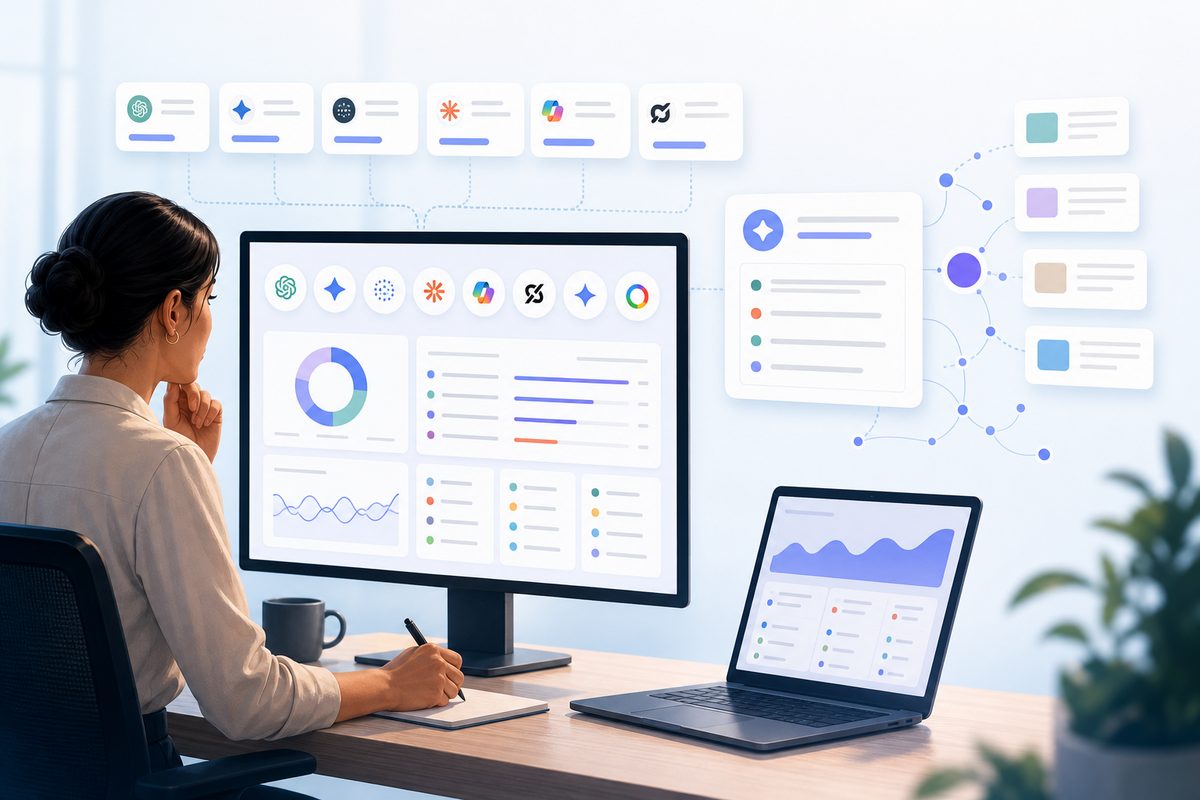
To track ChatGPT brand mentions, use a repeatable monitoring system: run a fixed set of buyer-relevant prompts, store the full answers, classify brand and competitor mentions, calculate visibility metrics, inspect citations, and rerun the same prompts on a schedule.
A screenshot proves that one answer happened. It does not prove whether your brand is consistently visible when buyers ask ChatGPT for vendors, alternatives, comparisons, implementation advice, or risk checks. The useful question is not “Did ChatGPT mention us once?” It is “Across the questions that matter, how often are we named, where do we rank, who appears instead, and what sources shape the answer?”
What Does It Mean to Track ChatGPT Brand Mentions?
To track ChatGPT brand mentions is to repeatedly test a fixed set of buyer-relevant prompts and record whether ChatGPT names, ranks, describes, cites, or omits your brand. The record should include the prompt, answer text, date, model/interface setting, competitors, sources, sentiment, and next action.
A complete record should answer these questions:
| Question | What to Record | Why It Matters |
|---|---|---|
| Did the brand appear? | Mentioned, omitted, cited only, or domain mentioned | Separates visibility from traffic |
| Where did it appear? | First mention, top three, list position, paragraph context | Shows shortlist strength |
| How was it described? | Category, use case, sentiment, strengths, limitations | Reveals positioning accuracy |
| Who appeared nearby? | Competitors, partners, marketplaces, publishers | Adds competitive context |
| What evidence appeared? | Citations, named sources, repeated claims | Shows likely source influence |
| What should change? | Content, PR, reviews, docs, schema, positioning | Turns monitoring into action |
This is the prompt-level evidence layer behind answer engine optimization and generative engine optimization.
The Short Workflow
Use this six-step workflow to track ChatGPT brand mentions:
- Build a prompt set from real buyer questions.
- Run prompts under controlled conditions and preserve the exact prompt text.
- Store the full answer, not just a screenshot.
- Classify mentions by brand, competitor, position, sentiment, and citation.
- Calculate metrics such as mention rate, top-three rate, first-mention rate, AI share of voice, and citation rate.
- Diagnose the cause, ship fixes, and rerun the same prompts to measure change.
The denominator is the part most teams miss. A statement like “ChatGPT mentioned us” is weak. A statement like “ChatGPT mentioned us in 48 of 180 tracked answer records, while Competitor A appeared in 74” is operational.
Why Manual Screenshots Break Down
Manual screenshots are useful as examples, but they fail as a measurement system. They do not preserve a clean denominator, trend line, prompt history, competitor baseline, or source map.
Screenshots usually fail in five ways:
- Sampling bias: teams save the surprising answer, not the full sample.
- Missing context: screenshots often omit the prompt, date, model, web-search state, region, account state, and prior conversation context.
- No metrics: you cannot calculate reliable mention rate from a folder of images.
- No source diagnosis: screenshots rarely show which citations or repeated claims may be shaping the answer.
- No repeatability: different team members can run different prompts and call the result “monitoring.”
Screenshots still have a role. Use them as qualitative proof in reports. Do not use them as the primary record.
Step 1: Build a Prompt Set That Matches Buyer Language
A good prompt set is a controlled sample of questions buyers actually ask before they shortlist, compare, or reject vendors. Start with 30 to 60 prompts for one product line. Expand only after the team trusts the first set.
Use these prompt types:
| Prompt Type | Example Pattern | What It Reveals |
|---|---|---|
| Category | “Best tools for [job]” | Whether your brand enters shortlist answers |
| Alternatives | “Alternatives to [competitor]” | Whether ChatGPT sees your brand as a substitute |
| Comparison | “[Brand] vs [competitor]” | How your strengths and weaknesses are framed |
| Problem | “How do I solve [pain]?” | Whether your category is connected to the need |
| Role | “What should a VP Marketing use for [task]?” | Persona-level relevance |
| Industry | “Best [category] tools for [industry] teams” | Vertical association |
| Risk | “What are the limitations of [brand]?” | Reputation and accuracy issues |
| Implementation | “How do I set up [workflow]?” | Whether your product appears in practical advice |
Do not paste SEO keywords directly into ChatGPT and call that a prompt strategy. Convert keywords into buyer questions. For example, “AI search visibility software” becomes “What are the best AI search visibility tools for a B2B SaaS marketing team?”
For a deeper prompt-building process, use maxaeo’s guide to AI search prompts for brand monitoring. If you are deciding how large the sample should be, use the guide on how many AI search prompts to track.
Step 2: Control the ChatGPT Test Conditions
ChatGPT answers can change based on wording, timing, conversation context, web search, account state, and available sources. You cannot remove all variation, but you can document the conditions.
For every run, record:
| Field | Recommended Rule |
|---|---|
| Prompt ID | Use a stable ID such as cat_001 or alt_014 |
| Prompt text | Store the exact wording |
| Platform | ChatGPT |
| Mode | Search on, search off, deep research, or other interface condition |
| Account state | Neutral account, logged-in account, or known user profile |
| Region/language | Record if controlled |
| Date and time | Use one time zone consistently |
| Conversation state | New chat or continued thread |
| Capture count | Number of repeated runs per prompt |
For baseline monitoring, use a new chat for every prompt unless your research question is specifically about follow-up behavior. Prior chat context can alter recommendations and make the run harder to compare.
Step 3: Store Answers, Not Screenshots
A stored answer is the full text record behind a ChatGPT response, paired with metadata that makes it auditable. To track ChatGPT brand mentions properly, store the answer itself.
Each record should include:
- Prompt ID and prompt text.
- Platform and interface condition.
- Date and time.
- Full answer text.
- Brand mention status.
- Brand position in the answer.
- Competitors mentioned.
- Sentiment or description quality.
- Citations or named sources when available.
- Accuracy notes.
- Recommended follow-up.
- Screenshot link as supporting evidence only.
This matters more for ChatGPT Search. OpenAI says ChatGPT Search can provide answers with links to relevant web sources and a Sources button for references in its ChatGPT Search announcement. Those citations are not decoration. They are clues about which pages, publishers, and third-party signals may influence how your brand is described.
Step 4: Classify Mentions With Clear Rules
Before calculating metrics, define what counts as a mention. Otherwise, two reviewers may score the same answer differently.
Use these classification rules:
| Classification | Counts as Mentioned? | Example |
|---|---|---|
| Brand named as recommendation | Yes | “Consider Acme for enterprise teams.” |
| Product named without company | Yes, if product is clearly yours | “ToolX is useful for workflow automation.” |
| Domain cited but brand not discussed | No for mention rate; yes for citation rate | example.com appears as a source only |
| Brand appears only in user prompt | No | The answer repeats the question but gives no brand assessment |
| Brand appears in a negative warning | Yes | “Avoid Acme if you need…” |
| Brand appears in a source title only | Usually no; classify as citation-only | A linked page title contains the brand |
Add a short “description quality” label:
| Label | Use When |
|---|---|
| Accurate-positive | Correct description and favorable context |
| Accurate-neutral | Correct but not recommended |
| Inaccurate | Wrong category, outdated feature, wrong audience, or false limitation |
| Negative | Correct or incorrect criticism that could affect consideration |
| Citation-only | Source appears, but brand is not part of the answer |
This prevents inflated reporting. A domain citation is useful, but it is not the same as being recommended.
Step 5: Calculate Mention Rate, Rank, and AI Share of Voice
Mention rate is the percentage of tracked answer records in which your brand appears. AI share of voice compares your visibility against competitors across the same prompt set.
Use these formulas:
| Metric | Formula | Use |
|---|---|---|
| Mention rate | Brand-mentioned records / total answer records | Basic visibility trend |
| Top-three rate | Records where brand appears in top three / total records | Shortlist strength |
| First-mention rate | Records where brand appears first / total records | Category leadership signal |
| AI share of voice | Brand mentions / all tracked brand and competitor mentions | Competitive visibility |
| Citation rate | Records citing your owned or earned sources / total records | Source influence |
| Accuracy rate | Accurate brand descriptions / brand-mentioned records | Reputation and positioning quality |
Here is a worked example, not an industry benchmark.
A B2B SaaS team tracks 60 prompts, captures each prompt three times in one week, and stores 180 answer records.
| Brand | Mentions | Mention Rate | Top-Three Mentions | First Mentions |
|---|---|---|---|---|
| Your brand | 48 | 26.7% | 21 | 8 |
| Competitor A | 74 | 41.1% | 46 | 23 |
| Competitor B | 52 | 28.9% | 29 | 11 |
The takeaway is not simply “Competitor A is winning.” The better diagnosis is: Competitor A is more likely to be shortlisted and more likely to be named first. That is the level of detail needed to defend a content, PR, or product marketing roadmap.
For metric definitions, use the maxaeo guide to AI mention rate calculation.
Step 6: Add Competitor Context Before Choosing Fixes
A brand mention without competitor context is incomplete. Every answer should show whether your brand appeared alone, appeared with competitors, was omitted while competitors appeared, or appeared in a weaker position.
Use this diagnostic table:
| Pattern | Likely Meaning | Fix Direction |
|---|---|---|
| Brand absent, competitors present | Weak category association | Build category and use-case evidence |
| Brand present, competitors first | Weak leadership signal | Add proof, comparisons, third-party validation |
| Brand cited, not recommended | Source authority without product clarity | Improve entity and product positioning |
| Brand mentioned inaccurately | Outdated or inconsistent source material | Update owned facts and pursue corrections |
| Brand mentioned negatively | Reputation issue or misunderstood limitation | Publish current facts and address recurring objections |
| No brands mentioned | Prompt may be informational, not vendor-seeking | Reclassify prompt intent |
Competitor context changes the fix. If ChatGPT describes your brand as “for small teams” while competitors are “for enterprise teams,” the issue may be positioning. If ChatGPT cites your blog but recommends competitors, the issue may be product-entity clarity. If competitors win category prompts but not implementation prompts, they may own awareness while you own practical depth.
Step 7: Diagnose Sources and Citations
Source diagnosis identifies which pages and publishers appear to support the answer. When ChatGPT includes citations, capture them. When it does not, record named sources, repeated claims, competitor language, and page types that may be influencing the response.
Classify sources into four groups:
| Source Type | Examples | What It Usually Means |
|---|---|---|
| Owned | Website pages, docs, blog, help center | Your content is retrievable and useful |
| Earned | Analyst articles, media, reviews, podcasts | Third-party validation is shaping trust |
| Community | Reddit, forums, GitHub, Q&A sites | User language is influencing perception |
| Competitor-owned | Competitor comparisons, docs, blogs | Rival framing may be filling the gap |
Citation tracking prevents wasted work. If ChatGPT repeatedly cites a dated third-party article that describes your product incorrectly, publishing another generic blog post may not fix the issue. The better fix may be a refreshed product page, a comparison page, a partner update, a PR correction, or review profile cleanup.
For a source-first workflow, use maxaeo’s guide to finding the sources behind AI answers about your brand.
Step 8: Turn Findings Into Fixes
Tracking is only useful when it changes the work queue. The best fixes improve clarity, evidence, and source consistency across owned and third-party surfaces. They do not rely on keyword stuffing or attempts to “trick” ChatGPT.
| Finding | Owner | Fix |
|---|---|---|
| Brand absent from category prompts | SEO/content | Improve category pages with definitions, use cases, proof, and buyer language |
| Wrong product description | Product marketing | Update positioning pages, homepage copy, docs, boilerplate, and structured data |
| Competitor wins alternatives prompts | Content/SEO | Create factual comparison and alternatives content |
| Weak citations | PR/comms | Earn or refresh third-party coverage and customer proof |
| Negative outdated answer | Comms/support | Publish current facts and address stale source material |
| No executive reporting | Growth/ops | Build weekly trend reporting with raw answer access |
Google’s guidance for generative AI features is relevant even when the monitoring target is ChatGPT. In its guide to optimizing for generative AI features on Google Search, Google says its generative AI features rely on core Search ranking and quality systems, retrieval-augmented generation, and query fan-out. The same guide emphasizes unique, useful, non-commodity content. Google’s people-first content guidance asks whether content provides original information, research, analysis, and substantial value compared with other search results.
That principle applies here: if the visibility gap is caused by weak evidence, more generic content will not solve it. Better evidence will.
A Worked Monitoring Example
A useful ChatGPT monitoring report shows the prompt set, stored answer count, competitor baseline, citation pattern, and recommended fixes.
This example uses 60 prompts, three captures per prompt, and 180 stored answer records.
| Measurement | Result |
|---|---|
| Tracked prompts | 60 |
| Captures per prompt | 3 |
| Stored answer records | 180 |
| Your brand mentioned | 48 answers |
| Your brand mention rate | 26.7% |
| Top-three mentions | 21 answers |
| First mentions | 8 answers |
| Answers with competitor present but your brand absent | 67 answers |
| Answers with citations to your owned domain | 9 answers |
| Answers with inaccurate or outdated description | 8 answers |
The action path is clear.
The brand is visible, but not yet a default shortlist recommendation. The largest gap is competitor-present, brand-absent prompts. That means the first fix should not be reputation defense. It should be category association and shortlist content.
The citation data adds another clue. Only 9 of 180 answers cite owned pages. If ChatGPT is relying more on third-party listicles, review sites, or competitor pages than your own site, owned content may be too vague, too thin, or too hard to retrieve.
A focused 30-day plan would be:
- Rewrite the main category page with direct definitions, use cases, proof points, and comparison language.
- Publish two competitor alternative pages for prompts where rivals win repeatedly.
- Update product positioning across the homepage, docs, boilerplate, and organization schema.
- Refresh third-party pages that ChatGPT already cites when they contain outdated claims.
- Rerun the same 60 prompts weekly and compare mention rate, top-three rate, and citation rate.
For executive reporting structure, use the AI visibility report template.
How Often Should You Monitor?
Monitor often enough to catch meaningful movement, but not so often that the team reacts to noise. For most B2B SaaS brands, weekly prompt runs are enough for trend reporting. Daily monitoring is useful for launches, incidents, reputation-sensitive categories, and agency dashboards.
| Situation | Recommended Cadence |
|---|---|
| New baseline | Weekly for 4 weeks |
| Active GEO campaign | Weekly |
| Executive reporting | Monthly summary with weekly data |
| Product launch | Daily for 1-2 weeks around launch |
| PR issue or reputation risk | Daily until stable |
| Agency client reporting | Weekly data, monthly narrative |
Keep the baseline stable. Add new prompts when needed, but preserve the original set so the trend line remains trustworthy.
How to Avoid False Positives
False positives happen when a team treats one answer as a market signal. Reduce that risk with stable definitions and repeated captures.
Use these controls:
- Run each important prompt more than once before calling a trend.
- Keep a locked baseline prompt set.
- Separate experimental prompts from reporting prompts.
- Record whether web search was used.
- Track exact prompt wording.
- Store full answers, not summaries.
- Classify competitors the same way every time.
- Review outliers manually before escalating them.
- Separate “mentioned,” “recommended,” and “cited only.”
Do not overreact when one answer excludes your brand. React when a cluster of prompts excludes your brand across repeated runs, especially when the same competitors appear instead.
The same rule applies to good news. One flattering ChatGPT answer is not proof that your brand can reliably get recommended. A rising mention rate across buyer prompts is stronger evidence.
What to Look For in an AI Visibility Tool
An AI visibility tool should replace manual screenshots with scheduled prompts, stored answers, trend lines, competitor comparisons, citation tracking, and action recommendations.
A practical evaluation checklist:
| Capability | Why It Matters |
|---|---|
| Scheduled prompt monitoring | Removes manual checking |
| Stored raw answers | Creates auditable evidence |
| Screenshot support | Helps with qualitative reporting |
| Competitor tracking | Shows real AI share of voice |
| Mention position tracking | Separates buried mentions from shortlist visibility |
| Citation tracking | Connects answers to source influence |
| Sentiment and description analysis | Supports AI reputation management |
| Prompt grouping | Separates category, comparison, alternatives, and pain-point intent |
| Multi-platform tracking | Compares ChatGPT, Gemini, Claude, Perplexity, Copilot, Grok, Google AI Mode, and AI Overviews |
| Exports and client reporting | Supports agencies and executive reporting |
| Recommended fixes | Turns data into action |
maxaeo is built for this operating model: LLM brand tracking across major AI answer engines, with visibility trends, competitor context, source diagnosis, and specific fixes for teams that need to report progress.
The buying question should not be “Can this tool find a mention?” It should be “Can this tool show what changed, why it changed, who gained visibility, which sources influenced the answer, and what we should fix next?”
Common Questions
Can Google Analytics show ChatGPT brand mentions?
No. Google Analytics can show referral traffic from some AI surfaces, but it cannot show how often ChatGPT mentioned your brand inside answers that did not lead to a click. To track ChatGPT brand mentions, use prompt-level answer monitoring.
Analytics still matters. If ChatGPT sends traffic, inspect it. Just do not confuse referral sessions with AI answer visibility.
How many prompts do you need to start?
Most B2B SaaS teams can start with 30 to 60 prompts for one product line. Use fewer prompts if the category is narrow and more prompts if you sell multiple products, serve multiple personas, or compete in several use cases.
Quality matters more than volume. A tight set of buyer questions is better than hundreds of generic prompts nobody can act on.
Should you monitor only ChatGPT?
No. ChatGPT is important, but buyers also use Gemini, Claude, Perplexity, Copilot, Grok, Google AI Mode, and AI Overviews. Start with ChatGPT if that is where your audience asks questions, then expand once the tracking workflow is stable.
Different AI systems retrieve, summarize, and cite sources differently. Platform differences are a strategy signal, not a nuisance.
Should web search be on or off?
Track both only if you have enough volume to keep the data separate. For most teams, start with the ChatGPT mode that best matches how buyers use the product. If you use ChatGPT Search, record citations. If you use a non-search model response, record named sources and claims but do not treat them as verified citations.
Never mix search-on and search-off results in the same trend line without labeling them.
Can you force ChatGPT to recommend your brand?
No. You cannot reliably force ChatGPT to recommend a brand. You can improve the signals that make your brand easier to understand, verify, compare, and cite.
The practical work is clearer positioning, stronger owned content, better third-party proof, accurate citations, consistent entity data, and ongoing monitoring.
What is the fastest useful report?
The fastest useful report shows five numbers: tracked prompts, mention rate, top-three rate, AI share of voice, and citation rate. Add three qualitative examples: one win, one miss, and one inaccurate description.
That gives executives the trend, competitive context, and next action without relying on a pile of screenshots.