
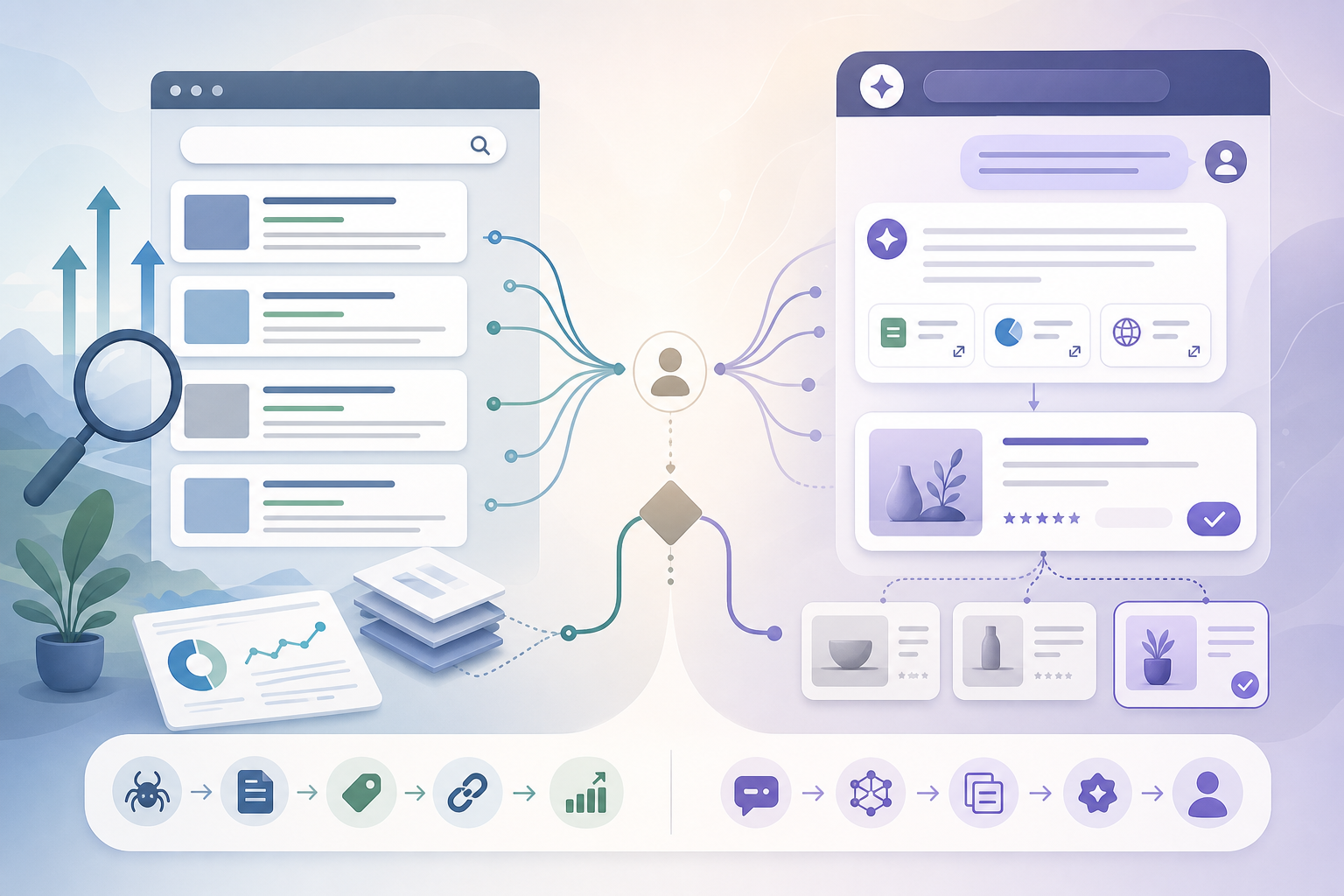
AI search vs SEO is not a choice between old and new search. SEO helps pages rank and earn clicks; AI search optimization helps brands get included, cited, accurately described, and recommended inside generated answers from systems such as ChatGPT, Gemini, Perplexity, Claude, Copilot, Grok, Google AI Mode, and AI Overviews.
The user searching "AI search vs SEO" usually wants four answers:
- Is traditional SEO still worth doing?
- What changes when buyers ask an AI engine instead of Google?
- How should content, technical SEO, PR, and product marketing adapt?
- How do you measure visibility when there is no normal search results page?
The short answer: SEO remains the foundation, but AI search changes the unit of competition from a ranking URL to a trusted brand answer. You still need crawlable, helpful, well-structured pages. But you also need prompt-level monitoring, citation analysis, third-party corroboration, entity clarity, and answer quality checks.
AI Search vs SEO: The 60-Second Definition
AI search vs SEO compares two discovery systems: traditional SEO optimizes web pages to appear in ranked search results, while AI search optimization improves whether answer engines mention, cite, summarize, compare, and recommend a brand in generated responses. SEO competes for clicks; AI search competes for inclusion, trust, and recommendation.
In traditional SEO, the main unit is usually a URL. You optimize a page, track rankings, measure impressions, and earn traffic.
In AI search, the main unit is often a prompt. A buyer asks a question, the engine retrieves or recalls evidence, synthesizes an answer, and may produce a shortlist, comparison, recommendation, or cited summary.
| Buyer question | Traditional SEO outcome | AI search outcome |
|---|---|---|
| "Best AI search visibility tools for B2B SaaS" | Ranked pages, ads, review sites, snippets | A synthesized shortlist with descriptions, pros, cons, and citations |
| "Why is ChatGPT recommending my competitor?" | Blog posts, forums, support pages | A diagnostic answer naming likely causes and fixes |
| "MaxAEO vs Otterly.AI for AI brand tracking" | Vendor pages and comparison articles | A summarized comparison that may cite owned or third-party sources |
| "Which tool should I use for AI share of voice tracking?" | Search results with category pages | A direct recommendation, often with only a few brands named |
This is why AI search vs SEO is an operating-model question, not just a content-format question.
What Actually Changes When Buyers Ask AI Instead of Google?
The biggest change is that the buyer may never see ten ranked results. They may see one synthesized answer, three recommended vendors, and a few citations. That makes brand inclusion, evidence quality, and answer accuracy as important as page rank.
Traditional SEO asks:
- Which page ranks?
- For which keyword?
- In what position?
- How many impressions and clicks did it earn?
AI search asks:
- Was the brand mentioned?
- Was it recommended or only listed?
- Was it cited?
- Which source supported the answer?
- Was the description accurate?
- Which competitors appeared instead?
- Did the answer change across engines or reruns?
The practical difference:
| Dimension | Traditional SEO | AI search optimization |
|---|---|---|
| Primary unit | Keyword and URL | Prompt and answer |
| Main outcome | Ranking and click | Inclusion, citation, recommendation |
| Competitive field | SERP positions | Shortlists, summaries, comparisons |
| Evidence used | Mostly indexed pages and links | Owned pages, third-party sources, entity data, reviews, docs, forums, citations |
| Measurement | Rank, impressions, clicks, CTR | Mention rate, recommendation rate, AI share of voice, citation share, sentiment, claim accuracy |
| Optimization owner | SEO and content | SEO, content, PR, product marketing, brand, customer marketing |
| Failure mode | Low ranking or low CTR | Silent exclusion, wrong positioning, outdated claims, competitor recommendation |
Google's own AI features guidance says foundational SEO best practices still apply to AI Overviews and AI Mode, and that there are no special technical requirements beyond being eligible for Google Search with snippets. It also says AI Overviews and AI Mode may use query fan-out, issuing multiple related searches across subtopics and sources to build a response: Google Search Central: AI features and your website.
So SEO is not dead. But SEO alone no longer describes the full discovery surface.
Ranking Is a Page Outcome; Recommendation Is a Brand Outcome
A ranking means one URL appeared in a list. A recommendation means the AI system selected your brand as a suitable answer to a buyer's problem. That shifts competition from page-level visibility to entity-level trust.
In classic SEO, a blog post can rank even if the broader brand story is inconsistent. In AI search, inconsistency is more expensive because the engine may summarize what your website, docs, review profiles, comparison pages, listicles, Reddit threads, analyst pages, and competitor content collectively imply.
For B2B SaaS and technology companies, there are four separate visibility states:
| State | What it means | Why it matters |
|---|---|---|
| Mentioned | Your brand appears in the answer | Basic awareness inside AI responses |
| Ranked | Your brand appears in a generated list or shortlist | Competitive ordering against alternatives |
| Cited | A source is used to support a claim | Evidence trail and possible referral traffic |
| Recommended | The answer says your brand is a good fit | Direct influence on vendor consideration |
A brand can be mentioned but not recommended. It can be recommended without its own website being cited. It can rank in Google but disappear from AI shortlists. Those are different problems, and they require different fixes.
A useful AI visibility report should therefore track prompt, engine, brand inclusion, position, citation source, sentiment, claim accuracy, and recommendation context together. A single ranking number is no longer enough.
How AI Answers Are Built Differently From Search Results
Traditional search retrieves and ranks documents. AI search retrieves, summarizes, reasons over, and formats information into an answer. The cited page may not be the highest-ranking page, and the source that influenced the answer may not always appear as the visible citation.
Recent research supports this distinction.
A 2026 empirical study comparing Google Search, AI Overviews, and Gemini across 11,500 user queries found that AI Overviews appeared for 51.5% of representative real-user queries in the dataset. It also found that retrieved sources differed substantially between systems, with less than 0.2 average Jaccard similarity: How Generative AI Disrupts Search.
Another 2026 measurement study of 55,393 trending queries found AI Overview activation at 13.7% overall, rising to 64.7% for question-form queries. It also found that nearly 30% of AI Overview-cited domains did not appear in co-displayed first-page results, indicating a source selection mechanism distinct from standard ranking: Measuring Google AI Overviews.
For marketers, the implications are concrete:
- A page can rank and still not be used in the AI answer.
- A third-party source can shape your brand description more than your own homepage.
- A brand can be recommended without receiving the click.
- Small prompt changes can change competitors, citations, and recommendations.
- AI visibility must be measured across engines, not inferred from Google rankings alone.
That is the central operational difference in AI search vs SEO.
The MaxAEO AI Visibility Matrix
To diagnose AI search performance, separate visibility into eight fields: prompt, engine, inclusion, position, recommendation, citation, sentiment, and claim accuracy. This matrix turns vague AI-search screenshots into a repeatable measurement system.
| Field | What to record | Example |
|---|---|---|
| Prompt | The exact buyer question | "Best AI search visibility tools for B2B SaaS" |
| Engine | Where the answer appeared | ChatGPT, Perplexity, Gemini, AI Overviews |
| Inclusion | Whether your brand appeared | Yes / No |
| Position | Where it appeared in the answer | 1st, 2nd, 3rd, not listed |
| Recommendation | Whether the engine endorsed it for the use case | Recommended / mentioned only |
| Citation | Which source supported the claim | Owned page, review site, analyst page, competitor page |
| Sentiment | How the brand was framed | Positive, neutral, negative, outdated |
| Claim accuracy | Whether facts were correct | Accurate, partly wrong, wrong |
Here is what this looks like in practice:
| Prompt | Engine | Included? | Position | Citation | Recommendation reason | Accuracy |
|---|---|---|---|---|---|---|
| "Best AI search monitoring tools for agencies" | ChatGPT | Yes | 3 | Category article | Strong multi-client reporting | Accurate |
| "Tools to track brand mentions in ChatGPT" | Perplexity | Yes | 2 | Third-party list | Good AI visibility tracking | Accurate |
| "Best answer engine optimization tools for SaaS" | Gemini | No | N/A | Competitor blog | N/A | Missed category fit |
| "MaxAEO vs Semrush AI visibility toolkit" | ChatGPT | Yes | 2 | Comparison page | More AEO-native tracking | Needs citation review |
This gives the team an actual work queue. If inclusion is low, the problem may be category visibility. If inclusion is high but recommendation is low, the problem may be proof or positioning. If citations are weak, the problem may be evidence quality. If accuracy is poor, the problem may be stale product information across owned and third-party sources.
For citation-specific diagnosis, see AI Search Citations: Definition, Tracking, and How to Earn Them.
Prompt Sets Are Replacing Keyword Lists
A keyword list captures what people type into search. A prompt set captures how buyers ask for judgment, comparison, and recommendation. AI search queries are longer, more contextual, and closer to a sales conversation.
A keyword list might include:
- "customer onboarding software"
- "best onboarding tools"
- "user onboarding platform"
A useful prompt set includes decision language:
- "What are the best customer onboarding platforms for a Series B SaaS company?"
- "Compare Appcues, Userflow, and Chameleon for product-led onboarding."
- "Which onboarding tool is easiest for a non-technical growth team?"
- "What should I use instead of Pendo for in-app onboarding?"
- "Recommend three onboarding tools that integrate with HubSpot and Segment."
Build prompts by buyer stage:
| Stage | Prompt type | Visibility question |
|---|---|---|
| Problem aware | "How do I improve activation?" | Does AI name the category and use cases you serve? |
| Category aware | "Best tools for customer onboarding" | Are you included in shortlists? |
| Comparison | "X vs Y" or "X vs Y vs Z" | Are tradeoffs accurate? |
| Alternative | "Alternatives to [competitor]" | Do you appear when buyers leave a rival? |
| Objection | "Is [brand] expensive?" | Does sentiment match current reality? |
| Purchase-ready | "Recommend a tool for [ICP/use case]" | Are you recommended for the right customer profile? |
A strong prompt set should vary:
- Company size: startup, mid-market, enterprise.
- Role: founder, VP marketing, RevOps, SEO lead, agency owner.
- Geography: US, UK, EU, global.
- Stack: Salesforce, HubSpot, Snowflake, Segment, Shopify.
- Use case: migration, compliance, reporting, automation, benchmarking.
- Competitor context: "best," "alternative," "compare," "replace," "cheaper than."
The mistake is tracking one or two prompts and calling it AI search monitoring. A useful benchmark needs enough prompts to reflect how real buyers ask questions.
What Still Works From SEO?
The fundamentals still matter: crawlability, indexability, helpful content, clear titles, internal links, structured data that matches visible content, and strong topical coverage. AI search did not make weak websites easier to trust.
Google's helpful content guidance emphasizes original information, complete descriptions, insightful analysis, clear sourcing, and value beyond what is already available in search results: Google Search Central: creating helpful content.
For AI search, classic SEO work creates the base layer of machine-readable trust:
- Crawlable pages give search and AI systems usable source material.
- Clear titles and H1s help systems identify the page topic.
- Descriptive headings create extractable answer blocks.
- Internal links explain entity relationships across your site.
- Schema that matches visible content confirms facts without contradicting the page.
- Updated product and pricing pages reduce stale summaries.
- Comparison pages help engines answer "X vs Y" prompts.
- Original data and examples give systems something worth citing.
The difference is that SEO hygiene is now the floor. AI search also needs off-site corroboration, prompt monitoring, and answer-level QA.
What Changes in Content Strategy?
Content strategy shifts from "rank this page for this keyword" to "make this claim easy to verify across answer engines." The best AI-search content is specific, current, sourced, and written in self-contained sections that can be extracted without losing context.
A strong AI-search content program includes more than blog posts:
| Asset | SEO role | AI search role |
|---|---|---|
| Category guide | Rank for informational demand | Define the market and vocabulary |
| Comparison page | Capture alternative and competitor queries | Help AI answer "X vs Y" accurately |
| Use-case page | Convert ICP traffic | Prove where the product is a strong fit |
| Data report | Earn links and PR | Provide citable evidence |
| Customer story | Demonstrate experience | Support recommendation reasons |
| Integration page | Capture long-tail searches | Match stack-specific prompts |
| Glossary definition | Win snippets | Supply concise definitions for answer engines |
| Methodology page | Build trust | Show how claims, rankings, or benchmarks were produced |
Every strategic page should answer five questions clearly:
- Who is this for?
- What problem does it solve?
- When is it a strong fit?
- When is it not the best fit?
- What evidence supports the claim?
That last question is where many pages fail. AI search engines need corroboration. If a page says "best for enterprise teams" but offers no customer examples, integration proof, security details, implementation process, or third-party support, the claim is easy to ignore.
For broader discovery tactics, see How to Get Discovered in AI Search: A Guide to AI Search Visibility.
Worked Example: When AI Recommends a Competitor
When AI recommends a competitor instead of you, the issue is rarely one missing blog post. It is usually a signal imbalance: clearer competitor positioning, stronger third-party validation, better comparison coverage, fresher citations, or more consistent entity data.
Example diagnosis:
| Prompt | AI answer pattern | Likely cause | First fix |
|---|---|---|---|
| "Best AI search visibility tools for agencies" | Competitor appears first; your brand absent | Competitor has agency-specific pages and mentions | Publish agency use-case proof and earn relevant third-party mentions |
| "Tools to track brand mentions in ChatGPT" | Your brand appears but sounds generic | Entity description is weak or inconsistent | Standardize product description across site, profiles, PR, and schema |
| "MaxAEO vs Otterly.AI" | Both appear; citations favor third-party pages | Comparison evidence is thin or outdated | Build factual comparison content and refresh external profiles |
| "How do I measure AI share of voice?" | Answer cites generic SEO blogs | Educational content is not distinctive enough | Publish definitions, formulas, examples, and templates |
| "Recommend an AI visibility platform for B2B SaaS" | Competitor recommended for your ICP | Competitor proof is easier to verify | Add ICP-specific cases, screenshots, reporting examples, and customer language |
The fix is not to repeat "get recommended by ChatGPT" across every page. The fix is to make the brand easier to select with evidence.
A practical repair sequence:
- Capture the answer, prompt, engine, citations, and competing brands.
- Identify the exact recommendation reason the competitor earned.
- Check whether your owned pages prove the same or better claim.
- Check whether third-party sources corroborate your claim.
- Update the highest-impact owned pages first.
- Refresh external profiles, partner pages, review descriptions, and category listings.
- Rerun the same prompt set over time, not once.
For a deeper playbook, read What to Do When AI Recommends Your Competitor Instead of You.
What Changes in Measurement?
SEO measurement asks, "Did we rank and get traffic?" AI search measurement asks, "Were we included, cited, described correctly, and recommended for prompts that influence buying?" That requires a different dashboard.
Weekly AI visibility reporting should include:
| Metric | Definition | Why it matters |
|---|---|---|
| Brand inclusion rate | Share of tracked prompts where your brand appears | Measures baseline AI visibility |
| Recommendation rate | Share of prompts where AI recommends your brand | Measures buying influence |
| AI share of voice | Your mentions divided by total competitor mentions | Shows category presence |
| Average AI rank | Average position inside generated lists | Tracks competitive ordering |
| Citation share | Share of citations pointing to owned or favorable sources | Measures evidence control |
| Source quality | Credibility and freshness of cited sources | Explains trust and citation gaps |
| Sentiment | Positive, neutral, negative, or outdated framing | Supports AI reputation management |
| Claim accuracy | Whether product facts are correct | Prevents mispositioning |
| Prompt volatility | How often answers change across reruns | Shows reliability of conclusions |
A standard SEO rank tracker cannot capture this because AI answers vary by engine, prompt wording, location, session context, and model behavior. You need LLM brand tracking across multiple systems.
A simple scoring model:
| Score | Meaning | Action |
|---|---|---|
| 0 | Brand absent | Build category evidence and off-site corroboration |
| 1 | Mentioned but not described | Improve entity clarity and product descriptions |
| 2 | Described but not recommended | Strengthen proof, use cases, and comparison content |
| 3 | Recommended but weakly cited | Improve owned evidence and citation-worthy pages |
| 4 | Recommended, cited, and accurate | Defend position and monitor volatility |
The goal is not to turn AI search into a perfect rank tracker. The goal is to identify repeatable visibility gaps that marketing teams can fix.
What Changes in Competitor Analysis?
Competitor analysis moves from page rankings to answer ownership. You are no longer asking only "Who ranks above us?" You are asking "Who does AI trust enough to recommend, for which prompts, and why?"
An AI search competitor analysis should inspect:
- Which competitors appear most often in category prompts.
- Which competitors appear in "best for" recommendations.
- Which competitors appear in alternative and replacement prompts.
- Which third-party sources support those recommendations.
- Whether AI descriptions match each competitor's current positioning.
- Which claims are repeated across engines.
- Which prompts trigger your absence.
- Which prompts trigger inaccurate or outdated descriptions.
- Which citations are controlled by competitors, neutral publishers, review sites, or your own domain.
This matters because AI answers compress the market. A Google results page may show ten organic listings, ads, videos, People Also Ask, and review sites. A ChatGPT-style answer may name only three vendors. If your brand is absent from that shortlist, the buyer may never know you were a credible option.
The MaxAEO guide to AI Search Competitor Analysis: How to Benchmark Brand Visibility Against Rivals explains how to benchmark rival visibility by prompt rather than relying on one anecdotal answer.
The AI Search Signal Ledger
A useful way to prioritize AI search work is to build a signal ledger: a table of the claims you want AI systems to repeat, the evidence that supports each claim, and the sources where that evidence appears.
Use this format:
| Claim you want AI to understand | Owned evidence | Third-party evidence | Current risk |
|---|---|---|---|
| "MaxAEO tracks brand visibility across AI answers" | Product page, feature page, screenshots | Tool lists, comparison articles | If third-party lists omit MaxAEO, competitors may be recommended first |
| "Best fit for B2B SaaS and tech marketing teams" | Use-case pages, customer examples | Reviews, partner mentions, case studies | If proof is generic, AI may describe the brand too broadly |
| "Tracks citations, mentions, competitors, and AI share of voice" | Feature documentation, methodology page | Category explainers, analyst mentions | If features are not clearly documented, answers may be incomplete |
| "AEO-native rather than a traditional rank tracker" | Positioning page, comparison pages | Independent comparisons | If distinction is unclear, AI may group the product with generic SEO suites |
This ledger prevents random content production. If a claim matters commercially, it needs visible evidence. If a claim has no evidence, it should not be the center of your AI search strategy yet.
How to Prioritize Fixes When You Find AI Visibility Gaps
Prioritize AI search fixes by buyer impact, answer frequency, and controllability. A wrong answer on a high-intent comparison prompt is more urgent than a missing mention on a broad educational prompt.
| Priority | Gap type | Example | First fix |
|---|---|---|---|
| P1 | Inaccurate brand fact | AI says you lack an integration you support | Update product pages, docs, schema, and third-party profiles |
| P1 | Competitor recommended for your core ICP | AI names a rival for your strongest use case | Build use-case proof and third-party validation |
| P1 | Negative or outdated positioning | AI repeats old pricing or old market category | Refresh owned pages and external descriptions |
| P2 | Missing from category shortlist | AI lists five tools and omits you | Improve category, comparison, and external mentions |
| P2 | Poor citation quality | AI cites outdated or unfavorable pages | Publish better evidence and earn better citations |
| P3 | Weak description | AI mentions you with generic wording | Standardize messaging across owned and earned sources |
| P3 | Low-value prompt absence | AI omits you from broad research prompts | Add educational content only if it supports real demand |
Use the same prompt set before and after fixes. Do not declare success from one favorable answer. AI search results can vary, so trendlines matter more than screenshots.
What a Good AI Search Answer Looks Like
A strong AI search answer includes your brand for the right use case, describes it accurately, cites reliable evidence, and explains why it belongs in the recommendation set. Anything less needs diagnosis.
| Answer component | Good outcome |
|---|---|
| Inclusion | Brand appears for relevant ICP prompts |
| Position | Brand appears near the top when fit is strong |
| Description | Product category, audience, and differentiators are current |
| Recommendation reason | AI explains the use case clearly |
| Citation | Owned documentation or credible third-party source supports the claim |
| Comparison | Tradeoffs are fair and specific |
| Sentiment | Positive or neutral, not vague or outdated |
| Accuracy | Pricing, features, integrations, and positioning are correct |
A weak answer might mention the brand but describe it as a generic "marketing tool." That is not a win if the product is an AI search visibility platform. A weak answer might cite a competitor's blog post as the main source for category guidance. That is risky if the buyer asked for neutral recommendations.
In AI search vs SEO, visibility is not just being seen. It is being understood correctly.
Where AI Search Creates New Risk
The main risk is not lower traffic alone. It is losing control of how your market is summarized. AI systems can compress outdated, incomplete, or third-party information into an authoritative-sounding answer.
Common risks include:
- Silent exclusion: competitors appear in shortlists while your brand is absent.
- Wrong fit: AI recommends you for the wrong segment, creating poor-fit leads.
- Outdated claims: old pricing, missing integrations, or old positioning persists.
- Negative framing: limitations are repeated without current context.
- Citation drift: AI cites pages you do not control or pages that no longer reflect the product.
- Competitor-defined categories: rival content becomes the source that explains your market.
- No-click consideration loss: buyers form a shortlist before visiting any website.
This is where AI reputation management becomes part of search strategy. Brand, communications, PR, and product marketing teams need to know how answer engines describe the company, not just how journalists or analysts describe it.
The goal is not to manipulate models. The goal is to make accurate, current, well-supported information easier to retrieve and verify.
Recommended 30-Day Plan
The fastest way to start is to build a baseline, not a content calendar. Before publishing new assets, learn where AI already mentions, omits, misranks, or misdescribes the brand.
- Days 1-3: Define the market map. List categories, competitors, alternatives, use cases, integrations, buyer roles, and objections.
- Days 4-7: Build 50-100 prompts. Include category, comparison, recommendation, alternative, integration, and objection prompts.
- Days 8-10: Run a multi-engine baseline. Track ChatGPT, Perplexity, Gemini, Claude, Copilot, Grok, Google AI Mode, and AI Overviews where relevant.
- Days 11-15: Score answer outcomes. Record inclusion, position, recommendation, citations, sentiment, and accuracy.
- Days 16-18: Identify the top five gaps. Separate missing visibility, inaccurate facts, weak citations, competitor displacement, and poor sentiment.
- Days 19-25: Ship fixes. Update high-impact pages, create missing comparison content, refresh third-party profiles, improve internal links, and strengthen proof.
- Days 26-30: Rerun the same prompts. Compare before and after results, then decide which fixes deserve deeper investment.
This workflow prevents random acts of GEO. It gives marketing leaders defensible evidence: where the brand was absent, what changed, and whether answer engines responded.
If you are selecting tools for this workflow, compare monitoring coverage, prompt management, citation tracking, competitor benchmarking, and reporting depth. The MaxAEO roundup of the best AI search and LLM monitoring tools is a useful starting point.
Common Mistakes to Avoid
The biggest mistake is treating AI optimization as keyword stuffing with new acronyms. Search systems and answer engines both reward clarity, evidence, and usefulness more than repeated phrases.
Avoid these traps:
- Tracking one prompt and calling it a benchmark.
- Optimizing only for ChatGPT while ignoring other AI search surfaces.
- Measuring mentions without checking sentiment or accuracy.
- Assuming a Google rank guarantees an AI citation.
- Publishing comparison pages without fair tradeoffs.
- Treating schema or llms.txt as a substitute for useful content.
- Ignoring third-party sources that AI uses to describe your brand.
- Reporting screenshots without trend data.
- Creating generic "AI SEO" pages with no original examples, methodology, or proof.
- Trying to force recommendations for use cases where the product is not a strong fit.
Google's AI features guidance is clear that special AI-specific markup is not required for AI Overviews or AI Mode, and that structured data should match visible page content. Durable AI search strategy therefore looks a lot like durable brand strategy: clear claims, strong evidence, current information, and trusted corroboration.
Frequently Asked Questions
Is AI search replacing SEO?
AI search is not replacing SEO; it is expanding the surface area of organic visibility. SEO still helps pages get crawled, indexed, ranked, and discovered. AI search adds another layer: whether answer engines include, cite, describe, compare, and recommend the brand.
The practical move is to keep SEO fundamentals and add AI search monitoring. If your site is technically weak, thin, or unclear, AI systems have less reliable evidence to use.
What is the difference between AI search and SEO?
SEO optimizes web pages for ranked search results. AI search optimization improves whether a brand appears in generated answers, citations, shortlists, and recommendations. SEO focuses on keywords, URLs, rankings, and clicks. AI search focuses on prompts, entities, citations, answer accuracy, recommendation frequency, and competitive visibility.
The two disciplines overlap, but they are not identical. Strong SEO gives AI systems better source material; AI visibility work checks whether that source material is actually shaping answers.
What is the difference between GEO and AEO?
Generative engine optimization focuses on visibility in generated AI responses, while answer engine optimization focuses on being directly answerable in answer-based interfaces. In practice, B2B teams often use both terms for the same operating goal: becoming clear, citable, and recommendable.
The label matters less than the workflow. Track prompts, inspect answer quality, close evidence gaps, and measure change over time.
Can a page rank in Google but fail to appear in AI answers?
Yes. A page can rank well in Google and still be absent from AI answers because ranking and AI source selection are not identical. Research on AI Overviews has found that cited domains may not appear in co-displayed first-page results, and different AI systems can retrieve different sources.
That is why SEO rank tracking and AI search monitoring should run side by side.
How do I get recommended by ChatGPT?
To get recommended by ChatGPT, make your brand easy to understand, verify, and compare for specific buyer prompts. That means clear positioning, strong use-case pages, accurate third-party profiles, comparison content, customer proof, current documentation, and consistent mentions across trusted sources.
You also need measurement. Track brand mentions in ChatGPT across a stable prompt set, then fix the gaps that show up repeatedly.
Do AI citations matter if buyers do not click?
Yes. AI citations matter because they reveal which sources the engine trusts enough to support an answer. Even when the buyer does not click, citations show whether your owned pages, neutral third-party sources, review profiles, or competitor content are shaping the narrative.
Citations are not the only metric, but they are one of the fastest ways to diagnose why an answer includes, excludes, or misdescribes a brand.
Should I create separate content for AI search?
Create separate content only when it serves a real buyer question better than an existing page. Do not publish thin "AI answer" pages. Instead, improve strategic pages so they include concise definitions, clear use cases, comparison details, evidence, FAQs, and current product facts.
The best AI-search content is also good human content: specific, sourced, scannable, and useful without algorithmic tricks.
What should marketing leaders report to executives?
Report AI visibility as a competitive metric, not a novelty metric. Show AI share of voice, recommendation rate, prompts won and lost, competitor displacement, citation sources, inaccurate claims fixed, and trend changes after content or PR work.
Executives do not need every screenshot. They need to know whether AI systems are recommending the company when buyers ask who to consider.
Final Takeaway
AI search vs SEO comes down to a change in the buyer interface. Google trained marketers to compete for ranked clicks. ChatGPT-style answer engines force brands to compete for inclusion, citation, accurate description, and recommendation.
The winning team will not abandon SEO. It will extend SEO into a broader AI visibility system: prompt tracking, citation analysis, competitor benchmarking, content fixes, PR corroboration, entity consistency, and weekly reporting.
For B2B SaaS and technology companies, the question is no longer only "Do we rank?" It is also: When buyers ask AI who to consider, are we named, trusted, and recommended for the right reasons?