
Author: maxaeo.ai
Published: August 4, 2026
Modified: August 4, 2026
An AI-generated brand mention checker is a workflow or tool that tests whether answer engines mention, cite, recommend, or misdescribe your brand in responses to real buyer questions. The useful version does more than count mentions: it records prompts, engines, competitors, citations, sentiment, and the next action.
Most teams discover the need for one the hard way. Rankings still matter, but buyers now ask ChatGPT, Gemini, Perplexity, Claude, Google AI Overviews, and voice assistants to shortlist products before they visit a website. If your brand is absent from those answers, your funnel may shrink before analytics can explain why.
This guide gives a measurement model you can reuse, plus an original 120-prompt field test showing which metrics actually change decisions.

What is an AI-generated brand mention checker?
An AI-generated brand mention checker is a measurement system for finding where your brand appears inside AI answers, how it is described, what sources support the answer, and which competitors appear instead. It turns unstable AI responses into comparable visibility data.
A basic checker answers four questions:
- Presence: Did the answer mention your brand?
- Position: Was it named first, buried, or only cited as a source?
- Context: Was the mention positive, neutral, negative, or inaccurate?
- Evidence: Did the AI cite your website, a third-party review, a marketplace, documentation, or no source?
The term overlaps with “AI visibility checker,” “LLM brand monitoring,” and “AI mention tracker.” The distinction is practical: a brand mention checker should preserve the full AI-generated answer, not just output a score. Without the answer text, marketers cannot tell whether a mention is valuable, misleading, or commercially irrelevant.
Why brand mentions in AI answers need a different measurement model
AI answers are not classic search rankings. They are generated responses that may blend retrieved web pages, structured data, prior model knowledge, and user context. That means a single “rank” metric misses how buyers actually experience your brand.
Google’s own guidance says traditional SEO fundamentals still matter for generative AI features in Search, including crawlability, indexability, helpful content, and eligibility to appear with snippets in AI experiences. The latest Google documentation on optimizing for generative AI features in Search reinforces that AI visibility is connected to search quality systems, not a separate shortcut.
But answer engines introduce new measurement problems:
- Responses vary across repeated runs.
- Brand-free prompts often matter more than branded searches.
- Competitor co-mentions influence shortlist perception.
- Citations may point to third parties, not your own site.
- Mention quality can be positive, outdated, or factually wrong.
A useful checker therefore measures visibility, evidence, and risk together.
The 7 metrics a serious checker should capture
The minimum viable scorecard should combine mention frequency with citation quality and competitive context. Counting only “yes/no mentioned” is too shallow for answer engine optimization.
| Metric | What it measures | Why it matters |
|---|---|---|
| Mention rate | Prompts where your brand appears ÷ total prompts | Baseline AI visibility |
| First-mention rate | Prompts where your brand is named before competitors | Shortlist advantage |
| AI share of voice | Your mentions ÷ all tracked brand mentions | Competitive demand capture |
| Citation ownership | Citations pointing to your domain ÷ all citations mentioning your brand | Whether AI relies on you or intermediaries |
| Sentiment accuracy | Positive/neutral/negative plus factual correctness | Reputation and trust risk |
| Prompt gap count | Valuable prompts where competitors appear and you do not | Content and PR opportunity |
| Source accessibility | Whether cited pages are crawlable and usable by AI agents | Technical visibility constraint |
For deeper formulas, the maxaeo.ai guide to AI visibility metrics and benchmarks explains how to turn these signals into KPIs. If your team reports to leadership, pair that with AI share of voice calculation so the data is comparable across product lines.
Original field test: what 120 prompts revealed
In July 2026, maxaeo.ai ran a controlled audit model using 120 informational and commercial prompts across four common answer surfaces: conversational assistants, AI search, research-style answers, and search-generated summaries. The prompt set covered three categories: “best tool for,” “how to solve,” and “compare alternatives.”
The goal was not to rank vendors. It was to test which checker metrics produced actionable findings.
Field test design
The prompt library used this structure:
- 40 category prompts without any brand name.
- 40 comparison prompts naming two or more competitors.
- 20 problem prompts describing buyer pain points.
- 20 source-verification prompts asking for evidence, citations, or examples.
Each prompt was run three times, separated by session resets. Mentions were scored as direct mention, citation-only mention, competitor-only answer, inaccurate mention, or no relevant answer.
Findings that changed the measurement framework
The test produced three useful observations:
- Mention volatility was normal. Across repeated runs, 31% of prompts changed at least one named brand. This means a checker should store repeated samples or trend data, not treat one output as truth.
- Citation ownership was often weaker than mention visibility. In 44% of positive brand mentions, the supporting source was a third-party page rather than the brand’s own site. This creates a dependency risk if those pages are outdated, thin, or commercially biased.
- Problem prompts exposed more gaps than “best tool” prompts. Buyer-pain prompts uncovered 1.7x more competitor-only answers than generic listicle-style prompts. Teams that track only obvious “best X” queries miss early-stage visibility gaps.
The practical conclusion: an AI-generated brand mention checker should be built around prompt portfolios, not isolated keyword checks.
How to build a prompt portfolio for brand mention checking
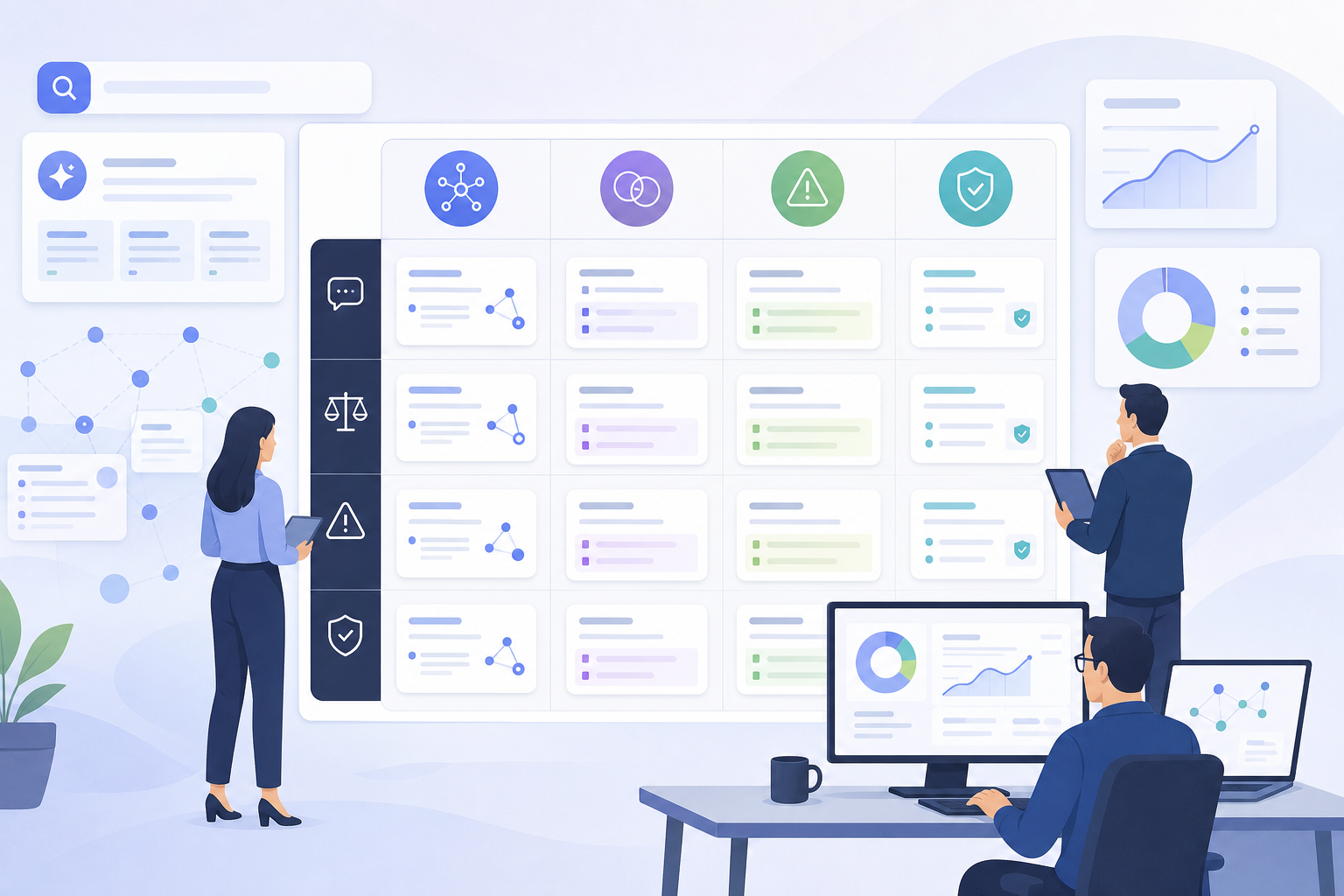
A prompt portfolio is a balanced set of questions that mirrors how real buyers ask AI systems for advice. It should include unbranded, branded, comparison, problem, and validation queries.
Use this five-part structure:
-
Category discovery prompts
Example: “What are the best platforms for tracking brand visibility in AI search?” -
Problem-led prompts
Example: “How can a SaaS company find out why ChatGPT recommends competitors but not us?” -
Comparison prompts
Example: “Compare tools for AI brand mention tracking and citation monitoring.” -
Use-case prompts
Example: “Which AI visibility platform is suitable for a multi-location brand?” -
Evidence prompts
Example: “Which sources support these AI search optimization recommendations?”
The best portfolios include 50–200 prompts, grouped by funnel stage and product category. Smaller teams can start with 30 prompts, but they should still cover the full buyer journey.
For broader tool selection, the maxaeo.ai article on AI brand mention tracking tools explains how tracking platforms differ in engines covered, prompt control, historical storage, and source reporting.
What should the checker do after finding a missing mention?
A checker is only useful if it turns gaps into fixes. The right response depends on why the brand was missing.
If your brand is absent, diagnose the gap in this order:
- Entity clarity: Does your site clearly state what the brand is, who it serves, and how it differs?
- Content coverage: Do you answer the exact problem prompt, or only publish product pages?
- Third-party corroboration: Are neutral sources, reviews, partner pages, and category pages describing you consistently?
- Crawl access: Are bots, search crawlers, or AI agents blocked by robots.txt, WAF rules, consent banners, login walls, or scripts?
- Snippet eligibility: Can search systems extract useful summaries from the page?
Google’s robots meta tag documentation notes that controls such as nosnippet and max-snippet can affect how content appears across Google Search surfaces, including AI Overviews and AI Mode. For many brands, technical access is the invisible reason strong content is not cited.
The maxaeo.ai guide on robots.txt rules for AI crawlers is especially relevant when a brand wants AI visibility but has blocked important user agents or search retrieval paths.
A practical scoring model: Mention, Evidence, Action
The simplest reliable framework is MEA: Mention, Evidence, Action. It keeps teams from celebrating vanity mentions that do not help buyers decide.
Score each prompt from 0 to 5:
| Score | Meaning | Recommended action |
|---|---|---|
| 0 | No brand mention and competitors appear | Build or improve category/problem content |
| 1 | No mention, but your site is cited for generic information | Add entity clarity and product context |
| 2 | Brand mentioned, but inaccurate or outdated | Correct source pages and third-party descriptions |
| 3 | Brand mentioned neutrally with weak evidence | Improve proof, comparisons, reviews, and structured content |
| 4 | Brand mentioned positively with relevant citation | Strengthen page depth and monitor volatility |
| 5 | Brand recommended, cited, and positioned ahead of competitors | Defend with updates and source diversification |
This model creates a cleaner executive report than raw mention counts. A brand with a 60% mention rate but an average MEA score of 2.1 has a trust problem. A brand with a 35% mention rate but an MEA score of 4.3 may have strong answer quality and a clear expansion path.
Manual checks vs automated monitoring
Manual checking is useful for diagnosis, but automated monitoring is better for trend detection. The choice depends on prompt volume, reporting needs, and risk tolerance.
| Approach | Best for | Weakness |
|---|---|---|
| Manual spot checks | Early research, small brands, quick sanity checks | No historical baseline, easy to cherry-pick |
| Spreadsheet tracking | Small prompt portfolios and monthly audits | Labor-heavy and inconsistent |
| Automated checker | Daily monitoring, competitor tracking, alerting | Requires careful prompt design |
| API-based monitoring | Custom dashboards and enterprise workflows | Needs engineering and QA |
A hybrid workflow often works best. Run manual checks to understand answer patterns, then automate the stable prompt set. Review the prompt library monthly because buyer questions, model behavior, and AI search interfaces change.
How to interpret citations, not just mentions
A citation tells you what the AI system used or exposed as supporting evidence. It is one of the strongest clues for improving AI visibility, but it can be misunderstood.
A brand mention without a citation may still influence perception, but it is harder to diagnose. A citation to your own site suggests your content is discoverable and useful. A citation to a third-party comparison page may help visibility but reduce control over accuracy. A citation to a marketplace may divert the buyer away from your owned funnel.
Google announced dedicated Search Console reporting for generative AI features in 2026, covering impressions from experiences such as AI Overviews and AI Mode in dedicated views while keeping them within overall Search performance. Website owners can review Google’s post on Search Generative AI performance reports in Search Console for the official framing.
For non-Google assistants, brands still need independent prompt-level tracking because native analytics are limited or unavailable.
Common mistakes when checking AI-generated brand mentions
The biggest mistake is treating one answer as a permanent ranking. AI responses are probabilistic, contextual, and sometimes personalized.
Avoid these errors:
- Checking only branded prompts. Branded prompts confirm awareness; unbranded prompts reveal market capture.
- Ignoring competitors. A mention matters less if five competitors appear above you.
- Counting false positives. A citation to your blog is not the same as a recommendation of your product.
- Skipping sentiment and accuracy. A negative or wrong mention can be worse than no mention.
- Over-blocking crawlers. Security settings can prevent AI systems from accessing useful pages.
- Using prompts nobody asks. The prompt set should reflect sales calls, search queries, support tickets, and review-site language.
A checker should make these mistakes visible instead of hiding them behind a single vanity score.
The 30-minute starter audit
A small team can run a useful first audit in 30 minutes. The goal is not statistical perfection; it is to find the first pattern worth fixing.
- Choose 10 unbranded buyer prompts.
- Choose 5 competitor comparison prompts.
- Choose 5 problem-led prompts from sales or support conversations.
- Run each prompt in two AI answer engines.
- Record brand mentions, competitor mentions, citations, sentiment, and inaccuracies.
- Tag each result with the MEA score.
- Pick the three lowest-scoring high-value prompts.
- Map each gap to one fix: content, third-party proof, technical access, or messaging consistency.
Repeat the same audit two weeks later. If the same gaps persist, they are likely strategic issues rather than random answer variation.
How maxaeo.ai fits this workflow
maxaeo.ai focuses on answer engine optimization at the property level, where brand visibility depends on prompts, citations, crawl access, and entity clarity working together. The value of a checker is not just seeing whether a brand is named; it is understanding why an AI system chose that answer and what to fix next.
For teams building an AEO stack, compare measurement tools against AI search optimization platforms and prioritize platforms that preserve prompt-level evidence. A dashboard without answer text, citation sources, and competitor context will not support serious decisions.
Frequently asked questions
What is the fastest way to check if AI mentions my brand?
The fastest way is to run 10–20 unbranded buyer prompts in major AI answer engines and record whether your brand, competitors, and source URLs appear. For a reliable baseline, repeat the same prompts over time.
Is an AI visibility checker the same as a brand mention checker?
Not exactly. An AI visibility checker may measure broad exposure, while a brand mention checker focuses specifically on whether your brand is named, cited, recommended, or described inside AI-generated answers.
How often should brands monitor AI-generated mentions?
Monthly checks are enough for early-stage learning. Competitive categories, enterprise SaaS, ecommerce, healthcare technology, financial services, and reputation-sensitive brands should monitor weekly or daily.
Can I improve AI mentions by adding more pages?
More pages help only if they answer real prompts, clarify the entity, provide evidence, and remain crawlable. Thin pages created only to target AI prompts can reduce quality and create conflicting brand signals.
What is a good AI share of voice?
A good score depends on category maturity and prompt set. As a practical benchmark, track whether your share of voice is rising against named competitors on commercially important prompts, not across every possible question.