
AI search optimization tools help marketers see how ChatGPT, Perplexity, Gemini, Google AI Overviews, and other answer engines describe their brand, and then decide what to change. This guide compares 13 platforms by the engines they cover, what they publish about price, and whether they stop at monitoring or turn visibility data into specific optimization actions. If you are shortlisting dedicated AEO / GEO tools, our AEO / GEO tools comparison goes deeper on that category.
What AI search optimization tools connect visibility data with specific actions for marketers?
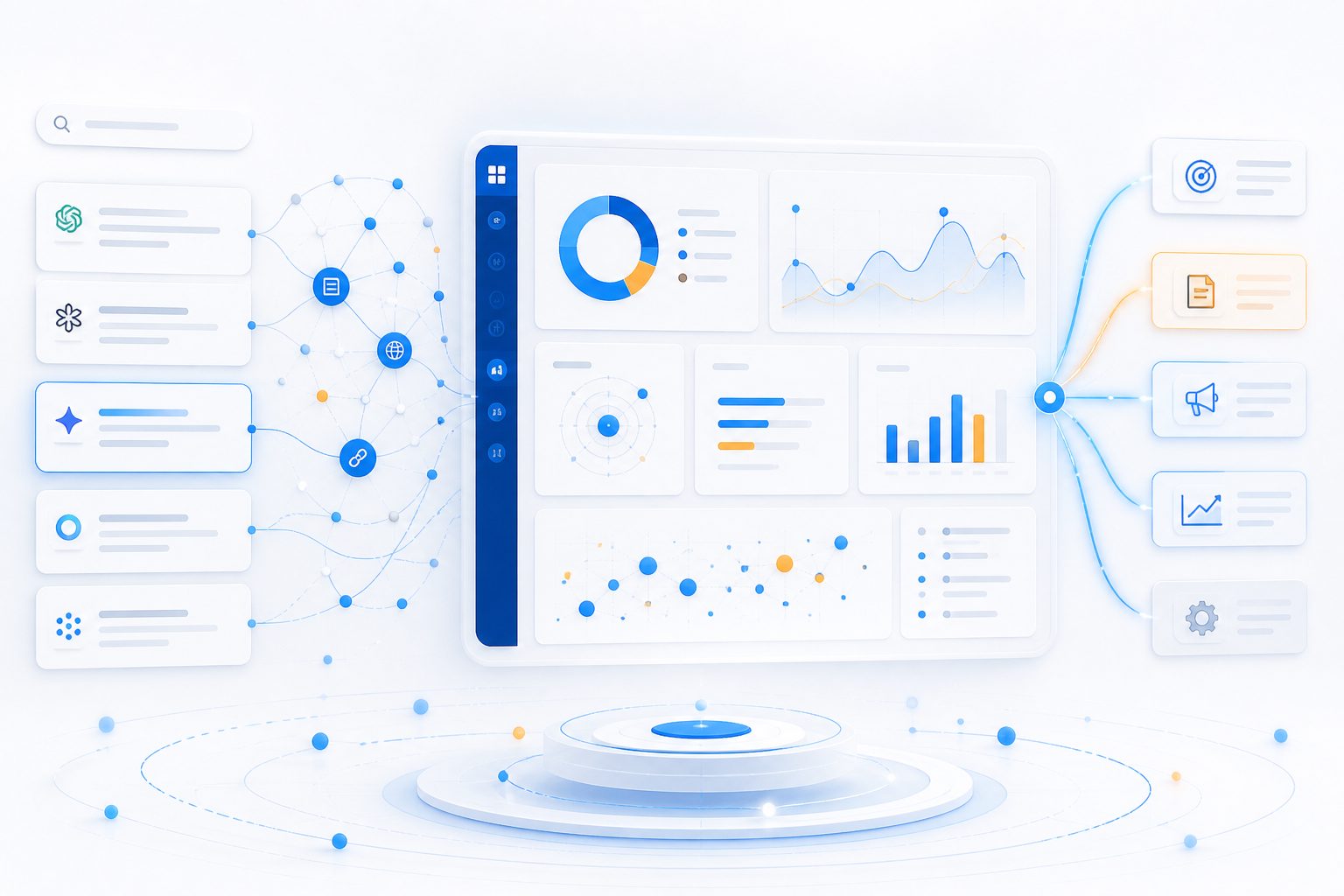
The best answer to what AI search optimization tools connect visibility data with specific actions for marketers? is simple: choose platforms that turn AI answer signals into a prioritized fix list. They should tell you whether an assistant only mentions your brand or actually recommends it, show the source behind the answer, and then track whether your changes move the next response. That is the difference between monitoring and optimization.
What makes a tool actionable instead of just observable?
An actionable tool does more than surface a score. It links visibility, diagnosis, and next steps in one workflow. For marketers, that usually means four things: it can separate mentions from recommendations, explain why the answer changed, suggest what to fix, and recheck the same prompt set over time.
Most dashboards stop at reporting. The useful ones end with a work order. That work order might be a content update, a source cleanup, a product-page rewrite, a schema change, or an outreach task. If a platform cannot connect the signal to a task, it is a reporting layer, not an optimization layer.
Why AI search visibility is different from SEO rankings
AI search visibility is less about one blue-link ranking and more about being selected, summarized, cited, and positioned correctly inside a generated response. A page can rank well in Google yet still be absent from ChatGPT, Perplexity, or Gemini recommendations.
Google’s guidance for generative AI features says site owners should still follow core Search best practices, create helpful content, and make content accessible to Google systems, according to its AI features optimization guide. That only covers one ecosystem. Other AI engines draw on a mix of web retrieval, training data, third-party sources, community discussions, and product pages. The 2026 survey "Optimizing Visibility in Generative Engines" describes AI visibility as a multi-stage pipeline involving retrieval, citation, prominence, factual absorption, and user behavior rather than a single ranking task.
For buyers, the implication is simple: SEO health is necessary but not sufficient. You need a measurement layer that sees what AI systems actually say, and a tool that turns what it sees into work.
AI search optimization tools vs. AI SEO tools
Search for "AI search optimization tools" and many of the results are lists of AI SEO tools. The two labels overlap, but they describe different jobs. AI SEO tools use AI to do SEO work faster: keyword research, content briefs, scoring drafts against top-ranking pages, writing, and technical audits. Some go further and act as agents that plan, write, and publish pages. AI search optimization tools, the subject of this guide, measure and improve how AI engines answer: whether ChatGPT, Gemini, Perplexity, or Google’s AI features mention your brand, which sources they cite, and what to change.
| Tool type | Main job | The question it answers |
|---|---|---|
| AI-assisted SEO and content tools | Speed up keyword research, briefs, writing, and on-page scoring | How do we rank and publish faster? |
| AI SEO agents | Run parts of the SEO workflow with less human input | Which SEO tasks can we automate? |
| AI search optimization tools | Track and improve mentions, citations, and recommendations in AI answers | What do AI engines say about us, and what should we fix? |
Many teams end up with one tool from the first group and one from the last. Most content tools cannot show what ChatGPT says about you, and most visibility tools stop short of writing the page, although a few platforms in the comparison table below do both. The phrase "AI SEO" carries both meanings; our explainer on what AI SEO is separates them, and our guide to AI SEO agents covers what agents handle well and where scaled content becomes a risk.
What to Check in an AI Search Optimization Tool Before You Buy
Platforms such as Semrush, Searchable, Yext Scout, and ReachLLM center their AI visibility products on dashboards, competitive benchmarking, and some form of recommendations or execution. When you evaluate any tool, look hardest at the handoff: what should you do when an AI assistant only mentions your brand versus actively recommends it?
Check these points in a demo or trial:
- Does it separate a mention from a recommendation?
- Can you inspect the source evidence behind each answer?
- Are the recommended actions specific, or generic?
- Can you see how results changed over time?
- Are language, market, and engine differences shown separately instead of flattened into one score?
That matters because AI search is not one channel. A brand can be cited in one engine, ignored in another, and recommended only for certain intents. A useful tool has to show that nuance before it suggests a fix.
Mention, citation, and recommendation are not the same signal
A strong AI visibility stack should separate at least three states: mentioned, cited, and recommended. A mention means the model names your brand. A citation means the model used your source. A recommendation means the model places your brand in the shortlist or presents it as the best fit.
That distinction changes the action. If you are mentioned but not recommended, the problem is often proof, positioning, or authority. If you are cited but not named, the problem is usually entity clarity or brand association. If you are neither cited nor mentioned, you may need to rebuild topical coverage, distribution, or source trust.
| Signal | What it means | What marketers should do |
|---|---|---|
| Mention only | Brand appears, but without preference | Strengthen proof, product framing, and source coverage |
| Citation without mention | Source is used, but brand is absent | Improve entity clarity and brand association |
| Recommendation | Brand appears in the shortlist or favored answer | Protect winning pages and expand adjacent queries |
| Negative mention | Brand is framed poorly or with risk | Repair reputation and address source claims |

Which features should a marketer prioritize first?
The best AI visibility analysis software is not the one with the biggest dashboard. It is the one with the cleanest action logic. Start with five features.
-
Multi-engine tracking
You need coverage across the engines that matter to your buyers, not just one model. -
Query-level evidence
A platform should show the exact prompt, the answer, and the source set behind it. -
Competitor comparison
You need to know whether the assistant prefers your brand, a competitor, or a category default. -
Action recommendations
The output should point to the next fix, not just to the problem. -
Trend tracking
If the platform cannot compare this week with last week, it cannot prove improvement.
For broader selection logic, see this AI search optimization platform framework and AEO performance tracking metrics and reporting model.
Which metrics should the tool report?
The core metrics are mention rate, recommendation position, citation coverage, sentiment, competitor share of voice, and factual accuracy. Together, they show whether AI engines know your brand, trust the right sources, and describe you accurately.
- Mention rate: how often your brand appears for monitored buyer prompts.
- Recommendation rate: how often it is suggested as an option, not merely named.
- Average recommendation position: whether the brand appears first, middle, or last in lists.
- Citation source mix: which review sites, blogs, documentation, Reddit threads, comparison pages, or official pages are used.
- Sentiment: whether descriptions are positive, neutral, negative, outdated, or inaccurate.
- Competitive gap prompts: prompts where competitors appear and your company does not.
- Factual accuracy: whether pricing, features, positioning, and use cases are correct.
The overlooked metric is source dependency. If one third-party article shapes several AI answers, that source becomes strategically important. A platform should expose that dependency instead of hiding it behind a single visibility score. For the workflow on lost prompts, see our AI search visibility gap analysis framework.
What tools should marketers actually consider?
When people ask what do people use to monitor how AI search engines recommend their products?, the answer is usually a combination of monitoring, benchmarking, and workflow tools. The market tends to fall into three buckets.
1) Visibility-first platforms
These are best when you need baselines and competitive share-of-voice. They tell you where you appear, how often you appear, and how often competitors show up instead.
This category includes tools that emphasize monitoring and benchmark reporting. For example, current pages from Semrush, Searchable, and Findable focus heavily on visibility, diagnostics, and progress over time.
Peec AI also sits closest to this bucket: it keeps the workflow deliberately focused on visibility, position, sentiment, and top citations, and is lighter on execution than the platforms below.
2) Recommendation-first platforms
These platforms go one step further and try to tell you what to change. They may prioritize content recommendations, source opportunities, or task lists based on the gaps they detect.
This is the right category when your team needs the tool to help answer a practical question: what should we do next? Some vendors also frame this as AI optimization, GEO, or AEO.
MaxAEO, AthenaHQ, and Otterly.AI fit here. MaxAEO pairs daily monitoring with optimization recommendations, AthenaHQ gives on-page and off-page content recommendations for AI citations, and Otterly.AI adds content audits and GEO recommendations on top of monitoring.
3) Closed-loop platforms
These are the most useful for marketers who need to connect AI visibility to business operations. They aim to connect the signal to analytics, CRM, campaign planning, or content execution.
That is where tools like Yext Scout, ReachLLM, and Amplitude AI Visibility position themselves: not just measurement, but a path to action.
Content-execution platforms belong here too. Writesonic’s Action Center rewrites pages and drafts outreach to earn citations, AirOps pairs an Insights layer with an Action layer that creates, refreshes, and publishes content, and Profound runs AEO content workflows with marketing agents and ties visibility to traffic through GA4.
AI search optimization tools compared: engines, actions, and price
The table below covers every platform named in this guide. Engine and price details come from each vendor’s public pages as summarized in the MaxAEO AI tools directory. A dash means the vendor does not publish that detail in a form we could verify, not that the capability is missing.
| Tool | AI engines covered | Monitoring only, or optimization actions? | Price |
|---|---|---|---|
| MaxAEO | 8: ChatGPT, Gemini, Perplexity, Claude, Copilot, Grok, Google AI Mode, Google AI Overviews | Monitoring plus optimization recommendations; does not publish content for you | See pricing |
| Profound | 9: ChatGPT, Perplexity, Claude, Gemini, Grok, Microsoft Copilot, Meta AI, DeepSeek, Google AI Overviews | Monitoring plus AEO content workflows and audits run by marketing agents | Starter $99/mo; Growth and Enterprise via sales |
| AthenaHQ | Up to 8 on Self-Serve: ChatGPT, Perplexity, Gemini, Google AI Overviews, Google AI Mode, Claude, Copilot, Grok | Monitoring plus on-page and off-page content recommendations | Self-Serve $295/mo ($245/mo billed annually); Enterprise custom |
| Otterly.AI | 6: ChatGPT, Gemini, Perplexity, Copilot, Google AI Overviews, Google AI Mode (4 on Lite) | Monitoring plus content audits and GEO recommendations | From $29/mo ($25/mo billed yearly) |
| Writesonic | Up to 10; Starter tracks ChatGPT only, all 10 on Enterprise | Monitoring plus content generation and an Action Center (Growth tier and up) | From $79/mo billed annually |
| AirOps | ChatGPT insights on the free tier; multi-engine insights on Pro | Monitoring plus an Action layer that creates, refreshes, and publishes content | Free Insights tier; paid plan prices not published |
| Peec AI | 3 models on self-serve plans; all models on Enterprise | Mainly monitoring: visibility, position, sentiment, and top citations | From $95/mo |
| Semrush AI Visibility Toolkit | ChatGPT, Google AI Mode, and other engines | Visibility-first: dashboards and competitive benchmarking | Add-on to Semrush SEO plans (Pro from $139.95/mo) |
| Searchable | — | Visibility-first | — |
| Findable | — | Visibility-first: visibility, diagnostics, progress over time | — |
| Yext Scout | — | Closed-loop: positioned as a path from measurement to action | — |
| ReachLLM | — | Closed-loop: positioned as a path from measurement to action | — |
| Amplitude AI Visibility | — | Closed-loop: positioned as a path from measurement to action | — |
Read the price column with the engine column. Several entry plans cover fewer engines than the headline number: Otterly.AI’s Lite plan tracks 4 engines, Writesonic’s Starter tracks ChatGPT only, and Peec AI’s self-serve plans include 3 models. Confirm the engines on the plan you would actually buy.
A practical selection framework for marketers
A simple way to choose is to ask four questions.
First, can the tool show whether the model only mentioned you or actually recommended you?
If not, it may be too blunt for decision-making.
Second, can it explain the source behind the answer?
If the tool cannot show citation sources or source gaps, it is hard to prioritize fixes.
Third, can it convert the signal into a task?
The best platforms can suggest a content update, a page rewrite, a source cleanup, or an outreach plan.
Fourth, can it verify the outcome later?
Optimization requires re-testing. Without repeat measurement, you are guessing.
A good rule: if a tool gives you a score but no next step, it is a dashboard. If it gives you a score, an explanation, and a follow-up action, it is an optimization system.
In a demo, a few follow-up questions separate the two quickly:
- Can it show the exact sentence where the brand was mentioned?
- Does it store original AI answers so you can audit them later?
- Does it identify the specific source URL or domain behind a citation?
- Does it update data often enough to catch trend shifts?
- Can non-technical marketers act on the recommendations without an analyst?
The Visibility Control Loop
The selection questions above map onto a six-step loop. If a tool cannot support every step, someone on your team will have to fill the gap by hand.
- Prompt discovery: convert SEO keywords, buyer questions, sales objections, and competitor comparisons into monitorable prompts.
- Answer capture: run those prompts regularly across multiple AI engines.
- Entity extraction: identify brands, products, sentiment, cited sources, and recommendation order.
- Gap diagnosis: compare your brand against competitors by prompt, engine, source type, and intent.
- Content and citation planning: create content briefs, comparison pages, documentation updates, and third-party source targets.
- Trend validation: re-run prompts daily or weekly to see whether visibility, sentiment, or citations changed.
Citation tracking without prompt discovery tells you which sources appeared, but not which buyer questions you are losing. Prompt tracking without competitor comparison tells you your visibility, but not whether the market is moving around you.
How to build a prompt set before choosing software
A platform is only as useful as the prompts it monitors. Build the prompt set first, then test every shortlisted tool against the same list.
| Intent type | Example prompt pattern | What it reveals |
|---|---|---|
| Category discovery | "Best tools for…" | Whether your brand is considered at all |
| Use-case fit | "Best platform for SaaS teams that need…" | Whether positioning matches buyer needs |
| Competitor comparison | "X vs Y for…" | Whether AI engines understand differentiation |
| Problem diagnosis | "How do I improve…" | Whether your content is cited as guidance |
| Risk evaluation | "Is X reliable for…" | Sentiment and trust signals |
| Implementation | "How to set up…" | Whether documentation is AI-readable |
For SaaS teams, pull prompts from sales calls, demo requests, paid search queries, support tickets, and competitor battlecards. Do not monitor only your brand name. Branded prompts show reputation; non-branded prompts show market opportunity.
Where MaxAEO fits in this workflow
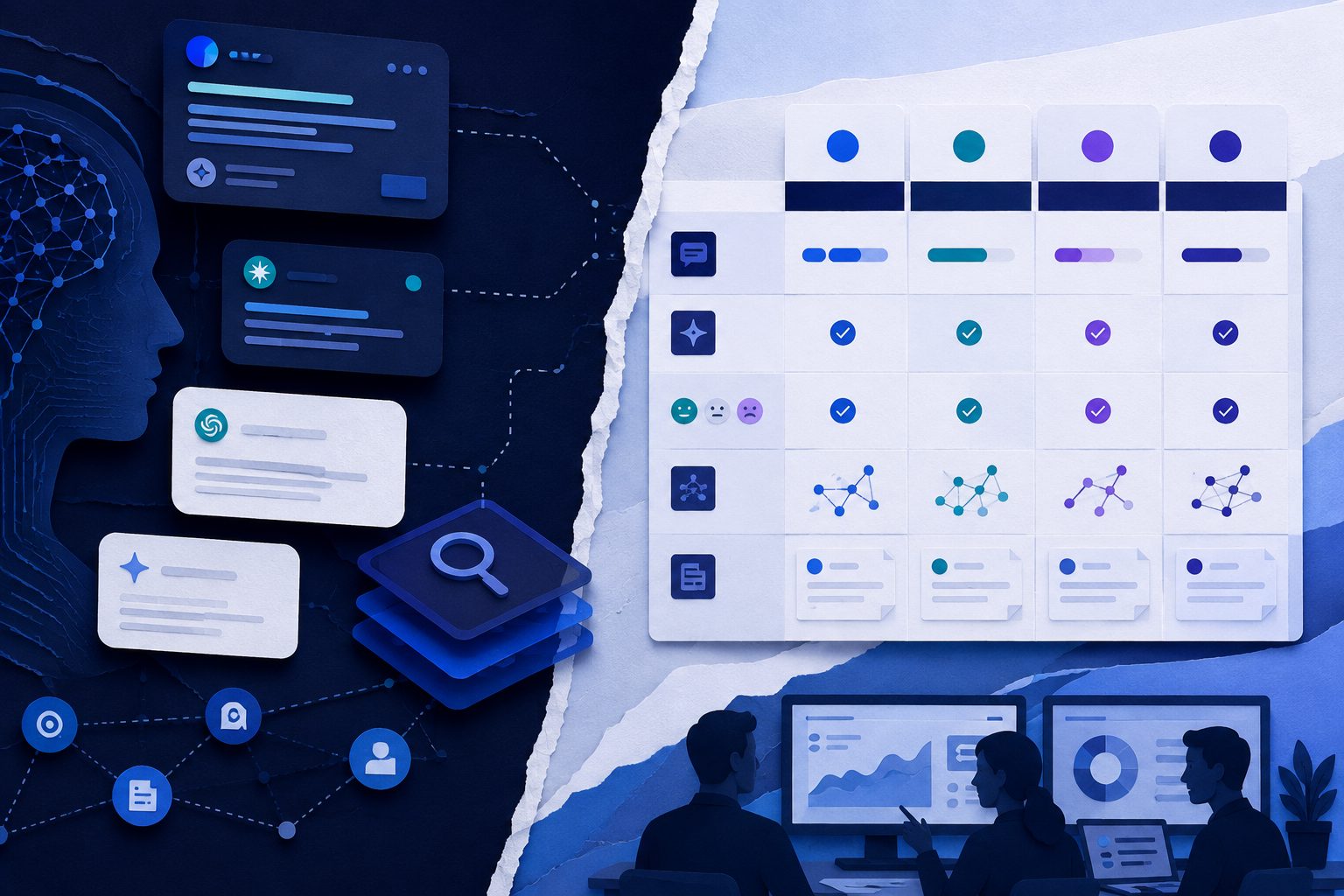
MaxAEO is built for teams that want visibility data and next steps in the same place. It monitors brand visibility across 8 AI engines (ChatGPT, Gemini, Perplexity, Claude, Copilot, Grok, Google AI Mode, and Google AI Overviews), updates data daily, and supports English and Chinese markets. It also offers a free AI visibility diagnostic report on the website.
For marketers who need a practical entry point, that combination matters. You can compare your brand with competitors, inspect mention rates, review cited sources, and compare sentiment without stitching together separate tools. If your job is to move from “we are visible” to “we know what to change,” that is the kind of workflow to look for.
Related reading: AI Share of Voice Tracking: A Practical Framework for Measuring Brand Visibility in AI Answers, AI Brand Reputation Monitoring: What to Track, What Tools Miss, and How to Respond, and How AI Retrieval Actually Works: Embeddings, Chunking, and Reranking, Explained for Marketers.

Which AI visibility optimization platforms can generate content recommendations and track results over time?
Look for platforms that do two things at once: generate recommendations and rerun the same queries on a schedule. That combination is what turns a one-time audit into an operating system.
Good platforms usually show:
- the current answer,
- the reason your brand appeared or disappeared,
- the recommended fix,
- and the next measurement cycle.
If a platform cannot show the before-and-after state, it is hard to know whether your change helped. That is especially important for SaaS buyers, where the buyer journey can shift quickly and the same query can produce different recommendations by engine.
When does a team need a dedicated platform?
A team needs a dedicated AI search optimization platform when AI answers influence discovery, comparison, or vendor shortlisting. That usually happens once buyers ask assistants for "best software," "alternatives," "tools like," or "which platform should I choose."
Early-stage teams can begin with a free scan. Growth-stage teams usually need daily monitoring across competitors and prompts. Larger teams often need exports, longer retention, competitive trend lines, sentiment tracking, and dedicated workflows. If you are still comparing platform types rather than vendors, our guide to AI visibility tools explains how monitoring, sentiment, and citation tracking fit together.
Common mistakes to avoid
The biggest mistake is treating AI search as a one-time audit. AI answers can change by engine, prompt wording, location, model update, source freshness, and retrieval behavior. A single report is a snapshot, not a strategy.
- Tracking only branded prompts. Buyers often discover vendors through unbranded category questions.
- Ignoring citations. If AI engines rely on outdated sources, your owned content may not be enough.
- Combining all engines into one score. ChatGPT, Perplexity, Gemini, Claude, Copilot, and Google AI experiences may behave differently.
- Optimizing only for content length. AI-ready content needs clear definitions, structured comparisons, evidence, and entity consistency.
- Skipping sentiment review. Being mentioned negatively or inaccurately can be worse than being absent.
AEO and GEO work best when they extend strong SEO foundations. Google’s people-first content guidance remains a sound baseline: helpfulness, reliability, originality, and user value still matter. For what has changed in SEO as AI answers take some of the clicks, see our take on whether SEO is dead.
How to optimize a website for AI search
A tool shows where you are missing. The fixes happen on your own site and on the third-party sources AI engines read. As noted above, Google’s guidance for its AI features comes back to core Search best practices, and the same basics help with other engines. Work through these before expecting any tool’s recommendations to move a number:
| Step | What to do | How a tool helps |
|---|---|---|
| Allow AI crawlers | Check that robots.txt does not block the crawlers of the engines you want to appear in | Readiness checkers flag blocked bots |
| Make text readable | Put key answers in HTML that loads without JavaScript | Readiness checkers test what crawlers can see |
| Answer directly | Use question-style headings with a short, direct answer right under each one | Prompt tracking shows which questions you lose |
| Back up claims | Add sources, original data, and clear product facts | Citation tracking shows which sources engines use instead |
| Earn third-party mentions | Get listed on the review sites, comparison pages, and communities AI answers cite | Source analysis shows which domains to approach |
| Keep facts consistent | Align pricing, features, and descriptions across your site and listings | Sentiment and accuracy checks catch outdated claims |
For the crawler step, our guide to robots.txt for LLMs covers which AI crawlers to allow, and the GEO readiness checklist covers the rest of the site-side work. A readiness check such as the free AEO checker tests crawler access, llms.txt, and text visible without JavaScript in one pass.
FAQ
I need AI visibility analysis software to show whether AI assistants only mention our brand or actually recommend it. What tools should I consider?
Choose tools that separate mention from recommendation and keep query-level evidence. If the platform also tracks history and competitor movement, it will be much more useful for action planning.
What do people use to monitor how AI search engines recommend their products?
Most teams use AI visibility platforms with prompt libraries, citation tracking, competitor benchmarking, and trend reporting. Many also pair those tools with analytics or CRM data so they can tie visibility changes to real business outcomes.
Which AI visibility optimization platforms can generate content recommendations and track results over time?
Look for platforms that produce prioritized fixes and rerun the same prompt set on a schedule. That is the only reliable way to know whether a content update, source change, or entity cleanup worked.
What should a marketer do if a tool only shows mention counts?
Treat it as a starting point, not a full solution. Mention counts are useful for baselining, but they do not tell you why the answer changed or what to change next.
Is one engine enough for AI search optimization?
Usually not. Buyers use different assistants, and each one can surface different sources and recommendations. Multi-engine tracking gives you a better view of where your brand is strong or weak.
Do AI search optimization tools replace SEO tools?
No. They complement SEO tools. Traditional SEO helps content become crawlable, useful, and authoritative. AI search optimization tools show whether that content and related third-party sources are influencing AI answers.
What should a first AI visibility audit include?
A useful first audit should include mention rate, recommendation position, sentiment, cited sources, competitor comparison, and prompts where competitors appear but your brand does not. It should also keep enough answer detail to verify each claim.
How often should AI search visibility be checked?
Daily monitoring is useful when AI visibility affects pipeline, category perception, or competitive positioning. Less frequent audits can work for early exploration, but they may miss engine-specific changes and newly emerging competitor mentions.
A useful AI search tool is not the one that shows the prettiest chart. It is the one that helps a marketer make a decision, ship a fix, and verify the outcome.
Can ChatGPT do SEO?
Partly. ChatGPT can draft outlines, rewrite titles and meta descriptions, suggest FAQ questions, write schema markup, and group keyword lists you give it. On its own, it has no search volume or ranking data. A single chat is also not a reliable measure of how ChatGPT presents your brand, because answers vary by prompt and by run; that takes repeated prompt tracking. Our guide to ChatGPT SEO tools covers prompts, apps, and trackers.
Which AI does Google Search use?
Google says AI Overviews and AI Mode run on custom versions of its Gemini models, working with its Search ranking systems. That is why Google’s advice for appearing in these features is the same as for Search in general. Visibility in Google’s AI features does not carry over to ChatGPT or Perplexity, which use their own models and retrieval, so track each engine separately.
Is SEO dead now that AI search exists?
No. AI engines still retrieve and cite web pages, and Google’s AI features link to pages that are indexed in Search. What has changed is that more questions get answered on the results page or inside a chat, so fewer clicks reach the site, and visibility inside AI answers needs its own measurement. Treat SEO as the foundation and AI search optimization as the layer on top of it.