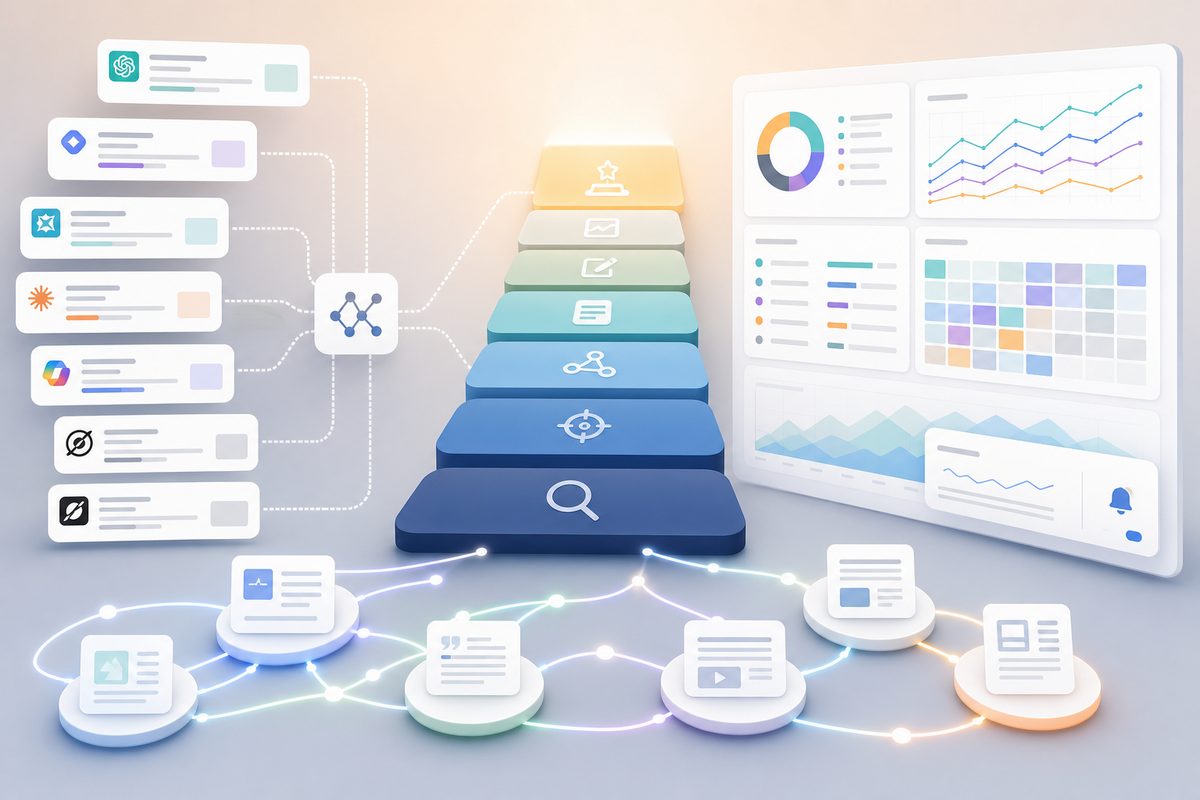
AI citation gap analysis is the process of comparing the sources AI assistants cite when they recommend a competitor against the sources they cite when they mention you — then closing the highest-impact differences. When ChatGPT or Perplexity puts a rival on a shortlist and leaves you off, that outcome is rarely random. It is assembled from a specific, traceable set of pages: a G2 category page, two listicles, a Reddit thread, a comparison article.
This guide shows how to extract that source list, diff it against your own, and rank every gap by how likely closing it is to flip the recommendation. You get a 7-step method, an original Citation Flip Score formula, a copy-ready capture schema, and a worked example with real tracking numbers from a 60-prompt, 4-platform engagement.
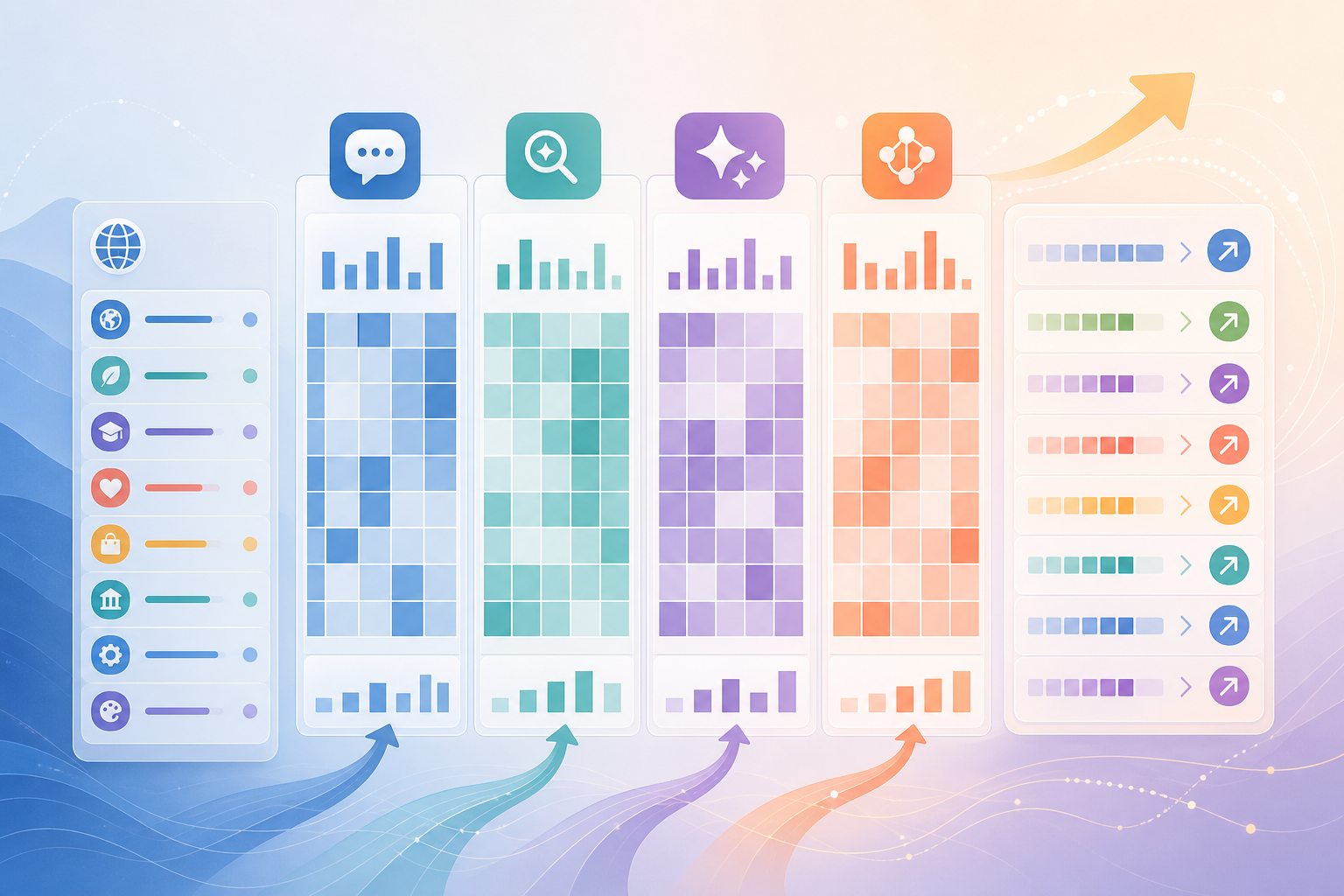
What Is AI Citation Gap Analysis?
AI citation gap analysis identifies the specific sources — domains, URLs, even individual passages — that AI engines retrieve when they talk about your competitors but not when they talk about you. The output is a ranked list of placements to win, pages to publish, and profiles to fix, ordered by expected impact on AI recommendations.
It is the answer-engine equivalent of backlink gap analysis, but the mechanics differ in ways that matter:
| Backlink gap analysis | AI citation gap analysis | |
|---|---|---|
| Unit of analysis | Domains linking to competitor | Sources cited in AI answers about competitor |
| Data source | Link indexes (Ahrefs, Moz) | Captured AI answers and their citations |
| What it improves | Rankings via authority | Inclusion in AI shortlists and descriptions |
| Refresh cadence | Monthly is fine | Daily to weekly — answers churn constantly |
| Win condition | A link | Being named in the cited passage itself |
A backlink helps any page about you rank. A citation only helps if the cited passage actually says something recommendable about you. That distinction drives the entire method below, and it is why citation gap work sits inside broader AI competitor analysis rather than replacing it.
Why Citations Decide Which Brands AI Recommends
AI assistants with web access build answers by retrieving a small set of sources and synthesizing them — so the brands named in those sources are the brands that get recommended. Your content can be excellent, but if the five pages an engine retrieves for "best CRM for small teams" never mention you, you do not exist in that answer.
Three findings about AI citations make this concrete:
- The Princeton-led GEO research (KDD 2024) tested nine optimization tactics across a 10,000-query benchmark and found that adding statistics, quotations, and cited sources lifted a page's AI answer visibility by 30–40%, with sources ranked around fifth position gaining up to 115%. What sources say and show changes what engines repeat.
- Profound's analysis of citation patterns (August 2024–June 2025) found Wikipedia accounted for 47.9% of ChatGPT's top-10 cited sources, while Reddit drove 46.7% of Perplexity's and about 21% of Google AI Overviews' citations. Each engine has a different "ballot box" of sources.
- A 680-million-citation audit found only 11% of cited domains overlap between ChatGPT and Perplexity. A gap closed on one platform often stays open on another.
The practical conclusion: you cannot fix AI visibility by guessing. You have to capture the actual citations behind competitor recommendations — the core job of daily AI search monitoring — and work the list.
How to Run an AI Citation Gap Analysis in 7 Steps
The short version:
- Build a buying-intent prompt set (40–100 prompts).
- Capture answers and citations daily across ChatGPT, Perplexity, Gemini, and Google AI Overviews.
- Extract the competitor's cited-source profile.
- Extract your own source profile.
- Diff the two into a gap matrix (hard, soft, and format gaps).
- Score every gap with the Citation Flip Score.
- Close the top gaps and re-measure weekly against a control set.
The detail below — prompt floors, capture fields, scoring — is what separates a defensible analysis from a one-off screenshot exercise.
Step 1: Build a buying-intent prompt set (40–100 prompts)
Start from prompts that produce shortlists, not definitions: "best [category] for [segment]", "[competitor] alternatives", "[you] vs [competitor]", "what should a [persona] use for [job]". Pull phrasing from sales calls, on-site search, and People Also Ask. 40 prompts is the floor for stable numbers; below that, normal answer volatility swamps real change.
Step 2: Capture answers and citations daily, across platforms
Run every prompt against at least ChatGPT, Perplexity, Gemini, and Google AI Overviews — daily — and store the full answer plus every cited URL. Each platform exposes citations differently: Perplexity numbers them inline, ChatGPT attaches source chips to browsed answers, AI Overviews lists sources in its expandable panel, and Gemini links corroborating pages below each section. Log the same fields everywhere:
| Field to capture | Why it matters |
|---|---|
| Date, platform, prompt | Separates normal answer volatility from real change |
| Full answer text | Engines paraphrase sources; wording reveals which source fed the description |
| Brands named + list position | Named first and named seventh are different outcomes |
| Every cited URL, in order | The raw material for the diff |
| Role of each cited passage | Recommendation, description, or background — this feeds the Flip Score |
Daily capture matters because the same prompt returns different answers run to run; single-day snapshots produce false gaps. This is the step that practically requires LLM brand tracking software — manual capture at 40 prompts × 4 platforms × 30 days is 4,800 answers.
Step 3: Extract the competitor's source profile
Filter to answers where the competitor is mentioned or recommended, and list every cited source with three attributes: citation frequency (share of competitor-positive answers citing it), platform spread (how many engines cite it), and passage role (does the cited text directly name the competitor in a recommendation, or just provide background?).
Step 4: Extract your own source profile
Repeat the extraction for your own brand mentions in ChatGPT, Perplexity, Gemini, and AI Overviews — including partial wins where you are named but described vaguely or inaccurately. Vague descriptions are a citation problem too: engines paraphrase whatever the dominant sources say, which is why this work overlaps with AI reputation management.
Step 5: Diff the profiles into a gap matrix
Three buckets fall out:
- Hard gaps — sources cited repeatedly for the competitor that never cite you (you're absent from the page).
- Soft gaps — sources that include both of you, but the passage favors them (you're on the page, below the fold of the answer).
- Format gaps — prompt types where their owned pages get cited (comparison pages, docs) and you have no equivalent page.
Step 6: Score every gap with the Citation Flip Score
Rank gaps by expected impact per unit of effort, using the formula in the next section. "Prioritize by revenue" is advice, not a scoring system; a numeric score makes the ranking reproducible — and defensible when someone questions the sprint budget.
Step 7: Close the top gaps, then re-measure on a fixed cadence
Execute the top five to ten items, keep an untouched subset of tracked prompts as a control group, and re-measure weekly. Watch mention rate, AI share of voice, and per-platform citation counts — the same numbers covered in our guide to AI visibility metrics. Expect platforms to pick up changes at different speeds (timelines in the worked example below).
The Citation Flip Score: Which Gaps to Close First
The Citation Flip Score ranks each gap source by how likely winning it is to change AI recommendations, relative to the work required:
Flip Score = (Frequency × Spread × Influence) ÷ Effort
- Frequency (F): percentage of competitor-positive answers citing the source (0–100).
- Spread (S): number of platforms citing it (1–4).
- Influence (I): 3 if the cited passage feeds the recommendation sentence itself, 2 if it shapes the description, 1 if background.
- Effort (E): 1 = you control it (your review profile, your own comparison page) up to 5 = practically closed to you (Wikipedia, tier-1 press).
Scored against real gap lists, the ranking is reliably counterintuitive:
| Gap source | F | S | I | E | Flip Score |
|---|---|---|---|---|---|
| G2 category page (wrong category for you) | 31 | 3 | 3 | 1 | 279 |
| "Best [category]" listicle on review blog | 18 | 4 | 3 | 2 | 108 |
| Competitor's own "X vs Y" comparison page | 9 | 2 | 3 | 1 | 54 |
| Reddit thread, 14 months old | 11 | 2 | 2 | 2 | 22 |
| Wikipedia category article | 6 | 3 | 1 | 5 | 3.6 |
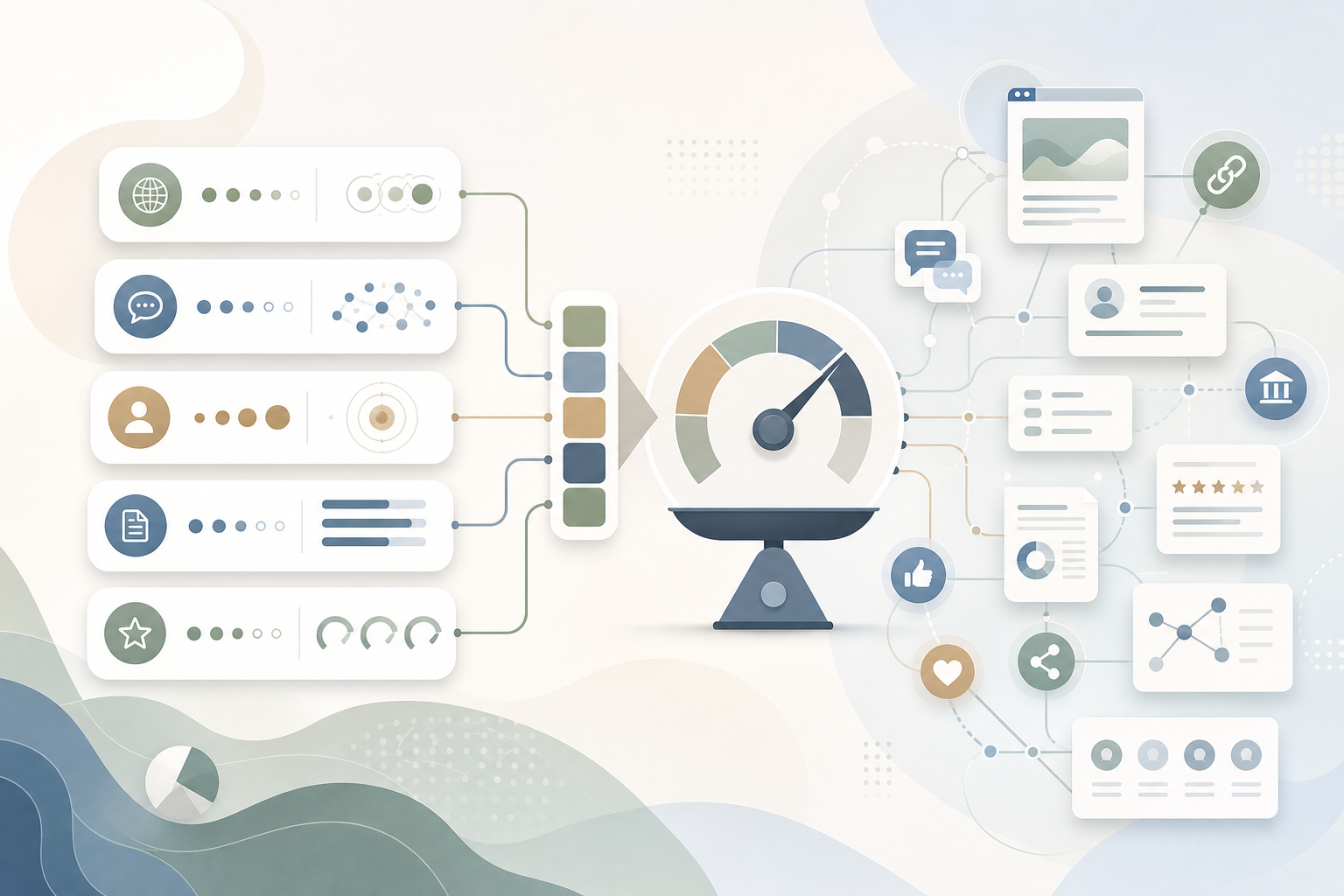
Two patterns repeat across engagements. Prestige and flip value are uncorrelated: Wikipedia scores near the bottom because its passages rarely drive recommendation sentences and edits rarely stick. And a competitor's own comparison page outranking a community thread surprises teams every time — engines cite vendor comparison pages directly, which means publishing your own is a gap you can close unilaterally. Our guide to winning "X vs Y" comparison queries covers that play in full.
Worked Example: Closing a 23-Source Gap in CRM Shortlist Prompts
Here is an anonymized engagement from maxaeo tracking data — a mid-market CRM vendor versus its lead competitor — with method and numbers, so you can judge the approach rather than take it on faith.
Setup. 60 buying-intent prompts, tracked daily across ChatGPT, Perplexity, Gemini and Google AI Overviews for a 30-day baseline: 7,200 captured answers. Baseline: the competitor appeared in 41 of 60 prompts; the client in 12 of 60. AI share of voice (the client's share of all brand mentions across tracked answers): competitor 34%, client 8%.
The diff. Competitor-positive answers drew on 67 unique domains; the client's on 31. 23 domains were cited five or more times for the competitor and zero times for the client. The top of the Flip Score ranking is the table above: a G2 category page cited in 31% of competitor-positive answers (the client sat in an adjacent, low-traffic category), two listicles (18% and 14%), a stale Reddit thread (11%), and the competitor's own comparison page (9%).
Actions over 9 weeks. Fixed the G2 category placement and ran a genuine review-request campaign to current customers (no incentivized reviews). Pitched both listicle authors with original benchmark data; one added the client in week 3, the second in week 7. Published an honest "client vs competitor" comparison page. For Reddit, the team skipped the stale thread and had its community manager start a disclosed-affiliation discussion instead — astroturfing is the fastest way to lose a source permanently.
Results. Mention rate rose from 12 to 31 of 60 prompts (20% → 52%); AI share of voice from 8% to 19%. Platform pickup was sequential: Perplexity reflected the listicle change in 11 days, AI Overviews in about 3 weeks after recrawl, ChatGPT in roughly 6 weeks; Gemini moved least. A 12-prompt control subset left untouched moved only from an 11% to a 13% average daily mention rate over the same period — consistent with the gap work, not market noise, driving the change.

One honest caveat: this is one engagement, not a controlled study. But the control subset, the per-platform pickup matching each engine's crawl behavior, and the dose-response between which gaps were closed and which prompts flipped make coincidence an expensive explanation.
Where Citation Gaps Hide: 6 Source Types to Diff
Across the gap matrices we build, the same six source types account for the large majority of high-Flip-Score entries. Diff each one explicitly — full platform-by-platform data on these is in our pillar on the source types AI cites most.
- Review and category sites (G2, Capterra, Gartner Peer Insights): the most common hard gap in B2B; often a category mismatch, not absence.
- Listicles and "best of" roundups: the single most flippable third-party type — authors update them, and engines re-retrieve them.
- Community threads (Reddit, Hacker News, niche forums): dominant on Perplexity and heavily cited in AI Overviews; only authentic, disclosed participation works.
- Comparison and alternatives pages, including competitor-owned ones: engines cite vendor pages directly, so a missing "you vs them" page is a self-inflicted gap.
- Wikis and structured databases (Wikipedia, Wikidata, Crunchbase): outsized weight in ChatGPT's citation mix, but low Flip Scores — edits rarely stick and passages rarely drive recommendations. Long-term hygiene, not sprint work.
- Industry press and analyst content: mid-frequency, high influence on descriptions ("the enterprise option", "the budget pick") — the phrases engines repeat verbatim.
How Each AI Platform Changes the Math
The same gap is worth different amounts on different platforms, because each engine retrieves from a different pool. Per Profound's 11-month dataset and our own tracking:
| Platform | Retrieval base | Citation skew | Fastest gap to close |
|---|---|---|---|
| ChatGPT | Bing index + browsing | Wikipedia ≈ 47.9% of top-10 cited sources | Bing-indexed listicles; neutral wikis |
| Google AI Overviews | Google index | Reddit ≈ 21% of citations; YouTube most-cited domain | Threads + pages already ranking top-10 |
| Perplexity | Own crawler, recency-biased | Reddit ≈ 46.7% of citations | Fresh community and comparison content |
| Gemini | Google index + Knowledge Graph | Skews to structured, entity-confirmed sources | Consistent entity data, structured markup |
With only ~11% domain overlap between ChatGPT and Perplexity, run the diff per platform, not in aggregate — an aggregate view hides the fact that your biggest ChatGPT gap may already be closed on Perplexity. Citation mixes also shift when platforms update retrieval, so a quarterly audit goes stale; continuous capture is what makes the analysis trustworthy. This per-platform retrieval logic is the core of answer engine optimization and generative engine optimization more broadly: you are optimizing the sources each engine trusts, not the engine itself.
5 Mistakes That Waste a Citation Gap Sprint
- Diffing domains instead of URLs and passages. "They have G2, we have G2" hides that their cited page is the category leaderboard and yours is a dead profile.
- Measuring one platform. At 11% overlap, a ChatGPT-only analysis misses most of the Perplexity and AI Overviews citation landscape.
- Chasing prestige sources first. Wikipedia and tier-1 press feel important and score terribly on effort-adjusted impact. Work the Flip Score order, not the vanity order.
- Astroturfing community sources. Undisclosed Reddit posts and incentivized reviews get removed, get flagged, and can poison how engines describe you — the opposite of getting recommended by ChatGPT.
- Treating it as a one-shot audit. Answers churn weekly. Without re-measurement against a control set, you cannot tell which closed gap actually moved the number — and you cannot defend the budget that paid for it.
Frequently Asked Questions
How is AI citation gap analysis different from a content gap analysis?
A content gap analysis finds topics you haven't covered; a citation gap analysis finds sources that don't cover you. Most citation gaps cannot be closed by publishing on your own site at all — they require winning placements on the third-party pages AI engines already retrieve, plus a small set of owned pages (comparisons, docs) engines cite directly.
Is AI citation gap analysis the same as AI share of voice?
No. AI share of voice is the outcome metric — the percentage of tracked answers that name your brand. Citation gap analysis is the diagnostic that explains the number: it identifies which sources produce competitor mentions and which placements you must win to move your share. Track both — one tells you if you're winning, the other tells you what to do next.
How many prompts and how much time do I need for a reliable baseline?
40–100 buying-intent prompts, captured daily for 30 days, across at least four platforms. Fewer prompts or single-day snapshots produce false gaps, because the same prompt returns different answers run to run. Stability comes from volume and repetition, not from any single capture.
How long until a closed gap shows up in AI answers?
In our tracking, Perplexity typically reflects source changes in 1–2 weeks, Google AI Overviews in 2–4 weeks after recrawl, and ChatGPT in 4–8 weeks, with Gemini slowest to shift descriptions. Plan a 9–12 week sprint: weeks 1–4 to baseline and diff, then 5–8 weeks for closed gaps to surface before you judge results.
Can I run this manually, without an AI visibility tool?
Yes, at small scale: 10–15 prompts, two platforms, weekly manual capture into a spreadsheet (use the field schema in Step 2) will surface your largest hard gaps. The trade-off is statistical: low-volume snapshots can't distinguish answer volatility from real change, and manual capture rarely survives past week three. Automate once the prompt list or stakeholder count grows.
Which platform should I analyze first?
The one your buyers use — check referral logs and ask sales. Absent better data, B2B SaaS teams get the fastest payback from ChatGPT (largest assistant audience) plus Perplexity (fastest to reflect changes), then add Google AI Overviews for top-of-funnel queries. Just don't average them: the 11% overlap means each platform needs its own gap list.
Your competitor's AI recommendations have a bibliography. AI citation gap analysis is simply the discipline of reading it, diffing it against your own, and closing the entries that pay. Run the baseline, score the gaps, work the top five — and re-measure with a tool like maxaeo so the next budget conversation starts from a chart, not a hunch.
This article was created with AI assistance and reviewed by a human editor.