
AI reputation management is the practice of monitoring, measuring and correcting how AI assistants — ChatGPT, Gemini, Perplexity, Claude, Copilot, Grok and Google's AI Overviews — describe, rank and recommend your brand, by fixing the sources those systems rely on and escalating to the platforms when source fixes fall short.
The stakes compound monthly. ChatGPT passed 800 million weekly users in October 2025, and Google's AI Overviews reached over 2.5 billion monthly users by May 2026. When an assistant calls your product "expensive," "legacy" or "best for small teams only," that judgment ships directly into the buyer's head — with no blue links to argue back.
This guide treats AI answers as a reputation surface, not a ranking game. It combines what most published advice keeps separate — sentiment tracking, source remediation, per-platform escalation paths, realistic timelines and budgets — into one operating playbook you can run weekly, grounded in MaxAEO's own cross-platform tracking data.
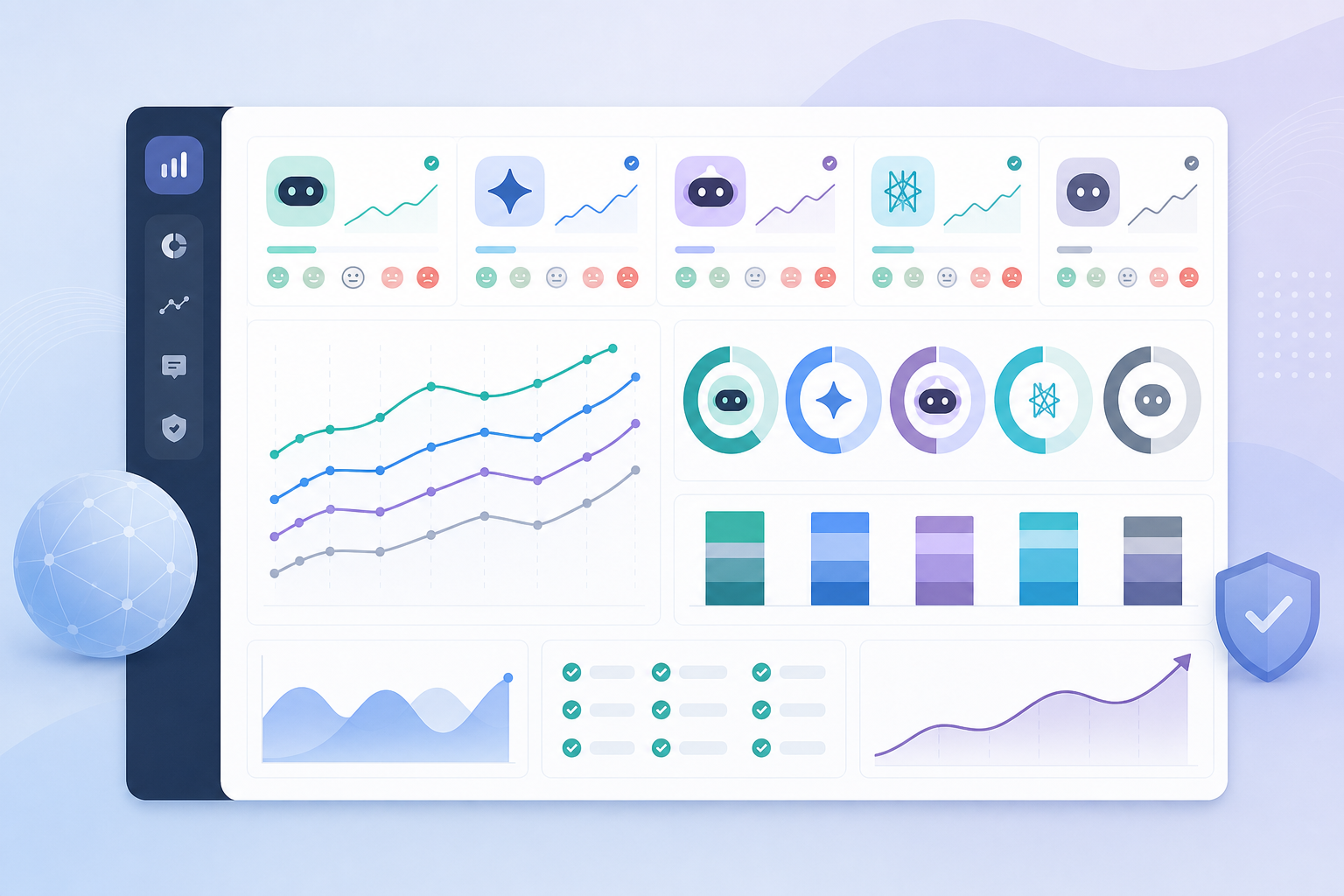
What Is AI Reputation Management?
AI reputation management is the ongoing process of tracking what AI assistants say about your brand, scoring those statements for sentiment and accuracy, fixing the underlying sources the models rely on, and escalating to the platforms when source fixes are not enough. The goal: when AI describes your company, the description is present, accurate and favorable.
One clarification first, because the term is genuinely ambiguous in search results. Many pages ranking for this phrase describe something else: using AI tools to automate review replies and social listening. That is AI-powered reputation management. This guide covers the newer, higher-stakes discipline — managing your reputation inside AI-generated answers. Here is how it relates to neighboring practices:
| Discipline | Surface it manages | Core question | Typical KPI |
|---|---|---|---|
| Online reputation management (ORM) | Google results, review sites, social, news | "What do people find about us?" | Review ratings, SERP sentiment |
| Generative engine optimization (GEO) / answer engine optimization (AEO) | AI answers and citations | "Do AI engines mention and cite us?" | Mention rate, AI citations |
| AI reputation management | AI answers as a narrative | "Is what AI says accurate and positive?" | Sentiment score, factual error rate, AI share of voice |
The three overlap, but the failure modes differ. GEO gets you into answers. AI reputation management governs how you appear once you're there — and what to do when the appearance goes wrong.
Why AI Answers Are a Reputation Surface, Not a Ranking Game
In classic search you compete for position; in AI answers you compete for characterization. There is no "position two" in a synthesized paragraph. The model either recommends you, frames you with caveats, describes you incorrectly, or leaves you out — and each of those is a reputation outcome, not a ranking outcome.
Three observed behaviors make this surface unusually unforgiving:
- Users don't verify. Pew Research Center found that when an AI summary appeared, users clicked a traditional result on only 8% of visits versus 15% without a summary — and clicked a source link inside the summary on just 1% of visits. The answer is the experience; your website rarely gets a rebuttal.
- The shift is structural, not a fad. Gartner predicted a 25% drop in traditional search engine volume by 2026 as chatbots absorb queries. Budget conversations should assume AI answers are a permanent channel.
- Answers are unstable. In MaxAEO's daily tracking, the same category-shortlist prompt re-run on consecutive days changed at least one top-five brand in roughly a third of runs. A single screenshot proves nothing; only repeated ai search monitoring reveals your real, average position in the narrative.
That instability is also the opportunity. Because answers re-form constantly from retrievable sources, a brand that fixes its sources can change its AI story in weeks — something traditional PR cycles rarely achieve.
The Four Ways AI Damages a Brand's Reputation
Across the B2B software brands MaxAEO tracked in Q1 2026 — daily runs of 40-prompt sets across ChatGPT, Gemini, Perplexity and AI Overviews — 28% showed at least one recurring factual error in branded answers, and the single most common error was outdated pricing. The damage follows four distinct patterns:
| Pattern | What it looks like | Detection signal |
|---|---|---|
| Omission | Absent from "best {category}" shortlists | Low presence rate while competitors recur |
| Misinformation | Stale pricing, killed features stated as fact | Rising factual error rate on branded prompts |
| Negative framing | "Powerful but complex" repeated to every prospect | Sentiment drift on specific attributes |
| Conflation | A competitor's incident attributed to you | Foreign entities or events in branded answers |
1. Omission: you're missing from the shortlist
When a buyer asks "best AI visibility tool for agencies" and you don't appear, you lose deals you never knew existed. Omission is primarily a GEO problem — thin third-party coverage, weak comparison content — and the fix starts with knowing which sources feed the shortlists. Our analysis of the source types ChatGPT, Perplexity and Gemini cite most shows where that coverage has to live.
2. Misinformation: confident, wrong, repeated
Models state stale pricing, killed features or invented capabilities with full confidence. This is the most measurable failure mode: every claim in a branded answer is checkable against ground truth. The remediation sequence — locate the claim's source, correct it, force re-retrieval — is covered step by step in our guide to correcting AI hallucinations about your company.
3. Negative framing: technically true, commercially poisonous
"Powerful but complex, with a steep learning curve" can be assembled honestly from three old G2 reviews and one Reddit thread — then repeated to every prospect for months. Sentiment problems hide inside answers that contain no factual errors at all, which is why mention counting alone misses them. The countermeasure is attribute-level sentiment tracking plus fresh counter-evidence on the sources doing the framing.
4. Conflation: you inherit someone else's record
Models merge similarly named companies, attribute a competitor's security incident to you, or pin a same-named executive's history on yours. Conflation responds well to entity disambiguation — consistent naming everywhere, Organization schema markup, a clear "About" page and a maintained Wikipedia/Wikidata footprint.
These four patterns rarely arrive alone. The audit below baselines all of them at once.
How Do You Audit What AI Says About Your Brand?
Run a structured audit before changing anything — you cannot defend a budget with anecdotes. A credible baseline takes five steps:
- Build a prompt set of 30–50 questions across three intents: branded ("What is {brand}? Is {brand} legit?"), category ("best {category} tools"), and comparison ("{brand} vs {competitor}").
- Run the set across every surface your buyers use — at minimum ChatGPT, Gemini, Perplexity and Google AI Overviews — and repeat runs across several days, because single runs mislead.
- Score four dimensions per answer: presence (mentioned or not), sentiment (positive / neutral / negative, per attribute — pricing, support, ease of use), accuracy (every claim checked against ground truth), and ai citations (which URLs the answer leans on).
- Compute AI share of voice — your mentions as a share of all brand mentions on category prompts — to turn the data into one competitive number executives understand.
- Inventory cited sources into a ranked list: which domains keep shaping your answers, and which carry the errors or negative framing.
The output is a baseline you can re-measure monthly. For what "good" looks like on each number, see the six AI visibility metrics that tell you if AI recommends your brand.
A note on scope: manual audits are a fine starting point, but four platforms × 40 prompts × daily repetition is 1,000+ answers a week. Teams that stick with llm brand tracking beyond the first month almost always automate it.
The AI Reputation Operating Playbook
A baseline without an operating rhythm decays in a quarter. The playbook below is the part most ranking guides skip: who checks what, how often, and what happens when a check fails.

Layer 1: Set a monitoring cadence
Match effort to volatility. Branded answers shift faster than most teams expect — model updates, fresh reviews and news can rewrite them overnight.
| Cadence | What to check | Acting trigger |
|---|---|---|
| Daily | Branded prompts + top 10 category prompts; new negative sentiment; new factual errors | Any new error or sentiment flip on a revenue-relevant prompt |
| Weekly | Full prompt set; AI share of voice vs. competitors; citation changes | Share-of-voice drop >5 points week over week |
| Monthly | Source inventory refresh; accuracy re-audit against ground truth | Same error persisting across two monthly audits |
| Quarterly | Full baseline rebuild; prompt set expansion; model-update review | New model versions or new AI surfaces in your market |
Layer 2: Track sentiment, not just mentions
Mention counts tell you that you exist; sentiment tells you what the model is doing to your pipeline. Score sentiment per attribute (pricing, support, reliability, ease of use), not per answer — an answer can praise your features while quietly torching your support reputation. Trend it weekly, and treat two consecutive negative weeks on one attribute as an incident, not noise. The full detection-and-turnaround process is in our negative AI sentiment playbook.
Layer 3: Remediate at the source
AI answers are assembled mostly from other people's websites. AirOps' 2026 State of AI Search analysis found about 85% of brand mentions in AI answers come from third-party domains, not the brand's own site. So remediation means editing the model's reading list, in priority order:
- Your own properties — pricing, feature and changelog pages, kept current and crawlable for AI bots.
- High-authority third parties — G2, Capterra, Wikipedia/Wikidata, industry directories: the sources that dominate brand mentions in ChatGPT and its peers.
- Community and reviews — Reddit threads and review responses, engaged honestly under your brand identity.
- Press and analyst coverage — slowest to change, heaviest when it lands.
A worked example from MaxAEO tracking: a mid-market HR-tech vendor found ChatGPT quoting its 2023 per-seat price in 7 of 10 pricing-prompt runs. The team updated its pricing page, corrected two review-site listings and published a dated pricing FAQ. Within five weeks the stale price appeared in 1 of 10 runs. No platform escalation was needed — the sources were the problem.
Layer 4: Escalate when sources aren't enough
When a damaging claim survives source fixes — or involves defamation or personal data — go to the platform directly. Escalation routes are real but underused:
| Platform | Route | Best for |
|---|---|---|
| ChatGPT | In-answer feedback; OpenAI privacy portal for personal-data requests; fix Bing-indexed sources to influence browsing answers | Persistent hallucinations; personal/executive data issues |
| Google AI Overviews / AI Mode | Per-answer "Feedback" link; legal content removal process; refresh cited pages and request recrawl in Search Console | Defamatory framing; outdated cited snippets |
| Gemini | Per-response feedback; remediation through the Google index | Recurring factual errors |
| Perplexity | In-answer report option and support channels; fastest source-fix propagation since it browses live | Time-sensitive corrections |
| Copilot | Bing Webmaster Tools content removal and IndexNow resubmission | Stale or removed pages still being cited |
Set expectations honestly: feedback forms rarely produce confirmed fixes on a deadline. Escalation is a pressure valve, not the strategy. Source remediation remains the lever that moves answers — escalate in parallel, never instead.
How Long Does It Take to Change What AI Says About You?
Two to six weeks for answers grounded in live retrieval, based on the corrections MaxAEO tracked in Q1 2026 — and months for claims baked into model training data:
| Where the claim lives | Typical correction window | What moves it |
|---|---|---|
| Live retrieval (Perplexity, ChatGPT with browsing, AI Overviews, Copilot) | 2–6 weeks after source fixes | Re-crawl and re-retrieval of corrected pages |
| Model training data (answered without retrieval) | 3–12 months | The next model refresh, on the vendor's schedule |
Two planning consequences follow. First, sequence fixes by surface: retrieval-grounded platforms reward you fast and produce the early wins you report to leadership. Second, gains are not permanent — a model update can re-rank sources overnight and resurface an error you fixed last quarter. That is why the Layer 1 cadence never drops to zero, and why teams that stop monitoring usually rediscover problems the slow way: in a lost deal's post-mortem.
How Much Does AI Reputation Management Cost?
A realistic 2026 budget runs $0 plus 4–8 analyst hours per week for a manual program, $30–$500 per month for dedicated monitoring software, and $1,500–$10,000+ per month for a managed agency program. The right tier depends on brand count, markets and how many AI surfaces you must cover.
| Approach | Typical monthly cost | Best for | The catch |
|---|---|---|---|
| DIY (spreadsheets + manual prompting) | $0 + 4–8 hrs/week analyst time | First baseline; single brand, one market | Collapses past ~1,000 answers/week; no trend data |
| Dedicated AI visibility software | $30–$500 (enterprise tiers $1,000+) | Ongoing monitoring; agencies running client portfolios | Feature spread is huge — verify surface coverage and citation-level data before buying |
| Managed agency program | $1,500–$10,000+ | Regulated industries; active incidents; no in-house bandwidth | Insist on citation-level reporting, not screenshot decks |
Two budget notes from the field. The expensive part is rarely the software — it's unowned response time when an alert fires with no named owner, so assign the daily check before buying anything. And hybrid is the most common end state: a tool for detection, in-house for source fixes, agency only for legal escalations.
What to Look For in an AI Reputation Management Stack
You can run month one with spreadsheets. Past that, the volume and re-run requirements argue for a dedicated ai visibility tool. Whatever you pick, hold it to six capabilities:
- Coverage of every surface that matters — not just ChatGPT, but Gemini, Perplexity, Claude, Copilot, Grok, Google AI Mode and AI Overviews.
- Daily automated runs, because answer variance makes weekly snapshots statistically thin.
- Sentiment and accuracy scoring per answer, not just mention counts.
- Citation-level source data, so every bad answer comes with a fix target attached.
- Competitive benchmarking — AI share of voice trended over time, exportable for reporting.
- Alerting tied to action — a flagged answer should arrive with the recommended remediation, not just a red number.
This is the category MaxAEO was built for: it monitors how ChatGPT, Gemini, Perplexity, Claude, Copilot, Grok, Google AI Mode and AI Overviews mention, rank and describe your brand every day, then tells your team exactly which sources to fix to get recommended by ChatGPT and its peers more often. Agencies use the same data to report AI visibility across client portfolios without manually re-prompting eight platforms.
However you tool it, start the baseline now. Every week without measurement is a week of AI systems describing your brand to buyers — in words you have never read.
Frequently Asked Questions
Is AI reputation management the same as online reputation management?
No. ORM manages what people find when they search — reviews, news, social posts and rankings. AI reputation management manages what AI systems say — synthesized answers that blend those sources into one confident narrative. They share raw material (your reviews feed both), but AI answers need their own monitoring, their own sentiment and accuracy metrics, and platform-specific escalation paths ORM playbooks don't include.
Can you get false or negative information removed from ChatGPT?
Sometimes, but rarely by asking the model. Practical order: correct the third-party sources the claim is retrieved from, update your own pages, then use platform routes — OpenAI's in-answer feedback and privacy portal for personal data, or legal removal processes for defamation. Retrieval-grounded answers usually correct within weeks of source fixes; claims memorized in training data may persist until a model update.
How often should you check what AI says about your brand?
Daily for branded and top category prompts, weekly for the full prompt set and competitive share of voice, monthly for accuracy audits, and quarterly for a full baseline rebuild. Daily sounds heavy, but answers are volatile — in MaxAEO tracking, a third of daily re-runs changed a top-five shortlist — and the cost of automation is far below the cost of a month-old error reaching live deals.
Does ranking #1 on Google protect your reputation in AI answers?
No. AI assistants weight sources differently from Google's ranking — review platforms, Wikipedia, community threads and comparison articles often shape answers more than the pages winning organic positions. Brands with dominant SEO regularly discover negative framing or stale facts in AI answers their rankings never reveal. Audit the AI surface separately; the overlap with your keyword rankings is smaller than most teams assume.
Does AI reputation management apply to executives and individuals?
Yes, and the risk profile is sharper. Assistants answer "Who is {name}?" by blending news, bios and old press — and conflation, inheriting a same-named person's record, is more common for people than for companies. The fixes are the same in miniature: consistent bios across owned profiles, a maintained Wikipedia/Wikidata entry where warranted, and OpenAI's privacy portal or Google's legal removal process for false personal data.
This article was created with AI assistance and reviewed by a human editor.