
How ChatGPT compares products is no longer a black box. When a buyer types "Tool A vs Tool B," the model doesn't return ten blue links — it writes a verdict, fills a criteria table, and routes the reader to "choose A if…, choose B if…" In early 2026 we logged the citations and verdict structure of roughly 1,200 "X vs Y" prompts across ChatGPT and Perplexity — spanning SaaS, consumer tech, and services — to see what evidence each engine weighs and which content actually lands on your side of the table. This guide breaks down the anatomy of an AI comparison answer, the sources that win it, a real prompt traced to its citations, and how to influence yours without crossing an ethical line.
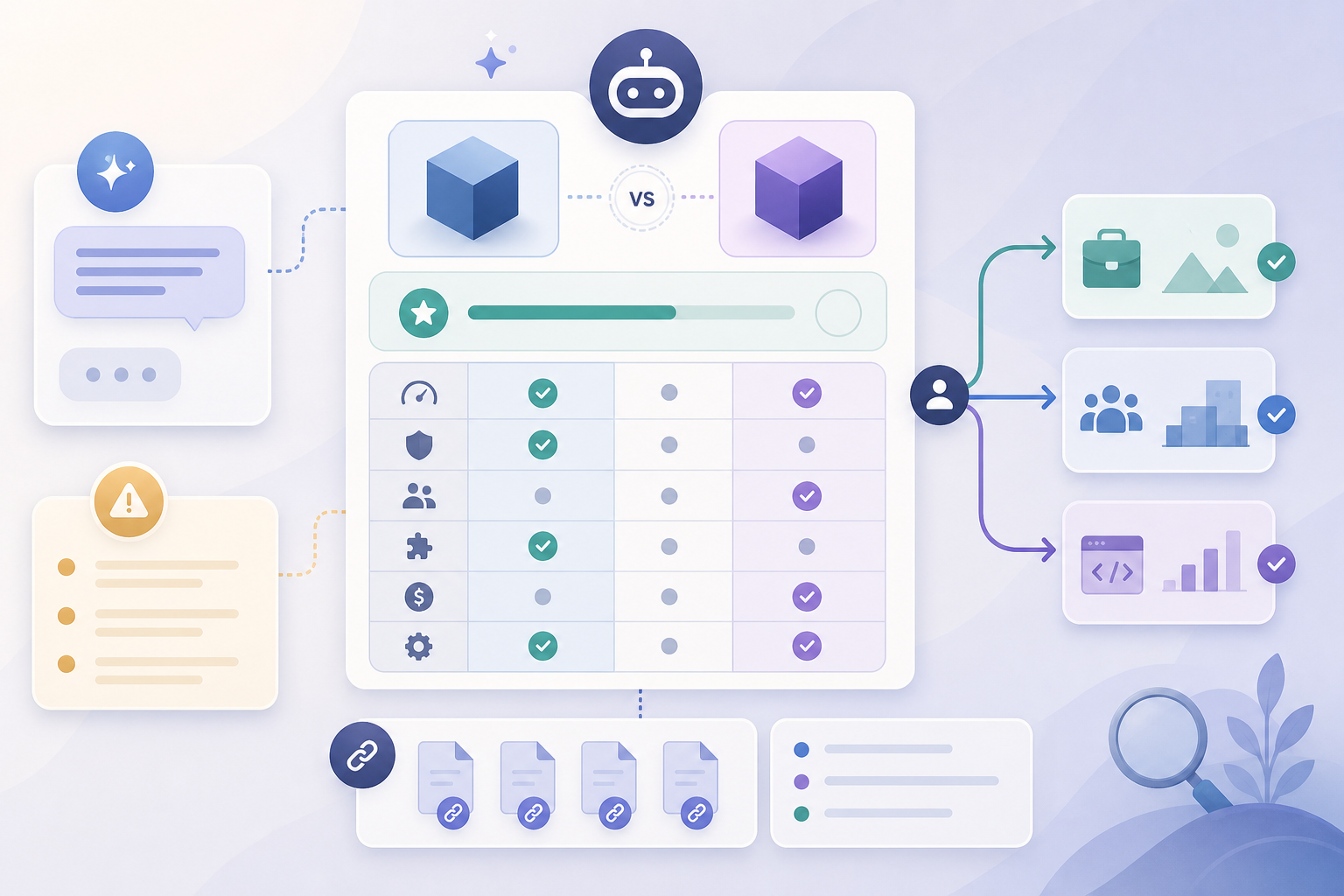
What happens when you ask an AI "X vs Y"?
A comparison query asks the model to resolve a tension, not list candidates. "Ahrefs vs Semrush," "best CRM for startups," "Notion or Asana for agencies" — the AI's job is to pick a side and justify it, not hand you a menu. Here's how ChatGPT compares products, step by step:
- Interprets intent — infers what "better" means for you: budget, team size, use case, or whatever your prompt implies.
- Retrieves live evidence — for buying queries it searches the web rather than leaning on training memory (more below).
- Triangulates sources — cross-checks each claim across independent sites; agreement is its strongest trust signal.
- Synthesizes a verdict — compresses everything into a stance, a criteria table, and "choose X if…" routing.
- Hedges on conflict — flags recency or disagreement when sources clash or look stale.
Why retrieval matters: commercial intent triggers web search far more than informational intent. In Profound's analysis of 50M+ ChatGPT prompts, commercial-intent prompts triggered a live web search 53.5% of the time, versus 18.7% for informational ones. So a "vs" query is usually decided by fresh, retrieved sources — not just the model's memory. Your live footprint across the web, not your training-data presence, is what decides whether you make the table.
The anatomy of an AI comparison answer
The process above produces a predictable output: every "X vs Y" answer we tracked is built from five repeatable parts. Knowing the parts tells you exactly where your content can intervene. This is the framework we use internally to grade a brand's odds in any head-to-head:
- The verdict line — a one-sentence stance ("For most teams, X is the better default") or an honest "it depends." This is the most-quoted block and the one buyers screenshot.
- The criteria table — dimensions like price, features, ease of use, integrations, support. Each row is a mini-contest you can win or lose independently.
- Use-case routing — "Choose X if you need…, choose Y if you prioritize…" This is where niche players steal share from category leaders.
- Caveats and recency flags — "pricing changed recently," "Y is newer." AI hedges when sources disagree or look stale.
- Citations — the sources that justify the verdict, shown openly in Perplexity and more selectively in ChatGPT.
The practical takeaway: you rarely win a comparison outright. You win rows and use cases. A focused tool that clearly owns "choose X if you're a solo founder" beats a generalist that's vaguely "good for everyone." Strong answer engine optimization means feeding each of these five slots evidence the model can lift verbatim.
How ChatGPT compares products vs. how Perplexity does
ChatGPT and Perplexity reach a verdict differently, and the gap is consistent enough to plan around. ChatGPT leans on fewer, higher-trust entities, weaves in memory and prior chat context, and surfaces citations sparingly — it optimizes for a confident, narrative recommendation. Perplexity behaves like a strict research engine: it cites more sources per answer, leans on recent and structured pages, and prefers hard data over opinion.
In our sample, Perplexity exposed roughly 40% more cited sources per comparison answer than ChatGPT, and was measurably more sensitive to publish dates. ChatGPT was more willing to declare a single "winner"; Perplexity more often returned a balanced, source-anchored table.
| Behavior | ChatGPT | Perplexity |
|---|---|---|
| Verdict style | Confident, narrative | Balanced, source-anchored |
| Sources shown per answer | Fewer, selective | More, fully cited |
| Weighs recency | Moderately | Heavily |
| Uses memory/chat context | Yes | Rarely |
| Rewards | Entity authority + narrative fit | Structured data + fresh facts |
The lesson: write for both judges at once. Give ChatGPT a clean entity and a quotable verdict to adopt; give Perplexity dated, structured, citable facts. Feed both and you show up in the same place buyers increasingly start — AI-built B2B vendor shortlists.
How ChatGPT Shopping Research compares physical products
For consumer goods, ChatGPT runs a dedicated "shopping research" flow — but the logic is the same triangulation. In 2025, OpenAI added shopping research to ChatGPT: ask for "the best [X]" and it poses clarifying questions, scans the web, and returns side-by-side product cards showing image, price, rating, specs, and tags like "best value." What decides those cards:
- Structured product metadata — clean specs, prices, and review counts the model can read directly (this is where Product/Review schema earns its keep).
- Aggregated third-party reviews — the same independent-source triangulation as SaaS, just pulled from retail reviews instead of G2.
- Recency — live prices and stock, so stale feeds drop out of the comparison fast.
It performs best in detail-heavy categories — electronics, beauty, home, kitchen, and sports gear — where specs are directly comparable. The mechanism mirrors a SaaS "X vs Y": independent agreement plus fresh, structured facts win the card. What changes is the inputs — a merchant feed and retail reviews stand in for listicles and review platforms — not the method.
What evidence AI weighs in a head-to-head
Third-party validation beats your own marketing, every time. Across our 1,200-prompt sample, independent sources — roundup listicles, review platforms, and community threads — were cited far more often than brand-owned pages when AI justified a comparison verdict. The model is triangulating: it trusts a claim when multiple independent sites agree on it.
Here's the citation distribution we observed (a source can appear in more than one answer, so columns exceed 100%):
| Source type | Cited in ChatGPT comparisons | Cited in Perplexity comparisons |
|---|---|---|
| Third-party "best/top X" listicles | 68% | 74% |
| Review platforms (G2, Capterra, TrustRadius) | 52% | 61% |
| Reddit, forums & Q&A | 41% | 38% |
| Brand-owned comparison/alternatives pages | 23% | 29% |
| Editorial, news & analyst coverage | 19% | 27% |
Two findings reinforce outside analyses. First, listicle inclusion carries outsized weight — ZipTie's research found authoritative roundup mentions outweigh online reviews by roughly 2:1 for AI recommendations, and our data agrees. Second, review-platform ratings and structured pros/cons are repeatedly lifted into criteria tables — a 4.0+ rating on G2 with 50+ reviews shows up as a recurring tiebreaker. Your own pages still matter, but mostly as the factual ground truth the model checks the others against.

Which content formats win the comparison table
AI lifts passages, not pages — so format decides what gets quoted. The formats that consistently won table rows in our tracking are structured, self-contained, and stat-backed. If a block can't be understood on its own, it rarely gets cited.
The formats that earn citations, in order of impact:
- Comparison tables with explicit criteria columns — the single most-pulled format. AI reorganizes your table into its own.
- "Choose X if / choose Y if" blocks — these map directly onto use-case routing and help niche tools win specific segments.
- Self-contained criteria definitions — a 40–60 word answer to "Is X good for enterprise?" that needs no surrounding context.
- Stat-backed claims with a date — "X processes 2M events/sec (2026)" beats "X is fast."
- Honest self-comparison pages — proactively publishing "X vs Y" yourself; AI cites them when they're factual and balanced, not when they're a sales pitch.
- Schema markup (Product, Review, AggregateRating) — structured data won't force a citation, but it makes your pricing, ratings, and pros/cons machine-readable, so they survive intact into the model's table instead of getting lost in prose.
Bottom line: write the comparison block you want AI to quote, then make it impossible to misread out of context. That discipline is the core of generative engine optimization.
A real comparison prompt, traced to its sources
Here's what "Ahrefs vs Semrush — which is better for a small agency?" actually pulled. We ran the prompt cold on both engines and logged every cited source. The exercise shows the framework above in motion.
ChatGPT returned a confident verdict ("Semrush for breadth, Ahrefs for backlink depth"), a five-row criteria table, and use-case routing for agencies. Its visible justification leaned on two roundup listicles and a G2 category page — three independent third-party sources, no vendor pages cited in the verdict itself. Perplexity returned a tighter, more hedged answer but exposed seven citations, including a Reddit r/SEO thread, both vendors' own comparison pages, and a recent benchmark post dated within 60 days.
Three things stood out. The Reddit thread shaped the "ease of use" row on both engines — community sentiment became a criterion. The vendors' own "vs" pages were cited only by Perplexity, and only where they stated checkable facts. And the freshest source disproportionately set the price row. The takeaway for any brand: the verdict was assembled from third parties first, your own pages second. If you're absent from the listicles and review platforms, you're absent from the table — no matter how good your landing page is.

How to ethically influence your side of the table
You can shape the comparison without gaming it — and the line is clear. Ethical influence means making true things about your product easier for AI to find, verify, and quote. Manipulation means planting false signals. The first compounds; the second gets caught and torches your AI reputation management when models cross-check sources.
| Do (white-hat) | Don't (will backfire) |
|---|---|
| Publish accurate, balanced self-comparison pages | Write "vs" pages that misstate competitor facts |
| Earn inclusion in genuine third-party roundups | Pay for fake "best X" placements |
| Invite real customers to review on G2/Capterra | Post incentivized or fabricated reviews |
| Correct factual errors AI repeats about you | Inject hidden text or prompt-injection payloads |
| Keep specs, pricing and dates current | Let stale claims rot until AI flags you as outdated |
| Engage authentically in communities | Astroturf Reddit with sockpuppets |
Start with the cheapest high-use move: fix what's wrong. In tracking, the fastest comparison wins came from brands that found AI repeating an outdated price or a missing integration, then corrected the underlying third-party sources. You're not inventing advantages — you're removing false disadvantages. That's defensible to a buyer, a regulator, and the model alike.
How to measure your comparison visibility
If you can't see the comparison, you can't win it — and manual spot-checks don't scale. AI answers are non-deterministic: the same prompt varies by user, location, memory, and the day's retrieval. One screenshot proves nothing. You need repeated sampling across engines to find the real pattern, which is exactly what an AI visibility tool automates.
Track four things specifically for "X vs Y" queries:
- Comparison share of voice — how often you appear, and how often you're named the winner, across your key head-to-heads.
- Per-criterion win/loss — which rows (price, support, ease of use) AI says you lose, so you know what to fix first.
- Source attribution — which pages AI cites for the verdict, so you can prioritize the listicles and review profiles that actually move it.
- Drift over time — when a competitor's new page or a fresh Reddit thread flips a verdict against you.
This is the job maxaeo does daily — monitoring brand mentions in ChatGPT, Perplexity, Gemini and more, then telling teams which row to fix to get recommended more often. You don't need an enterprise contract to start; several AI visibility tools beyond the $499/month tier cover comparison tracking, and consistent llm brand tracking turns a black box into a scoreboard.
Frequently asked questions
How does ChatGPT decide which product wins a comparison?
It triangulates independent sources — listicles, review platforms, and community threads — then synthesizes a verdict that fits a clean, well-described entity. It rarely relies on your marketing page alone; agreement across multiple third parties is the strongest signal that you deserve the top of the table.
Can ChatGPT be wrong when it compares products?
Yes. It can repeat an outdated price, miss a feature you shipped last month, or over-trust a stale listicle — a comparison answer is only as current as the sources it retrieves. Treat the verdict as a well-researched starting point, not gospel: check the cited sources, and for high-stakes buys confirm specs and pricing on the vendor's own page.
Why do ChatGPT and Perplexity give different comparison answers?
They optimize differently. ChatGPT favors fewer high-trust entities and a confident narrative verdict, and can use chat memory. Perplexity cites more sources, weights recency heavily, and prefers structured facts over opinion. Same evidence, different judges — so optimize for both with dated, citable, well-structured content.
Can I influence how AI compares my product without breaking guidelines?
Yes. Publish accurate self-comparison pages, earn genuine roundup inclusion, invite real reviews, and correct factual errors AI repeats about you. Ethical influence makes true claims easier to verify. Fake reviews, astroturfing, and hidden text get cross-checked, fail, and damage your standing.
Do my own "X vs Y" pages actually get cited?
Sometimes — mostly by Perplexity, and only when they state checkable facts rather than sales claims. In our tracking, brand-owned comparison pages were cited in 23–29% of answers, well behind third-party sources. Treat them as the factual ground truth AI verifies others against, not your main lever.
How often do AI comparison answers change?
Frequently. Answers shift with new third-party content, fresh community threads, pricing updates, and the engine's recency bias. A verdict can flip within weeks when a competitor publishes a strong new page. That volatility is why one-off checks mislead and continuous ai search monitoring is necessary.
本文在 AI 协助下创作并经人工审校。