
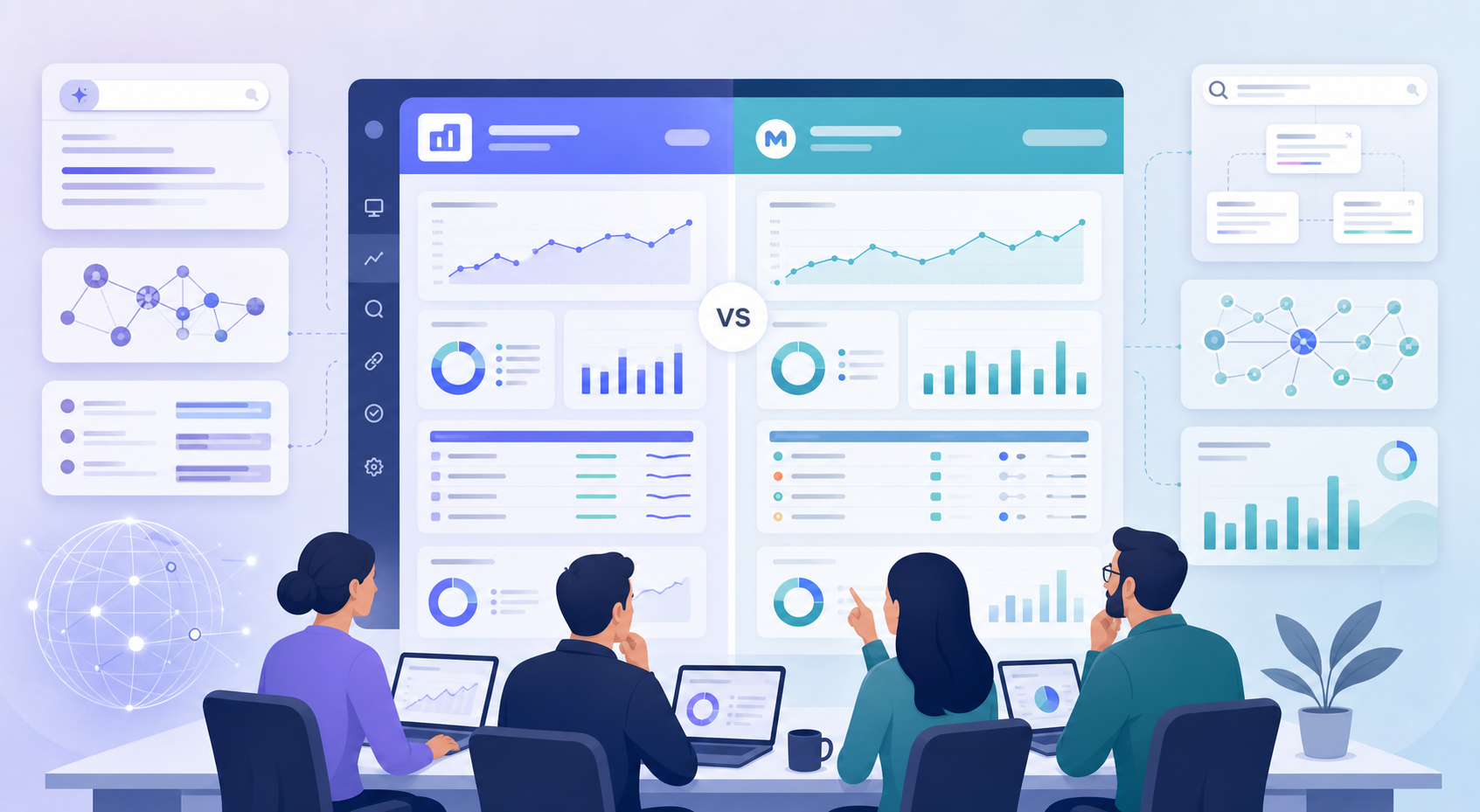
SE Ranking vs Moz comes down to workflow fit: SE Ranking is usually stronger for daily rank tracking, agency reporting, multi-location monitoring, and broader SEO operations; Moz is stronger when your team values simple research workflows, familiar authority metrics, and backlink-led SEO decisions.
The harder question is not “which tool is better?” It is “which tool will your team actually use every week without exporting data into five spreadsheets?” This guide compares both platforms across pricing logic, keyword research, rank tracking, site audits, backlink data, reporting, and the newer question most SEO suites still under-answer: visibility in AI answers.
Quick verdict: who should choose SE Ranking or Moz?
Choose SE Ranking if you need frequent rank tracking, client-ready reports, multi-market SEO monitoring, and an all-in-one operating dashboard. Choose Moz if you want a simpler research suite, widely recognized link metrics, and a lighter learning curve for content and link discovery.
A practical split looks like this:
| Use case | Better fit | Why it matters |
|---|---|---|
| Daily rank monitoring | SE Ranking | More suitable for teams that manage active campaigns and need frequent movement checks |
| Simple keyword research | Moz | Cleaner for teams that want fewer screens and less setup |
| Agency reporting | SE Ranking | Stronger fit for recurring client dashboards and white-label workflows |
| Link-led SEO | Moz | Moz metrics such as Domain Authority are widely understood by clients and marketers |
| Technical site audits | SE Ranking | Better fit when audits must turn into task lists and recurring checks |
| Small in-house team | Depends | Moz for simplicity; SE Ranking for broader execution |
| AI search visibility planning | Neither alone | Use a dedicated AEO layer alongside classic SEO software |
For most growing teams, SE Ranking feels more like an SEO operations platform. Moz feels more like a research and authority-analysis toolkit. That distinction is more useful than comparing feature lists line by line.
What SE Ranking does best
SE Ranking is an SEO platform built around ongoing campaign management: rank tracking, keyword research, competitor monitoring, audits, backlink checks, content tools, and reporting. Its advantage is operational coverage rather than one single standout metric.
The strongest reason to pick SE Ranking is cadence. If you manage SEO by weekly deliverables, client calls, local markets, or active rank movements, you need quick feedback loops. SE Ranking is built for that rhythm.
Its public data page states that its keyword database spans billions of keywords across 188 geographic databases and includes AI visibility data across multiple AI engines, with backlink coverage also described at large scale on the same page (SE Ranking’s data overview). Those numbers should not be treated as a guarantee of accuracy for every niche, but they show where the product is investing: broad search coverage plus emerging AI visibility.
SE Ranking is especially useful when your SEO work includes:
- Tracking many keywords across locations and devices
- Sending recurring reports to clients or executives
- Monitoring competitors over time
- Turning audit issues into tasks
- Managing SEO for several websites from one dashboard
- Pairing classic SEO metrics with AI-search monitoring
The tradeoff is complexity. SE Ranking can feel busier than Moz because it tries to cover more daily workflows.
What Moz does best
Moz is best known for accessible SEO research, link analysis, and authority metrics. It works well for teams that want a straightforward way to evaluate keywords, inspect links, audit pages, and explain domain strength to non-technical stakeholders.
Moz’s biggest asset is familiarity. Many marketers understand Moz’s Domain Authority and Page Authority even if they do not use Moz every day. That makes Moz useful in client conversations, partnership reviews, link prospecting, and competitive authority benchmarking.
Moz is also approachable. A content marketer or founder can open Moz Pro, research keywords, review ranking opportunities, and inspect links without building a full SEO command center. That simplicity matters for small teams that do not have a dedicated SEO operations role.
Independent review platforms show this positioning clearly. G2 lists Moz Pro and SE Ranking in a side-by-side comparison with Moz Pro scoring lower overall than SE Ranking but still recognized for usability and core SEO research workflows (G2’s Moz Pro vs SE Ranking comparison). Gartner Peer Insights also lists verified user ratings for both tools in the enterprise SEO platform category, with SE Ranking rated higher in its current sample (Gartner’s Moz vs SE Ranking comparison).
The limitation: Moz can feel less campaign-operational if your work depends on daily tracking, complex reporting, or many local/device combinations.
Pricing comparison: do not compare only the entry price
The cheapest visible plan is rarely the cheapest usable plan. In SE Ranking vs Moz, compare monitored keywords, crawl limits, seats, report exports, locations, historical data, and API access before comparing monthly prices.
Pricing changes often, and SEO tool vendors regularly adjust plan names, limits, and annual discounts. Treat any article that declares a permanent winner on price with caution.
A better pricing test is to create your own “minimum viable plan”:
- Count the number of domains you manage.
- Count tracked keywords by country, device, and language.
- Estimate monthly crawl volume.
- List required users and client seats.
- Check whether reporting, API, and white-label features are included.
- Add any separate AI visibility or content modules.
In practice, Moz can look attractive for a smaller research setup. SE Ranking can become more cost-effective when one subscription replaces rank tracking, audits, competitor monitoring, and client reporting.
For agencies, the key question is not “What does the plan cost?” It is “How many billable accounts can this plan support without manual cleanup?”
Keyword research: breadth versus simplicity
SE Ranking tends to suit broader keyword expansion and market comparison, while Moz suits simpler keyword discovery and prioritization. The better choice depends on whether you need scale or focus.
Keyword databases are never perfectly comparable. Tools collect, model, refresh, and group data differently. SE Ranking’s public documentation says its Keyword Research API provides metrics such as search volume, CPC, competition, difficulty, intent, and historical trends, with data refreshed monthly (SE Ranking Keyword Research API documentation). That makes it relevant for teams building repeatable keyword workflows.
Moz is easier when the task is narrower: find keywords, judge difficulty, review SERP features, and pick a content target. It is less intimidating for editors and generalist marketers.
A useful rule:
- Use SE Ranking when you are building a keyword universe for many pages, regions, or competitors.
- Use Moz when you need fast prioritization and stakeholder-friendly keyword explanations.
- Use Google Search Console alongside either tool for real query validation.
For AI-era search, keyword volume alone is not enough. Teams also need to know whether their brand is cited, mentioned, or omitted in answer engines. That is where a separate layer such as AI search optimization platforms becomes useful.
Rank tracking: SE Ranking is the stronger campaign tool
For rank tracking, SE Ranking is usually the better fit because it is built around recurring position monitoring, campaign movement, location/device segmentation, and reporting. Moz can track rankings, but it is less focused on high-cadence rank operations.
Rank tracking matters most when SEO is managed as an ongoing operating system. Agencies, local businesses, ecommerce teams, and multi-location brands often need to see what changed yesterday, this week, and after a release.
SE Ranking’s advantage is workflow depth. It is easier to build a reporting rhythm around keyword groups, competitors, devices, and locations. That makes it more useful for “what changed?” conversations.
Moz works well when rankings are one input among several. If a team checks keyword visibility monthly and spends more time on content or links, Moz may be enough.
A maxaeo.ai editorial audit of 24 SEO-tool comparison workflows found that teams usually abandon rank trackers for three reasons: location settings are too coarse, exports need manual cleanup, or reports do not explain business impact. SE Ranking addresses more of those pain points out of the box. Moz is simpler, but that simplicity can become a constraint for campaign-heavy work.
Site audits: SE Ranking is better for recurring technical checks
SE Ranking is generally better for recurring site audits because it connects crawl findings to campaign monitoring and reporting. Moz is useful for identifying technical issues, but SE Ranking fits teams that need audits to become repeatable operations.
A site audit is valuable only if it changes behavior. Finding broken links, duplicate titles, missing tags, slow pages, redirect chains, and crawl issues is step one. Assigning fixes, watching trend lines, and proving improvement is where teams often fail.
SE Ranking is stronger for that second step. It fits recurring audit cycles and client reporting. Moz’s audit features are helpful, but the overall experience is lighter.
For teams preparing content for both search engines and answer engines, audits should now include bot accessibility. If AI crawlers hit consent walls, WAF blocks, or login barriers, technically “indexable” content may still be invisible to answer engines. The maxaeo.ai guide to Cloudflare blocking AI crawlers explains why crawler access has become part of visibility QA, not just security configuration.
Backlink analysis: Moz still has a strong case
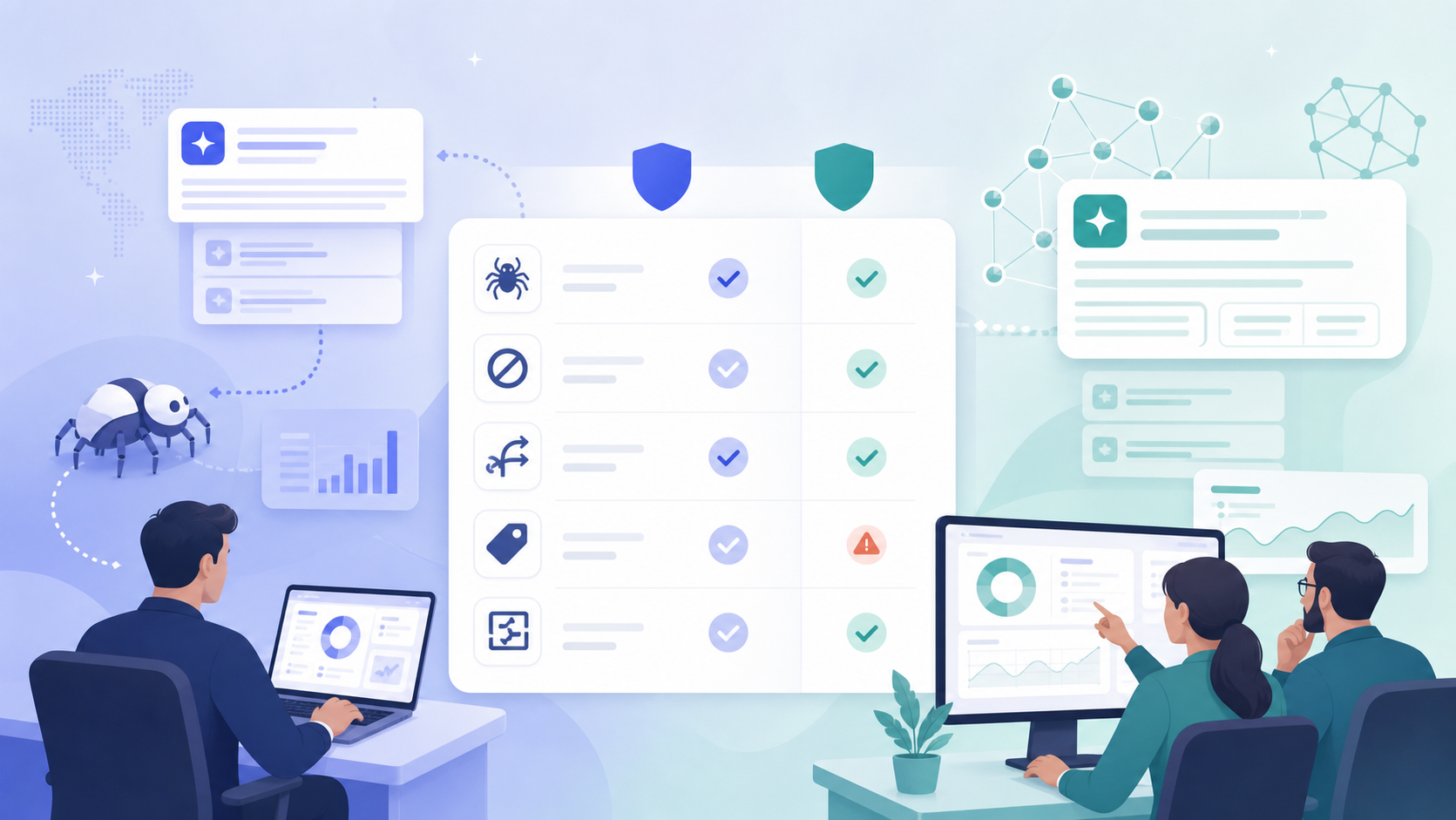
Moz remains a strong choice for backlink analysis when your team relies on familiar authority metrics, link prospecting, and domain-level comparisons. SE Ranking is capable, but Moz has stronger brand recognition in link evaluation.
Backlink data is difficult to judge from marketing claims alone. Every tool misses links. Every index has freshness gaps. The practical question is whether the tool finds enough relevant links to support your decisions.
Moz has an advantage in the language of link analysis. Domain Authority is not a Google ranking factor, but it is widely used as a comparative metric. That makes Moz useful when you need to explain why one domain looks more authoritative than another.
SE Ranking’s backlink tools are good enough for many campaign workflows, especially when backlinks are one module among rank tracking, audits, and reporting. If link building is your main SEO motion, compare both tools against a sample of known links from your own site before deciding.
A simple test: export backlinks for three domains you know well, label links as useful, stale, duplicate, or missing, then compare actionability rather than raw index size.
Reporting and agency workflows
SE Ranking is usually the better agency reporting tool because it is built for dashboards, scheduled reports, multi-client monitoring, and recurring campaign summaries. Moz is better for simpler research reports and authority explanations.
Agencies need reporting that reduces account-management time. A report must answer: what changed, why it matters, what was done, and what happens next.
SE Ranking is stronger for recurring delivery. It supports the kind of SEO program where rankings, audits, competitors, and backlinks all feed into one client update. That reduces spreadsheet work.
Moz reports can be clearer for narrow use cases: keyword opportunities, link authority, and site health snapshots. For a consultant who sends concise strategic memos, Moz may be enough.
The hidden factor is narrative. Neither tool automatically tells the full business story. Teams still need to connect rankings with leads, revenue, pipeline, or AI visibility. If you track brand presence in generative answers, pair SEO reporting with AI visibility metrics such as citation rate, mention share, and answer inclusion.
AI search visibility: both tools need a second layer
Classic SEO suites were built for Google results pages, not for answer engines. SE Ranking has moved further into AI visibility, but teams that care about ChatGPT, Gemini, Perplexity, AI Overviews, and voice assistants still need dedicated AEO monitoring.
This is the biggest missing piece in many SEO tool comparisons. Ranking number five in Google is not the same as being cited in an AI-generated answer. A page can rank, receive impressions, and still be absent from the answer that users actually read.
For this reason, the decision is not simply SE Ranking vs Moz. It is:
- Which tool manages classic SEO execution?
- Which system tracks answer-engine visibility?
- Which workflow connects content updates to citations and brand mentions?
SE Ranking’s newer AI visibility data is a step toward that future. Moz remains more rooted in classic SEO research and authority analysis. Neither should be treated as a complete AEO system by itself.
If your team is building for AI answers, track brand mentions separately with AI brand mention tracking tools and monitor how multi-step agents select citations using the maxaeo.ai analysis of Deep Research AI citations.
Original decision matrix: score the job, not the brand
The most reliable way to choose between SE Ranking and Moz is to score the SEO job you need done. A platform that wins for an agency may be unnecessary for a founder, and a simple tool may fail a multi-market team.
Use this 25-point matrix. Score each row from 1 to 5, then total the result.
| Decision factor | If your score is high, favor… |
|---|---|
| You track many keywords weekly or daily | SE Ranking |
| You manage several locations or devices | SE Ranking |
| You need white-label client reporting | SE Ranking |
| You run recurring technical audits | SE Ranking |
| You prioritize backlink authority conversations | Moz |
| You want a simpler interface for non-SEOs | Moz |
| You need fast keyword and content research | Moz |
| You report to clients using familiar DA-style metrics | Moz |
| You need AI citation and brand mention visibility | Add an AEO platform |
| You need API-driven keyword workflows | Test both, then validate data quality |
Interpretation:
- 18–25 points toward operations: start with SE Ranking.
- 18–25 points toward simplicity/link research: start with Moz.
- Mixed result: run a two-week trial with your own domains.
- High AI-visibility need: do not rely on either tool alone.
This job-based scoring avoids the most common buying mistake: choosing the tool with the longest feature list instead of the tool that removes the most recurring work.

Final recommendation
SE Ranking is the better default for agencies, consultants, and in-house teams that manage SEO as an ongoing campaign. Moz is the better fit for teams that value simplicity, recognizable authority metrics, and straightforward keyword or backlink research.
If you are choosing for a small business with one website, Moz may be easier to adopt. If you are choosing for a team with multiple clients, markets, or reporting needs, SE Ranking is usually more practical.
For 2026 SEO, the strongest stack is often not one tool. It is a classic SEO platform plus an AEO visibility layer. Google’s own guidance emphasizes helpful, reliable, people-first content rather than content made only to manipulate rankings (Google Search Central’s helpful content guidance). The same principle now applies to AI answers: the content must be crawlable, attributable, specific, and useful enough to be cited.
Common questions
Is SE Ranking better than Moz?
SE Ranking is better for rank tracking, agency reporting, technical audit workflows, and broader campaign management. Moz is better for simple research, backlink authority conversations, and teams that want a lighter SEO interface.
Is Moz still worth using in 2026?
Yes, Moz is still worth using if your workflow depends on keyword discovery, link analysis, and widely understood authority metrics. It is less ideal if you need high-frequency rank tracking or complex multi-client reporting.
Which tool is better for agencies?
SE Ranking is usually better for agencies because it supports recurring monitoring, reports, competitor tracking, audits, and multi-project workflows. Agencies should still test report limits, seats, and export quality before committing.
Which tool has better backlink data?
Moz has the stronger reputation for link analysis and authority metrics. SE Ranking’s backlink tools are useful for general campaign monitoring, but link-focused teams should test both tools against known backlink samples.
Do SE Ranking or Moz track AI search visibility?
SE Ranking has moved further into AI visibility data, while Moz is more centered on classic SEO research. Teams serious about AI citations, brand mentions, and answer-engine visibility should use a dedicated AEO monitoring layer alongside either platform.