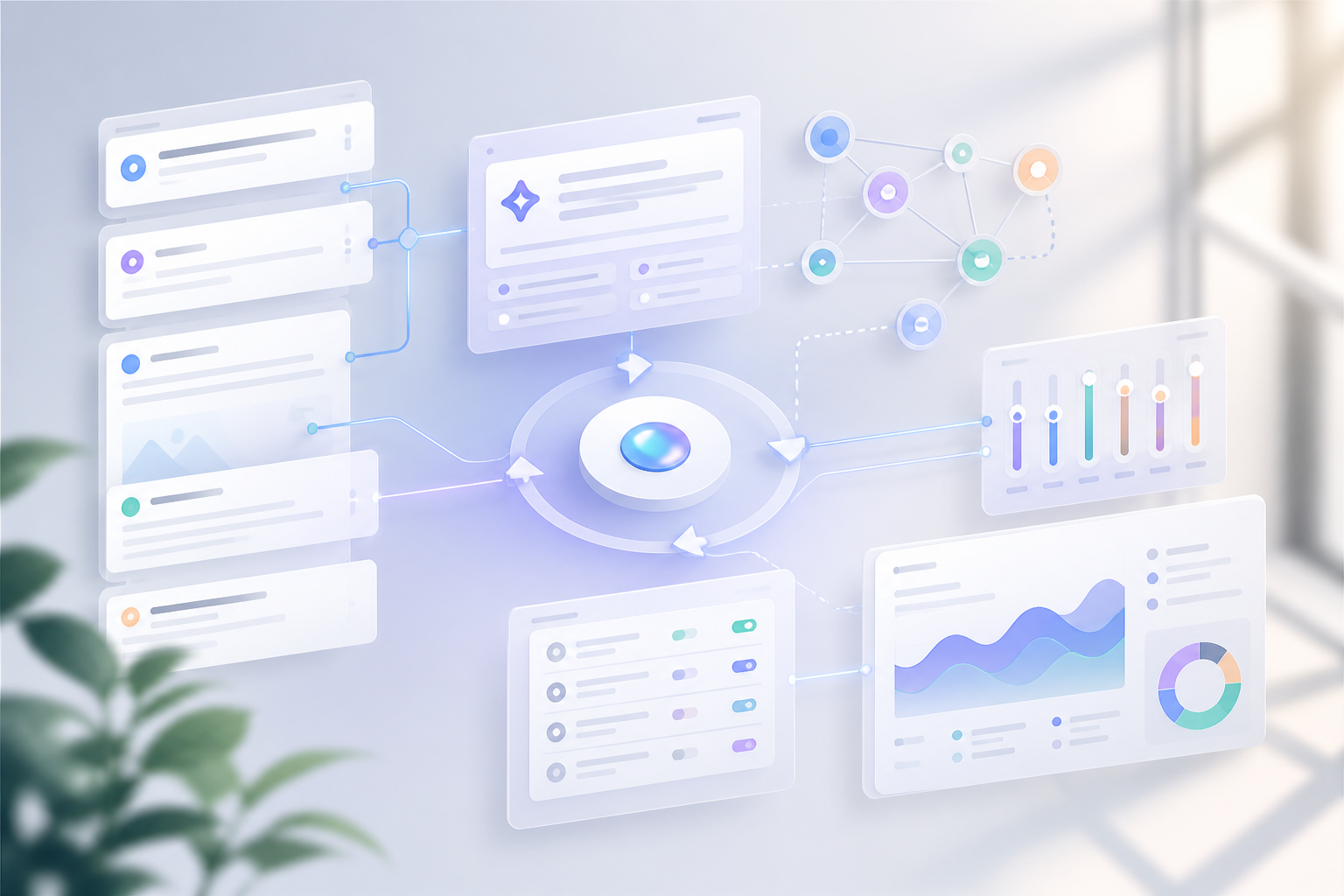
AI visibility optimization software helps a brand measure, diagnose, and improve how it appears in AI-generated answers across systems such as ChatGPT, Perplexity, Gemini, Claude, Copilot, and Google AI features. The best platforms do more than track mentions; they connect every visibility gap to a fix.
That difference matters. A dashboard that says “your brand was mentioned 12% of the time” is useful, but incomplete. A growth team needs to know which prompts triggered competitors, which sources shaped the answer, which pages were inaccessible, which claims were missing, and what action should be taken next.
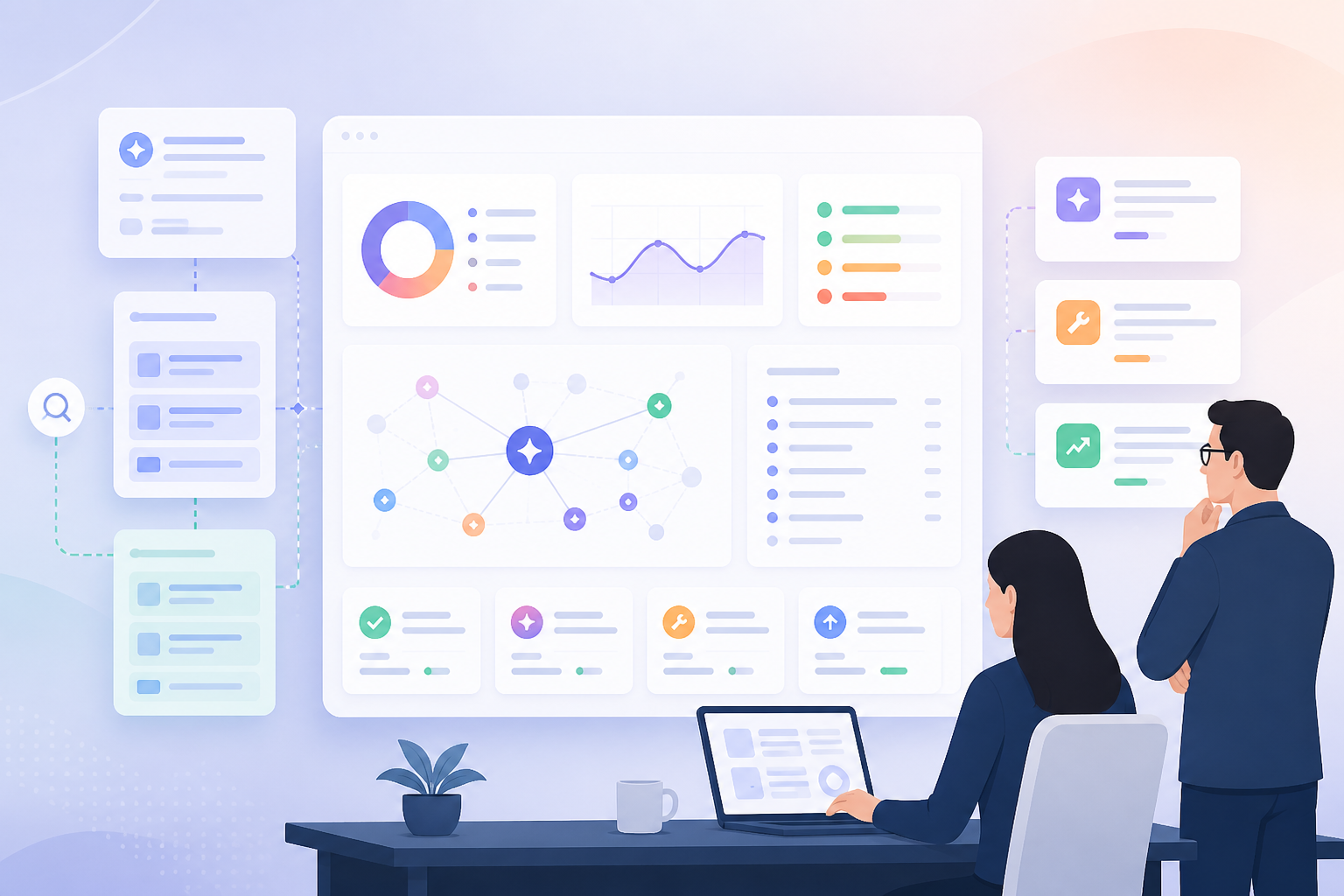
What is AI visibility optimization software?
AI visibility optimization software is a platform for improving brand presence in AI answers. It monitors prompts, brand mentions, citations, recommendations, sentiment, source pages, and competitors, then turns those observations into technical, content, entity, and authority-building actions.
Traditional SEO software measures rankings, backlinks, pages, and search demand. AI visibility tools measure a different surface: answers. In an answer engine, the user may never click a blue link, yet the assistant may still name one vendor, compare three products, or cite one source as evidence.
That is why an optimization platform needs three layers:
- Monitoring: where the brand appears, is cited, or is omitted.
- Diagnosis: why the answer engine chose that source or competitor.
- Remediation: what to change across pages, structured data, feeds, crawl access, reviews, and third-party proof.
For background on the measurement layer, maxaeo.ai’s guide to AI search engine monitoring tools explains how prompt sets, engines, locations, and competitors affect tracking quality.
Why AI visibility is not the same as SEO visibility
SEO visibility is page-centric; AI visibility is answer-centric. A page can rank well in Google and still be absent from ChatGPT, Perplexity, or an AI shopping answer if the model retrieves different sources, summarizes weakly, or prefers clearer third-party evidence.
Google’s own documentation still makes crawlability, titles, and links important. For example, Google Search Central’s title link documentation explains how page titles can influence what appears in search results, while Google’s link best practices emphasize crawlable links and descriptive anchor text.
But AI answers add extra uncertainty. A generative engine may:
- Reformulate the user query into several hidden sub-queries.
- Retrieve sources from search indexes, partner indexes, or live browsing.
- Allocate limited context to a few passages.
- Summarize multiple pages into one recommendation.
- Mention a brand without linking to it.
- Cite a publisher rather than the vendor being recommended.
A 2026 critical survey of generative engine optimization describes GEO as a pipeline spanning search activation, crawling, retrieval, citation, prominence, factual absorption, and user behavior, not a single ranking task. That framing matches what practitioners see: visibility depends on a chain of weak links, not one score.
The closed-loop model: measure, diagnose, fix, verify
The strongest platforms operate as a closed loop. They repeatedly ask representative prompts, record the answers, identify the sources and competitors behind those answers, recommend fixes, and retest after the work is shipped.
A practical loop looks like this:
-
Define the prompt universe
Group prompts by intent: informational, comparison, recommendation, troubleshooting, local, product, pricing, and “best for” queries. -
Run controlled answer tests
Test the same prompts across multiple engines, locations, languages, devices, and logged-out states where possible. -
Score the answer
Track whether your brand was mentioned, cited, recommended, positioned favorably, described accurately, and placed before competitors. -
Inspect the evidence layer
Identify source pages, citation domains, review sites, forums, product feeds, knowledge panels, and pages used by the assistant. -
Map gaps to fixes
Create actions for content, schema, crawl access, entity consistency, comparison pages, reviews, PR, internal links, or product data. -
Retest after publication
Compare pre-fix and post-fix prompt results. Do not declare success from one run; answer engines are stochastic.
For a deeper KPI model, the maxaeo.ai guide to AI visibility metrics breaks visibility into measurable indicators such as mention rate, citation rate, share of voice, and recommendation quality.
An original scoring framework: the 85-point AEO optimization index
A useful AI visibility platform should not collapse everything into one vague “AI score.” A better diagnostic model separates visibility, evidence, and fixability. The following 85-point index is a practical framework used to evaluate whether a brand can move from passive monitoring to active optimization.
| Dimension | Weight | What it measures | Example signal |
|---|---|---|---|
| Prompt coverage | 15 | Whether the system tests real buyer, researcher, and comparison prompts | “best software for X,” “alternatives to Y,” “how to solve Z” |
| Mention presence | 10 | How often the brand appears in relevant AI answers | Named, omitted, or replaced by competitors |
| Citation strength | 15 | Whether AI answers cite owned or favorable third-party pages | Vendor docs, reviews, guides, directories |
| Recommendation quality | 15 | Whether the brand is merely mentioned or actively recommended | First choice, shortlist, neutral mention |
| Claim accuracy | 10 | Whether facts about the brand are correct and current | Features, pricing model, category, audience |
| Competitive share | 10 | How visibility compares with named competitors | AI share of voice by prompt cluster |
| Crawl and access health | 10 | Whether answer engines can access key public pages | Robots rules, WAF blocks, consent walls |
| Fix execution readiness | 10 | Whether the platform gives actionable remediation | Briefs, page priorities, technical tasks |
| Verification loop | 5 | Whether the tool retests after fixes | Before/after prompt deltas |
The key insight is the fixability score. A brand with low visibility but clear citation gaps is easier to improve than a brand with moderate visibility but severe crawl blocks, outdated third-party profiles, and conflicting entity data.
This is where property-level systems such as maxaeo.ai matter: the goal is not just to observe AI answers, but to manage the assets that answer engines can retrieve, cite, and trust.

What features should the software include?
The best answer engine optimization software includes prompt testing, citation analysis, competitor tracking, technical access checks, content recommendations, entity monitoring, and performance reporting. Missing any one layer makes the platform useful for reporting but weak for optimization.
Use this feature checklist when evaluating platforms:
Prompt and engine coverage
A platform should support the engines that matter to your buyers, not just the engines that are easiest to scrape. At minimum, evaluate coverage for ChatGPT, Perplexity, Gemini, Claude, Copilot, and Google AI search surfaces where relevant.
It should also let you segment prompts by:
- Funnel stage.
- Persona.
- Geography.
- Language.
- Product line.
- Brand vs non-brand intent.
- Comparison and recommendation wording.
A small, high-quality prompt set is better than thousands of generic prompts. For most teams, 50 to 300 carefully mapped prompts produce more insight than a noisy keyword import.
Citation and source analysis
Citation tracking is the bridge between measurement and action. If an answer recommends a competitor, the software should identify the evidence behind that answer: review pages, category pages, analyst lists, Reddit threads, documentation, news articles, or marketplace listings.
The maxaeo.ai framework for AI-generated brand mention checking is useful here because mentions alone can be misleading. A brand can be mentioned negatively, cited through an outdated page, or excluded from the final recommendation even when it appears in supporting text.
Competitor recommendation analysis
AI answers often behave like shortlist builders. The platform should show not only whether your brand appears, but which competitor appears instead, why they appear, and what evidence supports them.
For example, if Perplexity repeatedly cites a competitor’s integration page for “best CRM for healthcare teams,” the fix may not be another generic blog post. It may be a dedicated healthcare integrations page, better schema, clearer customer proof, and third-party validation.
The maxaeo.ai guide to AI competitor recommendation analysis explains how to separate true competitive advantage from retrieval bias.
Crawl access and bot diagnostics
AI visibility can fail before content quality is evaluated. If search crawlers or AI retrieval bots cannot access your pages, the answer engine may rely on competitors or third-party summaries.
Official crawler documentation matters here. OpenAI’s crawler guidance distinguishes crawler access needs, while Perplexity’s crawler documentation recommends allowing PerplexityBot for appearance in search results. Anthropic also documents multiple bots for web data, search, and user-directed retrieval in its Claude crawler help article.
A serious platform should inspect:
robots.txtrules.- WAF and CDN blocks.
- 403 responses.
- Rate limits.
- Consent interstitials.
- Login walls.
- JavaScript-only content.
- Canonical and indexability conflicts.
- Product feed accessibility.
For practical technical remediation, see maxaeo.ai’s article on robots.txt rules for AI crawlers.
How to choose a platform by maturity stage
The right AI visibility optimization software depends on the maturity of your program. Early teams need reliable measurement; scaling teams need diagnosis; mature teams need workflow, governance, and proof of impact.
| Stage | Main problem | Must-have capability | Buying risk |
|---|---|---|---|
| Stage 1: Baseline | “Do AI engines mention us?” | Prompt monitoring and mention tracking | Overpaying for dashboards without action |
| Stage 2: Diagnosis | “Why are competitors recommended?” | Citation, source, and competitor analysis | Treating every omission as a content problem |
| Stage 3: Optimization | “What should we fix first?” | Prioritized remediation workflows | Producing content that AI systems never retrieve |
| Stage 4: Governance | “How do we scale safely?” | Multi-brand reporting, approvals, audits | Conflicting entity data across teams |
| Stage 5: Impact | “Did visibility improve revenue?” | Before/after tests and CRM attribution | Claiming ROI from unstable answer samples |
A common mistake is buying a Stage 4 enterprise dashboard when the team has not defined a prompt universe. Another mistake is choosing a cheap mention tracker when the real bottleneck is crawl access, poor third-party evidence, or weak comparison content.
The 30-prompt field test before you buy
A 30-prompt field test can reveal whether a platform is actionable before an annual contract is signed. The test should include 10 category prompts, 10 comparison prompts, five problem-solution prompts, and five high-intent recommendation prompts.
Use the same prompt set across shortlisted tools. Score each platform on four questions:
-
Did it capture the answer accurately?
Check raw answer text, timestamp, engine, location, and prompt variant. -
Did it identify the evidence?
Look for citations, retrieved sources, linked pages, and recurring domains. -
Did it explain the gap?
A useful tool distinguishes content gaps from authority gaps, access problems, and entity confusion. -
Did it produce a fix you could assign?
The recommendation should become a ticket, brief, technical task, PR target, or content update.
In practice, this test often exposes a sharp difference between “AI visibility monitoring” and “AI visibility optimization.” Monitoring tells you what happened. Optimization tells you what to do next and whether the fix worked.
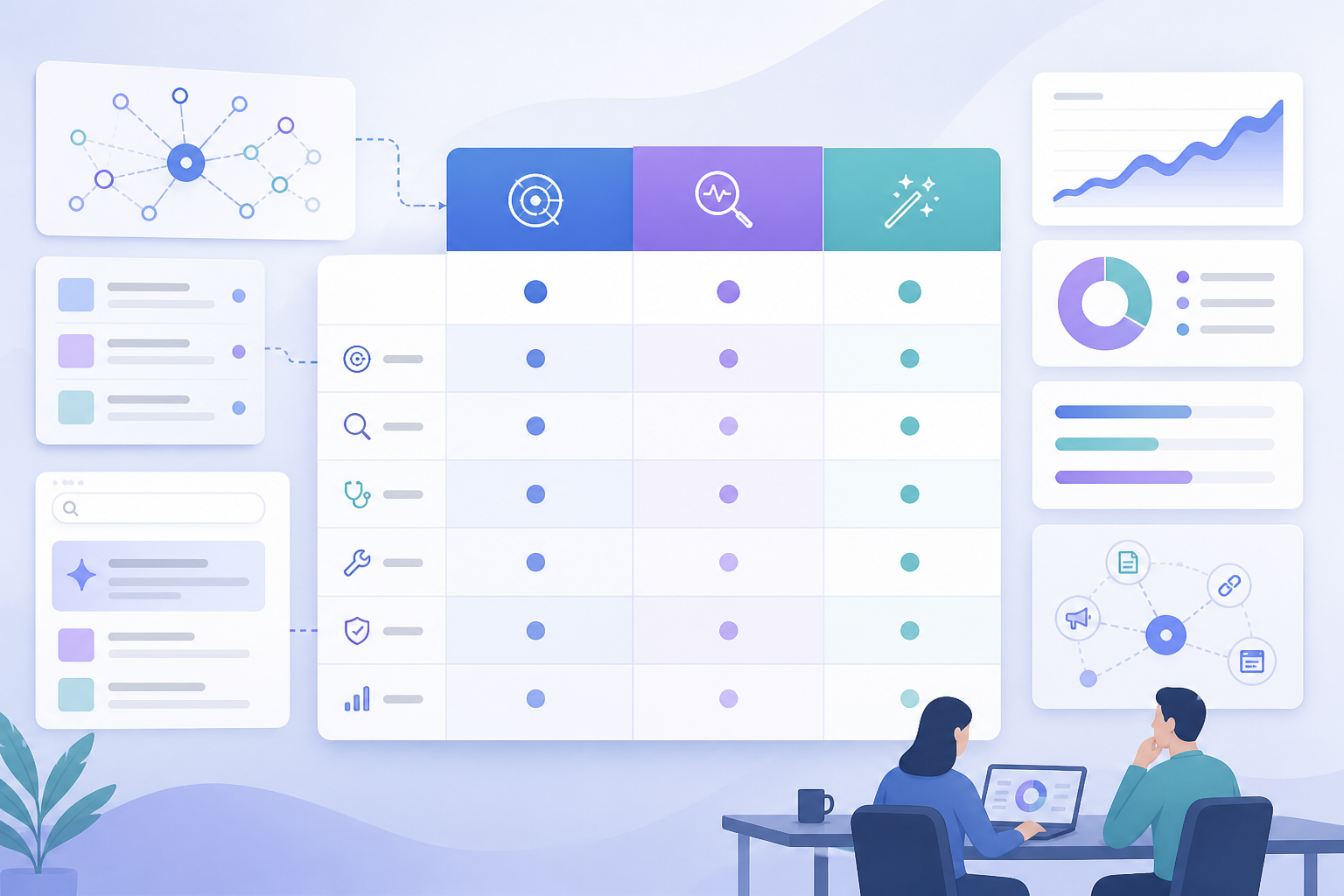
What should the first 90 days look like?
The first 90 days should create a baseline, remove access blockers, strengthen retrievable evidence, and retest priority prompts. The goal is not to chase every AI mention; it is to improve visibility in the answer journeys that influence real buyers.
Days 1–30: establish the baseline
Start with a controlled prompt map. Include branded, non-branded, competitor, “best,” “alternative,” “how to choose,” and problem-led queries.
Track:
- Mention rate.
- Citation rate.
- Recommendation position.
- Sentiment.
- AI share of voice.
- Competitor frequency.
- Source domains.
- Incorrect claims.
- Pages that should be cited but are not.
This baseline should become your measurement contract. Avoid changing prompts every week, or you will not know whether performance changed.
Days 31–60: fix retrieval and evidence gaps
Next, audit the pages and sources that answer engines can use. Improve pages that already have authority before creating net-new content.
Priority fixes usually include:
- Clearer category definitions.
- Comparison pages with factual, non-exaggerated claims.
- Product and integration pages with structured information.
- Updated author, organization, and review signals.
- Crawlable internal links.
- Public documentation and use-case pages.
- Consistent brand descriptions across third-party profiles.
If AI systems cite an outdated review or marketplace listing, update the upstream source. If they omit your strongest product page, check whether it is crawlable, internally linked, and semantically explicit.
Days 61–90: retest and operationalize
Retest the same prompt set and compare outcomes by cluster. A useful report should separate:
- Wins from new mentions.
- Wins from better recommendation position.
- Wins from owned-source citations.
- Losses where competitors gained.
- Neutral changes caused by answer variability.
At this stage, AI visibility becomes an operating rhythm. Product marketing updates claims. SEO improves retrievability. PR strengthens external evidence. Web teams remove access blockers. Leadership receives a concise answer-market report, not a pile of screenshots.
Common mistakes that make AI visibility programs fail
Most failures come from measuring too narrowly or optimizing the wrong asset. AI answers are shaped by a mix of owned content, third-party evidence, crawl access, and model-specific retrieval behavior.
Avoid these mistakes:
- Tracking only branded prompts. Branded visibility is useful, but category and comparison prompts drive discovery.
- Counting mentions without sentiment. Being named as “not suitable for enterprise teams” is not a win.
- Ignoring citations. Mentions show exposure; citations show retrievable evidence.
- Blocking useful crawlers by accident. WAF rules and broad bot blocks can erase eligible pages from AI retrieval.
- Publishing generic AEO content. Answer engines reward clear, specific, evidence-rich passages more than vague category pages.
- Expecting deterministic rankings. AI answers vary. Use repeated tests and trend lines, not one-off screenshots.
- Separating SEO and AEO teams. AI search still depends heavily on crawlability, authority, content quality, and structured site architecture.
Where maxaeo.ai fits in the optimization stack
maxaeo.ai is built for teams that need to move from analyzing visibility to improving it. The platform-level value is the closed loop: monitor AI search exposure, diagnose why answer engines choose certain brands or sources, and prioritize fixes that can be verified over time.
That makes it especially relevant for teams asking:
- Which AI answers mention our brand but fail to cite us?
- Which competitors are recommended more often, and from what evidence?
- Which public pages are blocked, weak, outdated, or hard to retrieve?
- Which content updates should be prioritized first?
- Did a shipped fix improve AI visibility after retesting?
For teams already benchmarking performance, the maxaeo.ai guide to AI search visibility benchmarking provides a practical structure for comparing visibility across engines, markets, and competitors.
Frequently asked questions
Is AI visibility optimization software different from AI brand monitoring?
Yes. AI brand monitoring tracks whether and how a brand appears in AI answers. AI visibility optimization software adds diagnosis and remediation, helping teams understand why those answers appear and what actions may improve future visibility.
What metrics matter most?
The most useful metrics are mention rate, citation rate, recommendation position, sentiment, claim accuracy, AI share of voice, and owned-source citation share. A single visibility score is helpful only if the underlying components are transparent.
How many prompts should a company track?
Most teams should start with 50 to 300 prompts. A local service business may need fewer, while a multi-product SaaS or ecommerce brand may need hundreds grouped by category, persona, geography, and buying stage.
Can AI visibility be guaranteed?
No credible platform can guarantee a specific AI answer. Generative systems are variable, and retrieval sources change. What software can do is improve the probability of being found, cited, described accurately, and recommended in relevant answer journeys.
Does traditional SEO still matter for AI answers?
Yes. Crawlability, clear titles, internal links, helpful content, authority, and structured information still matter. The difference is that AI visibility also requires answer-level measurement, citation analysis, entity consistency, and repeated prompt testing.