By maxaeo
AI citations change because answer engines do not maintain one permanent source list. Each answer is rebuilt from the prompt, session context, available index, retrieved passages, competing evidence, and current model behavior. If any layer changes—or generation simply varies—the engine may cite another URL even when the original page remains accurate and indexed.
A citation change is therefore not automatically a penalty, ranking loss, or verdict on content quality. It may be temporary sampling noise, deliberate source substitution, a technical discovery problem, or persistent citation decay.
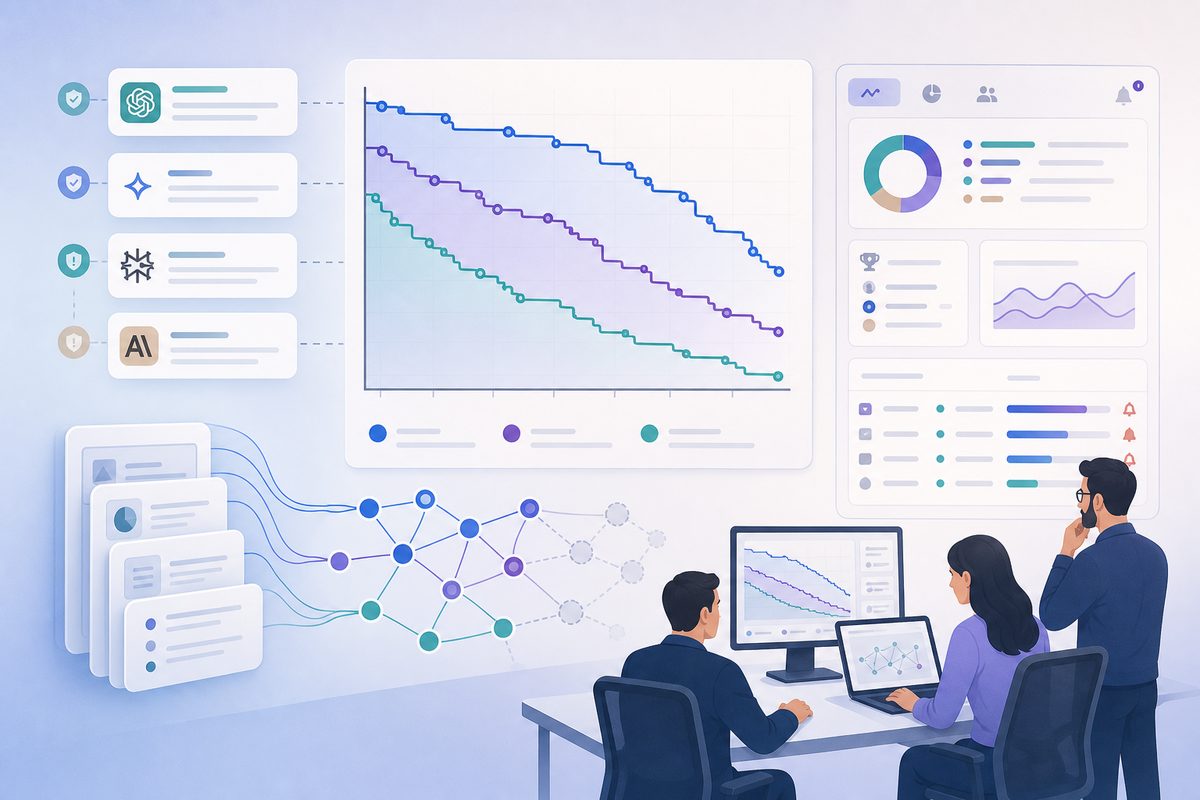
Why Do AI Citations Change? The Short Answer
AI citations usually change for one or more of seven reasons:
- Prompt wording or conversation context changed.
- The retrieval system assembled a different candidate set.
- A competing source provided stronger or more extractable evidence.
- A time-sensitive claim became outdated.
- The engine’s model or product behavior changed.
- A URL, canonical, redirect, or entity signal changed.
- The cited source became unavailable or harder to retrieve.
These causes happen at different layers and require different fixes. Updating a page may help stale evidence, but it will not repair a redirect loop or reverse an engine-wide model change.
For the underlying terminology and tracking requirements, see AI Search Citations: Definition, Tracking, and How to Earn Them.
What Is AI Citation Decay?
AI citation decay is the confirmed loss of a canonical source from repeated, comparable generated answers. It begins when the source first meets a declared presence rule and ends when it meets a declared disappearance rule. A single missing generation is variation—not sufficient evidence that the citation has decayed.
Useful terms include:
- Citation episode: One continuous period during which a canonical source remains cited.
- Source substitution: The answer remains similar, but a different source supports it.
- Answer drift: The claim, recommendation, or description changes, whether or not the citation changes.
- Revival: A previously lost citation returns after its first confirmed disappearance.
- Citation half-life: The time by which half of comparable citation episodes have ended.
Citation decay is narrower than overall brand visibility. An answer may continue mentioning a brand while citing a different source. It may also retain the same citation while changing the claim that the source appears to support.
| Answer state | Citation state | What changed |
|---|---|---|
| Stable | Stable | No observed answer or source turnover |
| Stable | Changed | Source substitution |
| Changed | Stable | The same source was interpreted differently |
| Changed | Changed | Both the answer and supporting evidence turned over |
| Absent | Absent | The topic, brand, or recommendation disappeared |
Track the answer, supported claim, canonical URL, citation position, and brand treatment separately. A link count alone cannot distinguish these states.
The Seven Main Reasons AI Citations Change
| Cause | How it changes citations | Typical signature | What to verify |
|---|---|---|---|
| Prompt and context | Small wording, history, or locale differences alter the interpreted question | Change appears only in certain sessions or prompt variants | Exact prompt, conversation history, language, location, account state |
| Retrieval variation | The engine retrieves a different set of candidate passages | Several sources rotate without a clear content change | Replicated runs, related prompts, source overlap |
| Evidence competition | A more direct, current, or authoritative passage displaces the source | One replacement URL appears repeatedly | Lost and replacement passages, attribution, source type |
| Freshness decay | A claim no longer meets the query’s recency requirements | Gradual loss on pricing, statistics, leadership, or product queries | Dates, primary sources, changed facts |
| Model or product update | Source selection or answer construction changes across the system | Many unrelated prompts shift during the same period | Engine segments, visible model label, release window |
| Technical or entity change | Discovery or identity signals fragment across URLs or domains | Old and new URLs split appearances | Status codes, redirects, canonicals, internal links, entity names |
| Source availability | Access restrictions or temporary failures remove the source from consideration | Citation loss coincides with access or rendering failures | Robots rules, authentication, server errors, rendered content |
No single clue proves causation. A citation that returns after a content update suggests—but does not prove—that the update caused recovery. Retrieval refreshes, competitor changes, and model behavior may have changed simultaneously.
Why Can a Page Rank in Google but Lose an AI Citation?
Traditional search visibility and AI citation visibility measure different selection events. A page can rank well for the original query but lose a citation if an answer engine retrieves a different passage for a subtopic, prefers a primary source for one claim, or finds a more concise answer elsewhere.
Google states that its AI search features may use query fan-out, issuing multiple related searches across subtopics and data sources. Its official documentation for AI features and websites explains why the evidence pool for a generated answer may extend beyond the results most visible for the user’s original wording.
| Dimension | Traditional search result | AI-generated answer citation |
|---|---|---|
| Primary selection unit | Usually a page for a query | Often a passage for a claim or subquery |
| User-visible output | Ranked result list | Synthesized answer with selected links |
| Context sensitivity | Query, location, device, personalization | Those variables plus conversation history and model behavior |
| Main measurement | Position, impressions, clicks | Presence, supported claim, citation position, survival |
| Common change | A URL moves between positions | A source appears, disappears, or supports a different statement |
Traditional rankings can still matter because discoverable, authoritative pages are more likely to enter retrieval systems. They do not guarantee that a particular page will be selected for every generated answer.
How Freshness Changes Citation Survival
Freshness matters when the cited claim can expire—not simply when a page becomes old. A five-year-old definition may remain valid, while a six-month-old price, executive list, certification status, or market statistic may already be unsafe to cite.
Evaluate freshness at the claim level:
- What exact statement did the citation support?
- Can that statement become outdated?
- Is its measurement period explicit?
- Does the page identify the primary source and methodology?
- Has a more recent first-party source published a replacement value?
- Was only the displayed date changed, or was the evidence actually updated?
Changing “last updated” without reviewing the underlying claim does not improve evidence quality. For a source-repair process, use Outdated AI Citations: How to Find, Prioritize, and Fix Stale Sources.
How Competing Evidence Displaces a Source
A replacement source often wins because one passage is more useful for the exact claim being generated. The winning page does not need to be better in every respect.
Compare the lost and replacement passages for:
- A direct answer near the beginning of the page.
- A named date, market, sample, or measurement period.
- Attribution to a primary source.
- Clearer entity and product names.
- Independent corroboration.
- A concise table, definition, or comparison.
- Fewer qualifications the answer engine must infer.
- Better alignment with the user’s audience or location.
Ask: “What could the replacement passage support that ours could not support as safely or directly?” That question is more diagnostic than comparing domain authority or total word count.
Source type also matters. A first-party specification may be preferred for product capabilities, while an independent review may be more useful for comparative recommendations. Neither source type is universally superior.
How Model Updates Create Structural Breaks
A model or product update becomes a plausible cause when unrelated prompts, domains, and source types change together. In survival analysis, this appears as a portfolio-wide increase in disappearance risk rather than an isolated page decline.
Record the visible engine and model label with every observation. Annotate known update dates on the citation timeline, then compare disappearance rates before and after each date.
Treat timing as evidence, not proof:
- If one URL or topic changed, investigate its evidence and retrieval path first.
- If unrelated prompt clusters changed together, a system-level cause becomes more plausible.
- If results return to their previous state within a few checks, the spike may reflect temporary volatility.
- If the new pattern persists, establish a new baseline before making site-wide edits.
The model-update visibility guide provides a fuller protocol for separating system shifts from ordinary sampling variation.
Is the Change Noise or Persistent Citation Decay?
A one-run change is usually insufficient to declare citation decay. Generated answers are variable, and retrieval candidates can rotate between otherwise similar runs.
Use the following evidence before treating a loss as persistent:
| More likely normal variation | More likely persistent decay |
|---|---|
| Citation is missing in one run but present in replicas | Citation is absent across repeated controlled checks |
| Several sources rotate without a consistent replacement | The same competing source repeatedly replaces the original |
| Loss occurs only in one conversation history | Loss also appears in clean sessions |
| Nearby prompt variants still cite the source | Multiple prompts in the same cluster lose the source |
| Citation returns during the next scheduled check | Absence continues beyond the declared failure threshold |
| Raw URL changed but canonical source remained | The canonical source disappeared entirely |
A practical daily monitoring rule is:
- Run the same prompt three times under controlled conditions.
- Mark the source present when at least two runs cite its canonical URL.
- Confirm disappearance after three consecutive absent daily states.
- Continue checking for revival.
This is a measurement policy, not an industry standard. High-frequency monitoring can use a shorter window; weekly monitoring may require two or three consecutive weekly absences. The rule must be declared before results are analyzed.
What Counts as One Citation Observation?
One observation should represent a fully specified engine, prompt, context, market, time, and canonical source combination. Mixing any of these variables can create false disappearance events.
Store at least:
- Engine and visible model or product label.
- Exact prompt and prompt-cluster ID.
- Timestamp and collection frequency.
- Locale, language, device, and signed-in state.
- Clean-session flag or complete conversation history.
- Generated answer and answer-text fingerprint.
- Cited URL and resolved canonical URL.
- Citation position and supported claim.
- Source domain, ownership, and source type.
- Brand mention, recommendation, sentiment, and rank.
- Collection errors or unavailable results.
Canonicalization should remove tracking parameters and fragments while preserving meaningful page differences. Redirected URLs should normally resolve to one source identity. A genuine domain migration should be recorded as an identity transition, not silently treated as a new source.
For migrations, follow Site Migrations and AI Citations: How to Change Domains Without Vanishing From AI Answers.
How to Measure Citation Decay With Survival Curves
A citation survival curve estimates the probability that a source remains cited after a specified amount of time. Unlike a snapshot count, it preserves when each disappearance occurred and correctly handles citations still present when observation ends.
1. Define a comparable population
Choose the engines, markets, prompt clusters, source types, and observation window in advance. Do not blend branded support prompts with unbranded product comparisons unless the groups will be analyzed separately.
2. Define when an episode begins
Start a citation episode only after the source meets a declared presence rule. For example, require the canonical URL to appear in two of three replicated runs.
Be careful with sources already cited when monitoring begins. Their true start dates are unknown. Treat them as a separate prevalent cohort or use methods that account for delayed entry; do not assume they were first cited on the monitoring start date.
3. Hold controllable variables constant
Use the same prompt, locale, session treatment, and collection schedule. Record unavoidable changes rather than silently combining them.
4. Define disappearance before reviewing results
A practical rule is three consecutive absent daily states. Backdate the event to the first absent state only if that convention is defined in advance.
With weekly checks, the exact disappearance time is unknown: it occurred between the last present and first absent observation. Report that interval or document which boundary the analysis uses.
5. Preserve right-censored episodes
A citation still present on the final day has not demonstrated an unlimited lifespan. It is right-censored: its observed survival time is at least as long as the study window.
Dropping these episodes biases the estimated lifespan downward.
6. Treat revival as a new event
Do not erase the first disappearance when a source returns. Record:
- Whether the citation revived.
- Time from disappearance to revival.
- Length of the new citation episode.
- Whether the same claim and canonical source returned.
7. Estimate the survival function
The Kaplan–Meier estimate is:
S(t) = ∏(1 − dᵢ / nᵢ)
Where:
S(t)is the estimated probability of surviving beyond timet.dᵢis the number of disappearances at timei.nᵢis the number of surviving, uncensored episodes immediately before that time.
The estimator comes from the original Kaplan and Meier paper.
Report confidence intervals when the sample will influence budget or strategy. Small cohorts can produce visually dramatic curves with substantial uncertainty.
A Transparent Citation Half-Life Example
The following constructed example demonstrates the calculation. It is not a maxaeo customer result or an industry benchmark.
Twelve citation episodes are monitored daily for 30 days. Each daily state comes from three replicated runs, and presence requires citation in at least two runs.
| Cohort | Observed episode durations in days | Day-30 survival | Median citation half-life |
|---|---|---|---|
| Time-sensitive sources | 6, 10, 12, 18, 24, 30+ | 16.7% | 12 days |
| Evergreen explainers | 18, 28, 30+, 30+, 30+, 30+ | 66.7% | Not reached |
30+ means the citation was still present when monitoring ended and is right-censored.
For the time-sensitive cohort, one of six episodes disappears on day 6, one of the remaining five on day 10, and one of the remaining four on day 12:
S(12) = (5/6) × (4/5) × (3/4) = 0.50
The estimated survival reaches 50% on day 12, so the median half-life is 12 days.
For the evergreen cohort, four of six episodes remain at day 30. The survival curve never falls to 50%, so the median is not reached. Reporting it as 30 days would be incorrect.

The FRESH Framework for Diagnosing Citation Loss
FRESH classifies citation change into five testable cause families: Freshness, Retrieval, Evidence, System, and History. It prevents teams from automatically rewriting content when the actual problem is technical, competitive, or context-dependent.
| Factor | Diagnostic question | Evidence to inspect | Appropriate response |
|---|---|---|---|
| F — Freshness | Did the supported claim become outdated? | Primary sources, dates, changed facts, replacement statistics | Correct and re-source the affected passage |
| R — Retrieval | Can the engine still discover and identify the intended page? | Status codes, rendering, canonicals, redirects, indexing observations | Repair access and consolidate URLs |
| E — Evidence | Did another source provide safer or more direct support? | Lost and replacement passages, attribution, source type | Improve the answer block or earn corroboration |
| S — System | Did unrelated citations change together? | Portfolio hazard, engine segments, update timing | Rebaseline before making broad edits |
| H — History | Is the result dependent on prompt or session context? | Prompt order, conversation history, locale, account state | Split the measurement population |
Apply FRESH using evidence from a window around the disappearance date. Record page edits, competitor publications, redirects, migrations, product updates, and failures in the monitoring controls.
What to Do When an AI Citation Disappears
Follow this sequence to avoid editing the wrong layer:
-
Save the original evidence.
Preserve the answer, cited URL, supported claim, timestamp, engine, prompt, and session state. -
Repeat the controlled check.
Run replicas using the same conditions. Do not declare decay from a single generation. -
Measure the scope.
Determine whether the loss affects one prompt, a prompt cluster, one engine, one source type, or the entire portfolio. -
Identify the replacement.
Compare replacement passages with the lost passage. Note stronger attribution, specificity, recency, or entity alignment. -
Check the retrieval path.
Test the final response code, canonical, redirect chain, rendering, internal links, and domain continuity. -
Audit the supported claim.
Verify the fact against its primary source. Update the evidence, period, or methodology when necessary. -
Check for a system-level break.
Compare unrelated prompt cohorts before blaming a model update. -
Apply one traceable intervention.
Avoid changing content, redirects, schema, and internal links simultaneously. A single intervention produces clearer evidence. -
Monitor revival and persistence.
One returning citation is not proof of durable recovery. Measure the new episode using the same presence and disappearance rules.
Which Fix Matches Each Cause?
| Diagnosed cause | High-value fix | Fixes unlikely to help |
|---|---|---|
| Stale fact or statistic | Replace the claim with current primary evidence and state the period | Changing only the page date |
| Weak answer passage | Add a concise, self-contained answer with adjacent attribution | Increasing word count without improving evidence |
| Stronger competing source | Address the missing evidence or earn independent corroboration | Copying the competitor’s wording |
| Broken retrieval path | Repair status codes, redirects, canonicals, rendering, and internal links | Rewriting unrelated sections |
| Entity fragmentation | Standardize names and consolidate duplicate or migrated URLs | Publishing another near-duplicate page |
| Engine-wide change | Establish a post-change baseline and retest | Editing every affected page immediately |
| Session dependence | Separate clean and contextual runs | Averaging incompatible observations |
When independent third-party evidence is required, seek accurate coverage rather than manufacturing mentions. First-party claims and earned corroboration play different roles in comparative answers.
How to Prioritize Citation Repairs
Not every lost citation deserves the same effort. Use a transparent prioritization score:
Priority = (Business relevance × Decay confidence × Controllability) ÷ Effort
Suggested inputs:
- Business relevance: 1–5 based on the prompt’s connection to reputation, consideration, or revenue.
- Decay confidence: 0–1 based on replication, duration, and prompt-cluster evidence.
- Controllability: 1–5 based on whether the cause is within the organization’s influence.
- Effort: 1–5 based on implementation and coordination cost.
This is a planning heuristic, not a statistical probability. Its purpose is to prevent a highly visible but unverified one-run change from outranking a persistent, commercially important citation loss.
How Monitoring Should Differ by Product Condition
Do not compare observations collected under materially different product conditions.
| Product condition | Why citations may differ | Required control |
|---|---|---|
| Live-web retrieval enabled | Available pages, indexes, and retrieval rankings can change | Record retrieval mode and collection time |
| Web retrieval unavailable or disabled | The answer may contain no comparable visible citations | Analyze as a separate population |
| Existing conversation | Earlier turns can reshape the interpreted query | Save history or start a clean session |
| Signed-in or personalized experience | Account settings and location may affect results | Keep account state consistent |
| Visible model selection | Different models may select or summarize evidence differently | Record the exact displayed label |
| Rapidly updated answer engine | Sources may change between checks without a named model release | Monitor product behavior, not only release announcements |
Perplexity, ChatGPT, Gemini, Claude, Copilot, and Google’s AI features should be reported separately unless testing shows their observations are comparable. For a product-specific example, see How Perplexity Picks Sources.
Which Citation Metrics Should Be Reported?
Citation survival and AI share of voice answer different questions. Share of voice measures how often a brand appears relative to competitors; survival measures whether the sources supporting that visibility persist.
| Metric | Question answered |
|---|---|
| Day-30 citation survival | What percentage of new episodes remain after 30 days? |
| Median citation half-life | When have half of comparable episodes ended? |
| Interval hazard | During which period is disappearance risk highest? |
| Revival rate | What percentage of disappeared citations return? |
| Median time to revival | How long does recovery usually take? |
| Source concentration | How dependent is visibility on a few domains? |
| Replacement-source share | Which domains repeatedly displace the brand’s sources? |
| Commercial-prompt survival | Do citations persist for high-value prompts? |
| Claim retention | Does the intended claim survive even when the URL changes? |
Segment every metric by engine, prompt cluster, market, source type, and source ownership. A blended average can hide durable visibility in one engine and rapid decay in another.
Retain the underlying answers and citations so stakeholders can audit how each metric was produced.
Measurement Mistakes That Create False Decay
Avoid these errors:
- Declaring a loss after one missing generation.
- Changing prompt wording during the observation window.
- Mixing clean sessions with conversations containing prior context.
- Combining locales, accounts, or product modes.
- Tracking raw URLs without canonicalization.
- Treating a redirect to the same canonical source as a new citation.
- Assuming monitoring began when an existing citation first appeared.
- Dropping right-censored episodes.
- Treating lower citation position as complete disappearance.
- Resetting history after every content update.
- Assigning causation from timing alone.
- Refreshing dates without reviewing the underlying evidence.
- Reporting citation counts without recording the supported claims.
- Comparing half-lives from cohorts with different collection intervals.
- Treating “median not reached” as zero or as the study duration.
A written protocol is the best protection against reactive decisions based on unstable observations.
Frequently Asked Questions
Why do AI citations change from one run to the next?
Retrieval candidates, generated wording, and prompt interpretation can vary between runs. Conversation history, location, model selection, and available web results can also change the evidence pool.
One changed result demonstrates variability, not permanent source loss. Confirm decay with controlled replicas and a predefined consecutive-absence rule.
How often should AI citations be checked?
Daily checks are appropriate for changing statistics, product comparisons, pricing, news, and reputation-sensitive prompts. Weekly checks may be sufficient for evergreen definitions and stable educational queries.
Use a collection interval shorter than the changes you need to detect, and keep the schedule consistent throughout the comparison period.
What is a good AI citation half-life?
There is no universal benchmark. Expected half-life depends on the engine, prompt intent, market, source type, collection method, and how quickly the underlying facts change.
Build internal baselines from comparable cohorts. Prioritize significant declines against the page’s own history and relevant competitor sources.
Does refreshing a page restore a lost citation?
Not reliably. A substantive update may help when a cited passage is outdated, ambiguous, or weaker than competing evidence. It will not fix a broken redirect, fragmented canonical signals, session-dependent behavior, or a system-wide change.
Record the intervention date and compare recovery with an untreated cohort where possible.
Can a brand mention survive after its citation disappears?
Yes. An answer may continue mentioning or recommending a brand while citing a different source—or no visible source for that statement. The opposite is also possible: the page remains cited while the brand’s description or recommendation rank changes.
Track mentions, claims, citations, sentiment, and source ownership as separate fields.
Can AI citation changes be prevented?
Not completely. Answer engines, indexes, competing sources, and user context continue to change. The practical goal is to reduce avoidable losses, extend the survival of accurate evidence, and detect meaningful decay before it affects important prompt clusters.
Is an AI citation loss the same as a Google ranking drop?
No. A page can retain its organic position while losing an AI citation, and it can gain a citation without ranking first for the original query. Investigate traditional rankings and generated-answer citations as related but distinct visibility systems.
Turn Citation Volatility Into a Retention Metric
Why AI citations change has no single universal answer, but it can be measured systematically. Define comparable citation episodes, control the prompt and session, preserve censored observations, and report survival by engine, source type, and prompt cluster.
Then use FRESH—Freshness, Retrieval, Evidence, System, and History—to diagnose the likely cause. The objective is not to make every citation permanent. It is to keep accurate evidence visible longer, repair controllable losses, and avoid wasting resources on normal generation noise.