Getting cited by Perplexity is a different game than ranking on Google. Perplexity is a live-web answer engine: it retrieves fresh sources for almost every query, leans hard on community discussion, and rewards pages it can quote cleanly. So the honest answer to how to get cited by Perplexity is that classic SEO signals — backlinks, domain age, exact-match keywords — matter far less than retrievability, freshness, and corroboration. This playbook breaks down how Perplexity actually picks sources, backed by public citation studies and the patterns we track daily across AI answer engines, then hands you a checklist to act on.
How does Perplexity choose which sources to cite?
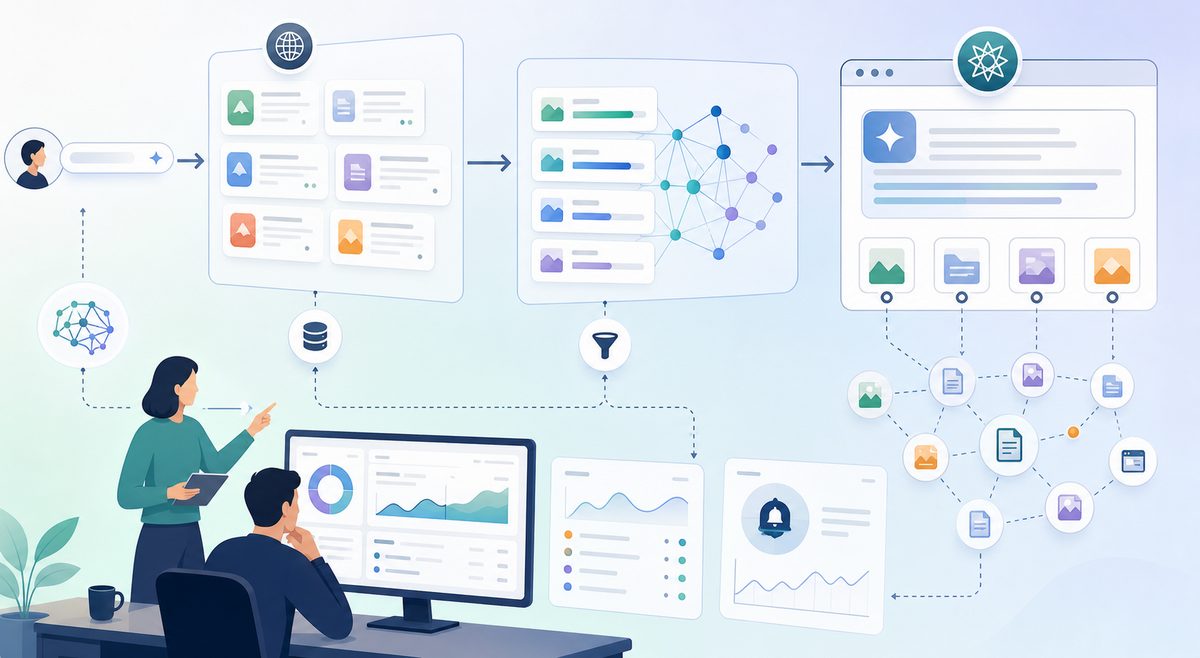
Perplexity chooses sources through a real-time retrieval pipeline: it reformulates your query, pulls dozens of live candidate pages, reranks them with machine-learning filters, then assigns citations before the language model writes a word. It is Retrieval-Augmented Generation (RAG) against the open web, not recall from a frozen training set.
That architecture matters because citations are pre-assigned. According to a teardown of Perplexity's answer pipeline by ZipTie, the system embeds source URLs, publication dates, and ranked excerpts into the prompt before generation, so the model can only cite from a shortlist it already trusts. Your job is not to persuade the writer — it is to survive the shortlist. Which index each assistant draws from shapes that shortlist; we mapped it in our guide to which search engines power each AI engine's answers.
The retrieval-to-citation funnel
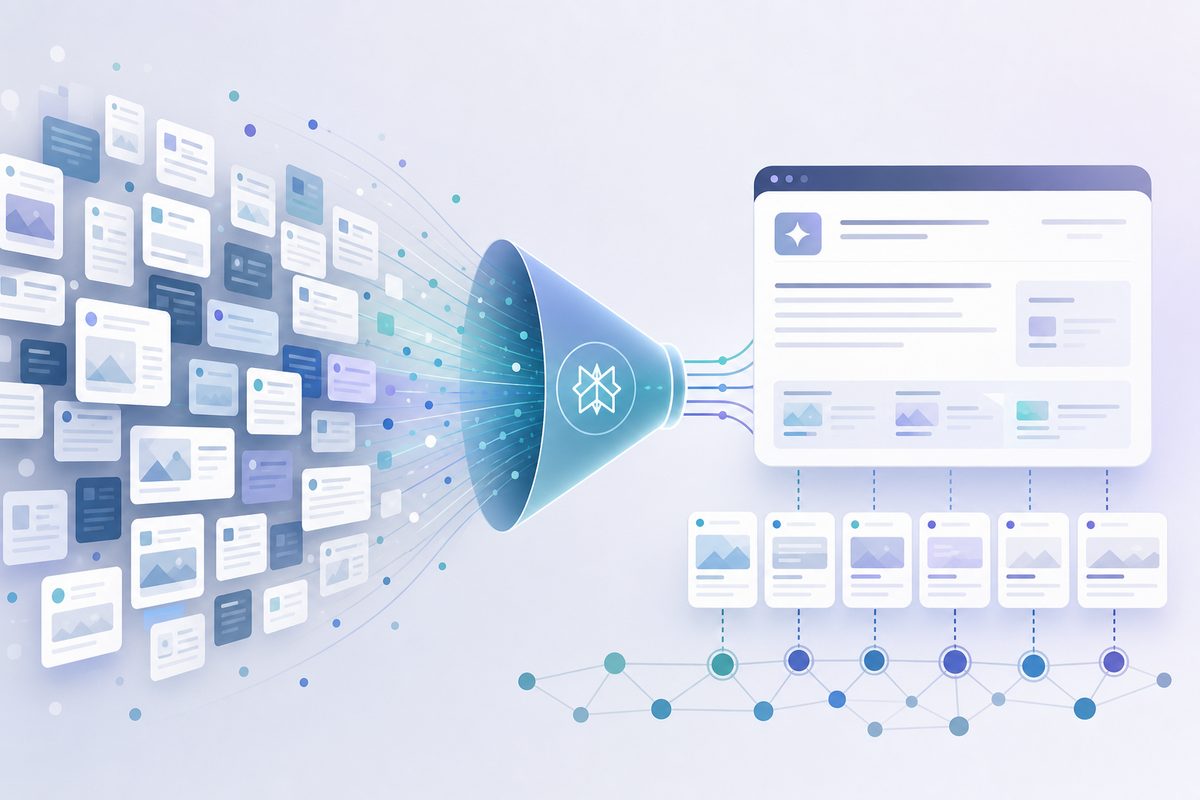
Perplexity retrieves far more than it shows. A standard search pulls 60+ candidate sources per query — Deep Research mode pulls hundreds — then narrows to a handful in the final answer. Tinuiti's January 2026 data put Perplexity's citation density at an average of 8.2 sources per answer, roughly 3.4× denser than ChatGPT.
The funnel looks like this:
- Retrieve: 60+ live pages via BM25 (keyword), dense (semantic), and hybrid methods
- Rerank: three ML layers (L1–L3) score candidates against a quality threshold (~0.7)
- Cite: typically 4–8 pages earn inline citations
If too few candidates clear the bar, ZipTie's analysis notes, the whole set is discarded and retrieval restarts. Being retrieved is not enough; you must be one of the few that clears reranking.
Why Perplexity's playbook differs from Google and Claude
Perplexity behaves like a live-web engine, so freshness and clean extraction beat the authority signals that win on Google. Optimizing for it in isolation is a mistake — but so is assuming one AEO checklist covers every engine. The mechanics diverge in ways that change your priorities.
| Dimension | Perplexity | Google AI Overviews | Claude |
|---|---|---|---|
| Retrieval model | Live retrieval on nearly every query | Grounded in Google's index | Live web search when the assistant decides to browse |
| Sources per answer | High (avg ~8.2 cited) | Moderate, blends organic results | Conservative, fewer sources |
| Community-source lean | Heavy (Reddit-dominant) | Moderate | Light |
| Freshness weight | Very high | High | Moderate |
| Backlink dependence | Low | Still meaningful | Lower than Google |
| Trackable referral traffic | Yes | Limited (often zero-click) | Minimal |
The takeaway: the same page can be too "SEO-shaped" for Perplexity and too thin for Google. Claude, by contrast, rewards workplace-grade, well-structured references — we cover that in how to get cited by Claude. Treat answer engine optimization as engine-specific, not one-size-fits-all.

The three gates every cited page must pass
We frame Perplexity citation as three sequential gates. Fail any one and you are out — regardless of how strong the other two are. This is our synthesis of public citation studies plus the movement we watch in tracking panels.
Gate 1 — Retrievability: can the bot fetch you, fast?
Retrievability means Perplexity's crawler can actually reach and load your page in real time. If the crawler is blocked or your page is slow, nothing downstream matters — you never enter the candidate set.
Concrete checks:
- Allow the crawlers. Perplexity uses two agents:
PerplexityBotfor indexing andPerplexity-Userfor live, on-behalf-of-a-user fetches. The indexing user-agent string isMozilla/5.0 AppleWebKit/537.36 (KHTML, like Gecko; compatible; PerplexityBot/1.0; +https://perplexity.ai/perplexitybot). Confirm neither is disallowed in robots.txt, per Perplexity's official crawler documentation. - Watch your CDN. Cloudflare and security plugins often flag AI bots generically. Verify traffic against Perplexity's published crawler IP ranges before blanket-blocking.
- Load fast. Live retrieval has a short patience window; heavy client-side rendering and multi-second loads get abandoned for a faster competitor.
One nuance: if you block PerplexityBot, Perplexity may still index your domain, headline, and a brief factual summary — but not the full quotable text that earns real citations.
Gate 2 — Extractability: can it quote a clean claim from you?
Extractability is how cleanly a machine can lift one accurate, self-contained fact from your page and attribute it. Perplexity selects for quotable pages, not merely relevant ones.
The evidence is consistent. LLMClicks found 90% of top citations answer the core question within the first 100 words — a BLUF (bottom-line-up-front) structure. Onely reported pages with schema markup earn a 47% Top-3 citation rate versus 28% without. And Perplexity visibly favors HTML tables for comparisons and bulleted lists for steps, because they parse without ambiguity.
Practical moves: lead each section with a direct 40–60 word answer, use descriptive subheads, convert prose comparisons into tables, and keep one idea per paragraph. Treat this as a site-wide discipline, not a one-page trick — structure brand evidence across your site so retrieval systems can find and lift it.
Gate 3 — Corroboration: do independent sources agree?
Corroboration is independent, third-party agreement — community threads, forums, and reference sites that echo your claim. Perplexity treats consensus as a credibility signal, which is why community platforms punch far above their domain authority.
A Profound study of 10,000 Perplexity responses on commercial queries found Reddit cited in 46.7% of answers — no other single domain came close. Tinuiti's January 2026 read attributed roughly 31% of Perplexity citations to social media, Reddit dominant. The lesson is uncomfortable for brand-controlled content: your own page is one voice, and Perplexity actively looks for others.
Freshness is a ranking signal, not a nicety
For Perplexity, recency is a hard ranking input — stale pages lose retrieval priority even when they are accurate. This is the single biggest divergence from evergreen Google SEO.
The numbers are blunt. LLMClicks found 70% of top Perplexity citations were updated within 12–18 months. Across AI engines in 2026, content under 30 days old earns an estimated 3.2× more citations than older pages, and roughly half of all AI-cited content is less than 13 weeks old. Perplexity is materially less likely to cite pages older than 12–18 months on commercial, news, or comparison queries.
Think in a decay curve:
- 0–30 days: peak citation potential
- 30–90 days: strong window if the page stays accurate and well-structured
- 90–180 days: decay begins as fresher competitors outrank you
The fix is a real update cadence — revised data, new dates, added sections — not a touched timestamp. Freshness is earned quarterly, not claimed once.
Why backlinks barely move the needle on Perplexity
On Perplexity, backlinks are close to irrelevant — clean, fresh, quotable content beats link authority. This is the most counterintuitive finding for SEO teams, and the strongest argument for a distinct generative engine optimization playbook.
ZipTie's pipeline analysis surfaced a striking figure: 92.78% of Perplexity-cited pages have fewer than 10 referring domains. The engine routinely cites pages that would never crack page one of Google on link equity. Because retrieval is semantic and real-time, a niche page that answers the exact question cleanly can beat a high-authority publisher that buries the answer.
That inverts the usual budget conversation. Instead of pouring spend into link building for AI visibility, redirect it toward extractability, freshness, and structured original data — the signals Perplexity actually rewards. Backlinks still help you get discovered and still matter on Google; they are simply not the lever here. Reserve heavy link investment for competitive commercial queries where Google still gates the click.
The community-source layer: earning corroboration honestly
To win Perplexity's community lean, be genuinely present and useful where your buyers ask real questions — do not astroturf. Perplexity rewards authentic, conversational, community-validated discussion, and it is increasingly good at discounting manufactured praise.
What this looks like in practice:
- Show up in the threads that already rank. Identify the Reddit and forum discussions Perplexity already cites for your category, and contribute substantive, disclosed, non-promotional answers.
- Give people something to quote. Publish original benchmarks, pricing breakdowns, or teardown data that community members want to reference. Corroboration follows useful facts.
- Earn neutral mentions. Comparison posts, roundups, third-party reviews, and news coverage that AI engines quote feed the "independent agreement" signal far more than your homepage does.
A word of caution on trust: Perplexity's community lean is not a license to game it. Engagement signals are volatile — one analysis noted poorly performing sources dropping out within about a week — and Columbia Journalism Review's Tow Center found Perplexity misattributed sources at a 37% error rate, which is exactly why the engine cross-checks multiple corroborating voices. Give it clean, consistent signals across the web and you become the safe brand to cite.
A worked example: turning an uncited page into a cited one
Here is an illustrative before-and-after that mirrors what we repeatedly see in tracking — a composite of a mid-market B2B SaaS "best [category] tools" page.
Before. A 2,400-word listicle, last updated 14 months ago, answer buried under a 300-word intro, no tables, 40 referring domains. It ranked #6 on Google and was cited by Perplexity in 0 of 20 tracked category prompts. Perplexity instead cited two Reddit threads and a competitor's comparison table.
Changes made. (1) Rewrote the opening to answer "what's the best tool for X" in the first 60 words. (2) Converted the feature comparison into an HTML table. (3) Added a fresh mini-study with original pricing data. (4) Updated the publish date with real revisions. (5) Seeded one honest, disclosed Reddit answer linking the data. No new backlinks.
After (tracked over ~6 weeks). The page appeared in Perplexity citations for 9 of the same 20 prompts, usually alongside — not instead of — the community threads. The lever was extractability plus freshness plus a corroborating community mention: exactly the three gates. Nothing about the domain's authority changed.

How to measure whether Perplexity is citing you
Perplexity is the most measurable AI answer engine: it passes a referrer, so citations show up as real sessions you can track — you do not have to guess. Unlike ChatGPT, it sends visible referral traffic.
Measure in two layers:
- Referral traffic: In GA4, filter Acquisition reports for
perplexity.aias a referral source to see which pages already earn clicks from citations. - Citation presence and share of voice: Referral traffic only shows pages people clicked. To see every answer where you are cited, described, or ranked against rivals — including prompts where a competitor owns the shortlist — you need continuous ai search monitoring across engines.
This is where an ai visibility tool earns its keep. MaxAEO runs your priority prompts daily across Perplexity, ChatGPT, Gemini, Claude, Copilot, Grok, and Google AI Mode, tracks your ai share of voice, surfaces the exact citations behind each answer, and flags which of the three gates to fix. Pair it with a source-level workflow — see AI citation tracking — to find and fix the pages driving or blocking your visibility. Measured this way, "get recommended by ChatGPT" and Perplexity stops being a hope and becomes a metric you can defend to a budget owner.
A 10-step checklist to get cited by Perplexity
Work these in order — the early steps are gates, the later ones are amplifiers.
- Unblock the crawlers. Allow
PerplexityBotandPerplexity-User; verify your CDN isn't silently filtering them. - Cut load time. Serve fast, server-rendered HTML; assume a short retrieval patience window.
- Answer first (BLUF). Put the direct answer in the opening 40–100 words of the page and each section.
- Structure for extraction. Use comparison tables, ordered lists for steps, and one idea per paragraph.
- Add schema markup. Article, FAQ, and Product/HowTo where truthful — it correlates with higher Top-3 citation rates.
- Refresh on a cadence. Update data and dates quarterly; treat anything past 90 days as at-risk.
- Publish original data. Ship benchmarks, surveys, or first-hand results that others want to quote.
- Support honest community discussion. Contribute disclosed, useful answers in threads your buyers actually read.
- Earn third-party corroboration. Get into neutral roundups, reviews, and comparisons for the "independent agreement" signal.
- Track and iterate. Monitor citations and share of voice weekly; fix the specific gate each missed prompt reveals.
Frequently asked questions
How long does it take to get cited by Perplexity after publishing?
Because retrieval is real-time, a well-structured page can be cited within days once PerplexityBot has crawled it — much faster than earning a Google ranking. In our tracking, the delay is usually crawl-and-freshness, not authority-building. Keep the page fast and quotable and you shorten the wait.
Does Perplexity cite sources that block PerplexityBot?
Rarely, and only shallowly. If you disallow the crawler in robots.txt, Perplexity may still surface your domain name, headline, and a short factual summary, but it won't have the full text needed for a substantive, quoted citation. To be cited properly, you must let it fetch the page.
Do I need backlinks to get cited by Perplexity?
No. Analysis of Perplexity-cited pages found roughly 93% had fewer than 10 referring domains. Backlinks help discovery and still matter on Google, but Perplexity's semantic, live-web retrieval rewards clean, fresh, quotable content over link authority. Spend on extractability and freshness first.
Can I track when Perplexity cites my brand?
Yes — more easily than most engines. Perplexity sends referral traffic you can see in GA4, and a dedicated llm brand tracking platform like MaxAEO shows every answer where you're cited or described, plus your share of voice against competitors, so you can prove impact and prioritize fixes.
Is getting cited by Perplexity different from ranking on Google?
Fundamentally. Google rewards authority and evergreen depth; Perplexity rewards real-time retrievability, recency, structured extractability, and independent corroboration. A page tuned only for Google can be invisible on Perplexity, which is why AEO and GEO deserve their own playbook rather than a reused SEO checklist.