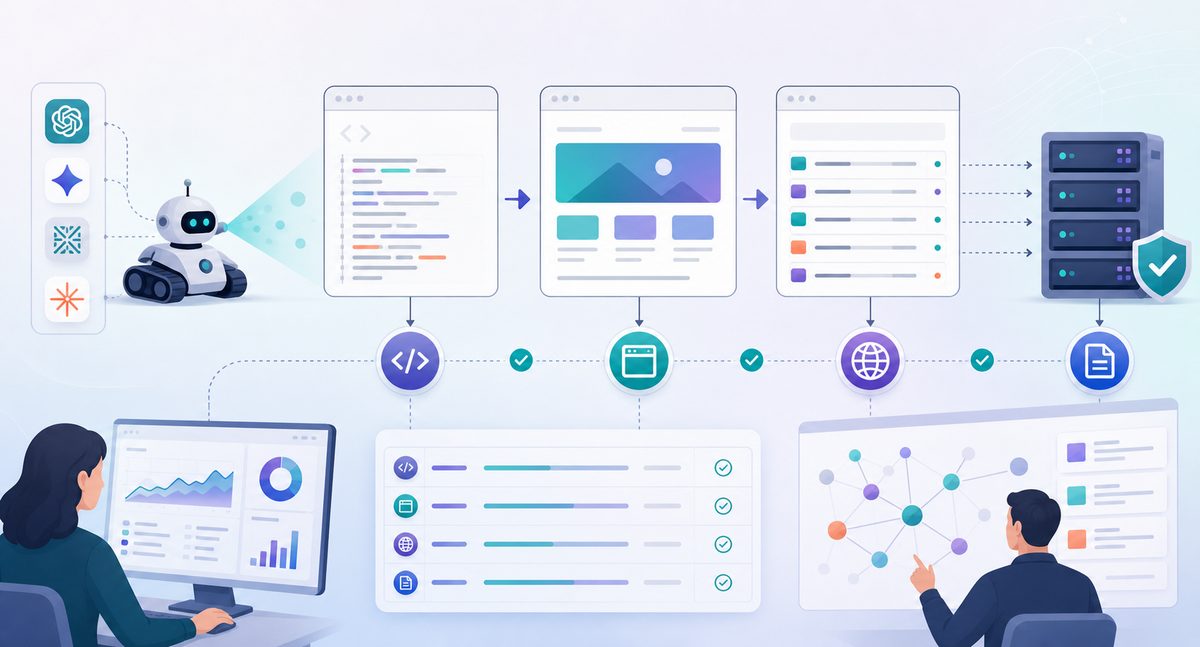
Answer engine optimization software has become a crowded category. Some products monitor whether a brand appears in ChatGPT. Others trace the sources behind an answer, compare competitors, analyze sentiment, improve content, or operate a full enterprise AEO program. Vendors often call all of these products “AEO tools,” even though they solve different parts of the job.
The short answer: MaxAEO is the best fit for lean marketing, brand, SEO, and agency teams that want a practical monitoring-to-optimization loop. Profound is the strongest enterprise choice for organizations that need deep analytics, governance, agents, and large-scale operations. OtterlyAI is an accessible option for transparent prompt monitoring, while HubSpot AEO offers a simple entry point for teams that want 25 prompts across three engines.
We ranked MaxAEO first because this is MaxAEO’s own guide. That commercial relationship is important context. To keep the comparison useful, we published the evaluation criteria, verified current public product and pricing pages on July 14, 2026, included limitations for MaxAEO, and avoided inventing hands-on test scores or G2 ratings.
The more important buying question is, “How quickly can this platform move us from an AI-answer gap to a verified improvement?” A useful platform should cover prompt research, a baseline, diagnosis, action, and remeasurement.
Best AEO Tools at a Glance
| Rank | AEO tool | Best for | Named AI coverage | Citation, competitor, and sentiment depth | Optimization-loop strength | Starting price or packaging note |
|---|---|---|---|---|---|---|
| 1 | MaxAEO | Lean teams that want monitoring plus prioritized optimization actions | Homepage names ChatGPT, Gemini, Perplexity, Claude, Copilot, Grok, AI Mode, and AI Overview; plan access varies | Strong across citations, competitors, sentiment, and recommendation position | Strong | $19/month Starter; annual from $15/month |
| 2 | Profound | Enterprise AEO programs, agents, governance, and executive reporting | Broad answer-engine coverage; Starter is currently ChatGPT-only | Deep enterprise answer, source, demand, and workflow intelligence | Strong | $99/month Starter billed yearly; $399 Growth |
| 3 | OtterlyAI | Small teams and agencies that want transparent prompt monitoring | Four base engines, with AI Mode, Gemini, and Claude sold as add-ons | Strong monitoring, citations, reports, and sentiment | Moderate | $29/month Lite |
| 4 | Peec AI | Marketing teams that want clean daily analytics across selected models | Public plans let buyers choose three models; more can be added | Strong visibility, position, competitor, and content-gap analysis | Moderate | Current public limits are clear; verify live price |
| 5 | Scrunch | Enterprises connecting AEO intelligence to AI-ready content and agent experiences | Multi-engine enterprise monitoring | Strong brand, source, content, and agent-readiness workflows | Strong | $250/month Core; Enterprise custom |
| 6 | AthenaHQ | Competitive intelligence and action-oriented AI-search programs | Public plans name ChatGPT, Perplexity, AI Overviews, Gemini, Claude, and more | Strong competitive blindspot and content-action capabilities | Strong | Free Essential; Starter $295/month |
| 7 | Semrush AI Visibility Toolkit | SEO teams already operating in Semrush | Major AI-search experiences inside the Semrush ecosystem | Strong research and SEO context; package details change | Moderate to strong | Verify current Semrush packaging |
| 8 | HubSpot AEO | A fast, lightweight AEO baseline with HubSpot context | ChatGPT, Perplexity, and Gemini | Visibility score, prompt tracking, competitor citations, recommendations | Moderate | $50/month or $45/month annually |
| 9 | SE Visible / SE Ranking | Teams that want brand intelligence plus an adjacent SEO/GEO suite | SE Visible names Gemini, AI Overviews, AI Mode, Perplexity, and ChatGPT | Strong visibility, sentiment, sources, and competitor analysis | Moderate to strong | SE Visible from $99/month |
| 10 | Ahrefs Brand Radar | Ahrefs users researching large-scale AI demand, competitors, and sources | AI Overviews, AI Mode, ChatGPT, Perplexity, Copilot, Gemini, and custom prompts | Strong research, citations, web-index context, and competitive discovery | Moderate | Plan and region dependent; verify current bundle |
Engine names on a homepage do not necessarily equal engines included in the least expensive plan. OtterlyAI sells several engines as add-ons, Profound’s Starter plan is currently ChatGPT-only, Peec plans start with three chosen models, and MaxAEO’s current self-serve pricing page describes four selected platforms with approximately six available. Verify the exact engines, countries, prompt frequency, and add-on economics before buying.
What Does an AEO Tool Actually Do?
An AEO tool measures and improves how answer engines describe, cite, and recommend a brand. Unlike a traditional rank tracker, it asks whether the brand enters a buyer’s shortlist, which competitor is recommended first, whether the answer is accurate, which sources shaped it, and what the team should fix next.
“AEO,” “GEO,” “AI SEO,” and “AI visibility” overlap, but buyers do not need a vocabulary debate before selecting software. They need an operating loop that covers five jobs.
1. Build a representative prompt set
The first job is prompt research. A useful set includes category questions, comparisons, problems, audiences, locations, purchase stages, and natural variations. Tracking only the brand name will tell you whether an engine knows the company, but not whether the company enters unbranded buying conversations.
2. Establish a brand and competitor baseline
The platform should measure mention rate, recommendation position, share of voice, answer consistency, and competitor frequency. A baseline turns “ChatGPT never mentions us” into a testable statement tied to specific prompts, models, dates, and markets.
3. Diagnose engine, topic, sentiment, and source gaps
Good AEO software explains why the baseline looks the way it does. It should reveal which prompts trigger competitors, which engines differ, whether the brand is described accurately, and which domains or pages are cited. If citation monitoring is your immediate priority, our separate guide to the best tools for monitoring AI citations goes deeper on that layer.
4. Execute content and source fixes
This is where platforms diverge. Some stop at a dashboard. Others recommend content updates, comparison pages, listicles, entity fixes, digital PR targets, third-party placements, technical changes, or new prompt-focused assets. A visibility score without a next action can become a vanity metric.
5. Remeasure and prioritize the next cycle
AI answers change as models, retrieval systems, cited pages, and competitor content change. AEO is not a one-time audit. The platform should make it possible to rerun the same prompts, compare periods, connect actions to changed outcomes, and choose the next highest-impact gap.
How We Evaluated the Best AEO Platforms
We reviewed the product through five dimensions derived from six live, AI-cited AEO listicles and the exact buyer prompts in MaxAEO’s monitoring data.
- Engine and prompt coverage: Which answer engines can the product monitor, how are prompts organized, and are engines included or sold as add-ons?
- Diagnostic depth: Does the tool show citations, sources, competitors, sentiment, position, answer text, topics, or market differences?
- Distance from insight to action: Does it only report a gap, or help the team decide what content, source, technical, or distribution action to take?
- Operational fit: How well does the product support setup, reporting, collaboration, integrations, governance, agencies, and enterprise requirements?
- Price clarity and buyer fit: Can a team understand the real entry cost, prompt limits, engine limits, and likely scaling path?
The ranking is a source-checked buyer comparison, not a controlled product benchmark. Public packages can change after publication, and vendor-reported case studies are directional evidence rather than guaranteed outcomes.
1. MaxAEO — Best for a Practical Monitoring-to-Optimization Loop
Best for: Marketing, brand, SEO/AEO, founder, and agency teams that need daily AI visibility data plus a prioritized list of actions.
MaxAEO is an AI-search brand visibility monitoring and optimization platform. It tracks how major AI experiences mention, rank, cite, and describe a brand, then connects those observations to competitor gaps, sentiment, citation sources, and content optimization work.
Where This Tool Shines
MaxAEO excels at shortening the distance between a bad answer and the next useful action. A team can start with a no-code brand diagnosis, identify the prompts and platforms where competitors win, inspect the sentiment and sources behind the gap, and move the finding into a structured optimization action. The product is designed around the full baseline → diagnosis → action → remeasurement cycle.
The homepage names eight AI experiences: ChatGPT, Gemini, Perplexity, Claude, Copilot, Grok, Google AI Mode, and Google AI Overview. That breadth is useful for teams whose buyers do not live in one assistant. However, plan packaging matters: the live pricing page currently describes four selected platforms on self-serve plans, with approximately six available, rather than promising every named platform on every tier.
Key Features
- Prompt-level monitoring and recommendation-position analysis
- Competitor benchmarking, mention-rate trends, and share-of-voice views
- Sentiment analysis across generated answers
- Citation tracing to the domains and pages influencing answers
- Content optimization recommendations and structured action tracking
- Daily monitoring and full nine-dimension analytics on self-serve plans
- No-code setup based on a brand website and generated monitoring profile
Best For
Choose MaxAEO when the same team is responsible for both explaining the visibility problem and fixing it. It is particularly useful for a startup, growth team, agency, or brand operator that wants to know not only, “Where are we missing?” but also, “Which source, topic, comparison, or content action should we work on next?”
Teams that want a wider catalog of adjacent products can also browse MaxAEO’s AI SEO and GEO tools directory.
Pricing
The current MaxAEO pricing page lists Starter at $19/month, Growth at $149/month, and Pro at $399/month. Annual equivalents are displayed as $15, $119, and $319 per month. Enterprise is custom.
Honest limitation: MaxAEO is focused on AI-search brand visibility and optimization. A company that mainly needs a broad legacy SEO suite may prefer Semrush, Ahrefs, or SE Ranking. A procurement-heavy global enterprise that needs extensive agents, bespoke integrations, and large governance programs may prefer Profound or Scrunch. Buyers should also check which engines are included in the selected MaxAEO plan.
2. Profound — Best for Enterprise AEO Operations
Best for: Enterprises, large agencies, and dedicated AEO teams that need deep answer intelligence, prompt demand, governance, agents, and executive reporting.
Profound is an enterprise-grade answer engine optimization platform. It specializes in operating AEO at scale, combining Answer Engine Insights with products for prompt demand, agent analytics, content optimization, shopping intelligence, workflows, and enterprise controls.
Where This Tool Shines
Profound excels at depth and organizational scale. Its public materials describe large prompt programs, source and answer analysis, Prompt Volumes, query fan-outs, agent analytics, and workflow automation. For a global brand, the problem is rarely one missing prompt. It is coordinating markets, categories, products, teams, security requirements, executive stakeholders, and a large stream of AI-answer data.
The AI-cited Profound guide also shows why the platform is frequently recommended: it uses direct language about enterprise fit, multi-engine visibility, competitive benchmarking, security, reporting, and what teams should do with the data.
Key Features
- Enterprise Answer Engine Insights and competitive visibility reporting
- Prompt Volumes and demand research
- Source, citation, query fan-out, and answer analysis
- Agent Analytics for AI crawler and infrastructure behavior
- Content creation, optimization, and workflow capabilities
- Enterprise security, integrations, support, and governance options
Best For
Choose Profound when AEO is becoming an operating function rather than a marketing experiment. It is a strong fit for organizations that need board-level reporting, multiple teams, large prompt sets, integration depth, and an enterprise roadmap that extends beyond basic monitoring.
Pricing
The current Profound pricing page lists Starter at $99/month billed yearly, Growth at $399/month billed yearly, and Enterprise with tailored pricing. Starter currently lists ChatGPT-only tracking and 50 prompts, so buyers should compare tiers rather than assuming the entry plan includes every engine.
Honest limitation: Profound can be more platform, process, and cost than a small team needs. Lean operators who mainly want a clear daily baseline and an actionable content queue may reach value faster with a narrower product.
3. OtterlyAI — Best for Transparent, Accessible Prompt Monitoring
Best for: Solo marketers, small teams, and agencies that want understandable prompt monitoring, brand reports, citations, and transparent public pricing.
OtterlyAI is an AI-search monitoring and content-intelligence platform. It specializes in making prompt-level visibility, brand coverage, competitor data, sentiment, and citations accessible without an enterprise contract.
Where This Tool Shines
OtterlyAI excels at low-friction evaluation. Its pricing page clearly shows prompt limits, workspaces, request limits, and engine add-ons. That transparency matters in a category where “multi-engine” can hide expensive packaging. The product also offers brand reports, AI keyword research, content audits, recommendations, exports, API access on higher tiers, and MCP-related capabilities.
For a small team, OtterlyAI can provide a fast answer to the basic monitoring questions: Does the brand appear? Which competitors appear? Which prompts and citations matter? Is the answer sentiment changing?
Key Features
- Prompt monitoring across four base AI engines
- Brand visibility, competitor, citation, and sentiment reporting
- AI keyword and prompt research
- Content audits and GEO recommendations
- Workspaces, exports, API access, and higher-tier reporting
- Optional Google AI Mode, Gemini, and Claude engine add-ons
Best For
Choose OtterlyAI when affordability, prompt visibility, and clear package limits are more important than an extensive enterprise operating system. It is also worth evaluating for agencies that need straightforward brand reports and do not yet need a heavier content-execution platform.
Pricing
The current OtterlyAI pricing page lists Lite at $29/month, Standard at $189/month, and Premium at $489/month. Annual equivalents are shown as $25, $160, and $422 per month. Google AI Mode, Gemini, and Claude are separately priced add-ons by tier.
Honest limitation: The $29 headline price does not represent broad six- or seven-engine access. Teams should calculate the real cost after adding the engines and prompt volume they need. OtterlyAI is strong at monitoring and guidance, but teams wanting a deeply managed action pipeline should compare the execution layer carefully.
4. Peec AI — Best for Clean Daily Analytics Across Selected Models
Best for: Marketing and SEO teams that want an approachable interface, daily tracking, multi-market analysis, and project-based AI visibility reporting.
Peec AI is an AI-search analytics platform for tracking and improving brand performance across selected AI models. It specializes in visibility, position, sentiment, competitor comparison, source analysis, and content-gap discovery for marketing teams and agencies.
Where This Tool Shines
Peec AI excels at turning a large answer dataset into understandable marketing analytics. Its public positioning emphasizes daily tracking, prompt and model selection, projects, multi-country support on larger tiers, integrations, and reporting. It is a credible option for teams that want a focused analytics product without the full complexity of an enterprise AEO operating system.
The package structure is also a useful buying signal. Public plans start with a defined number of prompts while letting the buyer choose three models, which can be easier to budget than a vague “all AI” claim.
Key Features
- Daily prompt tracking across selected AI models
- Brand visibility, position, sentiment, and competitor metrics
- Source and content-gap analysis
- Multi-country support on Advanced
- Looker Studio integration and enterprise options
- Unlimited users on the publicly described brand plans
Best For
Choose Peec AI when the primary need is a clean daily analytics layer for a defined set of models, projects, and markets. It is especially relevant for in-house marketing teams and agencies that want unlimited collaboration while keeping prompt and project scope explicit.
Pricing
The live Peec AI pricing page currently describes Starter with 50 prompts, three models, and one project; Pro with 150 prompts, three models, and two projects; and Advanced with 350 prompts, three models, and five projects. The static page retrieval for this review did not expose a stable currency amount, so buyers should check the live quote rather than rely on an old third-party price.
Honest limitation: Three-model packaging can be a constraint for teams that need broad cross-engine coverage from day one. Peec’s analysis is strong, but buyers should separately evaluate how recommendations become assigned, published, and measured actions.
5. Scrunch — Best for Enterprise Content and Agent Readiness
Best for: Enterprise teams that need brand monitoring, AI-ready content operations, data integrations, and an agent-experience strategy.
Scrunch is an enterprise AEO and agent-experience platform. It specializes in helping organizations monitor how AI systems perceive a brand, analyze the underlying gaps, and improve the content and data that AI agents consume.
Where This Tool Shines
Scrunch excels where AI visibility intersects with content delivery and agent readiness. Many AEO tools tell a brand which answers are weak. Scrunch’s positioning goes further into how the brand’s information is structured, distributed, and made useful to AI agents. That makes it relevant for companies treating AEO as part of a larger digital-experience or content-infrastructure program.
Its public package comparison is organized around Monitor, Analyze, Optimize, Workspace, Data Integrations, Security, and Support. That framing is a good fit for enterprises that need more than a marketing dashboard.
Key Features
- AI visibility and brand-answer monitoring
- Source, content, and entity analysis
- Optimization and agent-experience workflows
- Data integrations and enterprise workspace controls
- Security, support, and services for larger deployments
- Agency and enterprise routes
Best For
Choose Scrunch when the AEO problem involves enterprise content systems, AI-agent accessibility, cross-team governance, and an ongoing optimization program. It is particularly relevant for organizations that want to connect brand-answer intelligence to how content is prepared and delivered.
Pricing
The current Scrunch pricing page lists Core at $250/month and Enterprise with custom pricing.
Honest limitation: Scrunch is unlikely to be the cheapest or simplest route for a small company that only needs a prompt baseline. Its value depends on whether the buyer will use the broader content, integration, security, and agent-experience capabilities.
6. AthenaHQ — Best for Competitive Blindspots and Action Workflows
Best for: Brands and agencies that want competitive AI-search intelligence, prompt demand, content agents, and a route from blindspot detection to action.
AthenaHQ is an AI-search visibility and action platform. It specializes in monitoring brand performance, identifying prompts and topics that matter, comparing competitors, and using content-oriented agents and workflows to improve visibility.
Where This Tool Shines
AthenaHQ excels at competitive intelligence. A useful AEO platform should identify questions where rivals appear and the client does not, because those blindspots create a concrete research and content queue. Athena’s public product language emphasizes prompt volume, brand monitoring, content agents, agency workflows, ecommerce publishing, and attribution.
Its credit-based model can also work for teams that want to align spend with monitoring and action volume, as long as they understand how credits are consumed.
Key Features
- Prompt-volume and opportunity research
- Multi-engine brand monitoring
- Competitor and blindspot analysis
- Content agents and action workflows
- Agency, ecommerce, and enterprise capabilities
- Free entry tier and team-oriented paid plans
Best For
Choose AthenaHQ when the core job is finding where competitors win and turning those gaps into a structured program. It is a good fit for teams that value competitive intelligence and content action more than a simple mention counter.
Pricing
The current AthenaHQ plans page lists an Essential free entry with $25 in credit and 300 credits, a Starter plan at $295/month with 3,600 credits, and custom Enterprise pricing.
Honest limitation: Credit pricing requires workload modeling. A team should estimate prompts, engines, countries, content-agent usage, and reporting needs before comparing Athena’s headline price with fixed-limit subscriptions.
7. Semrush AI Visibility Toolkit — Best for Existing Semrush Workflows
Best for: SEO teams that already use Semrush for keyword research, site auditing, competitive research, content planning, and reporting.
Semrush AI Visibility Toolkit is an AI-search research and monitoring layer inside a broader marketing and SEO ecosystem. It specializes in connecting AI visibility, prompt research, competitor context, technical SEO, and content workflows to tools many search teams already use.
Where This Tool Shines
Semrush excels at ecosystem fit. A team that already lives in Semrush may prefer adding AI visibility to an established data, reporting, and workflow environment instead of procuring a separate platform. The adjacent SEO toolset also matters because many AEO fixes still involve crawlability, content depth, entity clarity, authority, and pages that need to be published or refreshed.
This is a different strength from a dedicated AEO-only platform. Semrush can connect AI observations to a larger search program, even if its AEO workflow is not as narrowly opinionated as MaxAEO’s.
Key Features
- AI visibility and brand-performance research
- Prompt and competitor intelligence
- Connection to Semrush keyword, content, technical, and market data
- AI-search auditing and optimization context
- Familiar reporting and collaboration for existing Semrush teams
- Broader SEO and marketing suite integrations
Best For
Choose Semrush when switching tools and dashboards would create more friction than value. It is particularly sensible for an SEO department that wants to add AI-answer visibility while retaining the same vendor, data conventions, and reporting habits.
Pricing
Semrush packaging changes and can combine platform subscriptions, toolkits, domains, prompts, or add-ons. The knowledge-base URL used by older comparisons redirected during this review, so we are not repeating a stale precise price. Check the current Semrush AI Visibility Toolkit page and model the total cost for every domain, market, and prompt set.
Honest limitation: A broad suite can be more expensive and complex than a focused AEO need. Teams should confirm whether the product provides the citation, sentiment, and action depth they need rather than assuming ecosystem breadth solves every AEO job.
8. HubSpot AEO — Best for a Fast, Lightweight AEO Baseline
Best for: Growth and marketing teams that want a small, understandable prompt set, three major engines, prioritized recommendations, and HubSpot context.
HubSpot AEO is answer engine optimization software for measuring and improving how a brand appears in AI answers. It specializes in a simple entry workflow: visibility score, prompt tracking, competitor citation analysis, and recommendations across ChatGPT, Perplexity, and Gemini.
Where This Tool Shines
HubSpot AEO excels at making the category approachable. Its public page clearly describes the trial length, monthly price, prompt count, and engine count. That clarity helps a team establish a first baseline without designing a large enterprise program.
HubSpot also has a strong content and CRM story. Its vendor-reported Sandler example says the AEO program drove 8,000 new website visitors in a few weeks and 12 account conversions, a 10% year-over-year increase. Treat that as a HubSpot case report, not a guaranteed result, but it illustrates why teams eventually want to connect AI visibility with traffic and pipeline.
Key Features
- Brand visibility score across ChatGPT, Perplexity, and Gemini
- Tracking for 25 prompts
- Prompt suggestions and conversational query monitoring
- Competitor citation and share-of-voice comparisons
- Prioritized AEO recommendations
- Connection to broader HubSpot marketing and CRM workflows
Best For
Choose HubSpot AEO when the team wants to start small, understands the value of a 25-prompt baseline, and prefers HubSpot’s marketing environment. It can be a practical first AEO purchase before a company needs more models, markets, prompts, or enterprise governance.
Pricing
The official page lists $50/month, or $45/month when paid annually, after a free 28-day trial. The package includes 25 prompts and three engines.
Honest limitation: Three engines and 25 prompts may be too narrow for a large category, international program, or multi-product organization. HubSpot is a strong entry point, but dedicated AEO platforms can offer broader engine, source, competitor, and workflow depth.
9. SE Visible / SE Ranking — Best for Brand Intelligence Plus SEO Execution
Best for: Marketing leaders, agencies, and SEO teams that want AI-brand intelligence and a related suite for executing SEO/GEO changes.
SE Visible is an AI-visibility platform for monitoring how brands appear, compete, and are described across Gemini, Google AI Overviews, Google AI Mode, Perplexity, and ChatGPT. SE Ranking is the adjacent SEO/GEO platform for search research, auditing, tracking, reporting, and content work.
Where This Tool Shines
SE Visible excels at clear brand intelligence. It focuses on visibility trends, sentiment, competitor comparisons, prompts, topics, and the domains and URLs that influence AI answers. The separation from SE Ranking can be useful: leadership gets an understandable brand view, while search operators use the broader suite to work on pages, keywords, technical issues, and reporting.
Key Features
- AI visibility and answer monitoring across five named experiences
- Competitor benchmarking and share-of-voice analysis
- Sentiment and brand-perception tracking
- Source-domain and cited-page insights
- Prompt and topic analysis
- Adjacent SEO/GEO execution through SE Ranking
Best For
Choose SE Visible when executives and brand teams need an accessible AI-answer view, while SEO specialists need deeper execution tools. Agencies may also value a vendor that understands multi-client search reporting and competitive data.
Pricing
The current SE Visible homepage lists Basic from $99/month and a 10-day free trial. Buyers should compare SE Visible with SE Ranking’s separate or bundled SEO/GEO capacity, because prompt, project, and execution economics depend on which product combination they choose.
Honest limitation: The split between the visibility product and the broader SEO suite can make procurement less obvious. Confirm which product owns prompts, projects, reports, content actions, API access, and users.
10. Ahrefs Brand Radar — Best for Large-Scale Demand and Source Research
Best for: Ahrefs customers that want to research brand demand, competitors, citations, and AI visibility using a large search-backed prompt database.
Ahrefs Brand Radar is an AI-visibility and brand-research product built on Ahrefs’ web and search data. It specializes in large-scale market discovery: finding how brands, products, people, and topics appear across AI answers and the sources that influence that visibility.
Where This Tool Shines
Brand Radar excels at research breadth. Ahrefs’ official page highlights a database of more than 401 million organic prompts, unlimited projects, instant research, custom prompts, competitor analysis, and source discovery. That is valuable when a team does not yet know which prompt universe it should monitor or wants to connect AI visibility with a mature web index.
The product can also help teams identify valuable citations and understand the content sources behind brand visibility. For an Ahrefs-heavy SEO team, that connection between the web graph, search demand, content, and AI answers is a meaningful advantage.
Key Features
- Large search-backed AI prompt database
- Research across brands, products, people, regions, and topics
- AI mention, competitor, and citation analysis
- Custom-prompt tracking
- Integration with Ahrefs web, content, and SEO intelligence
- Unlimited-project research positioning
Best For
Choose Ahrefs Brand Radar when prompt discovery, competitive research, source intelligence, and existing Ahrefs data matter more than a lightweight guided optimization queue. It is particularly strong for experienced SEO and content teams that can turn research into their own execution process.
Pricing
The official page displays plan- and region-dependent Brand Radar packages rather than one universal entry price. It names individual-platform and all-platform bundles plus custom-prompt checks. Verify the current currency, Ahrefs subscription requirement, included platforms, and check limits for your account.
Honest limitation: Brand Radar is powerful for research and diagnosis, but teams may still need a separate project system, content workflow, or AEO action engine to move from insight to published fixes.
Two Specialized Options: Frase and ZipTie
Two products from the broader action landscape are useful, but they solve narrower jobs than the ten core AEO platforms above.
Frase is strongest as a content research, creation, optimization, site-audit, and AI-visibility workflow. It specializes in what happens after a team identifies a content gap: researching the topic, drafting, optimizing, publishing, auditing, and refreshing pages. The current Frase pricing page lists Starter at $49 month-to-month ($39 annually), Professional at $129 ($103 annually), and Scale at $299 ($239 annually). Consider Frase as an execution layer, particularly if content production is the bottleneck.
ZipTie is a specialized AI-search monitoring option often included in AEO tool discussions. Its live site was blocked by Cloudflare during this review, so we are not asserting current prices, engine coverage, or limits. It remains a product to evaluate if its specific monitoring model matches your market, but procurement should rely on a live demo and current documentation.
How to Choose the Right AEO Software
The right platform depends on the broken step in your operating loop.
If you have no baseline
Start with a product that makes prompt setup, engine selection, and first reporting understandable. MaxAEO, OtterlyAI, HubSpot AEO, Peec AI, and SE Visible all provide clearer entry paths than building an internal monitoring system from scratch. Compare prompt counts, models, countries, competitors, and tracking frequency—not just the monthly price.
If you can see the gap but cannot act on it
Prioritize source tracing, content recommendations, competitor-gap analysis, and action management. MaxAEO, AthenaHQ, Scrunch, and Profound put more emphasis on the path from observation to intervention. Frase can become a useful downstream content layer.
If AEO must fit an existing SEO operation
Semrush, SE Ranking, and Ahrefs deserve extra weight because search teams already know the data, workflows, and reporting environment. The tradeoff is focus: a dedicated AEO tool may make AI-answer gaps and actions clearer, while a broad suite may reduce vendor sprawl.
If you are building an enterprise program
Evaluate Profound, Scrunch, AthenaHQ, and enterprise tiers from other vendors. Ask about SSO, access controls, data retention, exports, APIs, integrations, auditability, support, regions, language, custom prompts, model coverage, and the ability to serve multiple business units.
If you are an agency or multi-brand team
Model the real unit economics. A cheap starter plan can become expensive after adding brands, workspaces, prompts, engines, countries, exports, seats, or API volume. Ask whether prompts can be allocated across clients, whether reports can be white-labeled, and whether one workspace can isolate client data.
Before signing a contract, ask three questions:
- Which engines and markets do our buyers actually use, and are those included in this tier?
- Do we only need monitoring, or do we need a system that tells us what to fix and tracks the work?
- What will the full cost be at our real number of brands, prompts, engines, countries, and users?
Teams in ecommerce may also need product-feed, shopping-agent, and retailer-source capabilities. Our AEO tools guide for ecommerce brands covers that narrower buying context.
2026 AEO Trends and What to Measure in the First 30 Days
In 2026, AEO platforms are converging on multi-engine monitoring; differentiation is moving toward source intelligence, content execution, workflow governance, and transparent packaging. Use the first month to build a reliable baseline and test that operating loop.
- Mention and recommendation rate: How often is the brand named, and how often is it recommended rather than merely mentioned?
- Average position and share of voice: Where does the brand appear relative to competitors across important prompts?
- Sentiment and factual accuracy: Are answers positive, neutral, negative, incomplete, or wrong?
- Cited domains and pages: Which owned and third-party sources shape the answer? Which sources repeatedly support competitors?
- Prompt and engine variance: Does the brand perform differently by model, country, audience, or use case?
- Actions shipped: How many source, content, comparison, technical, entity, or distribution fixes were actually completed?
- Remeasured outcomes: Did the same prompt set show a meaningful change after those actions?
No vendor controls what an answer engine says, so avoid platforms that promise guaranteed rankings. The useful promise is disciplined measurement, better diagnosis, faster action, and a repeatable test cycle.
Frequently Asked Questions
Any decent software for AI engine optimization and brand tracking in 2026?
Yes. MaxAEO is a strong option for teams that want AI-engine brand tracking plus citation, sentiment, competitor, and optimization actions. Profound is better suited to large enterprise programs. OtterlyAI and HubSpot AEO provide accessible entry points, while Semrush, SE Ranking, and Ahrefs fit teams that want AI visibility inside a broader SEO environment. Compare the real prompt, engine, market, and project limits before choosing.
Are there any reliable platforms for monitoring AEO performance?
Reliable AEO monitoring platforms include MaxAEO, Profound, OtterlyAI, Peec AI, Scrunch, AthenaHQ, HubSpot AEO, SE Visible, Semrush, and Ahrefs Brand Radar. Reliability depends on transparent prompt execution, saved answer evidence, repeatable tracking, source visibility, and clear date/model context. A platform should let you inspect the underlying answers instead of showing only a proprietary score.
What do people use to monitor how AI search engines recommend their products?
Teams use AEO or AI-visibility platforms to run representative buyer prompts across ChatGPT, Gemini, Perplexity, Claude, Copilot, Google AI experiences, and other engines. They track whether a product is mentioned, where it appears, which competitor is recommended, the answer sentiment, and the sources cited. MaxAEO, Profound, Peec AI, OtterlyAI, SE Visible, and similar tools are built for this job.
My team needs to see how our competitors are being recommended by ChatGPT compared to us, what should we use?
Choose a platform with prompt-level competitor benchmarking, answer text, share of voice, recommendation position, and citation-source analysis. MaxAEO is a practical choice when the team also needs a prioritized optimization queue. Profound and AthenaHQ are strong for deeper competitive programs, while Peec AI, OtterlyAI, SE Visible, Semrush, and Ahrefs offer useful competitor views for different budgets and workflows.
Is there a platform that analyzes brand sentiment across different AI chatbots?
Yes. MaxAEO, Profound, OtterlyAI, Peec AI, SE Visible, AthenaHQ, Scrunch, and other AEO platforms include sentiment or brand-perception analysis. Do not evaluate sentiment alone. The useful workflow connects the positive or negative label to the exact prompt, answer, competitor context, and cited source so the team can correct inaccurate or harmful narratives.
What’s a good tool for benchmarking my brand’s visibility in AI search results?
MaxAEO is a good benchmark tool for teams that want mention rate, recommendation position, competitors, sentiment, citations, and next actions in one workflow. Profound is a stronger fit for enterprise-scale reporting. SE Visible offers an accessible brand-intelligence view, Ahrefs Brand Radar is strong for large-scale research, and OtterlyAI or Peec AI can work well for focused prompt programs.
I run marketing for a startup and need to track our visibility in AI search results, any good platforms for this?
Start with a tool whose prompt and engine limits fit the startup’s real market. MaxAEO Starter is currently $19/month and is designed for a no-code baseline plus daily analysis. OtterlyAI Lite is $29/month and provides four base engines. HubSpot AEO costs $50/month after its trial and includes 25 prompts across three engines. Choose the product that also gives the team a realistic path from the first gap to a shipped fix.
Final Verdict
The best AEO tool is not necessarily the platform with the most engines, the largest dashboard, or the loudest “AI visibility” claim. It is the platform that gives your team trustworthy answer evidence and shortens the distance from a gap to a completed, measurable action.
Choose MaxAEO when you want a practical monitoring-to-optimization loop for brand mentions, competitors, sentiment, citations, and content actions. Choose Profound when AEO requires an enterprise operating system. Choose OtterlyAI, Peec AI, HubSpot AEO, or SE Visible when a focused monitoring and reporting path fits the current stage. Choose Semrush or Ahrefs when AI visibility must live inside an established SEO stack.
If you do not yet know where your brand stands, start with a free MaxAEO AI visibility diagnosis. Use the result to define a representative prompt set, identify the first competitor or source gap, and evaluate every platform against the same operating loop.
About the author: The MaxAEO Research Team studies how brands are mentioned, recommended, sourced, and compared across AI search engines. This guide was reviewed against live vendor pages, monitored AI citation data, and six complete AEO-tool listicles on July 14, 2026.