RAG AI search visibility is the ability of an AI answer system to retrieve, trust, and reuse evidence about your brand when it generates an answer. It matters because search-grounded AI engines usually do not recommend brands from desire or memory alone. They assemble evidence first, then summarize, compare, and cite.
When a user asks ChatGPT, Gemini, Perplexity, Claude, Copilot, Grok, Google AI Mode, or AI Overviews for a shortlist, your real competition is not only the page ranking above you. It is every retrievable passage, citation, review, comparison page, documentation page, and third-party source that can help the model answer with confidence.
Key Takeaways
- AI engines cannot cite evidence they cannot retrieve. Crawling, indexation, clean HTML, internal links, and accessible text still matter.
- RAG visibility is passage-level. A page can rank and still lose if the exact passage needed for the answer is vague, buried, or not self-contained.
- Query fan-out expands the battlefield. One buyer prompt may trigger hidden searches across pricing, integrations, alternatives, reviews, risks, and use cases.
- Evidence beats adjectives. Specific claims, dated proof, third-party corroboration, named integrations, and clear limitations are easier for AI systems to reuse.
- Measurement must be repeated. One prompt result is not a strategy. Track visibility across engines, prompt clusters, dates, citations, and competitors.
What Is RAG in AI Search?
Retrieval-augmented generation, or RAG, is a method where an AI system retrieves external information, adds that information to the model's context, and generates an answer grounded in the retrieved evidence.
The original RAG research paper, accepted at NeurIPS 2020, described models that combine parametric memory with a dense vector index. In simpler terms: the model can use what it learned during training and also look up outside knowledge before answering.
That matters for marketing because many AI search experiences are retrieval-shaped even when each product uses different infrastructure. Some answers may come from model memory. Others use web search, proprietary indexes, knowledge graphs, shopping data, maps, product databases, documents, or live browsing. The practical SEO question is the same: is your evidence eligible, retrievable, selected, grounded, and cited?
How RAG Decides Whether a Brand Appears
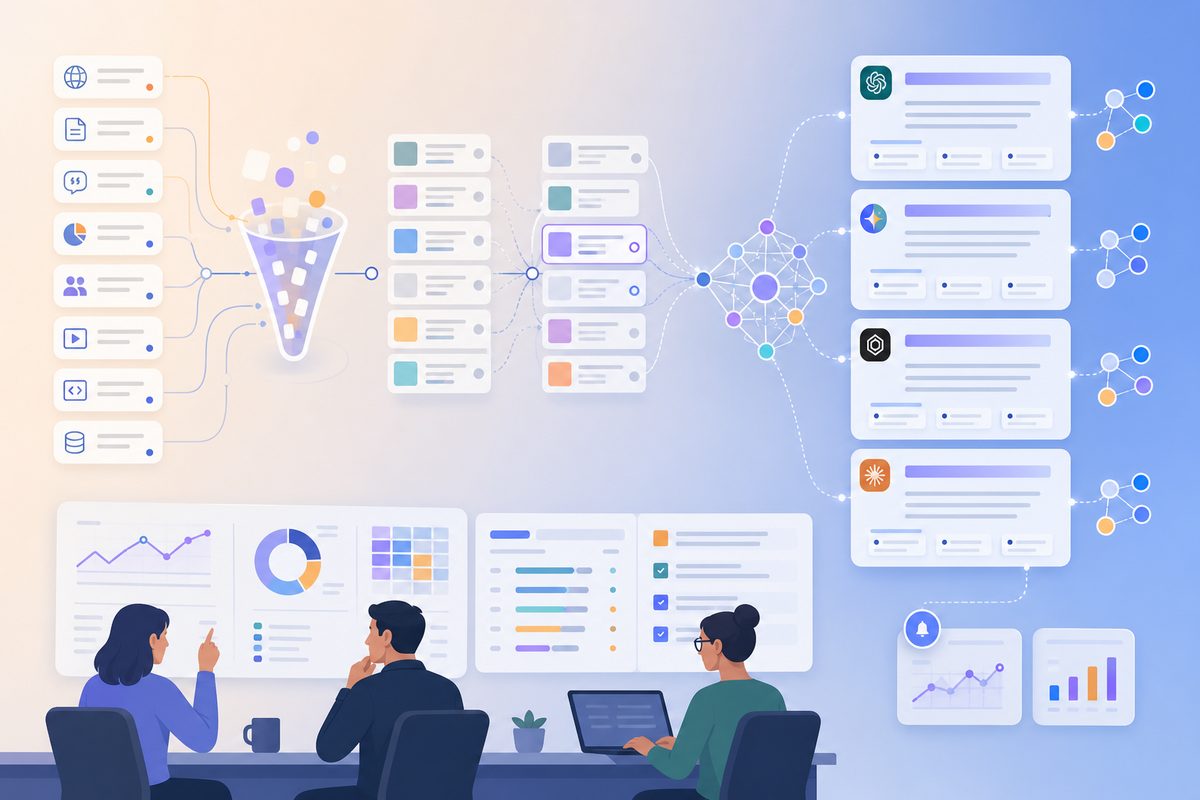
A RAG-style answer typically moves through five steps:
- Interpret the prompt. The system identifies the user intent, entities, constraints, and likely subquestions.
- Retrieve candidate evidence. It searches indexes, pages, documents, databases, or web results for relevant passages.
- Rerank sources. It filters and prioritizes evidence by relevance, quality, freshness, authority, and usefulness.
- Generate the answer. The model synthesizes the selected evidence into a response.
- Attach citations or links. Some systems cite sources directly; others mention brands without visible source attribution.
For RAG AI search visibility, the failure can happen at any step. You might be blocked before retrieval, retrieved but outranked, selected but not cited, cited but described inaccurately, or mentioned once and then disappear in the next run.
Why RAG AI Search Visibility Is Different From Classic SEO
Classic SEO optimizes for ranking on a search results page. RAG AI search visibility optimizes for inclusion in an evidence set and influence inside a generated answer. Ranking still matters, but it is no longer the only surface.
| Classic SEO question | RAG AI search visibility question |
|---|---|
| Can Google crawl and index the page? | Can AI systems retrieve the right passage when the prompt needs it? |
| Does the page rank for a keyword? | Does the evidence get selected for synthesis and citation? |
| Is the title attractive enough to earn clicks? | Is the claim specific enough to be reused safely in an answer? |
| Are backlinks and authority signals competitive? | Do owned, earned, and third-party sources agree about the entity? |
| Are rankings stable enough to report? | Are mentions and citations stable across repeated runs and engines? |
Google's own AI features documentation says SEO fundamentals remain relevant for AI Overviews and AI Mode. It also says eligible pages must be indexed and eligible for Search snippets, and that there are no additional technical requirements or special schema.org markup required for those features.
The implication is not that "nothing changed." It is that RAG visibility adds a retrieval layer on top of the crawl-index-rank foundation. For a broader channel comparison, see AI Search vs SEO: What Changes, What Still Works, and How to Measure It.
The RAG Visibility Ledger: A Practical Framework
The RAG Visibility Ledger is a six-gate framework for diagnosing why an AI engine does or does not mention a brand. It maps a technical retrieval step to a marketing, SEO, PR, or product marketing action.
| Gate | What can go wrong | Visibility lever | Metric to track |
|---|---|---|---|
| Eligibility | Page is blocked, thin, unindexed, gated, or hard to parse | Crawlable HTML, indexable pages, stable canonicals, internal links | Eligible source count |
| Retrievability | The best answer is buried or semantically distant from the prompt | Answer-first passages, category language, use-case pages | Prompt-to-passage match rate |
| Selection | Competitor evidence looks stronger, fresher, or more authoritative | Original data, third-party proof, reviews, citations, dated updates | AI share of voice |
| Entity clarity | The model confuses the brand, category, audience, or product | Consistent naming, organization schema, comparison context | Accurate entity mention rate |
| Grounding | The model cannot safely repeat or cite the claim | Specific claims with nearby evidence and limitations | Claim accuracy rate |
| Measurement | One prompt sample creates false confidence | Repeated tracking across engines, prompts, dates, and locations | Mention distribution over time |
This framework is deliberately operational. "Write for AI" is too vague. The useful question is: which gate is failing, and which source should be repaired?
Gate 1: Make Evidence Eligible
Eligibility means your evidence can be discovered, crawled, indexed, parsed, or otherwise accessed by the systems that feed AI answers. If your best proof sits in JavaScript-only content, gated PDFs, expired campaign pages, screenshots, or contradictory boilerplate, retrieval may never reach it.
Start with the unglamorous checks:
- Keep strategic claims in crawlable HTML, not only images, carousels, videos, or PDFs.
- Make product, category, comparison, documentation, and proof pages indexable where appropriate.
- Use stable canonical URLs for important evidence pages.
- Link from high-authority internal pages to pages you want retrieved.
- Put important facts in text near the entity name they describe.
- Avoid blocking useful sources through robots.txt, noindex, nosnippet, or CDN rules unless the block is intentional.
For Google AI Overviews and AI Mode, Google says pages need to be indexed and eligible for snippets. It also says you do not need new machine-readable files, AI text files, or special schema to appear in those features. Schema still matters, but as support for visible facts, not as a magic AI visibility tag. For implementation details, see Schema for AI Search: How to Use Structured Data for AI Visibility.
Gate 2: Structure Content for Passage Retrieval
RAG systems often retrieve passages or chunks, not full pages. A long guide can rank well and still fail retrieval if the exact answer is buried, overworded, or separated from the brand entity.
Use this passage formula for high-value claims:
Entity + category + audience + problem + differentiator + evidence + limitation.
Weak passage:
"That is why it works better for teams like these."
Retrievable passage:
"Acme Analytics is a warehouse-native product analytics platform for B2B SaaS teams that need account-level usage data, CRM-connected expansion alerts, and reporting that works inside Snowflake. It is a better fit for revenue and growth teams than for consumer mobile apps that only need event funnels."
The second passage can match prompts such as "best product analytics tools for B2B SaaS," "warehouse-native product analytics," "tools for expansion revenue signals," and "Acme Analytics alternatives."
A good retrievable passage usually has these traits:
- It names the brand or entity directly.
- It answers before explaining.
- It uses the buyer's category language, not only internal positioning.
- It includes a specific differentiator.
- It places proof close to the claim.
- It includes constraints, tradeoffs, or fit criteria.
If a paragraph cannot stand alone when copied into a blank document, it is probably weak for passage retrieval.
Gate 3: Match Query Fan-Out, Not Just the Exact Keyword
Query fan-out means an AI system may break one user question into multiple related searches. Google says AI Mode uses a query fan-out technique that issues related searches across subtopics and data sources before bringing results together.
A buyer asking "best SOC 2 automation tools for startups" may trigger hidden searches about:
- SOC 2 automation pricing
- implementation time
- auditor collaboration
- startup compliance tools
- security questionnaire automation
- Vanta alternatives
- Drata alternatives
- reviews and complaints
- integrations with Jira, Slack, AWS, or Google Workspace
This is why one "best tools" page is not enough. You need a source set that covers the evidence journey.
| Fan-out surface | Page or source to build | What the passage should prove |
|---|---|---|
| Category | Category or solution page | What the product is and is not |
| Use case | Role, industry, or workflow page | Who uses it and in what situation |
| Comparison | Competitor or alternatives page | How choices differ on real criteria |
| Proof | Case study, data page, review, benchmark, certification | Why the claim is credible |
| Docs | Integration, security, API, or setup documentation | Whether the product can do the task |
| Freshness | Changelog, updated guide, pricing notes | What changed recently |
| Limits | Fit and non-fit section | When a buyer should choose something else |
For AI search, topical coverage should not mean publishing hundreds of thin pages. It should mean building the minimum set of sources needed to answer the questions a real buyer would ask before trusting a recommendation.
Gate 4: Clarify the Entity Before You Chase Mentions
A retrieval system can find your pages and still describe you incorrectly if the entity is unclear. This is common when a brand has a generic name, overlaps with another company, changed categories, acquired a product, or uses different positioning across pages.
Maxaeo audits often find the same entity drift pattern: the homepage says one category, review sites say another, comparison pages use competitor-led language, and old press releases preserve outdated positioning. A human can reconcile that. A retrieval system may choose the clearest external description, even if it is no longer accurate.
Fix entity clarity with a single source of truth:
- Use the same legal name, brand name, product name, and category language across key pages.
- Add an "is / is not" definition where confusion is likely.
- State headquarters, founding context, parent company, and product line relationships when relevant.
- Keep Organization, SoftwareApplication, Product, Article, and FAQ schema aligned with visible content.
- Update old pages that still use obsolete positioning.
- Build comparison pages for commonly confused competitors or similarly named entities.
If AI systems confuse your company with a similarly named brand, use the process in When AI Confuses Your Brand With a Similarly-Named Company: An Entity Disambiguation Playbook.
Gate 5: Win Selection With Stronger Evidence
Selection is the competitive step. The system has several candidate sources and must decide which evidence is useful enough to influence the answer.
Your page is not competing only against direct competitors. It is also competing against:
- review sites
- analyst pages
- comparison articles
- Reddit and forum discussions
- YouTube transcripts
- documentation
- partner directories
- app marketplaces
- Wikipedia-style explainers
- press coverage
- customer stories
The GEO paper, accepted to KDD 2024, introduced a benchmark for generative engine optimization and reported visibility gains of up to 40% from content changes. The practical lesson is not to stuff pages with citations. It is that generative engines can reward evidence that is easier to verify, quote, and reuse.
Strong evidence usually includes:
- original data, benchmarks, or methodology
- dated statistics with clear sources
- named integrations and supported workflows
- customer segments and use cases
- implementation timelines or requirements
- pricing model clarity where possible
- third-party reviews, awards, listings, and media coverage
- clear comparison criteria
- limitations and non-fit cases
Weak evidence sounds like this:
"An innovative, scalable, AI-powered platform that helps modern teams streamline workflows."
Stronger evidence sounds like this:
"Acme automates vendor risk intake for mid-market SaaS security teams by routing questionnaires, SOC 2 evidence, contract review steps, and renewal reminders across Slack, Jira, Google Workspace, and Salesforce. The product is designed for teams managing 100 to 2,000 vendors, not for enterprises that require a full GRC suite."
AI systems can do more with the second version because it contains concrete retrieval hooks.
Gate 6: Make Claims Safe to Ground and Cite
Grounding means the generated answer can connect a statement to supporting evidence. A claim is easier to ground when it is specific, visible, internally consistent, and supported near the sentence that makes it.
Bad RAG AI search visibility often comes from claim ambiguity. A brand says "we automate compliance." A review site says "security questionnaire tool." A job listing says "GRC workflow platform." A founder interview says "AI agent for trust centers." The model has to choose a description, and the chosen description may not be the one you want.
Build pages that answer these questions directly:
- What category are you in?
- What exact problem do you solve?
- Which teams and company types use you?
- Which products do you integrate with?
- Which competitors are you commonly compared with?
- Which claims are backed by data, customers, documentation, or third-party sources?
- Which claims should AI systems avoid because they are outdated, exaggerated, or only true for some customers?
This is also AI reputation management. You are not only trying to get mentioned. You are trying to prevent inaccurate, stale, or competitor-shaped descriptions from becoming the default answer.
When AI engines cite competitor pages instead of yours, the cause is often retrievability or evidence quality, not a mysterious brand preference. The diagnostic path in Why AI Search Engines Cite Competitor Pages Instead of Yours pairs directly with this gate.
A Worked Example: Why a Good SaaS Brand Misses AI Shortlists
Consider a cybersecurity startup that sells vendor risk management software for mid-market SaaS companies. It ranks on page one for several vendor risk keywords, but it appears inconsistently in AI answers for "best vendor risk management tools for SaaS startups."
A retrieval audit finds five failures:
| Finding | Evidence problem | Repair |
|---|---|---|
| Category mismatch | Homepage says "third-party trust platform," while buyers search "vendor risk management software" | Add a clear entity definition across homepage, product, and comparison pages |
| Weak passage retrieval | Use cases sit inside long narrative sections with few direct answers | Add answer-first blocks for security, procurement, compliance, and legal teams |
| Missing fan-out coverage | No source covers "startup vendor risk," "SOC 2 vendor reviews," or "security questionnaire automation" | Publish use-case pages tied to real buyer prompts |
| Competitor evidence is stronger | Competitors list integrations, setup steps, review workflows, and policy coverage | Add named integrations, implementation details, and workflow proof |
| Measurement is too thin | Team checks one prompt manually every few weeks | Track a prompt set repeatedly across engines and report share of voice |
The fix is not "write more blog posts." It is a retrieval repair plan. Every edit exists because a specific RAG gate failed.
The 30-Minute RAG Visibility Audit
Use this quick audit before building a larger program.
- Pick 10 buyer prompts. Include category, comparison, alternative, problem, and persona prompts.
- Run each prompt in 3 AI engines. Record brand mentions, competitors, descriptions, citations, and missing sources.
- List cited domains. Separate owned pages, earned media, review sites, community pages, and competitor pages.
- Map misses to the ledger. Decide whether each miss is eligibility, retrievability, selection, entity clarity, grounding, or measurement.
- Find the missing passage. Ask: "What single paragraph should have existed for the engine to cite us?"
- Prioritize fixes. Repair pages that affect many prompts first, especially category, comparison, proof, and docs pages.
- Retest weekly. Look for trends across repeated runs, not one lucky answer.
This audit gives you a source-level backlog instead of a vague AI visibility wish list.
How to Build a RAG Visibility Playbook
A durable RAG visibility playbook connects prompts, sources, claims, owners, and measurement.
1. Build a Prompt Universe
Include:
- category prompts
- "best tool" prompts
- alternatives prompts
- competitor comparison prompts
- problem prompts
- integration prompts
- industry prompts
- persona prompts
- reputation prompts
- pricing and implementation prompts
For prompt volume planning, use How Many AI Search Prompts Should You Track?.
2. Group Prompts by Intent
Definitions need crisp entity content. Comparisons need criteria. Shortlists need proof and differentiation. Troubleshooting prompts need documentation. Reputation prompts need consistent third-party evidence.
3. Record the Whole Answer
Do not track only whether your brand appears. Record:
- whether the brand appears
- where it appears in the answer
- whether it is recommended or merely mentioned
- how it is described
- which competitors appear
- which sources are cited
- whether citations support the claims
- whether the answer is accurate
- whether the answer changes across repeated runs
4. Assign Fixes to Owners
SEO owns crawlability, indexation, internal links, and content architecture. Product marketing owns positioning and comparison criteria. PR owns earned evidence. Customer marketing owns proof. Web owns templates and structured data. Product owns documentation and integration accuracy.
5. Retest as a Distribution
A 2026 paper, Don't Measure Once: Measuring Visibility in AI Search, argues that AI search answers vary across runs, prompts, and time, making one-off observations unreliable. Treat AI visibility as a distribution, not a single screenshot.
For cross-engine tracking design, see AI Search Visibility Tracking: Measure Your Brand Across 8 AI Engines.
What to Measure in RAG AI Search Visibility
Measure RAG AI search visibility by prompt set, engine, answer position, citation source, brand description, sentiment, and competitor overlap. The goal is not to celebrate one mention. The goal is to know whether retrieval systems consistently find and reuse your strongest evidence.
| Metric | What it tells you |
|---|---|
| Mention rate | How often your brand appears for tracked prompts |
| Recommendation rate | How often the answer actively suggests your brand |
| Citation rate | How often your owned or earned sources are cited |
| AI share of voice | Your visibility versus named competitors |
| Description accuracy | Whether engines describe your category and value correctly |
| Source mix | Which owned, earned, community, and third-party pages influence answers |
| Competitor overlap | Which brands repeatedly appear beside or above you |
| Volatility | How much answers change by run, engine, or date |
| Fix impact | Whether content, PR, technical, or schema changes improve outcomes |
A simple AI share of voice formula is:
AI share of voice = your brand appearances / all tracked competitor brand appearances
Track that by prompt cluster. A brand might have strong share of voice for category prompts but weak share of voice for comparison prompts, which requires a different fix.
What Recent AI Overview Research Adds
Recent research supports the idea that AI source selection is not identical to classic organic ranking. A May 2026 arXiv study, Measuring Google AI Overviews, issued 55,393 trending Google queries across 19 categories over a 40-day window. It reported that AI Overviews triggered on 13.7% of all queries and 64.7% of question-form queries. It also found that nearly 30% of cited domains did not appear in co-displayed first-page results, and that 11.0% of atomic claims were unsupported by cited pages in the researchers' pipeline.
Those numbers should make marketers more precise, not more panicked. Ranking still matters. But AI visibility also depends on whether a source is selected for synthesis and whether its claims survive grounding.
Google's AI Mode announcement also reinforces the same point: complex prompts can trigger multiple related searches across subtopics and data sources. Optimize for the evidence journey, not only the visible keyword.
What Not to Do
Do not treat RAG AI search visibility as permission to create low-value pages at scale. Google's guidance on helpful, reliable, people-first content asks whether content provides original information, substantial value, expertise, and trustworthy sourcing. It also warns against content made mainly to attract search visits, thin summarization, and writing to a supposed preferred word count.
Avoid these shortcuts:
- hidden AI-only text
- fake expert quotes
- invented statistics
- doorway comparison pages
- schema that contradicts visible content
- keyword-stuffed "LLM-friendly" blocks
- near-duplicate pages for every prompt variation
- changing dates without meaningful updates
- treating
llms.txtor metadata as a substitute for evidence - measuring one answer once and calling it strategy
The durable pattern is simple: make your best evidence accessible, specific, current, corroborated, and easy to cite.
Common Questions
Does RAG Mean AI Search Ignores Traditional SEO?
No. RAG does not replace SEO. It adds another layer between ranking and recommendation. Search and AI products still need crawlable, indexable, well-structured, useful content. The difference is that retrieved evidence may be summarized, compared, and cited inside an answer before the user clicks.
Can Schema Alone Improve AI Visibility?
Schema can help systems understand entities and page context, but it is not a standalone AI visibility tactic. Google says there is no special schema.org structured data required for AI Overviews or AI Mode. Use structured data to reinforce visible facts, not to make claims the page does not support.
How Many Prompts Should a Brand Track?
Track enough prompts to represent real buyer language across intent types. A small B2B SaaS program might start with 50 to 150 prompts across category, comparison, alternative, problem, integration, and persona clusters. Larger teams should track more when reporting AI share of voice across products, regions, or competitors.
Why Does ChatGPT Mention Competitors but Not Us?
Common reasons include weak retrievability, unclear entity positioning, missing third-party evidence, stale content, limited comparison coverage, and stronger competitor pages. The fix is to identify which RAG gate is failing, improve the source evidence, and monitor whether brand mentions in ChatGPT and other engines improve over repeated runs.
How Fast Do RAG Visibility Fixes Work?
Timing varies by engine, source type, crawl frequency, and whether the answer uses live retrieval, product-specific indexes, or model memory. Owned-site fixes can appear quickly in some search-grounded systems. Broader reputation changes usually require repeated external signals from credible sources. Measure daily, but judge trends over weeks.
Is llms.txt Required for RAG AI Search Visibility?
No. llms.txt is not a substitute for crawlable pages, strong evidence, entity clarity, or citations. It may become useful in some workflows, but Google says no new machine-readable file is required for AI Overviews or AI Mode. Treat it as supplementary, not as the core strategy.
The Bottom Line
RAG AI search visibility is not a mystery layer separate from SEO. It is the retrieval logic behind whether AI systems can find, trust, describe, and cite your brand.
The teams that win will not be the ones publishing the most AI search content. They will be the ones building the clearest evidence base: crawlable pages, quotable passages, consistent entity signals, third-party corroboration, fresh proof, and repeated measurement across engines. That is how answer engine optimization becomes defensible channel work rather than hype.