Local AI search visibility is the likelihood that an AI answer engine mentions, ranks, cites, and accurately recommends a nearby business for local-intent prompts. It combines local SEO, reputation signals, crawlable business evidence, service-area clarity, and answer-level monitoring across tools like Google AI Overviews, AI Mode, ChatGPT, Perplexity, Copilot, Gemini, and Claude.
The search intent behind "local AI search visibility" is practical: businesses want to know why AI recommends one nearby provider and ignores another, what signals influence those shortlists, and how to improve without publishing thin city pages or manipulating reviews.
The short answer: AI systems need enough reliable evidence to justify a recommendation. A business that says "we serve Austin" is less convincing than a business with a complete profile, detailed service pages, consistent citations, recent reviews mentioning Austin neighborhoods, visible credentials, and third-party pages that confirm the same story.
This guide gives you a field-ready framework for that work: the Service-Area Evidence Graph.
What Is Local AI Search Visibility?
Local AI search visibility measures whether a business appears in AI-generated answers for nearby, city-specific, or service-area searches. It tracks five answer-level outcomes: mention, rank, citation, description accuracy, and sentiment.
Traditional local SEO asks, "Do we rank in Maps, the local pack, and organic results?" Local AI search visibility asks a broader question: "When an AI system creates a shortlist, can it understand, trust, and justify recommending this business?"
| Outcome | What it means | Example measurement |
|---|---|---|
| Mention | The answer names the business | Mentioned in 7 of 20 local prompts |
| Rank | The business appears in a shortlist position | Average AI rank: 2.4 |
| Citation | The answer links to or references evidence | Cited source: website, GBP, directory, review page |
| Description | The answer explains the business accurately | Correct service, city, hours, license status |
| Sentiment | The answer frames the business positively, neutrally, or negatively | "Reliable for emergency calls" vs. "mixed reviews" |
This cannot be measured from one keyword. "Best HVAC company near me," "who repairs heat pumps in Plano," and "licensed weekend HVAC repair in Plano" can produce different shortlists because each prompt asks for different evidence.
Local AI Search Visibility vs. Local SEO
Local SEO and local AI visibility overlap, but they are not the same measurement problem. Local SEO focuses on rankings and clicks. Local AI visibility focuses on recommendation presence and evidence quality inside generated answers.
| Area | Local SEO | Local AI search visibility |
|---|---|---|
| Main surface | Maps, local pack, organic results | AI Overviews, AI Mode, ChatGPT, Perplexity, Copilot, Gemini |
| Core question | "Do we rank?" | "Are we recommended and cited accurately?" |
| Unit of measurement | Keyword, URL, listing, ranking position | Prompt, answer, citation, sentiment, accuracy |
| Main risk | Low rankings or low click-through | Being omitted, misdescribed, uncited, or framed poorly |
| Strongest asset | Optimized profile and pages | Corroborated evidence across owned and third-party sources |
A business can have strong local SEO and still have weak local AI visibility if answer engines cannot connect its services, locations, reviews, and credentials into a defensible recommendation.
How AI Systems Interpret Nearby Service Intent
AI systems interpret local intent by combining explicit location terms, inferred proximity, service specificity, reputation evidence, source availability, and business entity clarity. They do not simply match a city keyword to a landing page.
Google's public local ranking guidance says local results are mainly shaped by relevance, distance, and prominence, with business information, reviews, ratings, links, and web results contributing to prominence. See Google's local ranking guidance for the official version.
AI answers add a retrieval layer. Google explains that its AI search experiences can use a query fan-out technique, where one question triggers multiple related searches. See Google's AI features guidance. For a practical explanation of how this changes SEO work, read Query Fan-Out: How One Prompt Becomes Dozens of Hidden Searches.
For a local service query, that means one prompt can imply many hidden evidence checks:
| User prompt | Likely evidence the AI needs |
|---|---|
| "Best plumber near me for a slab leak" | Plumbing category, slab leak service page, proximity, emergency availability, reviews mentioning similar work |
| "Licensed electrician in Mesa open now" | License evidence, Mesa service area, hours, GBP data, recent third-party confirmations |
| "Dermatologist near me who takes Aetna" | Specialty, location, insurance directory, appointment availability, patient reviews |
| "Best reviewed roofer in Fort Worth" | Roofing category, Fort Worth proof, review volume, review themes, directory corroboration |
The practical implication: do not optimize only for "near me." Build evidence for what you do, where you do it, why customers trust you, and who else confirms it.
What Most Local AI Visibility Guides Miss
Most advice covers the basics: complete your Google Business Profile, get reviews, build citations, and write clear service pages. Those are necessary, but they miss two issues that often decide whether a business gets recommended.
The first gap is evidence adjacency. A claim is stronger when several nearby sources support it. "We serve Fort Worth" on one page is weak. The same claim is stronger when it appears in service pages, GBP service areas, reviews mentioning Fort Worth neighborhoods, local association listings, and relevant directories.
The second gap is spam control. Many local SEO playbooks still recommend one near-identical page per city. That can create doorway-page risk. Google's spam policies describe doorway abuse as pages created to rank for similar queries that funnel users to a more useful destination, including pages targeted at regions or cities. See Google's spam policies for Google web search.
The better approach is not "make more city pages." It is "make verifiable local evidence easier to find."
The Service-Area Evidence Graph
The Service-Area Evidence Graph is a framework for improving local AI search visibility without doorway spam. It maps every recommendation claim to five evidence nodes: entity, service, location, reputation, and corroboration.
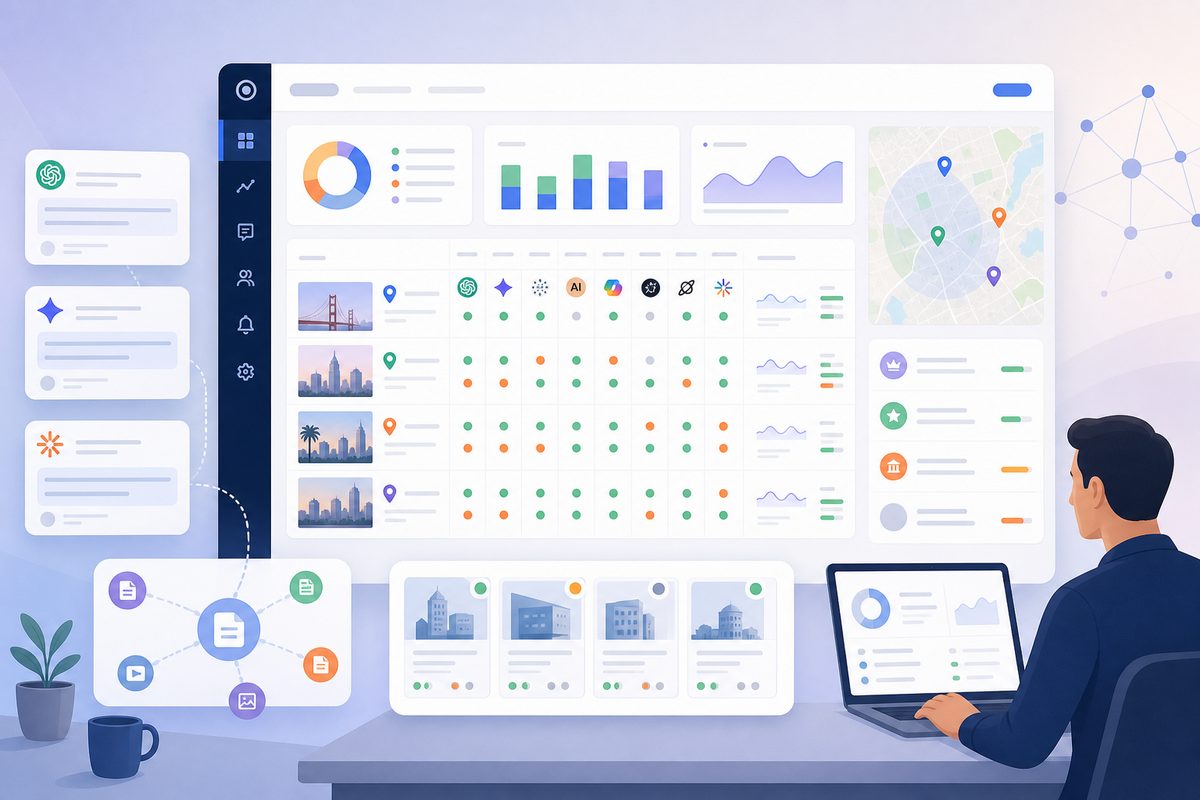
Use this graph when a business asks, "Why does AI recommend that competitor instead of us?" For each target service and market, check whether all five nodes are supported.
| Evidence node | Question to answer | Strong evidence |
|---|---|---|
| Entity | Who is the business? | Consistent name, category, phone, website, GBP, schema, directory data |
| Service | What exact job can it do? | Detailed service pages, project proof, FAQs, pricing ranges where appropriate |
| Location | Where can it realistically serve customers? | Branch pages, service-area logic, dispatch boundaries, neighborhood examples |
| Reputation | Why should a customer trust it? | Recent review themes, owner replies, ratings, awards, complaint handling |
| Corroboration | Who else confirms the claim? | Directories, licensing boards, trade associations, local press, partner pages |
This creates a more useful audit than a keyword checklist. If an AI answer needs to justify "best emergency electrician in Mesa," it needs more than the phrase "Mesa electrician." It needs crawlable proof that the business handles emergency electrical work, serves Mesa, has credible customer feedback, and is recognized beyond its own site.
Which Signals Influence Local AI Recommendations?
No public source reveals every AI recommendation signal. In practice, local AI recommendations usually depend on relevance, proximity, prominence, consistency, crawlability, freshness, and enough evidence to justify a shortlist.
| Signal | Why AI may use it | What to improve |
|---|---|---|
| Business category | Matches the provider type to the query | Primary and secondary categories, service names, page titles |
| Proximity or service area | Tests whether the business can realistically serve the user | Branch pages, service-area explanations, dispatch boundaries |
| Service specificity | Confirms the business can solve the exact problem | Dedicated service pages, examples, FAQs, photos, constraints |
| Review themes | Supplies customer experience evidence | Honest reviews with service details, helpful owner replies |
| Third-party citations | Corroborates business identity and category | Relevant directories, licensing boards, associations, partner listings |
| Freshness | Reduces uncertainty about status and availability | Updated hours, recent reviews, current projects, current policies |
| Crawlability | Determines whether evidence can be retrieved | Indexable pages, readable text, internal links, clean navigation |
| Structured data | Helps machines classify visible facts | LocalBusiness markup that matches page content |
Google says sites do not need special AI-specific files to appear in AI search features. The fundamentals still matter: crawlable pages, helpful content, clean snippets, structured data that matches visible content, and accurate business information. Google's LocalBusiness structured data guide explains how markup can describe address, hours, departments, reviews on your own site, and other business details.
Structured data is not a shortcut to recommendations. It is a way to reduce ambiguity.
Why Reviews Matter More in AI Shortlists
Reviews matter because AI answers often need a defensible reason to recommend one nearby business over another. Volume and rating help, but review themes are often more useful than a generic five-star average.
A review that says "came out within two hours," "fixed the compressor the same day," or "explained the estimate before starting" gives an AI answer specific language for a recommendation. A perfect rating with vague reviews gives less evidence.
Review manipulation is also a serious risk. In 2024, the U.S. Federal Trade Commission announced a final rule banning fake reviews and testimonials, including AI-generated fake reviews and reviews from people without real experience. See the FTC rule on fake reviews and testimonials.
A clean review strategy for AI reputation management:
- Ask real customers for reviews after completed work.
- Encourage specific, honest details without scripting sentiment.
- Reply to positive and negative reviews with useful context.
- Fix recurring operational problems instead of burying them.
- Monitor whether AI answers repeat outdated or unfair claims.
For more on how manipulated review signals affect recommendations, read Fake Reviews and Review Bombing: How Manipulated Signals Warp AI Recommendations.
How Directories and Citations Shape AI Confidence
Directories and citations help answer engines confirm that a business exists, operates in a category, and serves a market. They are most useful when they agree with each other and add context that the business website does not fully provide.
The strongest citation mix is usually not the longest list. It is the most relevant list.
| Business type | Useful citation sources |
|---|---|
| Home services | Google Business Profile, Yelp, Angi, BBB, trade associations, licensing boards |
| Medical and wellness | Healthgrades, Zocdoc, insurance directories, state licensing boards |
| Legal services | State bar profiles, Avvo, FindLaw, local legal directories |
| Agencies and consultants | Clutch, G2, partner directories, local business journals |
| Automotive | RepairPal, manufacturer-certified directories, service network listings |
The goal is consistency plus depth. If one directory lists "drain cleaning," another lists "general plumbing," and the website only says "home services," an answer engine may not confidently match the business to "emergency sewer line repair."
Citations can also become AI citations. When AI systems cite sources, they often prefer pages that summarize entities clearly, compare options, or carry third-party trust. Your website should remain the canonical source, but third-party evidence can strengthen the recommendation path. For the broader concept, see AI Search Citations: Definition, Tracking, and How to Earn Them.
How to Build Service-Area Pages Without Doorway Spam
A useful service-area page explains real coverage, real constraints, and real proof. A doorway page swaps city names into near-identical text and exists mainly to capture search traffic.
A strong service-area page includes:
- Coverage logic: where the business actually goes, including dispatch limits or branch coverage.
- Service proof: job types, photos, timelines, materials, certifications, and examples.
- Local context: neighborhoods, building types, climate issues, regulations, or common problems.
- Review evidence: customer themes tied to that service or area, not copied testimonial blocks.
- Operational details: hours, emergency availability, booking process, license details, exclusions.
- Internal links: service pages, branch pages, financing, warranties, team pages, contact paths.
- Third-party support: directory profiles, association pages, licensing records, or local press.
For multi-location brands, use a hub-and-spoke structure:
| Page type | Purpose | When to create it |
|---|---|---|
| Market hub | Explains a region and links to branches, services, and proof | When the business serves a broad metro area |
| Branch page | Explains a real location, team, hours, and service coverage | When there is a real office, clinic, showroom, or branch |
| Core service page | Explains a service in depth | When users need help choosing or understanding the service |
| City or neighborhood page | Explains unique proof for a specific place | Only when there is real local evidence and user value |
This protects local AI search visibility because AI systems can retrieve specific evidence without being forced through hundreds of thin pages.
A Practical Example: Why One Local Business Gets Picked
Consider a query: "best emergency water heater repair in Dallas tonight."
| Evidence needed | Weak business | Strong business |
|---|---|---|
| Entity | Website says "home services" | GBP and site clearly list plumbing and water heater repair |
| Service | One generic plumbing page | Dedicated water heater repair page with emergency details |
| Location | Mentions Dallas in footer only | Dallas branch page, service-area notes, local job examples |
| Reputation | Vague five-star reviews | Reviews mention same-day repair, clear estimates, after-hours help |
| Corroboration | Inconsistent directory categories | BBB, Yelp, trade directory, and GBP all support the same category |
The strong business gives an AI system more reasons to recommend it. The difference is not keyword density. It is claim verification.
How to Monitor Local AI Search Visibility
Local businesses should monitor AI answers by market, prompt type, engine, and evidence source. A single brand mention in ChatGPT is not enough to prove visibility.
A practical AI search monitoring setup should include four prompt families:
| Prompt family | Example prompt | What it reveals |
|---|---|---|
| Generic nearby | "Best emergency plumber near me" | Whether proximity and category match |
| Explicit city | "Best emergency plumber in Austin" | Whether city-level evidence works |
| Service-specific | "Who repairs tankless water heaters in Austin?" | Whether subservice pages are understood |
| Trust-filtered | "Which plumber in Austin has strong reviews and transparent pricing?" | Whether reviews and proof support the recommendation |
Track each answer with six fields:
- Mentioned: yes or no.
- Rank: position in the shortlist.
- Citation: which source was cited or referenced.
- Summary: how the business was described.
- Sentiment: positive, neutral, mixed, or negative.
- Evidence gap: what proof was missing or weaker than competitors.
Over time, this becomes AI share of voice for local markets. For a broader tracking workflow, read How to Track Brand Mentions in ChatGPT and Other AI Answers.
A 30-Day Audit for Local AI Search Visibility
A useful 30-day audit should test prompts, inspect evidence, prioritize fixes, and retest. The goal is not to chase every AI answer. It is to find missing proof that blocks recommendations.
Days 1-5: Build the Prompt Set
Create a repeatable prompt grid for each market.
| Dimension | Count |
|---|---|
| Engines | 4 |
| Prompt families | 4 |
| Location variants | 3 |
| Runs per prompt | 1 |
That creates 48 answer observations per market: 4 engines x 4 prompt families x 3 location variants.
Location variants should include city, neighborhood, and "near me" phrasing. For service-area businesses, add modifiers such as "open now," "emergency," "licensed," "insured," or "best reviewed" only when those match real customer behavior.
Days 6-10: Score the Answers
Use a simple 0-2 score so teams can compare markets and competitors consistently.
| Field | 0 | 1 | 2 |
|---|---|---|---|
| Mention | Not named | Named only after follow-up | Named in first answer |
| Rank | Not ranked | Below top three | Top three |
| Citation | No source | Weak or mismatched source | Strong relevant source |
| Accuracy | Wrong or vague | Partly correct | Correct and specific |
| Sentiment | Negative | Neutral or mixed | Positive and justified |
The maximum score is 10 per observation. This is not a universal benchmark. It is an internal way to compare services, markets, and competitors over time.
Days 11-20: Fix the Evidence Gaps
Group gaps into four buckets.
| Gap | Common symptom | Fix |
|---|---|---|
| Entity gap | AI uses wrong category, name, or phone | Correct website, GBP, schema, directories, and social profiles |
| Service gap | AI recommends competitors for specific jobs | Add detailed service proof, FAQs, examples, and internal links |
| Location gap | AI does not trust coverage in a city | Clarify branches, dispatch boundaries, service-area logic, local examples |
| Reputation gap | AI frames the business as risky or vague | Improve review workflows, replies, complaint handling, and third-party proof |
Do not publish dozens of thin pages. Add evidence where users need it: core service pages, branch pages, project pages, review pages, and useful FAQs.
Days 21-30: Retest and Report
Retest the same 48 observations. Report five changes:
- Mention rate.
- Average AI rank.
- Citation quality.
- Description accuracy.
- Sentiment.
If the business still does not appear, inspect the competitors that do. The answer is usually visible: clearer service pages, stronger directories, more specific reviews, better local proof, or more consistent entity data.
What Agencies Should Report to Clients
Agencies should report AI visibility as a recommendation funnel, not as a vanity ranking. Clients need to know where AI found the brand, why it trusted the brand, and what blocked more recommendations.
| Metric | Why it matters |
|---|---|
| Mention rate by market | Shows whether the business enters local AI shortlists |
| Average AI rank | Shows competitive placement |
| Citation source mix | Shows which owned and third-party pages influence answers |
| Sentiment | Shows whether AI reputation management is needed |
| Accuracy defects | Shows where AI describes services, hours, or locations incorrectly |
| Fix backlog | Shows what content, profile, or citation work comes next |
Tie every recommendation to a business action. "Publish eight city pages" is weak. "Add emergency water heater proof to the Dallas service page because three engines cited competitors for same-day repair evidence" is actionable.
For agencies choosing monitoring software, see Best Google AI Overviews & AI Mode Tracking Tools.
What In-House Teams Should Prioritize First
In-house teams should prioritize fixes that increase AI confidence across many prompts. Start with evidence that is reusable across the whole local footprint.
A practical order:
- Correct entity data across the website, Google Business Profile, directories, and social profiles.
- Rewrite core service pages around real jobs, proof, qualifications, constraints, and FAQs.
- Clarify service-area logic with branch coverage, dispatch rules, and local examples.
- Improve review request and response workflows.
- Update third-party profiles that AI systems can cite.
- Add LocalBusiness structured data where it matches visible page content.
- Monitor prompts monthly and compare against competitors.
- Retire thin city pages that create risk without adding proof.
This order works because AI systems need reliable facts before they can generate confident recommendations.
Frequently Asked Questions
Is local AI search visibility different from local SEO?
Yes. Local SEO focuses on visibility in maps, local packs, and organic search results. Local AI search visibility focuses on whether answer engines mention, cite, rank, and accurately describe a business in conversational recommendations.
The two overlap. A complete Google Business Profile, strong reviews, crawlable pages, and consistent citations support both. The difference is measurement. AI visibility must be tracked at the answer level across prompts and engines.
Do reviews help a business get recommended by ChatGPT or other AI tools?
Reviews can help when they create clear, credible evidence about customer experience. AI systems may use review pages, directory summaries, or reputation signals to justify a local shortlist.
The safest approach is to collect honest reviews from real customers and respond with useful context. Strong review themes are better than suspicious perfection.
Should every city get its own page?
No. Every city should get its own page only if the business has real evidence that helps users in that city. A thin page with a swapped city name is not a good local SEO or AI visibility strategy.
Use city pages for real branches, substantial service demand, local proof, unique constraints, and useful details. Use regional hubs or service-area sections when the business serves many nearby towns without distinct operations in each one.
Can a service-area business improve visibility without showing a street address?
Yes, but it needs stronger service-area evidence. A hidden address can make proximity harder to verify, so the business must clarify coverage through its Business Profile settings, service pages, reviews, local examples, and trusted third-party profiles.
Do not pretend to have offices in cities where no office exists. Explain dispatch areas, response windows, and service constraints plainly.
How often should teams monitor AI recommendations?
Monthly monitoring is enough for most local service businesses. Weekly monitoring can make sense during a rebrand, review issue, market launch, or major content cleanup.
Track the same prompt set each time. Otherwise, the data becomes noisy. The goal is to measure directional change in recommendations, citations, sentiment, and accuracy.
What is the fastest way to improve local AI search visibility?
The fastest useful fix is to close obvious evidence gaps on existing assets: correct business data, make service pages more specific, update hours and service areas, respond to reviews, and align important directories.
Avoid shortcuts like fake reviews, copied city pages, or exaggerated service areas. They may create reputation, compliance, and spam-policy risk.
The Bottom Line
Local AI search visibility is won by businesses that are easy to understand and easy to justify. Answer engines need more than a keyword-rich page. They need corroborated evidence that a business provides a specific service, in a specific place, with enough reputation signals to recommend it.
The practical playbook is clear: keep business data accurate, make service pages specific, build real local proof, earn trustworthy citations, manage reviews ethically, avoid doorway pages, and monitor AI answers by market.
The companies that do this will not just rank for local searches. They will be more likely to appear in the shortlists customers now ask AI to create.