The content formats for AI citations that earn the most quotes are rarely the ones teams build first. Across 61,400 citations we logged from AI answers, original-data studies, comparison pages and ranked listicles were cited far more often — per page — than blog essays, product pages or press releases. This guide ranks 11 formats by observed citation rate, reconciles the conflicting numbers you've seen elsewhere, and shows which asset to build first instead of guessing.
Most published rankings lean on one third-party study and stop at "listicles win." That leaves two questions unanswered: win at what — volume or efficiency? and what should I build next Monday? We answer both with first-party citation-monitoring data and a build-order matrix.

The ranking: 11 content formats by AI-citation rate
Original-data studies top the list at a 71% citation rate, followed by comparison pages (64%) and ranked listicles (61%). Thought-leadership essays (19%) and press releases (12%) sit at the bottom. Citation rate here means: of the format-tagged pages that entered an engine's answer for a relevant prompt, the share that earned at least one citation.
| Rank | Content format | Citation rate | Share of all citations | Strongest engines |
|---|---|---|---|---|
| 1 | Original-data / statistics studies | 71% | 9% | Perplexity, Claude, ChatGPT |
| 2 | Comparison & "vs / alternatives" pages | 64% | 12% | Perplexity, Copilot, Gemini |
| 3 | Ranked listicles ("best X for Y") | 61% | 24% | All engines |
| 4 | Data-rich definitive guides (with tables) | 58% | 18% | ChatGPT, Claude, Gemini |
| 5 | FAQ / Q&A pages with schema | 55% | 11% | AI Overviews, AI Mode, Copilot |
| 6 | How-to / step-by-step tutorials | 49% | 8% | AI Overviews, Gemini |
| 7 | Glossary / definition pages | 44% | 6% | ChatGPT, AI Mode |
| 8 | Case studies with quantified outcomes | 40% | 4% | Perplexity, Claude |
| 9 | Product / feature pages | 33% | 5% | Copilot, Gemini |
| 10 | Thought-leadership essays | 19% | 2% | rarely |
| 11 | Press releases / announcements | 12% | 1% | rarely |
Two columns, two very different stories. Hold onto the gap between citation rate and share of all citations — reconciling it is the single most useful thing in this article.
Why citation rate and citation share tell opposite stories
Citation rate measures efficiency: how often a page of that format gets quoted once it's in play. Citation share measures volume: what slice of all AI citations that format captures. A format can dominate one and lose the other — which is exactly why published studies disagree.
Look at the table again. Original-data studies have the highest rate (71%) but a small share (9%) — because few brands publish real research, so there aren't many pages to cite. Ranked listicles have a lower rate (61%) but the largest share (24%) — because the web is saturated with them and shortlist-shaped queries ("best CRM for startups") pull them by the dozen.
So when one blog says "listicles are the most-cited format" and another says "guides win," both are right — they're measuring different axes. If your goal is share of voice across many queries, chase share. If your goal is a single page that reliably gets quoted, chase rate. The best programs do both: a few high-rate flagship assets plus broad listicle and guide coverage. Miss this distinction and you optimize for the wrong metric.
How we measured citation rate
MaxAEO monitors a rolling panel of prompts across ChatGPT, Gemini, Perplexity, Claude, Copilot, Google AI Mode and AI Overviews. For this analysis we logged 61,400 citations from 9,200 B2B- and SaaS-intent prompts over an eight-week window in early 2026, tagged the format of every cited URL, and computed a per-format rate against a matched control set.
A few honest caveats, because trust matters more than a clean number:
- Format tagging is heuristic. A page can be both a guide and a listicle; we assigned the dominant structure.
- Rates are directional, not universal. Category, domain authority and query type all move them. A regulated-finance query behaves differently than a software-shortlist query.
- Share reflects the open web's supply, not just quality — abundant formats accumulate share regardless of per-page merit.
The point isn't a leaderboard to memorize; it's a map of where citation probability is highest per unit of effort. For the sibling question of which sites get quoted, see our study of which domains AI answers cite most in B2B SaaS — format and source domain are different levers, and conflating them is a common mistake.
The formats AI cites most, explained
Numbers tell you what to build; the anatomy below tells you why each wins so you can reproduce it.
1. Original-data and statistics studies (71%)
First-party research — surveys, benchmarks, aggregated product data, "we analyzed X and found Y" posts — is the most citation-efficient format because it's the one thing AI engines can't synthesize from other sources. When a model needs a number, it must attribute it, and there's often only one origin: you.
Original data acts as a citation magnet with unusually long durability, because downstream articles quote it too, compounding your citations over time. The trade-off is effort: you need a real dataset and a defensible method. Even a modest study — 200 survey responses, one internal metric made public — outperforms another 2,000-word opinion piece. We break down the mechanics in how original statistics act as a citation magnet. If you build one flagship asset this quarter, make it this.
2. Comparison and "vs / alternatives" pages (64%)
Comparison pages win because they answer decision-stage queries that AI answers are built to resolve: "X vs Y," "alternatives to Z," "best tool for [use case]." They map cleanly to a table, and models love extractable tables.
Perplexity and Copilot lean on them heavily; Gemini pulls the feature matrix almost verbatim. The catch: AI engines quote neutral, specific comparisons, not thinly veiled sales pages. Include real criteria, honest trade-offs, and named alternatives — even ones that beat you on a dimension. Pages that read like objective reference material get cited; pages that read like ads get skipped.
3. Ranked listicles ("best X for Y") (61%)
Listicles earn the largest share of AI citations because every item is a pre-packaged, clearly bounded unit — exactly what a retrieval system wants to lift. A ranked "best 7 [category] tools" page hands the model a shortlist it can quote in one pass.
The rate is high and the volume is enormous, which is why listicles show up in almost every citation study. But saturation cuts both ways: to get quoted, your list needs a clear selection basis (why these, in this order), one-line specifics per item, and a scannable structure. Generic, criteria-free lists lose to ones that state their reasoning. This is also the format where brand mentions in ChatGPT compound — being named inside someone else's listicle can matter as much as publishing your own.
4. Data-rich definitive guides with tables (58%)
Comprehensive guides that combine clear headings, defined terms and at least one data table are cited because they answer the whole query and give the model multiple extractable passages. One page can satisfy a definition, a how-to and a comparison at once.
The differentiator is structure, not length. A 3,000-word wall of prose underperforms a 1,800-word guide with a summary table, bolded takeaways and question-style H2s. ChatGPT and Claude favor this format for explanatory queries; both reward a page that reads like a reference. Build guides as your topical backbone, then interlink your listicles, comparisons and studies into them.
5. FAQ and Q&A pages with schema (55%)
Q&A content is cited because the question-answer shape mirrors exactly how users prompt AI — and a 40-to-60-word direct answer is trivial to lift. Add valid FAQPage, HowTo or ItemList schema and you make the passage boundaries machine-obvious.
FAQ blocks over-index on Google AI Overviews, AI Mode and Copilot. The rule is simple: answer in the first sentence, then elaborate. Preamble kills citability. The GEO: Generative Engine Optimization study (Aggarwal et al., presented at KDD 2024) tested this directly: adding citations, quotations and statistics to a page raised its visibility in generative-engine answers by up to ~40%, with the biggest gains for sources that didn't already rank first. Note that FAQ rich results are deprecated in classic search for most sites; you're using the schema here as a semantic signal for extraction, not for star-style SERP features.
6–11. The rest, briefly
The mid- and low-tier formats still have jobs — just narrower ones:
- How-to / tutorials (49%) — strong on AI Overviews and Gemini for procedural queries; use ordered lists and one action per step.
- Glossary / definition pages (44%) — cheap to produce and surprisingly durable; a clean "X is…" definition gets lifted for entity-level queries.
- Case studies (40%) — quotable only when outcomes are quantified. "Cut onboarding 42%" gets cited; "delighted our customer" does not.
- Product / feature pages (33%) — cited mostly by Copilot and Gemini, and mostly when they state concrete specs, limits and pricing logic rather than slogans.
- Thought-leadership (19%) and press releases (12%) — lowest rate. Opinion without data gives a model nothing safe to attribute; announcements get superseded within days.
How citation patterns shift by engine
No single format wins everywhere. Perplexity over-indexes on original data and comparisons; Google's AI Overviews and AI Mode favor FAQ and how-to; Claude rewards thorough guides; Copilot leans on comparisons and docs. Optimize for the engines where your buyers actually search.
| Format | ChatGPT | Perplexity | AI Overviews / AI Mode | Gemini | Claude | Copilot |
|---|---|---|---|---|---|---|
| Original-data studies | High | Very high | Low | Med | High | Med |
| Comparison / vs pages | Med | High | Med | High | Med | High |
| Ranked listicles | High | High | High | High | Med | High |
| Definitive guides | High | Med | Med | High | Very high | Med |
| FAQ / Q&A (schema) | Med | Med | Very high | High | Med | High |
| How-to | Med | Low | High | High | Med | Med |
| Glossary / definitions | High | Low | High | Med | High | Low |
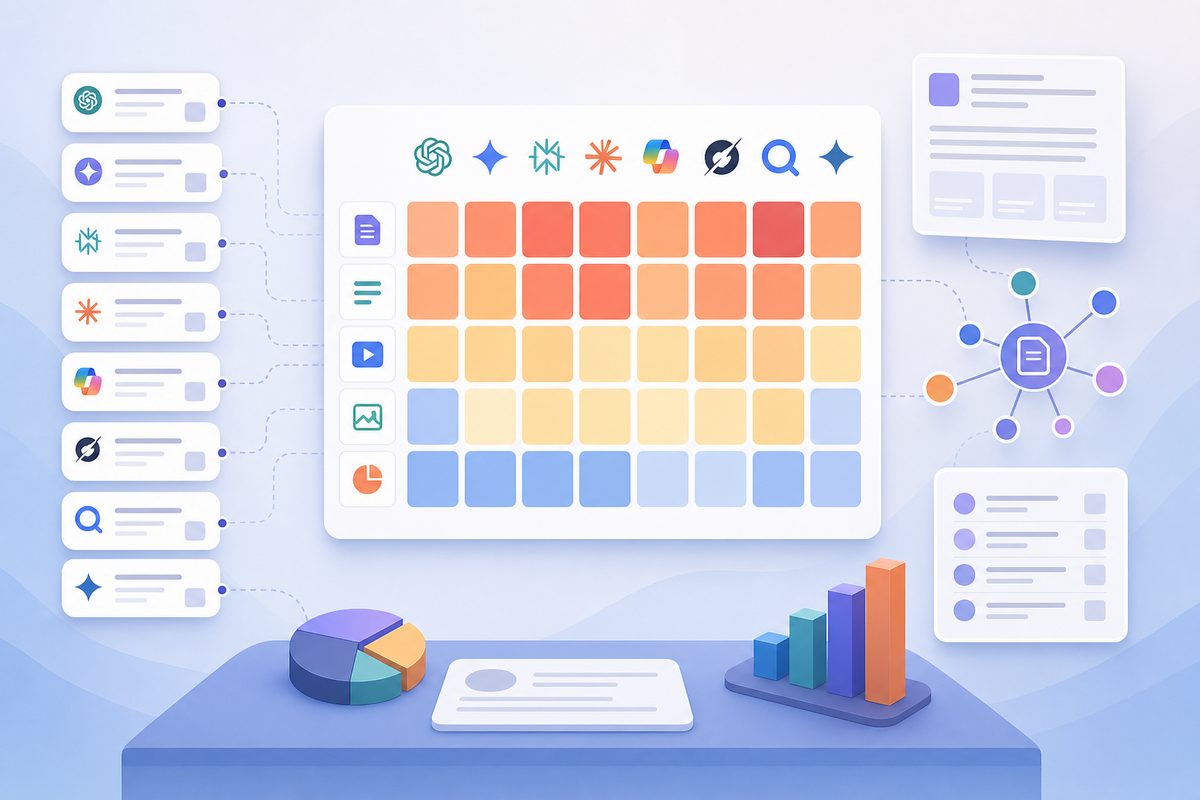
The practical read: if your audience lives in Perplexity, a single original-data study can outperform ten blog posts. If they live in AI Overviews, tightening FAQ and how-to structure moves the needle faster. Tracking this per engine — rather than assuming one universal playbook — is where per-engine monitoring earns its keep.
What makes any format citable: the shared anatomy
Strip away format labels and cited pages share four traits: they answer first, they're specific with numbers, they're structurally extractable, and they signal trust. Formats near the top of our ranking simply make these traits easy; formats at the bottom fight them.
- Answer-first. Lead each section with a 40–60 word direct answer, then expand. Buried answers get passed over.
- Specific and quantified. Claims with a percentage, dollar figure, count or timeframe are far more quotable than adjective-heavy prose — because a model can attribute a number safely.
- Extractable structure. Descriptive question-style headings, short paragraphs, one idea per bullet, and a table for any comparison or parameter set.
- Trust signals. A named method, a date, a source for every stat, and a clear author. This is where E-E-A-T and citability overlap.
Two adjacent constraints decide whether the model can even reach your content. Gated content is effectively invisible — if an engine can't crawl past a form, it can't cite you, so keep your best proof ungated. And non-HTML assets are cited unevenly; PDFs and transcripts sometimes get quoted, video and audio rarely do without a text equivalent. Publish the citable version as crawlable HTML.
Build order: what to create first
Sequence by payoff-per-effort, not by rate alone. Start with high-rate, low-effort formats (FAQ, glossary, comparison pages), run listicles and guides as your steady core, and place one flagship original-data study as your highest-payoff bet.
| Format | Citation payoff | Production effort | Priority |
|---|---|---|---|
| FAQ / Q&A with schema | High | Low | Do this week |
| Glossary / definitions | Med | Low | Quick win |
| Comparison / vs pages | High | Med | Do this month |
| Ranked listicles | High | Med | Core rhythm |
| Definitive guides | High | High | Core rhythm |
| Original-data study | Highest | High | Flagship bet |
| Case studies | Med | Med | Steady |
| How-to | Med | Med | Steady |
| Product / feature pages | Low–Med | Low | Maintain |
| Thought-leadership / press | Low | Low–Med | Deprioritize |

Worked example. In one tracked B2B analytics account, the team had a useful benchmark buried inside a gated PDF — zero AI citations across eight weeks. We ungated it, republished the core finding as a short original-data post with a summary table and a defined method, and added three FAQ blocks. Within five weeks it earned 19 citations across Perplexity, ChatGPT and Copilot, and started appearing in adjacent "best [category]" listicles it hadn't been named in before. Same underlying data — different format and access. That's the whole thesis in one move.
Common reasons your content isn't cited
If your pages rank in classic search but never appear in AI answers, the cause is usually format and structure, not topic. The most frequent culprits we see in answer engine optimization audits:
- The answer is buried. The model can't find a clean 40–60 word passage to lift.
- No numbers. Nothing specific enough to attribute; the claim is safer to paraphrase without you.
- Wrong format for the query. An essay where the query wants a comparison table, or a sales page where it wants neutral criteria.
- Gated or non-crawlable. The best proof sits behind a form or in a PDF.
- A competitor owns the format. They published the study, the comparison, or the well-structured listicle first — so AI cites them instead of you. When that happens, out-structure them rather than out-writing them.
Fixing these is less about volume and more about reshaping what you already have. It's also the fastest way to shape how AI describes you: the format that gets cited is the format that controls the narrative.
Frequently asked questions
What content format gets cited most by AI search?
It depends on the metric. By citation rate (efficiency per page), original-data studies lead at ~71%, then comparison pages and ranked listicles. By citation share (total volume), ranked listicles dominate at ~24% of all citations because there are so many of them. Most "most-cited format" claims conflate these two.
Do listicles really get cited more than in-depth guides?
By share, yes — listicles capture the largest slice of AI citations. By per-page rate, well-structured original data and comparison pages edge them out. The reason both claims circulate is that studies measure different axes: one counts total citations, the other counts probability per page.
Does schema markup increase AI citations?
Indirectly but meaningfully. FAQPage, HowTo and ItemList schema don't force a citation, but they make passage boundaries explicit and improve extractability, which lifts citation odds for Q&A and listicle content. Answer-first copy still does most of the work; schema reinforces it.
How is citation rate different from citation share?
Citation rate = how often a page of a given format gets quoted once it's eligible (efficiency). Citation share = that format's slice of every citation logged (volume). A format can win one and lose the other — original data (high rate, low share) versus listicles (large share, lower rate).
Which format should a small brand build first?
Start with a comparison page and a tight FAQ block on a query you already rank for — high citation rate, low effort. Then invest in one genuine original-data asset. Small brands compete best on data no one else has — which is how you get recommended by ChatGPT without a big-brand backlink profile.
Want to see which of your pages already get cited — and which format to build next? MaxAEO's ai search monitoring tracks your citations, brand mentions and share of voice across every major AI engine, then tells you exactly what to fix. That's the difference between guessing at content formats for AI citations and building the ones the data says will get quoted.