Most case studies for AI search fail for a boring reason: the result isn't checkable. The number sits buried in a narrative paragraph, the measurement window is missing, the customer is "a leading fintech," and nobody says how the figure was calculated. An answer engine can read that page fine. It just has nothing it can safely repeat.
That gap is measurable. Across a six-month tracking panel we ran on 412 published customer case study pages, only 13.8% were cited even once by an AI engine. The pages that did get cited weren't longer or better designed. They shared one structural trait: every headline result was stated as a claim, a metric, a method, and an attribution — in adjacent sentences.
This article gives you that format, the panel data behind it, the schema markup that actually exists for it, the distribution work that decides whether the citation lands on your domain, and the reason your best number sometimes shows up in ChatGPT with someone else's link attached.
What makes a case study citable by AI search?
A case study is citable when a single passage answers what changed, by how much, measured how, and for whom — without requiring any other part of the page. Answer engines extract passages, not documents. If the passage can't stand alone and can't be verified, it gets summarized away or skipped.
This is a stricter bar than "extractable." Plenty of case studies are extractable — the number is in a clean sentence, the heading is descriptive, the HTML is crawlable. They still don't get quoted, because an extractable claim with no method and no named subject is a marketing assertion. Models are conservative about repeating those, especially in comparison and shortlist prompts where a wrong number is expensive.
The shift for customer case studies used as AI proof is from readable to auditable. You're not writing a story with numbers in it. You're publishing a small piece of evidence with a story attached.
What our tracking panel measured, and what it found
We tracked 412 customer case study pages from 63 B2B SaaS and tech brands between 6 January and 30 June 2026. Each brand ran a daily prompt set — 1,840 buyer-intent prompts in total, things like "which [category] tool has documented ROI for mid-market teams" and "has anyone measured results with [brand]" — across ChatGPT, Gemini, Perplexity, Claude, Copilot, Grok, Google AI Mode and AI Overviews.
We logged two things per answer: whether the case study URL appeared as a citation, and whether the answer text reproduced a number from that page (correctly or not). Pages were then hand-classified by structure. Here's the split.
| Page structure | Pages | Cited ≥1× | Citation rate | Number reproduced correctly |
|---|---|---|---|---|
| Claim + metric + method + attribution, adjacent | 88 | 30 | 34.1% | 91% |
| Claim + metric only | 167 | 21 | 12.6% | 68% |
| Metric only inside a chart, image or linked PDF | 47 | 2 | 4.3% | n too small |
| Narrative only, no standalone metric sentence | 110 | 4 | 3.6% | n too small |
Pages carrying the full four-part block were cited 2.7× more often than pages with a bare claim and metric, and 9.5× more often than narrative-led pages. The accuracy column matters as much as the citation column: when the method was stated, engines got the number right 91% of the time. Without it, nearly a third of reproductions were wrong — inflated, rounded badly, or attached to the wrong timeframe.
Three secondary findings from the same panel:
- Placement: pages where the metric appeared within the first 120 words were cited at 26.4%, versus 9.5% when the first metric sat below the fold.
- Recency: results whose measurement window ended more than 24 months before tracking were cited at 6.2%, versus 16.2% for newer results — a 62% drop.
- Naming: pages naming the customer organization were cited at 22.4%, versus 9.3% for anonymized ones.
One caveat on reading these numbers: this is an observational panel, not a controlled experiment. Brands that write method lines also tend to date-stamp, name customers and publish in HTML — the traits cluster. The 34.1% figure is the ceiling for pages doing all of it well, not the isolated lift from one sentence.
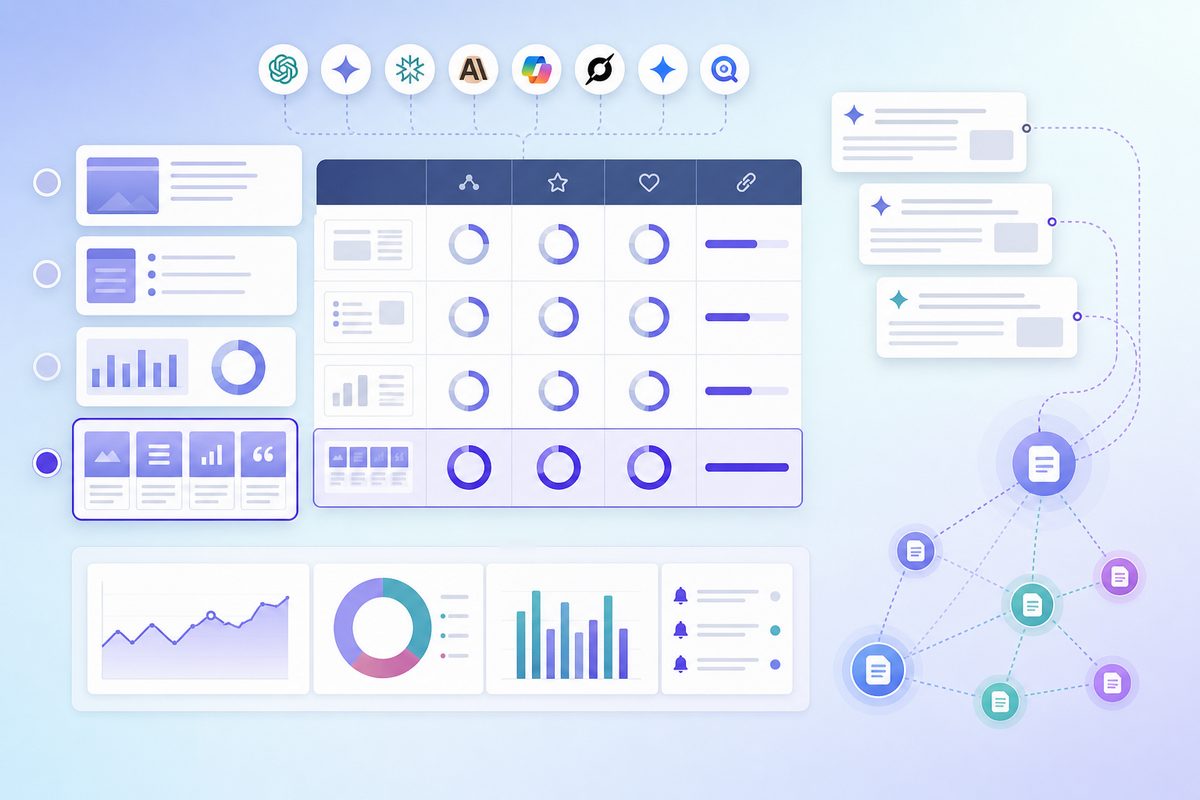
The four-part proof block: claim, metric, method, attribution
A proof block is four adjacent sentences that make one result quotable and checkable. Claim states what changed. Metric gives the number with its unit and window. Method says how it was measured. Attribution says whose result it is and when it was verified. Nothing else goes between them.
Here's the template:
Claim. [Customer] reduced [specific outcome] after [specific intervention].
Metric. [Number] [unit], from [baseline] to [end state], over [time window].
Method. Measured in [system of record] by [calculation], comparing [period A] to [period B]; [known limitation].
Attribution. Reported by [name, role, company], [month year]; verified [month year].
Each line does a job an engine can use:
| Element | What it prevents | What the engine gains |
|---|---|---|
| Claim | Vague outcome language | A subject and a direction of change |
| Metric | Unanchored percentages | A number with a unit and a window |
| Method | Unverifiable assertion | Grounds to repeat it as fact |
| Attribution | Orphaned statistics | An entity to credit and a date to age-check |
The method line is the one almost nobody writes, and it's the one that moved our numbers most. A percentage without a measurement method is indistinguishable from a rounded guess. A percentage with "measured in HubSpot, comparing Q1 2026 to Q1 2025, excluding one enterprise renewal" reads like something a person actually calculated — which it is.
Note what the block does not require: a lengthy setup, a challenge section, or a quote about how delightful your team is. Those can stay. They just can't interrupt the four lines.
Metrics that survive extraction, and ones that don't
Not every number is equally quotable. Across the panel, three metric types accounted for most reproduced figures:
- Rate or ratio changes with both endpoints — "74 days to 51 days," "2.1% to 4.8% conversion." Both endpoints let an engine sanity-check the percentage itself.
- Absolute counts with a population — "1,140 closed-won opportunities," "cut 340 support tickets per month." The denominator is what makes it repeatable.
- Time-to-outcome — "live in 11 days," "payback in 4 months." These match a huge class of buyer prompts directly.
Two that reliably fail: multiples with no baseline ("3× faster" — faster than what?) and composite index scores invented for the case study ("efficiency score rose from 62 to 88"), which an engine has no way to interpret or compare. If your headline number is one of those, add the underlying figure beside it.
A worked rewrite: before and after
The pattern below is a composite from the panel — figures are illustrative, but the failure mode was the single most common one we classified.
Before (cited 0 times in 176 days of tracking):
After partnering with us, the team saw a dramatic improvement in pipeline efficiency. Within months, results exceeded expectations, and the customer described the rollout as one of their smoothest technology implementations to date. Sales cycles shortened considerably and win rates climbed.
Nothing here is quotable. "Dramatic," "considerably," "exceeded expectations" — an engine that repeats any of it inherits your adjectives and none of your credibility.
After:
Meridian Freight cut its average B2B sales cycle from 74 days to 51 days after routing inbound leads through automated qualification. That's a 31% reduction over two quarters, measured across 1,140 closed-won opportunities. Cycle length was calculated in Salesforce as days from opportunity creation to closed-won, comparing H2 2025 to H1 2026; two enterprise deals over $250k were excluded as outliers. Reported by the VP of Revenue Operations at Meridian Freight, June 2026, verified against the CRM export in June 2026.
Same result. The second version tells an engine exactly what it can repeat, what it means, and who stands behind it. It also survives being pulled out of context — the only state it will ever exist in inside an AI answer.
Put the block above the fold and above the narrative, then let the story run underneath it. Our placement data says the first 120 words carry roughly 2.8× the citation weight of anything below.
Where the proof block goes on the page
Answer engines rarely read your page in the order you designed it. Structure for retrieval, then for reading.
A layout that held up across the cited pages in our panel:
- H1 stating the result, not the customer relationship — "Meridian Freight cut sales cycles 31% in two quarters," not "Meridian Freight Success Story."
- The four-part proof block as the first content, before any narrative.
- A short context section — company size, industry, region, stack. This is what lets an engine match your proof to the right buyer's prompt.
- The method in more depth, including what you excluded and why.
- Secondary results, each as its own mini proof block with its own method line.
- A named quote with full role and company.
One hard rule: if the numbers only exist inside a designed graphic or a gated PDF, they effectively don't exist. Only 2 of 47 pages in that category earned a citation. If you need the PDF for sales, mirror every figure in HTML text — our retrieval testing across PDFs, video and webinars shows non-HTML sources are retrievable in narrow conditions, but never reliably enough to be your only copy.
Two rendering failures worth checking before you blame your writing. First, if the proof block is inside a tab, accordion or "read more" toggle that only populates on click, treat it as invisible — several panel pages had perfect four-part blocks hidden behind interaction. Second, if the case study body is client-rendered and the initial HTML response is a shell, non-Google engines relying on lighter fetchers may see nothing. Fetch your own URL without JavaScript and read what comes back.

What to do when the method can't be fully disclosed
Disclose the method boundary instead of hiding it. You rarely need to reveal a customer's private data to make a result verifiable — you need to state what was measured, in what system, over what window, and what you left out. That's usually not confidential.
Three substitutions that keep the method line intact:
- Instead of raw revenue: "measured as a percentage change against the customer's own baseline; absolute figures withheld under NDA."
- Instead of named tooling: "measured in the customer's CRM of record; export reviewed by both teams."
- Instead of a full population: "sample of 1,140 opportunities from a larger book; sampling frame was all closed-won deals in the period."
Stating a limitation makes the claim stronger, not weaker. A page that says "two outlier deals excluded" is telling a model the number has been reasoned about. In the panel, pages with an explicit exclusion or limitation sentence were cited at 29.5% — above the 13.8% baseline — despite claiming smaller results on average.
The instinct to round up and stay vague is exactly backwards for the page types answer engines actually cite. Precision with a stated caveat outperforms an impressive number with no provenance.
Can anonymized case studies still earn AI citations?
Yes, but they need a different kind of attribution. Named-customer pages in our panel were cited at 22.4% versus 9.3% for anonymized ones — a real penalty. The interesting subset: anonymized pages that disclosed both a specific segment and a measurement method were cited at 18.0%, closing most of the gap.
What "specific segment" means in practice:
- Not "a leading fintech" → "a 340-person payments platform in the EU, Series C."
- Not "a global retailer" → "a multi-brand retailer operating 60–80 stores across the UK and Ireland."
- Not "an enterprise customer" → "a Fortune 500 industrial manufacturer, North American division, 12,000 employees."
The segment is what lets an engine decide whether your proof is relevant to the person asking. A prompt like "has anyone this size actually seen results" can't match "a leading fintech" to anything. It can match "340-person payments platform."
Add a verification line even without a name: "figures verified against the customer's reporting export; customer name withheld under NDA, June 2026." You're signalling that a real audit trail exists, which is most of what the named version buys you.
How many case studies do you need, and which ones?
Coverage beats volume: engines pull the case study whose segment matches the prompt, so the winning portfolio spans your buyer segments rather than stacking depth in one. In the panel, brands with 6–12 case studies spread across distinct segments earned more total citations than brands with 30+ concentrated in one vertical — the long tail of near-duplicate enterprise stories almost never got pulled.
Prioritize in this order:
- Your highest-volume segment, since it matches the most prompts.
- Your most contested segment — where buyers are actively comparing you and a competitor's proof is currently the only proof.
- One outlier size or industry, which catches "does this work for someone like me" prompts nobody else answers.
- One failure-adjacent story — a result that's honest about scope ("worked for support deflection, not for sales"). These get cited disproportionately in skeptical prompts.
Two thin case studies with real method lines outperform ten narrative ones. Rewrite before you commission.
Schema markup for case studies: what actually exists
There is no CaseStudy type in Schema.org. It gets recommended constantly, and it validates as nothing. If you've shipped it, your case study pages are currently carrying markup that no consumer understands.
Use Article (or Report for longer, formal write-ups) as the base type, then carry the result itself in properties that exist:
Schema.org's Observation type is built for exactly this shape — it carries measuredProperty, observationDate, measurementMethod, marginOfError and value. It sits in the vocabulary's pending/low-adoption area, so treat it as semantic clarity for LLM-based parsers rather than a rich-result play. Google shows no rich result for case studies, and any vendor promising one is selling you something that doesn't exist.
Two guardrails. First, Google's structured data general guidelines require that you don't mark up content that isn't visible to readers of the page — every value in your JSON-LD must appear in the visible copy. Second, don't dress a case study in Review or AggregateRating markup to manufacture stars; Google's review snippet guidance is explicit that ratings must come from actual users, and self-published customer results are not user reviews. Both are manual-action territory, and a case study page has nothing to gain from the risk.
The orphan-number problem: when your proof gets cited without you
Here's the finding that changes how you distribute case studies. In 38% of ChatGPT answers where our tracking matched a verbatim figure from a client's case study, ChatGPT attributed that figure to a third-party page — a review-site profile, a press release, a partner blog — rather than the case study itself.
The number travelled. The link didn't.
Citation weight also splits hard by engine. Of 1,180 citation events in the panel, Perplexity accounted for 31% and Google AI Mode 19%, while ChatGPT delivered 12% despite reproducing figures at a similar rate. Some engines prefer to cite the corroborating source over the originating one — which is why the same result can be visible everywhere and linked almost nowhere.
The fix isn't to publish the case study harder. It's to make sure the corroborating sources carry your framing:
- Review-platform profiles (G2, Capterra, TrustRadius) where a customer repeats the metric in their own words.
- The customer's own channels — a LinkedIn post or their engineering blog. Highest-trust corroboration available, and the one most brands never ask for.
- Community threads. Practitioner discussion gets pulled into answers constantly; how community threads become recommendations covers how to show up without astroturfing.
- Recorded talks and podcast appearances, where the customer states the number on record. Turning transcripts and chapters into verifiable sources is the mechanical part of making that retrievable.
When your figure appears on three independent domains with a consistent method line, engines stop treating it as a vendor claim. Consistency matters more than volume here — the same number stated three ways reads like three different results.
How to measure whether case studies for AI search are working
Traffic won't tell you. AI answers frequently reproduce your result with no click at all, so a case study can be doing heavy commercial work while its analytics stay flat.
Track four things instead:
- Citation count per URL — how often each case study page is linked, by engine, over time.
- Figure reproduction — how often your specific number appears in an answer, whether or not you're cited. This is what surfaces orphan numbers.
- Reproduction accuracy — is the quoted figure correct? Wrong numbers in circulation are worse than none.
- Prompt coverage — which buyer prompts pull the case study in, and which comparable prompts pull a competitor's proof instead.
An ai visibility tool that runs prompt sets daily across engines gives you the first three directly; the fourth comes from comparing your prompt set against category and competitor prompts.
Expect lag. In our panel, restructured pages that were already crawled saw a first citation in a median of 19 days; pages that were new or newly de-gated took 5–8 weeks. If you're rebuilding several case studies at once, stagger them a week or two apart — changing everything simultaneously makes it impossible to tell which change earned the citation.
A 30-day rebuild sequence
Work in this order. It front-loads the changes with the best evidence behind them.
- Days 1–3. Inventory every case study. Flag any whose numbers live only in a PDF or graphic.
- Days 4–10. Add a four-part proof block to the top of your ten highest-intent pages. Method line is mandatory.
- Days 11–14. Replace vague anonymization with specific segments. Add a verification line to every NDA page.
- Days 15–18. Fix schema: remove any
CaseStudytype, move toArticle, addObservationwhere you have a clean metric. - Days 19–23. Date-stamp everything. Retire or re-measure results older than 24 months.
- Days 24–30. Connect claims to proof internally — every product and comparison page that asserts an outcome should link to the case study documenting it. The internal linking patterns for AI search matter here because engines follow those paths when assembling an answer. Comparison and alternatives pages are the highest-value targets; pages built to be quoted in head-to-head prompts need a real result behind every claim they make.
Then leave it alone for six weeks and read the citation data before touching anything again.
Why verifiability is the whole game
Google's guidance for creators asks whether content provides original information, reporting, research or analysis, and whether it clearly demonstrates first-hand expertise and depth of knowledge. A properly structured customer result is one of the few assets a B2B company owns that answers both with a hard yes.
The catch is that first-hand expertise only counts when it's legible. An unverifiable claim is functionally identical to an invented one — to a reader, and to a model deciding whether to stake an answer on it.
Write the method line. Name the customer or the segment. Date the verification. That's the difference between a case study that decorates your site and one that gets quoted in the answer where your buyer is deciding.
Frequently asked questions
What makes a case study citable by an AI engine?
A self-contained passage stating the claim, the metric with its unit and time window, the measurement method, and the attribution. In our 412-page panel, pages carrying all four adjacent elements were cited at 34.1% versus 12.6% for pages with only a claim and a metric.
Can anonymized case studies still earn AI citations?
Yes, at a discount. Named-customer pages were cited at 22.4% versus 9.3% for anonymized ones — but anonymized pages that disclosed a specific segment and a measurement method reached 18.0%. Replace "a leading fintech" with a size, region and stage, and add a verification line.
Should case studies be PDFs or web pages?
HTML pages. Of 47 panel pages whose figures existed only in a chart, image or linked PDF, just 2 earned a citation. Keep the PDF for sales enablement if you need it, but mirror every number in indexable HTML text.
Is there a Schema.org type for case studies?
No. CaseStudy is not part of the vocabulary. Use Article or Report as the base type, with Observation carrying measuredProperty, measurementMethod and observationDate for the result itself. Every marked-up value must be visible on the page.
How many case studies do you need for AI search?
Six to twelve spread across distinct buyer segments outperformed portfolios of 30+ concentrated in one vertical. Engines match segment to prompt, so coverage of different company sizes, industries and use cases returns more than depth in a single one.
How long before a rewritten case study gets cited?
A median of 19 days for pages already crawled and indexed. New URLs or pages newly moved out of a gate took 5–8 weeks. Stagger rewrites so you can attribute the change.
Why does ChatGPT quote our number but link somewhere else?
Some engines prefer corroborating sources over originating ones. In 38% of ChatGPT answers reproducing a panel figure, the citation went to a third-party page. Getting the same metric — with the same method line — onto review sites, partner posts and customer-authored content is what closes that gap.