AI shopping assistant visibility is the measurable ability of a product or brand to appear, rank, be accurately described, and earn a valid buying path in AI-generated shopping recommendations. It covers mention rate, shortlist position, citations, evidence quality, sentiment, and product data accuracy across assistants such as Amazon Alexa for Shopping, Perplexity Shopping, ChatGPT, Google, and other AI buying surfaces.
This matters because shopping assistants collapse the buyer journey. A shopper may no longer compare ten blue links, five retailer pages, and three review roundups. They may ask, “What is the best standing desk for a small apartment under $500?” and choose from a short list.
If your product is missing from that answer, the loss happens before a click, impression, or product-grid rank appears in a traditional SEO report.
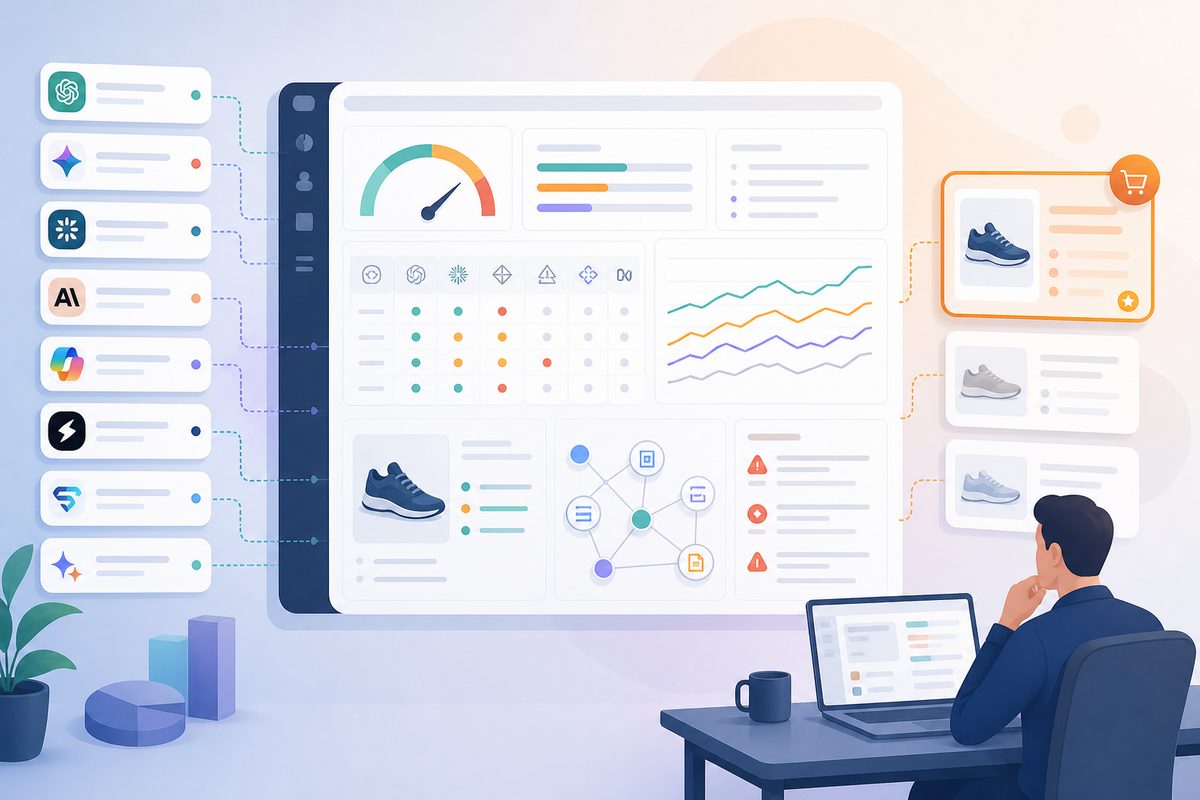
What AI shopping assistant visibility measures
AI shopping assistant visibility measures recommendation behavior, not only search traffic. A product can rank well in Google, sell on Amazon, and still be weak in AI shopping answers if assistants cannot find, verify, compare, or confidently recommend it.
Track these signals:
| Signal | What it answers |
|---|---|
| Mention rate | Does the assistant mention the product at all? |
| Shortlist rank | Is the product first, top three, or buried? |
| Recommendation reason | Why does the assistant say the product fits the prompt? |
| Citation source | Which pages, reviews, listings, or third-party sources support the answer? |
| Attribute accuracy | Are price, specs, compatibility, availability, and positioning correct? |
| Sentiment | Does the answer recommend, hedge, warn, or dismiss? |
| Buying path | Does the answer point to a valid product page, retailer, cart, or checkout flow? |
| Competitor adjacency | Which brands define the comparison set around you? |
The core KPI is not “Did AI mention us once?” It is: when a buyer asks what to buy, does the assistant include us in the right shortlist for the right reason?
Why this became urgent in 2026
AI shopping moved from novelty to transaction layer. Amazon, Perplexity, Google, OpenAI, and browser-based agents are all moving product research closer to conversational answers, product cards, and automated purchase flows.
Amazon is the clearest example. In May 2026, Amazon said Rufus had been brought together with Alexa+ to create Alexa for Shopping. Amazon also reported that Rufus helped more than 300 million customers in 2025 research, compare, and buy products. Alexa for Shopping can answer questions in the Amazon search bar, compare products from results, summarize product categories, show price history, schedule purchases, and shop across other stores through agentic buying features.
Perplexity has taken a different route. Its shopping features package recommendations into answer-style product cards. The Verge reported in 2024 that Perplexity Shopping introduced product cards with images, prices, AI-written summaries of features and reviews, Buy with Pro for eligible U.S. Pro users, merchant redirects, and a merchant program. In 2025, The Verge also reported Perplexity’s AI personal shopper with product cards, specs, reviews, and PayPal-backed purchasing through participating merchants.
The practical SEO question is now broader than product-page ranking: can your product survive assistant retrieval, evidence extraction, comparison, and answer packaging?
Where AI shopping visibility appears
AI shopping assistant visibility is not one platform. It is a set of recommendation surfaces that use different evidence and different buying paths.
| Surface | How visibility usually appears | Evidence brands should improve |
|---|---|---|
| Amazon Alexa for Shopping / Rufus lineage | Product suggestions, category summaries, product comparisons, listing Q&A, price history, cart actions | Amazon detail pages, titles, bullets, variants, reviews, Q&A, price, availability, images |
| Perplexity Shopping | Conversational answers, product cards, review summaries, citations, merchant links, checkout flows | Crawlable product pages, retailer data, review sources, comparison pages, merchant feeds, cited third-party content |
| Google AI and Shopping surfaces | Product snippets, merchant listings, AI answers, Google Shopping, image and Lens discovery | Product structured data, Merchant Center feeds, crawlability, reviews, shipping, returns, images |
| ChatGPT and other answer engines | Product shortlists, buying advice, source-backed recommendations, comparison answers | Clear category pages, comparison content, support docs, review proof, authoritative third-party mentions |
| Browser and agentic shopping tools | Product finding, cross-site comparison, cart building, checkout assistance | Accessible product data, stable URLs, current pricing, stock, policies, account-free product information |
This is why treating AI shopping as “schema only” is too narrow. Structured data helps machines understand facts, but assistants also rely on language, reviews, sources, visual context, merchant reliability, and buyer-fit reasoning.
How Amazon Alexa for Shopping builds recommendations
Amazon’s shopping assistant uses marketplace data, product expertise, personalization, and web information to answer purchase questions. Amazon’s original Rufus announcement said Rufus was trained on Amazon’s product catalog, customer reviews, community Q&As, and information from across the web to answer shopping questions, compare products, and make recommendations.
Amazon also described product-page answers based on listing details, customer reviews, and community Q&A. That is important because Amazon’s assistant is close to the transaction. Weak or inconsistent marketplace evidence can block visibility even if your broader web presence is strong.
For Amazon, prioritize:
- Product title clarity: Include brand, product type, model, key differentiator, size or compatibility where useful.
- Bullet completeness: Cover material facts, dimensions, use cases, limitations, setup requirements, warranty, and included items.
- Variation hygiene: Keep colors, sizes, models, bundles, and accessories separated cleanly.
- Review usefulness: Encourage specific, policy-compliant reviews that mention use case, fit, durability, setup, and trade-offs.
- Q&A coverage: Answer practical buyer questions directly: washable, compatible, beginner-friendly, giftable, safe, returnable.
- Visual evidence: Use images that show scale, contents, setup, controls, packaging, and real use.
- Commercial freshness: Keep price, availability, coupons, delivery, and return terms current.
The goal is not to “game” Rufus or Alexa for Shopping. The goal is to remove ambiguity so the assistant can recommend the right product to the right buyer.
How Perplexity Shopping chooses product cards
Perplexity Shopping visibility depends on both product data and citable web evidence. Unlike Amazon, Perplexity is not limited to one marketplace listing. Its answers can be shaped by product pages, merchant pages, review articles, comparison content, third-party sources, and user-visible citations.
That makes Perplexity a useful model for answer-engine commerce. If Perplexity cites a stale roundup, an outdated retailer page, or a forum thread that describes the product inaccurately, the answer may inherit that framing.
For Perplexity, build a source map:
| Prompt | Product shown? | Rank | Cited sources | Source owner | Accuracy issue | Fix owner |
|---|---|---|---|---|---|---|
| “Best lightweight carry-on for international travel” | Yes | 3 | Review roundup, retailer page | Third party / retailer | Old weight and price | PR + ecommerce |
| “Product A vs Product B for families” | No | N/A | Competitor blog, marketplace page | Competitor / retailer | Missing family-use evidence | Content + product |
| “Is Product X good for beginners?” | Yes | 1 | Product page, reviews | Owned / third party | Correct | Monitor |
The source map turns AI citations into an action list. You can see whether the problem is missing owned content, stale retailer data, weak review language, poor category framing, or a third-party source that outranks your own evidence.
The maxaeo consideration-set audit
The consideration-set audit is a repeatable way to find where a product disappears before an AI assistant recommends it. It separates the assistant journey into five layers: retrieval, interpretation, evidence, comparison, and packaging.
| Layer | What the assistant needs | Common failure | Fix |
|---|---|---|---|
| Retrieval | Product exists in a catalog, feed, index, merchant database, or web corpus | Product is not found for the category or use case | Improve crawlability, feed data, listings, internal links, category language |
| Interpretation | Assistant understands buyer intent, constraints, budget, compatibility, and occasion | Product is matched to the wrong need | Add use-case copy, compatibility sections, buyer-fit language |
| Evidence | Specs, reviews, Q&A, pricing, shipping, returns, and proof are extractable | Assistant cannot justify the recommendation | Add facts, FAQs, reviews, case proof, structured data |
| Comparison | Product beats alternatives on prompt-specific criteria | Competitors have clearer proof or stronger review language | Publish comparisons, trade-offs, benchmarks, buying guides |
| Packaging | Assistant presents product card, rank, summary, citation, and buying path | Product is mentioned but buried or described poorly | Improve titles, snippets, images, product-card data, cited pages |
A product can fail at any layer. A polished product title will not fix missing compatibility evidence. A strong review profile will not fix unavailable pricing. A great comparison page will not help if the assistant cannot crawl or cite it.
A scoring model for AI shopping assistant visibility
A useful score separates presence from recommendation quality. Being mentioned once is weaker than ranking first with accurate attributes, strong citations, and a valid buying path across many purchase prompts.
Use a 100-point score:
| Component | Weight | Scoring question |
|---|---|---|
| Shortlist inclusion | 25 | Does the product appear in the answer or product-card set? |
| Rank and prominence | 20 | Is it first, top three, or visually prominent? |
| Evidence quality | 20 | Does the assistant cite or summarize credible product proof? |
| Attribute accuracy | 15 | Are specs, pricing, compatibility, use cases, and availability correct? |
| Sentiment and fit | 10 | Is the recommendation confident and aligned with the prompt? |
| Buying path | 10 | Does the answer lead to a valid product, retailer, demo, trial, or checkout path? |
Interpret the score by failure pattern:
| Pattern | What it means | Likely next action |
|---|---|---|
| High inclusion, low accuracy | The product is known but poorly understood | Correct product data, claims, specs, and cited sources |
| Low inclusion, high accuracy when mentioned | The product evidence is good but coverage is narrow | Expand category pages, comparisons, reviews, and prompts |
| High rank, weak buying path | The assistant likes the product but cannot complete the journey | Fix merchant pages, stock, feeds, checkout links, or demos |
| Strong owned citations, weak third-party proof | Your site is clear but outside validation is thin | Earn reviews, comparisons, partner pages, marketplace proof |
| Strong third-party citations, weak owned citations | Others define the product better than you do | Improve owned product, comparison, FAQ, and support content |
This is where an AI visibility tool should do more than count mentions. It should preserve prompts, answers, ranks, citations, sentiment, competitors, screenshots, and changed evidence over time. For a broader measurement model, see maxaeo’s guide to AI recommendation ranking.
How to build a prompt panel
A prompt panel is a fixed set of buyer questions used to test visibility repeatedly. It should cover how real buyers discover, compare, validate, and reject products.
Start with 30 to 100 prompts across six groups:
| Prompt group | Example | What it tests |
|---|---|---|
| Category discovery | “Best project management tool for a 40-person agency” | Whether you enter the initial shortlist |
| Constraint search | “Best standing desk for a small apartment under $500” | Whether product attributes match specific needs |
| Comparison | “Product A vs Product B for remote teams” | Whether differentiators are understood |
| Validation | “Is Product X good for beginners?” | Whether product-page and review evidence answer concerns |
| Replacement | “Alternative to Product A with lower setup time” | Whether competitor-adjacent positioning is clear |
| Risk and reputation | “What are the main complaints about Product X?” | Whether negative or outdated sources dominate |
For each run, record:
- Assistant and surface tested.
- Exact prompt.
- Date, country, language, and account state if relevant.
- Products shown.
- Rank and visual prominence.
- Citations or referenced sources.
- Recommendation reason.
- Incorrect or missing attributes.
- Sentiment.
- Competitor co-mentions.
- Screenshot or exported answer.
A single screenshot is an anecdote. A repeated prompt panel becomes AI search monitoring.
What product pages should include for AI assistants
Product pages should expose the facts a buyer uses to compare, justify, or reject a purchase. Assistants need both structured data and clear human-readable evidence.
Google’s Product structured data documentation explains that merchants can provide product data through Product structured data, Google Merchant Center feeds, or both. Google also notes that merchant listing markup can include detailed product information such as sizing, shipping, and return policy data.
For AI shopping assistant visibility, treat structured data as the machine-readable layer. The page itself still needs buyer-ready answers:
- Who is this product best for?
- What problem does it solve better than alternatives?
- What is included and excluded?
- What sizes, platforms, integrations, materials, or workflows is it compatible with?
- What are the limitations or trade-offs?
- What proof supports each claim?
- What price, plan, warranty, trial, return, or delivery terms apply?
- What should a buyer compare before choosing?
Use plain language. A human should be able to scan the page and understand whether the product fits. If a human cannot compare it quickly, an assistant may not compare it well either.
What evidence gets products recommended
Assistants favor evidence that is specific, current, corroborated, and tied to the buyer’s prompt. Generic copy gives the model little to extract. Concrete facts and buyer proof make recommendations easier to justify.
Weak evidence:
“A premium solution for modern teams that boosts productivity.”
Stronger evidence:
“Includes SSO, SCIM provisioning, SOC 2 Type II reporting, Jira integration, role-based permissions, and a 14-day sandbox for teams over 100 employees.”
For physical products, strong evidence includes dimensions, materials, battery life, certifications, weight, compatibility, safety limits, warranty, return policy, packaging contents, and use-case photos.
For software, strong evidence includes integrations, security posture, pricing model, implementation time, admin controls, migration support, customer proof, support commitments, and limitations.
Buyer Q&A is especially valuable because it uses natural purchase language. The AmazonQA research dataset, introduced in a 2019 paper, included 923,000 questions, 3.6 million answers, and 14 million reviews across 156,000 products. That scale shows how often buyers ask practical questions that product copy fails to answer directly.
Product evidence map by prompt type
Map every important prompt to the evidence an assistant would need to answer it. This prevents teams from publishing generic “AI-optimized” content that does not solve the real retrieval problem.
| Buyer prompt type | Evidence the assistant needs | Page or asset to improve |
|---|---|---|
| “Best X for Y” | Category fit, use cases, differentiators, proof | Category page, use-case page, buying guide |
| “X under $Y” | Price, plans, discounts, total cost, availability | Pricing page, product feed, merchant listing |
| “X vs Y” | Feature differences, trade-offs, limitations | Comparison page, product table, FAQ |
| “Is X good for beginners?” | Setup time, onboarding, support, complexity | Beginner guide, reviews, Q&A |
| “Does X work with Z?” | Compatibility, integrations, versions, exclusions | Integration page, specs, support docs |
| “What are complaints about X?” | Known limitations, fixes, support responses | Review response strategy, help docs, changelog |
| “Best alternative to X” | Positioning, switching reasons, migration proof | Alternative page, migration guide, case study |
| “Can I buy X today?” | Stock, delivery, returns, checkout path | Merchant feed, retailer page, PDP |
This is the fastest way to move from vague generative engine optimization to concrete product work.
How to diagnose why a product is missing
Diagnose missing visibility by matching the failed prompt to the failed evidence layer. A product may be absent because the assistant cannot find it, cannot classify it, cannot justify it, or finds stronger competitor evidence.
Use this workflow:
- Capture the exact answer. Save prompt, assistant, date, location, citations, product cards, and screenshot.
- Label buyer intent. Category discovery, comparison, validation, replacement, budget, compatibility, reputation, or purchase.
- Check retrieval. Does the product appear in normal search, marketplace search, site search, Merchant Center, product feeds, and indexed pages?
- Check entity consistency. Are product name, brand, model, SKU, variant, and category consistent across the web?
- Check evidence completeness. Are specs, reviews, Q&A, price, availability, returns, images, and proof extractable?
- Check citations. Which sources shape the answer: owned pages, retailers, reviews, affiliates, forums, media, or competitors?
- Check language match. Does your content use the buyer’s wording, or only internal product terms?
- Ship one fix. Update the product page, feed, schema, FAQ, comparison page, review request flow, or merchant listing.
- Retest the same prompt panel. Compare mention rate, rank, source, sentiment, and accuracy.
If your brand is missing across many AI answers, use the same diagnosis model in Brand Not Showing Up in AI Search? to separate indexing, authority, entity, and evidence gaps.
Amazon-specific fixes for Alexa for Shopping
For Amazon, improve listing evidence before chasing external signals. Alexa for Shopping sits close to Amazon’s product detail pages, reviews, Q&A, price, inventory, purchase history, and marketplace context.
Focus on these fixes:
| Area | What to improve |
|---|---|
| Title | Brand, product type, model, key spec, size, compatibility |
| Bullets | Use case, dimensions, materials, setup, included items, limitations |
| Description | Comparison-ready explanation of who should and should not buy |
| Images | Scale, parts, packaging, controls, compatibility, before/after use |
| Variants | Clean parent-child relationships and no mixed models |
| Reviews | Policy-compliant requests that encourage specific buyer context |
| Q&A | Direct answers to recurring purchase objections |
| Availability | Current stock, delivery, price, coupons, return terms |
| Category fit | Correct browse node, attributes, and search terms |
Do not stuff titles or manufacture reviews. Both create trust risk. Better AI shopping assistant visibility comes from clearer evidence, not noisier listings.
Perplexity-specific fixes for product discovery
For Perplexity, improve the sources that the answer engine can cite. Product cards and conversational recommendations may be influenced by a broader web footprint than a single marketplace listing.
Prioritize:
- Owned product pages: Make specs, use cases, pricing, availability, and limitations crawlable.
- Comparison pages: Explain trade-offs between your product and alternatives without exaggerated claims.
- Review pages: Keep third-party review profiles accurate and current.
- Merchant and partner pages: Ensure retailers, resellers, affiliates, and marketplaces use the right product name and facts.
- Support docs: Answer compatibility, setup, integration, and troubleshooting questions directly.
- Source freshness: Update pages that still show old pricing, discontinued features, obsolete models, or outdated screenshots.
For SaaS and technical products, Perplexity often behaves less like a store and more like a research assistant. That means citations, review summaries, integration pages, and proof pages can influence whether you make the shortlist.
What B2B SaaS and tech companies should do differently
B2B products need a broader definition of shopping. The buyer may not click “buy now,” but assistants still create vendor shortlists for software, agencies, APIs, cloud tools, security platforms, analytics products, and AI platforms.
For SaaS, product evidence includes:
- feature pages;
- pricing pages;
- integration pages;
- security and compliance documentation;
- API docs;
- changelogs;
- case studies;
- implementation guides;
- migration pages;
- support documentation;
- G2-style review evidence;
- analyst, partner, and customer mentions.
A prompt like “best SOC 2-ready customer support platform for a 200-person SaaS company” requires proof across security, scale, integrations, migration effort, support quality, and cost. A homepage tagline is not enough.
This is where AI shopping assistant visibility overlaps with broader AI search visibility. The buying journey is conversational, but the ranking input is still evidence.
How to run controlled experiments
Run controlled tests by changing one evidence layer, freezing the prompt set, and comparing pre/post assistant outputs. AI answers fluctuate, so one improved answer does not prove causality.
A clean test has four parts:
| Test element | Minimum standard |
|---|---|
| Prompt panel | 30 to 100 prompts across discovery, comparison, validation, and alternatives |
| Baseline window | Multiple repeated runs before changes, using the same assistants and settings |
| Single treatment | One meaningful fix, such as Product schema, expanded Q&A, corrected feed data, or comparison copy |
| Outcome metrics | Mention rate, rank, citation source, attribute accuracy, sentiment, and buying path |
Use a control group when possible. For example, update five product pages with missing compatibility data and leave five similar pages unchanged. If visibility improves only on the treated pages, the evidence is stronger.
A good first experiment is one flagship product, three competitors, and 50 purchase prompts. That is enough to reveal whether the product is missing because of retrieval, weak proof, bad positioning, or competitor authority.
Product evidence checklist
The fastest way to improve AI shopping assistant visibility is to make product evidence complete, consistent, and easy to compare.
| Evidence area | What to check |
|---|---|
| Entity clarity | Product name, brand, model, category, variants, SKU, GTIN, and identifiers are consistent |
| Use-case language | Pages mention the buyer jobs assistants are likely to hear in prompts |
| Product facts | Specs, materials, integrations, dimensions, limits, and compatibility are complete |
| Proof | Reviews, case studies, ratings, expert comparisons, customer Q&A, and benchmarks support claims |
| Commercial data | Price, availability, shipping, returns, warranty, trial, and checkout terms are current |
| Visual evidence | Images show scale, setup, components, packaging, UI, results, or fit |
| Comparison content | Alternatives and trade-offs are explained clearly and fairly |
| Crawlability | Important details are indexable, not trapped only in images, scripts, PDFs, or inaccessible tabs |
| Structured data | Product, offers, ratings, shipping, returns, and variants are marked up where appropriate |
| Source consistency | Retailers, marketplaces, partners, affiliates, and review sites use accurate facts |
| Monitoring | Prompt results are saved weekly or daily for AI share of voice reporting |
This checklist also protects brand accuracy. Many teams first notice AI visibility only after an assistant says something wrong. Better LLM brand tracking catches those issues before they shape buyer perception.
How often to monitor visibility
Monitor priority shopping prompts weekly, and monitor daily during launches, seasonal peaks, pricing changes, or reputation events. Assistant answers change because product pages, feeds, reviews, citations, model behavior, and competitor evidence change.
Use daily monitoring when:
- launching a new product, feature, model, or pricing tier;
- entering a high-value category;
- fixing inaccurate AI answers;
- responding to a competitor campaign;
- updating pricing, packaging, or availability;
- preparing for Prime Day, Black Friday, Cyber Monday, or a major industry event;
- managing a product recall, review issue, or PR event.
Weekly tracking is usually enough for stable evergreen categories. Monthly tracking is often too slow because assistants can update recommendations before traditional SEO dashboards show a traffic shift.
For tool selection, prioritize systems that store prompts, answers, citations, screenshots, ranks, competitors, and sentiment by assistant and market. maxaeo’s testing framework for AI search and LLM monitoring tools explains what to look for when evaluating platforms.
Common mistakes that reduce AI shopping assistant visibility
Most failures come from unclear evidence, inconsistent entities, thin comparison content, stale commercial data, and unmonitored assistant answers. The issue is rarely one missing keyword.
Avoid these mistakes:
- Writing persuasive product copy that lacks extractable facts.
- Using different product names across Amazon, retailers, feeds, reviews, and your site.
- Hiding specs in images, PDFs, inaccessible tabs, or scripts.
- Ignoring Q&A even when buyers repeatedly ask the same practical questions.
- Treating structured data as a substitute for useful content.
- Publishing comparison pages that never state trade-offs.
- Letting outdated affiliate or retailer pages define your product.
- Measuring only traffic after an assistant has already shaped demand upstream.
- Chasing fake reviews, fake citations, or inauthentic mentions.
- Updating product evidence without retesting the same prompts.
Google’s helpful content guidance asks whether content provides original information, complete coverage, analysis beyond the obvious, and value compared with other search results. That is also the right bar for AI shopping assistants.
Google’s guide to generative AI features in Search makes the practical point that crawlability, technical structure, unique valuable content, and people-first usefulness still matter. There is no separate magic layer for AI shopping. Assistants need trustworthy product evidence they can access and explain.
A 30-day AI shopping visibility playbook
A 30-day plan should move from measurement to diagnosis, fixes, and controlled retesting. Start with products and prompts most likely to influence revenue.
| Day range | Workstream | Output |
|---|---|---|
| Days 1-5 | Build prompt panel | 30-100 prompts grouped by buyer intent |
| Days 6-8 | Run baseline | Answers, screenshots, ranks, citations, sentiment, accuracy notes |
| Days 9-12 | Diagnose gaps | Failed layer for each prompt: retrieval, interpretation, evidence, comparison, packaging |
| Days 13-20 | Ship fixes | Product pages, feeds, schema, Q&A, comparison content, review requests, merchant updates |
| Days 21-25 | Retest | Same prompts, assistants, markets, and scoring model |
| Days 26-30 | Report | Change in mention rate, rank, citation ownership, accuracy, sentiment, and buying path |
The strongest first target is one flagship product, three competitors, and 50 buyer prompts. That creates enough signal to decide whether the next investment should be product data, marketplace cleanup, comparison content, review generation, or authority building.
Common questions about AI shopping assistant visibility
Does Product schema guarantee inclusion in AI shopping assistants?
No. Product schema helps search systems understand product facts, but it does not guarantee inclusion or ranking. For AI shopping assistant visibility, schema should support complete product evidence: price, availability, reviews, shipping, returns, variants, compatibility, and clear on-page explanations.
Is Amazon Rufus still relevant after Alexa for Shopping?
Yes, as product lineage and search language. Amazon says Rufus was renamed Alexa for Shopping on May 13, 2026. Marketers should track the current Alexa for Shopping surface while recognizing that many sellers, analysts, and buyers still refer to the behavior as Rufus.
How is AI shopping assistant visibility different from marketplace SEO?
Marketplace SEO focuses on rankings inside marketplace search results. AI shopping assistant visibility focuses on conversational recommendations, shortlist rank, cited evidence, reasoning, sentiment, and answer accuracy. Both matter, but assistants can influence buyers before they scan a traditional product grid.
Can this help teams get recommended by ChatGPT too?
Yes. The measurement logic transfers: prompt panels, shortlist rank, citations, source accuracy, sentiment, and competitor co-mentions. ChatGPT, Gemini, Claude, Perplexity, Copilot, Grok, Google AI surfaces, and shopping assistants use different systems, but the business question is the same: when a buyer asks what to buy, are you recommended?
What is the first fix if a product is invisible?
Start with diagnosis, not content volume. Run the product through category, comparison, validation, and compatibility prompts. If the assistant cannot find the product, fix retrieval and entity consistency. If it finds the product but will not recommend it, fix evidence, reviews, comparisons, and buyer-fit language.
The bottom line
AI shopping assistant visibility turns product recommendation into a measurable discovery channel. Amazon’s Rufus-to-Alexa transition and Perplexity’s product-card model show where shopping is heading: assistants that interpret intent, compare options, summarize proof, cite sources, and sometimes complete the purchase.
The winning playbook is practical. Track the prompts that matter. Score whether you appear, rank, and get described correctly. Map every failure to retrieval, interpretation, evidence, comparison, or packaging. Then fix the source of truth: product pages, feeds, structured data, reviews, Q&A, images, merchant listings, comparison pages, and third-party proof.
Brands will not win by writing the most “AI-optimized” copy. They will win by making their products easiest for assistants to find, verify, compare, and confidently recommend.