AI-influenced pipeline is the dollar value of open opportunities where an AI assistant touched the buying process before the opportunity was created — counted once per opportunity, not once per signal. That last clause is where most reporting falls apart. Teams stack three separate AI signals on top of the same deal and hand leadership a number roughly twice the real one.
This guide gives you the definition, the three credit tiers, a tie-break table for ambiguous cases, a step-by-step calculation, the CRM fields to build it on, and a full worked example from a $6.1M quarter where the naive method produced $3.93M of AI-influenced pipeline and the deduplicated method produced $2.02M.
What counts as AI-influenced pipeline?
AI-influenced pipeline is open opportunity value where at least one verifiable AI touch — a citation, a referral session, or a documented buyer statement — occurred inside the qualifying window before the opportunity record was created. It is a coverage metric, not a revenue metric. It never adds to sourced revenue; it overlaps with it.
The distinction matters because CFOs read "influenced" as "caused." Once you present $3.9M of AI-influenced pipeline against $6.1M of total new pipeline, you have implicitly claimed AI search drove 64% of the quarter. You will not survive the follow-up question.
The fix is structural. Instead of asking "did AI touch this deal?" for every signal you collect, you ask "which single signal has the strongest evidentiary claim on this deal?" — and you record only that one.
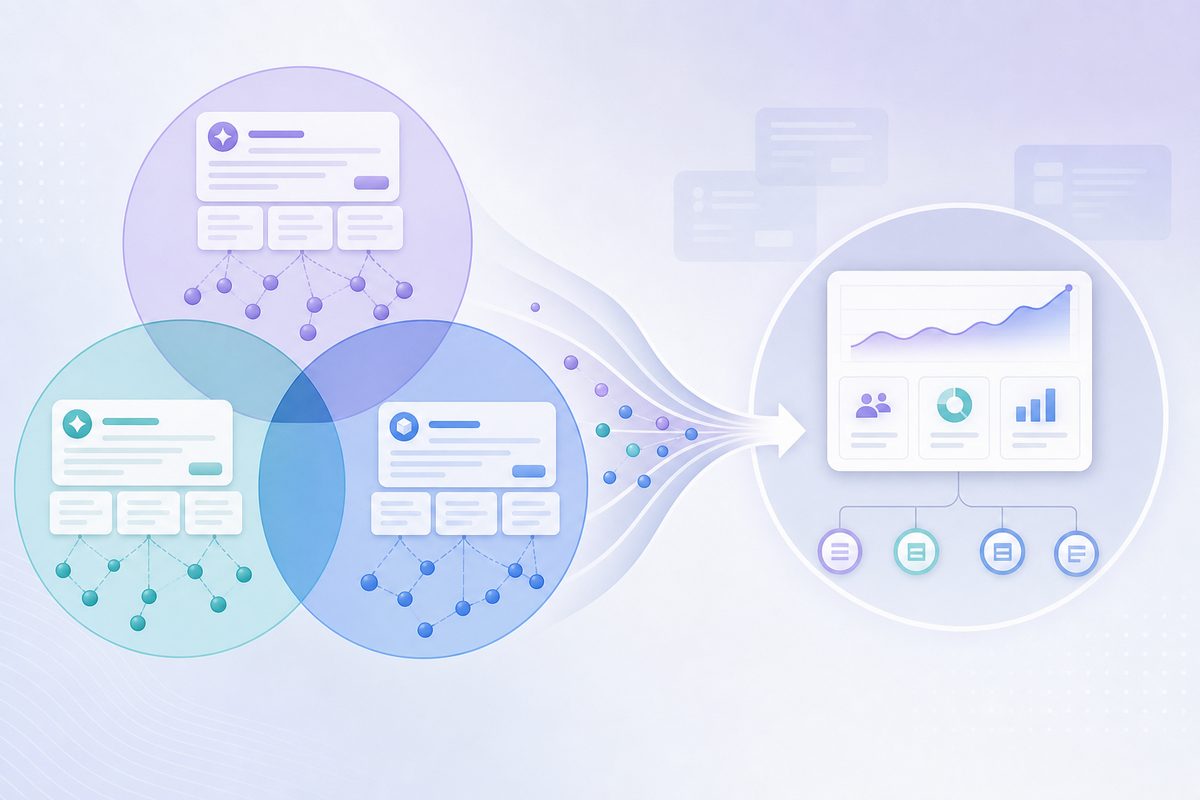
AI-influenced vs AI-sourced vs AI-attributed
These three get used interchangeably in decks and they mean different things. Fix the vocabulary before you fix the math.
| Term | What it claims | Denominator | Who should read it |
|---|---|---|---|
| AI-sourced | The AI touch was the first touch on the record that became the opportunity | New pipeline created in period | CFO, board — this is the defensible number |
| AI-influenced | At least one qualifying AI touch happened in the window before creation | New pipeline created in period | CMO, demand gen — coverage, not causation |
| AI-attributed | A fractional model assigned some share of a deal to AI | Closed-won revenue | Nobody, yet — the touch set is too incomplete to weight |
Use "sourced" when someone asks what AI caused. Use "influenced" when someone asks how far AI reaches. If your deck only has one of the two, it is the wrong one.
Why AI-influenced pipeline inflates faster than any other channel
Three things make this metric uniquely prone to over-counting, and they compound.
Signals arrive from independent systems that never reconcile. Your AI visibility platform reports citations. GA4 reports referral sessions from chatgpt.com and perplexity.ai. Your form reports a self-reported answer. Each system is confident, each is measuring the same buyer, and none of them knows the others exist.
AI touches are invisible more often than they are visible. Referrer analyses of AI-assistant traffic consistently find that a large majority of AI-originated sessions arrive with no usable referrer and land in "direct" — assistants strip or omit the referrer, and copy-pasted URLs carry nothing at all. So teams over-correct with generous inference rules, then apply those rules on top of the touches they can see. This is the same measurement gap behind dark AI search — buyers who used an assistant but never clicked a citation.
The buyer uses AI at every stage, not just discovery. A buyer who found you through a Google search in March may still ask ChatGPT to compare you against two competitors in May, and again to sanity-check your security posture in July. All three touches are real. Only one of them plausibly created the opportunity.
Add a fourth accelerant: AI browsers and agentic assistants fetch your pages live and strip referrer data in the process, so the same session can be logged as direct, as an AI referral, and as a self-reported ChatGPT touch depending on which system you ask.
There is a structural reason the citation count and the session count never line up. A single prompt triggers query fan-out — the assistant runs a dozen or more hidden searches behind one question, so your brand can be retrieved and shown several times inside one buyer session that produces, at most, one click. Citation volume is not session volume, and treating them as interchangeable inflates the count before you even reach the CRM.
The three credit tiers, defined precisely
Every AI touch belongs to exactly one of three tiers. The tiers are ordered by evidentiary strength — strongest first — because that ordering is what makes deduplication deterministic.
| Tier | Name | Evidence required | Qualifying window | Typical share |
|---|---|---|---|---|
| 1 | AI-Sourced | First-touch session on a tracked AI referrer, or first-touch UTM from an AI-cited URL, on the record that became the opportunity | First touch only | 8–12% of new pipeline |
| 2 | AI-Assisted | Any AI referral session or tracked AI citation click by any contact on the account, after first touch | ≤90 days before opportunity creation | 15–25% |
| 3 | AI-Self-Reported | Buyer states AI use in a form field, survey, or logged discovery call note | Statement captured before or within 14 days of opportunity creation | 10–20% |
The share ranges are what we have observed across mid-market B2B SaaS cleanups, not a published benchmark — calibrate against your own first two quarters rather than treating them as targets.
Two rules make the table work. First, tier 1 is a first-touch definition and nothing else — if the AI session was the third touch, it is tier 2, permanently. Second, tier 3 is a residual bucket: an opportunity only lands there when tiers 1 and 2 produced no evidence.
Self-reported answers are the noisiest input but the only one that reaches buyers who never clicked a citation. You need the tier. You just cannot let it stack.
The one-opportunity-one-tier rule
Here is the entire deduplication principle in one sentence: an opportunity is written into the highest tier for which it qualifies, and is removed from every lower tier's count.
That is it. No weighting, no fractional credit, no W-shaped model. Fractional multi-touch models are fine for comparing marketing programs against each other, but they are the wrong tool here because AI touches are not reliably observable — you cannot fractionally weight a touchpoint set you know is incomplete.
The CRM build: one field, one value
The practical implementation is a single custom field on the opportunity object.
- Field:
ai_influence_tier— picklist on Opportunity, valuessourced / assisted / self_reported / none - Supporting field:
ai_touch_date— date of the qualifying touch, used to enforce the window and to strip post-creation touches - Supporting field:
ai_evidence_source— text, e.g.ga4_referral,form_field,discovery_note,citation_click - Validation rule:
ai_influence_tiercannot besourcedunlessai_touch_date≤ the record's first-touch date; cannot be non-noneunlessai_evidence_sourceis populated - Reporting rule: every AI report in the CRM reads from
ai_influence_tierand nothing else
The three raw source lists still exist — you need them for diagnostics and for the overlap rate below — but they live in a staging report, not in the board deck.
The tie-break table for ambiguous cases
| Situation | Ruling |
|---|---|
| AI referral session and self-reported "ChatGPT" on same contact | Tier 1 or 2 (the observed session wins; discard the self-report) |
| Self-reported "ChatGPT" but zero AI sessions on the account | Tier 3 |
| AI session occurred 4 days after opportunity creation | none — post-creation touches are expansion signal, not pipeline creation |
| Two contacts on one account, one AI-sourced, one AI-assisted | Tier 1, at the opportunity level |
| Buyer says "I asked Claude" but rep logged it, no form field | Tier 3, flagged unverified |
| AI session 140 days before opportunity creation | none — outside the 90-day window |
| Assistant cited you, buyer clicked a competitor, then found you via branded search | Tier 3 if the buyer says so; otherwise none — you cannot observe this |
| Same contact, AI session on two separate opportunities | Both opportunities score independently; credit is per-opportunity |
The fourth row is the one teams get wrong most often. Credit is assigned at the opportunity level, never the contact level. If you assign at contact level and roll up, a six-contact buying committee can generate six claims on one deal.
Worked example: a $6.1M quarter, before and after deduplication
The figures below come from one quarter of reporting cleanup at a mid-market B2B SaaS company selling a $40K–$90K ACV product into engineering orgs. Deal values are rounded and the account is anonymized; the ratios are untouched.
Method. We pulled three independent lists for the quarter: (1) opportunities whose primary contact had a first-touch session from a tracked AI referrer; (2) opportunities with any AI referral session or tracked citation click by any account contact; (3) opportunities where any contact selected an AI option in the "How did you first hear about us?" field or a rep logged an AI mention in discovery notes. Then we matched them on opportunity ID.
Step 1: the raw claims
| Signal list | Opportunities | Pipeline value |
|---|---|---|
| AI-Sourced list | 19 | $612K |
| AI-Assisted list | 58 | $1.94M |
| Self-reported AI list | 41 | $1.38M |
| Naive total | 118 | $3.93M |
Total new pipeline for the quarter was $6.1M across 214 opportunities. The naive total says AI influenced 64% of new pipeline. The company's own AI referral sessions were 1.9% of site traffic that quarter. Both numbers cannot be true.
Step 2: match on opportunity ID
The three lists contained 118 claims against 71 unique opportunities worth $2.41M. Forty-seven claims were duplicates — the same deals appearing on two or three lists.
That gives you a diagnostic worth tracking on its own:
Influence Overlap Rate = (total tier claims − unique opportunities) ÷ unique opportunities
Here: (118 − 71) ÷ 71 = 66%. Across the accounts we have run this on, anything above 40% means the reporting stack is describing the same buyers three times. Below 15% usually means one of your three signals is broken and collecting nothing.
Step 3: apply the hierarchy
| Tier | Opportunities | Pipeline |
|---|---|---|
| AI-Sourced | 19 | $612K |
| AI-Assisted (22 already counted as sourced, removed) | 36 | $1.21M |
| Self-reported only (25 already counted above, removed) | 16 | $588K |
| Deduplicated total | 71 | $2.41M |
Step 4: strip post-creation touches
Nine of the 71 opportunities had their only qualifying AI touch after the opportunity record already existed — three in assisted, six in self-reported. Those are real AI engagement, but they did not create pipeline. They belong in a separate late-stage or post-purchase AI answer report, where they are genuinely useful for spotting where assistants misdescribe your product to existing customers.
Final AI-influenced pipeline: 62 opportunities, $2.02M — 33% of new pipeline.
| Method | Pipeline | % of quarter |
|---|---|---|
| Naive stacked total | $3.93M | 64% |
| Deduplicated + timing-filtered | $2.02M | 33% |
| Phantom pipeline removed | $1.91M | 31 pts |
The naive method inflated the number by 1.95x. And the tier that survives scrutiny in a QBR — AI-Sourced — was $612K, or 10.0% of new pipeline. Sanity-check your own sourced share against your AI referral traffic share: sourced pipeline running many multiples above your AI session share means the first-touch logic is leaking, not that AI buyers convert supernaturally well.
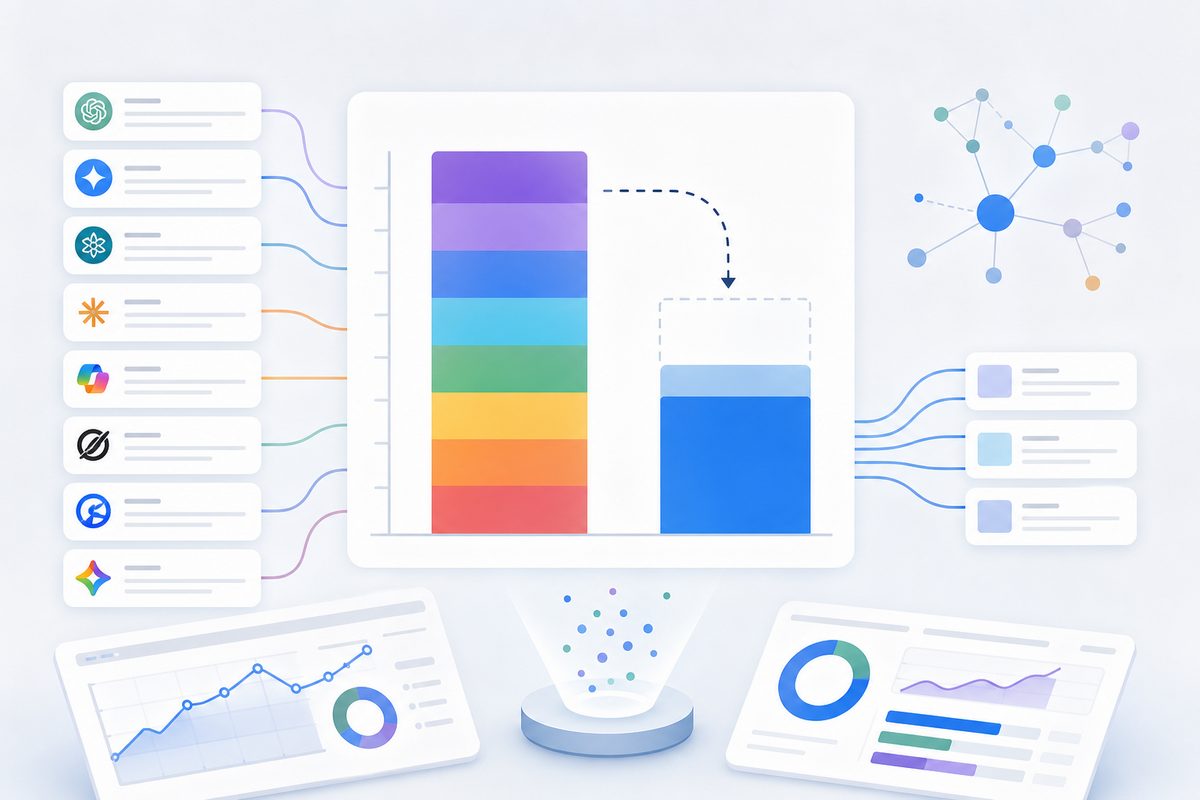
How to calculate AI-influenced pipeline, step by step
- Define your AI referrer list and freeze it for the quarter. At minimum:
chatgpt.com,perplexity.ai,claude.ai,gemini.google.com,copilot.microsoft.com. Adding referrers mid-quarter breaks period comparability. - Set the qualifying window. Use your median sales cycle, capped at 90 days. A 140-day-old AI session is not why the deal opened.
- Pull the three lists separately using the tier definitions above. Do not deduplicate yet — you need the raw counts for the overlap rate.
- Match on opportunity ID and record the count of unique opportunities and the total claim count.
- Compute the Influence Overlap Rate. Log it. It is your data-quality gauge quarter over quarter.
- Assign one tier per opportunity, highest tier wins, and write it to the single
ai_influence_tierfield. - Drop post-creation-only touches to a separate report.
- Report AI-influenced pipeline as a percentage of total new pipeline, with the sourced sub-total shown separately.
- Never sum AI-influenced pipeline with other channels' influenced pipeline. Influenced totals across channels routinely exceed 100% of revenue, which is expected and fine — as long as no one adds them up.
Minimum instrumentation before your first calculation
Do not attempt the calculation until all four are in place, or you will produce a number you then have to retract.
- GA4 (or equivalent) referral capture with the AI hostnames above kept out of the "direct" bucket, and the referrer preserved on the first session, not just the converting one
- A first-touch field on the lead/contact record that survives lead-to-opportunity conversion — most CRMs overwrite this by default
- A free-text "How did you hear about us?" field on the primary conversion form (see below for why free text beats a dropdown)
- An AI visibility record of which prompts surfaced your brand that period, so tier 3 claims can be corroborated against whether you were citable at all
Missing the first-touch field is the most common blocker. Without it, tier 1 collapses into tier 2 and your defensible number disappears.
What to do with self-reported answers you cannot verify
Self-reported attribution is the only instrument that reaches buyers who read an AI answer and never clicked. It is also the tier most likely to be wrong, because buyers compress their memory: "I found you on ChatGPT" often means "I found you somewhere, and I use ChatGPT a lot."
Rather than throwing the tier out or trusting it wholesale, split it in two:
- Corroborated self-report — the buyer names AI and the account shows branded search lift, a direct traffic spike, or a documented AI citation for a relevant prompt in the preceding 60 days. Count at full value.
- Uncorroborated self-report — the claim stands alone. Report it in a clearly labelled sub-line, and do not include it in the headline number you defend in a QBR.
In the worked example, 10 of the 16 self-reported-only opportunities were corroborated by an AI citation the company was already tracking across ChatGPT and other assistants for the exact product-category prompts those buyers were likely running. That corroboration step is the difference between a number sales trusts and a number sales rolls its eyes at.
One design detail that measurably improves the raw input: make the "How did you hear about us?" field a free-text box with an optional dropdown, not a dropdown alone. Free text surfaces the specific prompt language — "asked ChatGPT for alternatives to [competitor]" — which is directly actionable for your answer engine optimization work in a way that a checked box never is. It also tells you whether the buyer arrived on a branded prompt or an unbranded one, and branded and non-branded AI prompts describe completely different demand: a buyer who asked "is maxaeo any good" was already in your funnel, while one who asked "best AI visibility tools" was not.
Connecting AI-influenced pipeline back to visibility work
Pipeline dedup tells you how big the number is. It does not tell you what to fix. For that, you need the upstream metric to move first and the pipeline metric to follow.
The practical sequence: your AI share of voice across a tracked prompt set is the leading indicator, AI citations and mentions are the mechanism, and deduplicated AI-influenced pipeline is the lagging indicator that arrives one sales cycle later.
If share of voice climbs 12 points in Q1 and AI-sourced pipeline is flat in Q3, the visibility gain is landing on prompts your actual buyers do not run. That is a prompt-set problem, not a content problem, and no amount of extra publishing fixes it.
That lag is also why you should never report AI-influenced pipeline for the current quarter's visibility work. Report Q1 visibility against Q2 or Q3 pipeline, with the offset stated explicitly on the slide. Marketers who skip the offset end up claiming credit for pipeline that was already in motion before the generative engine optimization program started.
Reporting cadence that survives review
| Metric | Cadence | Audience | Compared against |
|---|---|---|---|
| AI share of voice on tracked prompts | Weekly | Content team | Prior week, same prompt set |
| Citations and mentions by prompt | Monthly | Demand gen | Prior month |
| AI-sourced pipeline | Quarterly | CFO, board | Total new pipeline, same quarter |
| AI-influenced pipeline (deduped) | Quarterly | CMO | Total new pipeline, offset one sales cycle |
| Influence Overlap Rate | Quarterly | RevOps | Prior quarter — data quality, not performance |
The last row is the one nobody builds and everybody needs. A jump in Overlap Rate quarter over quarter usually means a tracking change, not a market change — check the referrer list and form fields before you interpret the pipeline number at all.
Six failure modes that inflate the number
- Contact-level credit. Six-person buying committee, six AI touches, one deal, six claims. Assign at opportunity level.
- Unbounded lookback. "Any AI touch ever" turns AI into the channel that influenced everything and explains nothing.
- Counting post-creation touches as pipeline creation. A buyer researching your security docs in Claude three weeks after the opp opened did not create it.
- Treating "direct traffic went up" as AI evidence. It is a correlate at best. Use it to corroborate a self-report, never as a standalone tier.
- Changing the referrer list mid-period. Adding a new assistant to the list will show growth that is purely definitional. Same risk applies to a domain change — a site migration can drop you out of AI answers entirely while your CRM tiers keep reporting as if nothing happened.
- Publishing influenced without sourced. If the deck shows only the big influenced number, the first person who asks "so what did AI actually cause?" gets a shrug. Always show both.
Frequently asked questions
Is AI-influenced pipeline the same as AI-sourced pipeline?
No. AI-sourced is a strict subset. Sourced requires the AI touch to be the first touch on the record that became the opportunity; influenced includes any qualifying touch inside the lookback window. In the worked example, sourced was $612K and total influenced was $2.02M — a 3.3x difference between the two definitions of the same quarter.
Can I add AI-influenced pipeline to my other channels' influenced pipeline?
No, and no attribution model makes it safe to do so. Influenced totals across channels are expected to sum well past 100% of pipeline, because deals genuinely have multiple influences. Report each channel's influenced coverage as an independent percentage of the same denominator, and put a one-line note on the slide saying the columns do not sum.
What is a healthy Influence Overlap Rate?
Across the accounts we have run this calculation on, 15–40% is the working range. Above 40% suggests your three signals are re-observing the same buyers and your naive number is badly inflated. Below 15% usually means a collection failure — most often a self-reported field with no AI options, or a GA4 setup lumping AI referrals into direct.
How long should the lookback window be?
Use your median time from first touch to opportunity creation, capped at 90 days. Longer windows do not find more real influence; they find more coincidence. If your median cycle is 45 days, a 45-day window will give you a defensible number and a 180-day window will give you an argument.
Do I need an AI visibility tool to calculate this, or can I do it in the CRM?
You can build tiers 1 and 3 with GA4 plus CRM fields alone. Tier 2 corroboration is where it breaks down, because clicked citations are only a fraction of citations shown — most AI answers that mention you produce no session at all. That is the gap an AI visibility tool fills: it tells you which prompts surfaced your brand, so an uncorroborated self-report can be checked against whether you were actually citable that week.
How do I report AI-influenced pipeline to a CFO who does not believe in AI search?
Lead with AI-sourced, not influenced, and show it as a percentage of new pipeline next to your AI referral traffic share. Then show the Influence Overlap Rate and the phantom pipeline you removed. A marketer who arrives having already cut their own number by 49% is treated very differently from one defending the biggest figure the data allowed.
Should closed-won revenue use the same tiers?
Yes — reuse ai_influence_tier unchanged and filter to closed-won. Do not re-run the assignment at close, and do not let a late-stage AI touch upgrade a deal's tier. The tier records how the opportunity was created; changing it retroactively destroys quarter-over-quarter comparability and quietly reintroduces the double counting you just removed.
The uncomfortable takeaway from every one of these cleanups: the honest AI-influenced pipeline number is smaller than the one already circulating internally. That is the point. A defensible $2.02M survives a CFO's questions and funds next quarter's work. An indefensible $3.93M gets audited once, and then nobody trusts the AI numbers again.