AI hallucination monitoring is a measurement and incident-response practice for finding false, unsupported, or outdated claims in ChatGPT, Gemini, Perplexity, Claude, Copilot, Grok, Google AI Mode, and AI Overviews.
The goal is not to make every generated answer deterministic. It is to detect claims that could change a customer’s decision, verify them against approved evidence, preserve reproducible observations, and assign corrective action before the error spreads.
This guide focuses on external answer engines describing a company, product, executive, or employer. Teams operating their own AI applications can use the same claim-verification principles, but they also need production traces, retrieval logs, evaluation datasets, and application-level guardrails.
What is AI hallucination monitoring?
AI hallucination monitoring is the repeated collection and verification of AI-generated claims against dated, authoritative evidence. Each material discrepancy is recorded with its prompt, answer, citations, scope, severity, recurrence, owner, and resolution status so teams can distinguish isolated variation from persistent misinformation.
The NIST Generative AI Profile uses confabulation for confidently presented erroneous or false content. For brand monitoring, the operational scope should also include claims that are materially outdated, assigned to the wrong plan or market, or supported by citations that do not substantiate the answer.
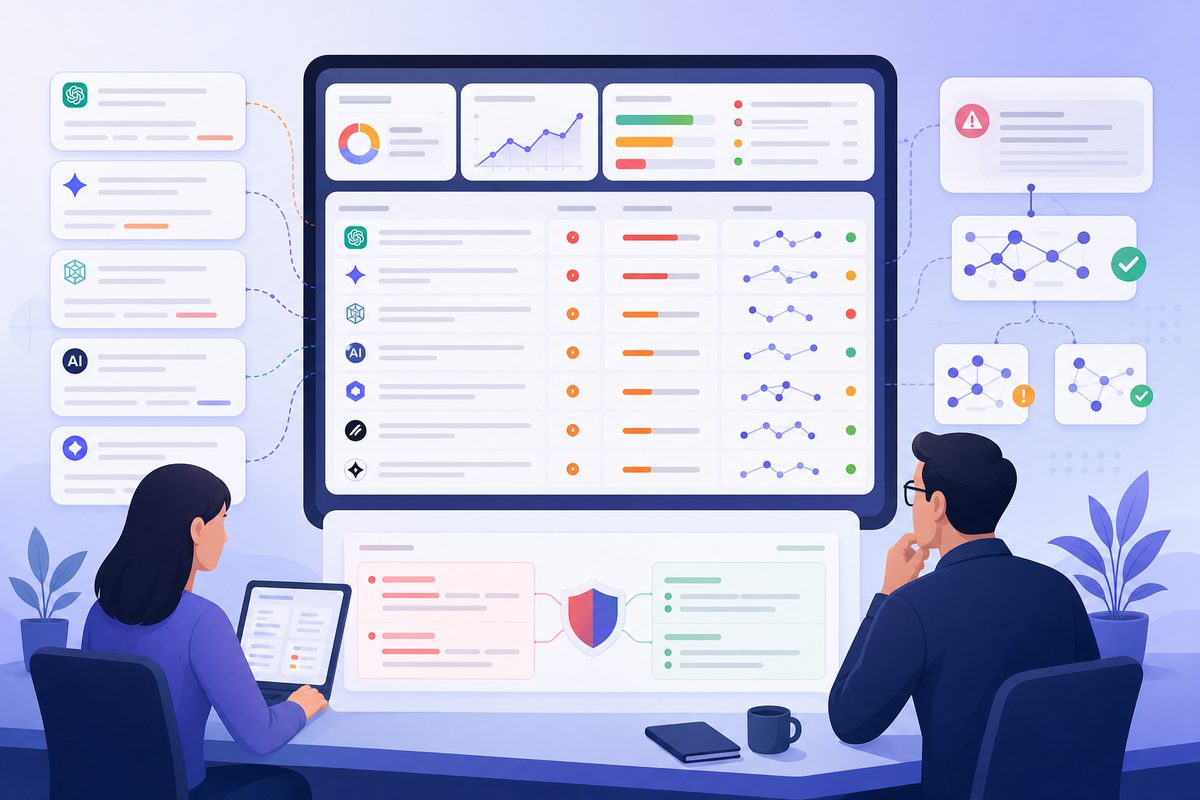
A complete monitoring workflow has eight steps:
- Define the company facts that require protection.
- Build prompts around real customer decisions.
- Run a fixed prompt cohort across relevant engines and contexts.
- Split each answer into atomic, verifiable claims.
- Compare those claims with a versioned truth set.
- preserve the response, citations, context, and correct evidence.
- Score business risk and route the incident to an owner.
- Correct controllable sources and retest the original cohort.
What should—and should not—count as a hallucination?
A hallucination is a generated factual claim that is fabricated or contradicted by reliable evidence. Stale facts, omissions, opinions, and citation failures are related monitoring problems, but separating them prevents inflated error rates and sends each issue to the right corrective workflow.
Use a mutually exclusive primary classification:
| Classification | Meaning | Example | Count as a hallucination? |
|---|---|---|---|
| Fabrication | No reliable evidence supports the claim | “The company is SOC 2 certified” when it is not | Yes |
| Contradiction | The claim conflicts with authoritative evidence | “SAML is included on every plan” when it is Enterprise-only | Yes |
| Scope error | A true fact is attached to the wrong product, plan, market, or date | A US-only feature is described as global | Usually |
| Stale fact | The claim was once correct but is no longer current | An old price or former executive | Track separately |
| Unsupported inference | The answer presents an interpretation as settled fact | “The company is financially unstable” without evidence | Requires review |
| Citation mismatch | The cited page does not support the generated statement | A privacy policy is cited for a certification claim | Track separately |
| Omission | A relevant company, feature, or qualification is absent | The brand is missing from a category shortlist | No |
| Sentiment | The answer summarizes an opinion or perception | “Users find setup difficult” | No, unless factual support is invented |
This taxonomy matters because visibility loss is not necessarily a hallucination. Exclusion from a recommendation list, weak positioning, and an incorrect factual claim require different metrics and remedies.
How is brand monitoring different from monitoring an AI application?
The two disciplines share a verification layer but observe different systems.
| Dimension | External answer-engine monitoring | Internal AI application monitoring |
|---|---|---|
| System access | Black-box observation | Access to prompts, traces, retrieval, and outputs |
| Main risk | False public claims about a brand | Incorrect answers delivered by your product |
| Ground truth | Company truth set and authoritative public records | Evaluation datasets, policies, databases, and retrieved context |
| Reproducibility | Limited by model and product variability | Can often preserve model version and generation settings |
| Corrective controls | Source correction, platform feedback, clearer public evidence | Retrieval changes, prompt design, guardrails, model changes |
| Primary owners | SEO, communications, product, security, HR, legal | Engineering, product, model risk, security, compliance |
A vendor claiming to monitor hallucinations should make this scope explicit. A system that evaluates your support chatbot is not automatically capable of tracking public claims across third-party answer engines.
How do you build a reliable brand truth set?
A brand truth set is a version-controlled ledger of claims the company can substantiate at a specific time. Every claim needs approved wording, acceptable variants, evidence, scope, an owner, an effective date, and a review date.
Do not import the entire website. Start with facts that could influence purchase, compliance, employment, investment, or reputation decisions.
| Truth-set field | Purpose | Example |
|---|---|---|
| Claim ID | Stable identifier across revisions | SEC-014 |
| Canonical claim | Smallest independently verifiable statement | “SAML SSO is available on Enterprise.” |
| Approved variants | Acceptable paraphrases | “Enterprise customers can use SAML-based SSO.” |
| Prohibited implication | Wording that changes the meaning | “SAML is included on every paid plan.” |
| Evidence | Authoritative record supporting the claim | Current security documentation |
| Scope | Product, plan, market, language, or date | Global; Enterprise plan |
| Owner | Person accountable for validity | Head of Security |
| Effective date | When the claim became true | 2026-05-01 |
| Review or expiry date | When it must be revalidated | Quarterly |
| Default risk class | Sensitivity before exposure is measured | Security—high |
Resolve internal disagreement before monitoring
A monitoring system cannot determine the truth when pricing pages, contracts, product documentation, and sales materials disagree. Flag these conflicts as truth-set defects, not model incidents.
Use this evidence hierarchy unless company policy requires a different one:
- Executed legal, regulatory, or certification records
- Approved product and security documentation
- Current pricing, policy, and support pages
- Official corporate announcements
- Structured data and third-party profiles
- Marketing copy without named evidence
Keep confidential evidence separate from the public truth set. Reviewers and software should receive only the information required to validate the claim.
Which prompts should AI hallucination monitoring cover?
Monitor questions asked at discovery, comparison, qualification, and risk-validation stages. Brand-name prompts alone miss the unbranded recommendations and objection-handling answers most likely to influence a decision.
Build the prompt library around customer journeys:
| Prompt family | What it reveals | Example |
|---|---|---|
| Discovery | Category inclusion and positioning | “Which tools monitor brand visibility in AI search?” |
| Comparison | Feature and competitor claims | “How does Brand A compare with Brand B?” |
| Qualification | Plan, integration, and market details | “Does Brand A support SAML and EU data residency?” |
| Recommendation | Suitability for a defined buyer | “What is the best option for a 200-person SaaS company?” |
| Risk validation | Security, stability, and trust claims | “Is Brand A secure and financially stable?” |
| Reputation | Customer, media, and employee perceptions | “What do customers and employees say about Brand A?” |
| Post-purchase | Support and implementation expectations | “How long does Brand A take to deploy?” |
For each high-value question, create only variants that test a meaningful dimension:
- Direct versus unbranded wording
- Category versus competitor comparison
- Buyer role and company size
- Country, city, or language
- Regulated versus non-regulated use case
- Neutral versus objection-led wording
A practical pilot is 48 prompts across four answer engines, run daily for seven days. That creates up to 1,344 scheduled observations. This is a sampling design, not a universal minimum. Report successful responses separately so collection failures cannot make the error rate appear to improve.
When the initial scope is ChatGPT, use a structured record rather than manually accumulating screenshots; this guide explains how to track ChatGPT brand mentions with reproducible evidence.
How do you control for model variability?
Use a fixed measurement cohort for trend reporting, then maintain a separate discovery cohort for new questions. Changing prompts, engines, or locations inside the benchmark makes before-and-after comparisons unreliable.
Record every context the product exposes:
- Exact prompt and conversation history
- Answer engine and product surface
- Displayed model label, if available
- Timestamp and time zone
- Country, city, and language
- Logged-in or logged-out state
- Personalization or memory state, when known
- Citations and linked sources
- Full text and visual capture
Consumer answer engines may not expose model versions, temperature, retrieval queries, or index state. Do not invent missing metadata. Mark it as unavailable and avoid describing a rerun as technically identical when the product cannot guarantee that.
For each prompt, retain correct as well as incorrect results. “One false answer” has a different meaning when it occurred in one of two runs versus one of 100.
How should generated answers be converted into testable claims?
Split each answer into atomic claims that can be independently supported, contradicted, marked stale, or left unverifiable. Never give an entire paragraph one accuracy label: a response can combine correct positioning with a dangerous invented detail.
Consider this fictional answer:
“Northstar Cloud is a European analytics platform. It supports SAML on all paid plans, is HIPAA compliant, and is mainly used by healthcare enterprises.”
The passage contains at least four claims:
| Generated claim | Truth-set fact | Status | Reason |
|---|---|---|---|
| European analytics platform | US company with an EU subsidiary | Contradicted | Geographic identity is wrong |
| SAML on all paid plans | SAML is Enterprise-only | Contradicted | Plan scope is materially wrong |
| HIPAA compliant | No approved HIPAA claim exists | Fabricated | A compliance status was invented |
| Mainly used by healthcare enterprises | Customers span several industries | Unverifiable | “Mainly” lacks supporting data |
Store the original passage with the atomic assessments. Reviewers need both: the individual claim supports consistent scoring, while the surrounding answer preserves context.
Use a stable incident key
Group paraphrases with this key:
Incident key = truth-set Claim ID + error classification + affected scope
“HIPAA certified,” “HIPAA compliant,” and “meets HIPAA certification requirements” may belong to one incident when they express the same unsupported status. This prevents wording changes from inflating the incident count.
Do not merge claims that require different corrections. “SAML is unavailable” and “SAML is included on every plan” concern the same feature but represent different errors.
Which detection methods work best?
Reliable AI hallucination detection uses several layers. Deterministic rules find exact conflicts, semantic matching connects paraphrases to truth-set claims, citation checks test supporting evidence, and authorized reviewers decide ambiguous or high-risk cases.
| Detection method | Best use | Main limitation |
|---|---|---|
| Exact and rule-based matching | Prices, dates, certifications, plan names, named executives | Misses paraphrases |
| Entity and relation extraction | Converting prose into subject–predicate–object claims | Can split or attach entities incorrectly |
| Semantic retrieval | Finding the most relevant truth-set claim | Similarity does not prove agreement |
| Entailment classification | Estimating whether evidence supports or contradicts a claim | Sensitive to phrasing and evidence quality |
| Citation validation | Checking whether a cited passage substantiates the statement | A valid citation can still rely on stale evidence |
| Human review | Resolving scope, legal meaning, sentiment, and materiality | Slower and requires accountable expertise |
A second language model can help extract or classify claims, but it should not be the final source of truth. Require the system to show the generated claim, matched evidence, comparison rationale, and confidence. Route low-confidence and veto-rule subjects to a human reviewer.
Common false positives to test
Before opening an incident, check for:
- Product aliases and former company names
- Negation, hedging, and conditional wording
- Plan, market, and date qualifiers
- Acquisitions, subsidiaries, and reseller relationships
- Currency and tax differences
- Facts that changed after the truth set was approved
- Conflicts inside the truth set itself
- Opinions incorrectly converted into factual propositions
How does the maxaeo Claim Risk Index prioritize errors?
The maxaeo Claim Risk Index scores an incident from 0 to 100 using truth gap, business impact, exposure, and persistence. It is a transparent triage framework—not an industry benchmark—and should be calibrated against each organization’s risk policy and incident history.
Score each factor from 0 to 5:
Claim Risk Index = (0.35 × Truth Gap + 0.30 × Business Impact + 0.20 × Exposure + 0.15 × Persistence) × 20
| Factor | 0 | 3 | 5 |
|---|---|---|---|
| Truth gap | Supported | Materially incomplete or stale | Directly contradicted or fabricated |
| Business impact | No plausible decision impact | Could affect evaluation or support | Could affect purchase, compliance, safety, or reputation |
| Exposure | Obscure prompt on one surface | Repeated in a relevant prompt family | Common across major engines, markets, or personas |
| Persistence | One unconfirmed occurrence | Repeated along one dimension | Repeated across dates and prompts or engines |
For the fictional HIPAA claim, assume scores of 5, 5, 3, and 3:
(0.35 × 5 + 0.30 × 5 + 0.20 × 3 + 0.15 × 3) × 20 = 86
That incident enters the critical band.
| Score | Default action | Target handling time |
|---|---|---|
| 0–19 | Log and sample again | Next scheduled review |
| 20–39 | Verify evidence and truth-set scope | Five business days |
| 40–59 | Assign source investigation and correction | Three business days |
| 60–79 | Escalate to channel and subject owner | One business day |
| 80–100 | Open a critical reputation incident | Same day |
Add a veto rule
Security, privacy, certification, legal status, safety, financial distress, fraud, discrimination, and serious misconduct claims should receive specialist review regardless of the numeric score.
Ownership follows the fact:
- Product owns features, plans, and integrations.
- Security owns certifications and security controls.
- Communications owns corporate descriptions and executive facts.
- HR owns employer-brand facts.
- Finance owns approved financial statements.
- Legal reviews regulated or potentially defamatory claims.
- SEO or GEO coordinates measurement but does not unilaterally define truth.
A broader risk model is available in maxaeo’s monitoring-first guide to brand protection in AI answers.
When should an error be considered persistent?
Treat an error as persistent when the same incident survives independent changes in time, prompt formulation, or answer engine. Repeated wording is unnecessary; semantically equivalent claims count when they map to the same incident key.
Use three recurrence tests:
- Temporal: The claim appears on at least two separate days.
- Prompt: It survives direct, comparative, or unbranded formulations.
- Cross-engine: Two or more independent answer products repeat it.
For ordinary commercial claims, require recurrence across at least two dimensions before calling the incident persistent. This is a defensible operating threshold, not a scientific law.
Do not wait for recurrence when the potential harm is severe. A fabricated certification or safety claim deserves immediate review even if it has appeared only once.
Report recurrence with its denominator:
Observed in 5 of 24 successful runs across three prompt variants, two engines, and four days.
That statement is more useful than “AI frequently gets this wrong.”
What evidence should every incident contain?
A defensible evidence packet lets another reviewer reproduce the question, identify the smallest disputed statement, verify the correct fact, and understand the severity decision. Capture it before correction work because answers, citations, and linked pages can change.
Each incident should contain:
- Incident ID and stable incident key
- Affected truth-set Claim ID and version
- Exact prompt and relevant conversation history
- Engine, product surface, and displayed model label
- Timestamp, location, language, and account context
- Full response text and visual capture
- Smallest disputed quotation
- Citations shown with the answer
- Relevant passages from those citations
- Approved evidence for the correct claim
- Classification and Claim Risk Index inputs
- Reviewer, owner, status, deadline, and escalation history
- Retest cohort and closure criteria

Archive cited material only when licensing, privacy, and internal policy allow it. Avoid storing personal prompts, account identifiers, or confidential records that are unnecessary for verification.
How do you verify whether a citation supports the answer?
A citation is not evidence merely because it appears beside a sentence. Review the cited passage for direct support, correct scope, freshness, and authority. Record citation validity separately from claim accuracy.
Use this sequence:
- Open the exact cited page.
- Find the passage most likely to support the claim.
- Confirm that it addresses the same entity, product, market, and date.
- Check whether the answer adds a stronger conclusion than the source permits.
- Compare the page’s publication or update date with the truth-set effective date.
- Record whether the source is primary, independent, or merely repeating another page.
- Mark the citation as supporting, partial, contradictory, stale, or unrelated.
An answer may be correct with a weak citation, or false despite citing an authoritative domain. These are different defects and should not share one score.
How should a company correct a false AI claim?
Correct the information environment supporting the wrong answer. Confirm the approved fact, remove contradictions from owned content, publish a clear and citable statement, update authoritative third-party records, use eligible platform feedback channels, and rerun the fixed benchmark cohort.
Follow this order:
- Validate the truth set. Confirm that product, legal, security, and communications teams agree on the current fact.
- Audit controlled sources. Check pricing pages, documentation, PDFs, press releases, structured data, profiles, localized pages, and old subdomains.
- Publish an explicit correction. State the subject, fact, scope, and effective date in language that can stand alone.
- Consolidate conflicting pages. Update or redirect obsolete content where appropriate.
- Correct authoritative external records. Contact partner directories, databases, publishers, review profiles, and resellers when they contain the error.
- Submit platform feedback. Use the answer product’s factual-feedback process when one exists.
- Retest the original cohort. Keep prompts, engines, locations, and reporting rules consistent.
- Monitor recurrence. Do not close the incident after one clean response.
Avoid mass-producing near-duplicate “correction” pages. One authoritative page with direct evidence, consistent internal links, accurate structured data, and a visible effective date is more defensible.
Google Search Central’s guidance for AI features states that the established fundamentals for appearing in Google Search also apply to its AI experiences. Crawlable, indexable, well-supported source material remains more useful than speculative tactics intended only to manipulate an answer engine.
For an incident-specific remediation sequence, see how to find and fix AI hallucinations about a company.
How do you prove that a correction worked?
A correct answer after remediation shows correlation, not causation. Verify recovery across a fixed cohort and multiple dates, while documenting every source change made during the incident.
Use three comparison layers:
- Exact cohort: Original prompts, engines, locations, and account contexts
- Variant cohort: Semantically related direct, comparative, and unbranded prompts
- Control cohort: Unchanged claims with similar exposure and risk
A reasonable closure rule is:
- Two clean retests on different days
- No recurrence in the original prompt and engine
- A clean result in at least one meaningful variant
- A second engine checked for high-exposure incidents
- Corrected owned sources still live and internally consistent
Do not claim that one page update “taught the model” unless the platform provides evidence of that mechanism. Search indexes, retrieval systems, model updates, citations, and ordinary response variation can all affect the result.
For a broader response process spanning detection, correction, and governance, read AI brand reputation management for wrong AI answers.
What should an AI visibility tool automate?
An AI visibility tool should automate collection, claim matching, recurrence analysis, and evidence retention while leaving factual approval and high-risk escalation with authorized people. An opaque visibility score is not a substitute for claim-level records.
Evaluate whether a tool can:
- Schedule prompts across relevant engines, markets, and languages
- Preserve full responses, timestamps, citations, and screenshots
- Record successful, failed, and blocked runs separately
- Group paraphrases under stable incident keys
- Compare claims with a versioned truth set
- Distinguish fabrications, stale facts, omissions, sentiment, and citation failures
- Explain why a claim was matched or flagged
- Alert by severity, market, prompt family, and owner
- Show recurrence before and after source corrections
- Export evidence for communications, security, legal, and clients
- Apply role-based access, retention, and deletion policies
- Use access methods permitted by each platform’s terms
Manual, in-house, or commercial monitoring?
| Approach | Best for | Advantages | Trade-offs |
|---|---|---|---|
| Spreadsheet plus manual runs | Small pilot or critical-claim audit | Fast to start; easy human review | Poor scale, inconsistent collection, weak recurrence analysis |
| In-house pipeline | Teams needing custom integrations or controls | Flexible data model and workflow | Engineering cost, connector maintenance, policy risk |
| Commercial platform | Ongoing multi-engine programs | Faster coverage, dashboards, alerts, evidence history | Vendor dependency; methodology must be inspected |
Ask vendors to demonstrate a real incident from prompt collection through claim verification and retesting. A current comparison of coverage, evidence features, and pricing appears in the 2026 guide to AI search and LLM monitoring tools.
How can teams estimate monitoring workload?
Estimate response volume and review capacity before expanding the prompt library. Scheduled runs measure collection load; flagged responses and extracted claims determine human workload.
Use these formulas:
Scheduled responses = prompts × engines × locales × personas × runs per period
Review hours = flagged responses × average review minutes ÷ 60
For example, a seven-day pilot with 48 prompts and four engines schedules 1,344 responses. If 8% require review and each review takes six minutes, the pilot requires approximately 10.8 reviewer hours. The 8% rate is a planning assumption, not a benchmark; replace it with the pilot’s observed flag rate.
Also budget time for:
- Truth-set approval and maintenance
- Connector failures and blocked runs
- Specialist review of high-risk claims
- Source investigation and correction
- Retesting and incident closure
- Privacy, retention, and access reviews
This capacity model prevents teams from adding thousands of prompts while leaving material incidents unreviewed.
Which metrics show whether monitoring works?
Measure collection quality, error exposure, response speed, and verified recovery separately. Error counts without stable denominators can improve simply because fewer prompts ran successfully.
Track:
| Metric | Calculation | What it answers |
|---|---|---|
| Successful run rate | Successful responses ÷ scheduled responses | Is collection reliable? |
| Material claim error rate | Material false claims ÷ assessed claims | How often are verified claims wrong? |
| Affected prompt rate | Prompts with a material error ÷ successful runs | How much of the customer journey is exposed? |
| Cross-engine exposure | Engines reproducing an incident ÷ engines tested | How widely is the error distributed? |
| Mean time to detect | First observation to incident creation | How quickly are errors found? |
| Mean time to assign | Incident creation to named owner | Is triage working? |
| Mean time to contain | Incident creation to controlled-source correction | How quickly can the brand respond? |
| Verified recovery rate | Incidents meeting closure criteria ÷ incidents retested | Are corrections followed by stable improvement? |
| Recurrence rate | Closed incidents that reappear ÷ closed incidents monitored | Are problems returning? |
| Truth-set freshness | In-date claims ÷ total truth-set claims | Is the benchmark itself reliable? |
Never report “hallucinations fell by 50%” without the prompt cohort, engines, dates, successful run count, claim denominator, and severity threshold.
What are the most common monitoring failures?
| Failure | Why it distorts results | Better control |
|---|---|---|
| Monitoring only branded prompts | Misses unbranded discovery and recommendations | Map prompts to real decision stages |
| Calling every omission a hallucination | Inflates accuracy incidents | Track visibility and factual accuracy separately |
| Using an LLM as the sole fact-checker | Replaces one probabilistic answer with another | Require cited evidence and accountable review |
| Treating screenshots as the database | Prevents recurrence and cohort analysis | Store structured observations with screenshots attached |
| Changing the benchmark every week | Makes trend comparisons invalid | Separate fixed and discovery cohorts |
| Ignoring failed runs | Artificially improves error rates | Report collection success as its own metric |
| Closing after one correct answer | Confuses random variation with recovery | Require multi-day retesting |
| Publishing many repetitive correction pages | Creates conflicting or low-value evidence | Maintain one clear canonical source |
| Monitoring without owners | Produces alerts but no correction | Assign ownership by truth-set claim |
| Collecting excessive personal data | Creates privacy and security risk | Minimize, restrict, and expire evidence |
What does a 30-day implementation plan look like?
A useful first month produces a governed truth set, a fixed benchmark cohort, tested escalation rules, and at least one completed incident drill. Coverage can expand after the team proves it can review and resolve the alerts already generated.
Week 1: Define risk and truth
- Identify 25–50 purchase, security, reputation, and employer-brand claims.
- Assign an owner to every claim.
- Add evidence, scope, effective dates, and review dates.
- Define veto-rule subjects and retention requirements.
- Resolve conflicts in owned sources.
Week 2: Build the benchmark
- Interview sales, support, product, communications, and recruiting.
- Create 30–50 high-value prompts across the customer journey.
- Select engines, locations, languages, and account contexts.
- Separate the fixed benchmark from discovery prompts.
- Run an initial multi-day baseline.
Week 3: Calibrate detection and triage
- Extract atomic claims from baseline answers.
- Review matching and classification false positives.
- Score sample incidents with the Claim Risk Index.
- Confirm owners and handling times.
- Test the evidence packet with security, legal, and communications.
Week 4: Run an incident drill
- Choose one verified, non-sensitive error.
- Audit controlled and authoritative external sources.
- Publish or update the canonical evidence.
- Repeat the fixed cohort.
- Document what changed, what did not, and where the workflow stalled.
After launch, collect priority prompts daily, review incidents twice weekly, retest corrections weekly, and audit truth-set freshness monthly. Rebuild the prompt library quarterly or after major launches, pricing changes, acquisitions, executive transitions, or security events.
Frequently asked questions
Can a company completely prevent AI hallucinations about its brand?
No. A company does not control every model, retrieval index, source, or generated response. It can reduce ambiguity, remove contradictions from authoritative pages, monitor decision-relevant prompts, and shorten the time harmful errors remain visible. The practical objective is lower exposure and faster recovery, not perfect prevention.
How often should brand claims be monitored?
Check high-risk claims daily or after material changes. Weekly sampling may be sufficient for lower-risk descriptive claims. Increase frequency during launches, pricing changes, acquisitions, executive transitions, security events, or major press coverage. Frequency should reflect potential harm and observed volatility.
How many prompts are enough to start?
Start with 30–50 prompts tied to real buying, trust, and reputation decisions. Cover multiple prompt families before creating near-duplicates. Add engines, locations, and languages only when they represent meaningful audiences and the team has capacity to review resulting incidents.
Can one LLM reliably detect another LLM’s hallucinations?
Not by itself. A second model can extract claims, retrieve candidate evidence, and classify likely contradictions, but it can also make mistakes. High-confidence automation still needs a versioned truth set, visible evidence, deterministic checks where possible, and human approval for ambiguous or high-risk claims.
Is negative sentiment automatically a hallucination?
No. Negative sentiment may be opinion, a supported summary of reviews, an outdated perception, or a false factual assertion. Separate evaluative language from testable claims. “Users find setup difficult” requires different evidence from “implementation always takes three months.”
Are incorrect citations considered hallucinations?
Sometimes. A fabricated or contradicted claim remains a hallucination even when accompanied by a citation. If the claim is correct but the cited page does not support it, record a citation mismatch instead. Tracking the two conditions separately makes remediation more precise.
When should an incident be closed?
Close an incident only after the correct fact appears across the defined retest cohort on multiple days and the corrected sources remain consistent. For high-exposure claims, include a second engine or meaningful prompt variant. One correct response is insufficient evidence of recovery.
Start with claims that can change a decision
Effective AI hallucination monitoring does not begin with the largest possible prompt list. It begins with the facts that could change a purchase, compliance review, employment decision, or reputation judgment.
Build a dated truth set, measure a fixed cohort, extract atomic claims, preserve evidence, and route incidents according to customer harm. Keep visibility omissions, sentiment, stale information, citation failures, and factual hallucinations separate.
That structure turns unstable AI answers into a reviewable operating process—and makes it possible to show not only what was wrong, but how often it appeared, who owned the correction, and whether the answer environment recovered.