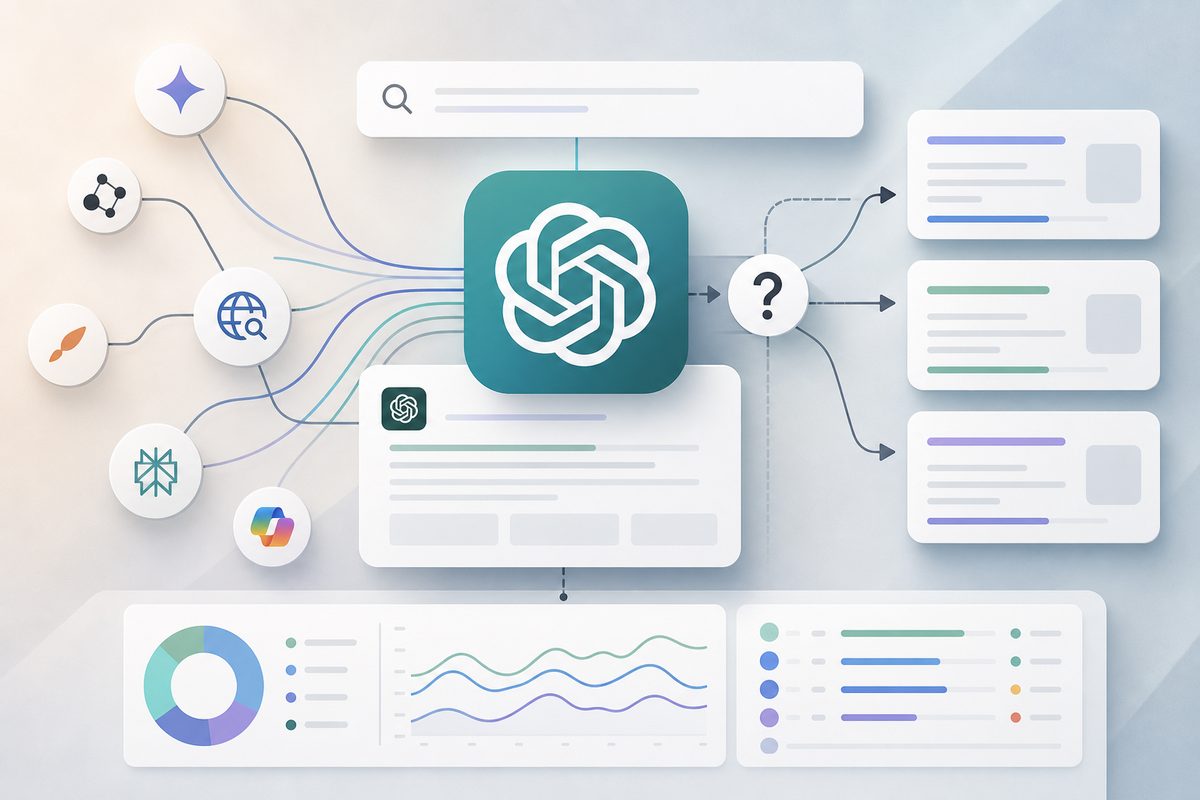
Yes, ChatGPT uses Bing in some search flows, but ChatGPT is not just Bing wrapped in a chat interface. OpenAI says ChatGPT Search can use third-party search providers, content from partners, rewritten search queries, source citations, and OpenAI's own OAI-SearchBot crawler. Bing is explicitly named in OpenAI's ChatGPT Search help documentation, but it is not the whole retrieval system.
For SEO and GEO teams, the practical answer is: treat Bing as one measurable input, not as a perfect proxy for ChatGPT visibility. A page can rank in Bing and still not be cited by ChatGPT. A page can also be surfaced by ChatGPT through OpenAI crawling, partner data, query rewriting, or another retrieval path.
Short answer: does ChatGPT use Bing?
ChatGPT can use Bing when it searches the live web, but not every ChatGPT answer uses Bing. Some answers come from the model's existing knowledge. Some use ChatGPT Search. Search answers may involve third-party providers, partner content, rewritten queries, OpenAI crawlers, and source-selection logic that differs from normal Bing rankings.
That means the correct answer is more precise than "yes" or "no":
| User question | Accurate answer |
|---|---|
| Does ChatGPT use Bing? | Yes, sometimes. OpenAI names Bing among third-party provider privacy references for ChatGPT Search. |
| Does every ChatGPT answer use Bing? | No. Many answers do not trigger live web search. |
| Is ChatGPT Search the same as Bing Search? | No. OpenAI describes a broader system using search providers and partner content. |
| Can Bing rankings influence ChatGPT citations? | Often, but imperfectly. Bing visibility is a useful input, not a guarantee. |
| Should SEO teams ignore Bing? | No. Bing matters for ChatGPT Search, Microsoft Copilot, and measurable AI discovery workflows. |
What OpenAI and Microsoft have actually said
The strongest public evidence comes from official documentation, not speculation about the Microsoft-OpenAI relationship.
| Source | What it says | Why it matters |
|---|---|---|
| OpenAI's ChatGPT Search launch post | ChatGPT Search uses third-party search providers and partner-provided content. | Bing can be part of the system, but OpenAI does not describe a one-provider pipeline. |
| OpenAI's ChatGPT Search Help Center article | ChatGPT may rewrite prompts into search queries and may send queries to third-party search providers. Bing is listed among provider privacy references. | This confirms Bing is in the documented provider ecosystem. |
| OpenAI's crawler documentation | OAI-SearchBot is used to surface websites in ChatGPT search features; GPTBot is separate and relates to training. | A site can allow search visibility without making the same choice for model training. |
| Microsoft's New Bing engineering post | Microsoft's Prometheus system combines the Bing index, ranking, answers, and OpenAI models for Bing's AI answers. | Bing is core infrastructure for Microsoft Copilot and AI-powered Bing experiences. |
| Google's AI features documentation | AI Overviews and AI Mode may use query fan-out and supporting links that differ from classic search results. | AI answers commonly use retrieval patterns that do not map one-to-one to classic rankings. |
The simplest reading is this: Bing is documented as part of ChatGPT Search's search-provider environment, while OpenAI also operates its own search crawler and partner-content relationships.
How ChatGPT can answer a current web question
When someone asks ChatGPT a current question, several paths are possible. The user usually sees only the final answer and citations, not the retrieval path behind it.
| Path | What happens | SEO implication |
|---|---|---|
| Model-only answer | ChatGPT answers from its existing learned patterns without live search. | Bing indexing is not involved in that answer. |
| ChatGPT Search | ChatGPT decides to search the web or the user selects Search. | Search-provider visibility and source quality can matter. |
| Rewritten query | ChatGPT converts the prompt into one or more search-style queries. | Ranking for the obvious keyword may not be enough. |
| OAI-SearchBot discovery | OpenAI's search crawler discovers pages for ChatGPT search features. | Blocking OAI-SearchBot can remove a site from ChatGPT search answers. |
| Partner content | OpenAI uses content provided directly by partners. | Some answers may come from datasets or publisher arrangements, not a normal SERP. |
| ChatGPT-User fetch | A user-triggered action visits a page with the ChatGPT-User agent. | This is not the same as automatic search crawling. |
This is why the search query "does ChatGPT use Bing" has a short answer and a longer operational answer. Yes, Bing is part of the picture. No, Bing is not the entire picture.
What MaxAEO found in a Bing-to-ChatGPT citation test
MaxAEO ran an internal directional benchmark to estimate how often Bing visibility overlaps with ChatGPT citations. The goal was not to prove causation. It was to answer a practical SEO question: when ChatGPT cites a URL in B2B software prompts, how often is that URL or domain also visible in Bing?
The sample covered 1,200 English B2B software prompts over 28 days. Prompts included pricing, alternatives, "best tools," integrations, category research, security, compliance, and vendor comparison queries. News, local, shopping, sports, and medical prompts were excluded because their retrieval patterns are different.
For each prompt, MaxAEO recorded ChatGPT Search citations and compared them with US Bing desktop results for the same day. The comparison used the obvious query plus inferred fan-out queries, then matched cited URLs and domains against Bing's top 20 results.
| Measurement | Result | Interpretation |
|---|---|---|
| Cited URL appeared in Bing top 20 | 38% | Bing rankings explain a meaningful minority of ChatGPT citations. |
| Cited domain appeared in Bing top 20 | 61% | ChatGPT often cites domains Bing already recognizes, even when the exact URL differs. |
| Cited URL appeared in Bing top 5 | 24% | Strong Bing visibility helps, but top rankings are not required. |
| Cited URL did not appear in Bing top 20 | 62% | Query rewriting, source selection, OpenAI crawling, partners, freshness, and passage specificity change the citation set. |
The practical conclusion: Bing indexing is a controllable input, but ChatGPT citations need separate tracking. Treating Bing rank as the whole KPI will miss most of the visibility problem.
Why Bing indexing still matters
Bing indexing matters for three reasons.
First, OpenAI's ChatGPT Search documentation explicitly points to Bing among third-party provider references. That does not mean every ChatGPT search answer comes from Bing, but it does mean Bing visibility can be part of ChatGPT's source environment.
Second, Microsoft Copilot and Bing's AI answers are directly grounded in Bing infrastructure. Microsoft's Prometheus explanation says the system combines the Bing index, ranking, and answers with OpenAI model capabilities. For engine-specific tactics, MaxAEO's guide to Microsoft Copilot brand visibility covers that channel in more depth.
Third, Bing gives teams operational controls: Bing Webmaster Tools, sitemap submission, URL inspection, crawl diagnostics, URL submission, and IndexNow support. You cannot force ChatGPT to cite a page, but you can remove obvious discovery blockers.
Bing rankings are not ChatGPT citations
A Bing ranking is a position in a search result. A ChatGPT citation is a source selected inside a generated answer. Those are related, but they are not the same measurement.
| Signal | What it measures | What it does not prove |
|---|---|---|
| Bing indexation | Bing can discover and store the URL. | ChatGPT will cite the URL. |
| Bing ranking | The page is visible for a query in Bing. | The page is the best source for ChatGPT's answer. |
| ChatGPT mention | The brand appears in an answer. | The brand is recommended or cited. |
| ChatGPT recommendation | The brand is included in a shortlist or advice. | The brand's site was used as evidence. |
| ChatGPT citation | A page is used as a visible source. | The page will hold that citation across prompts, sessions, or dates. |
This pattern is not unique to Bing. MaxAEO's analysis of whether Google rankings predict AI citations found the same strategic lesson: classic search visibility is useful infrastructure, but AI source selection adds another layer.
For Bing and ChatGPT, five factors break the one-to-one relationship:
- ChatGPT may rewrite one prompt into several hidden search queries.
- The cited passage may come from a page that does not rank for the obvious keyword.
- OpenAI may use partner content or its own crawled source pool.
- OAI-SearchBot access may differ from Bingbot access.
- The answer may prefer a more specific, fresher, or more quotable passage over a higher-ranking page.
The better marketing question is not only "does ChatGPT use Bing?" It is: which prompts cite us, which upstream systems can find our pages, and which competitors are winning source selection?
Query rewriting changes the Bing playbook
OpenAI says ChatGPT Search may rewrite a user's prompt into a more targeted search query, and may send additional, more specific queries after reviewing initial results. Google describes a related query fan-out pattern for AI Overviews and AI Mode.
For B2B SaaS teams, this changes keyword research. A buyer may ask:
"What are the best SOC 2 automation tools for startups?"
The retrieval layer may look for related queries such as:
- "SOC 2 compliance software pricing"
- "Vanta alternatives"
- "Drata vs competitors"
- "startup security compliance checklist"
- "SOC 2 automation tools with AWS integration"
A page can lose the visible prompt but win a hidden fan-out query. The inverse is also true: a page can rank for the head term and still lose because it lacks the specific passage the answer needs.
MaxAEO maps prompts into retrieval families rather than isolated keywords. A retrieval family groups the buyer prompt, likely fan-out queries, target pages, competitor source pages, and citation outcomes. That approach also matters when comparing training-data answers versus live-web answers.
The crawler controls that matter
OpenAI separates its main crawler controls. This is one of the most important details for SEO teams because a blanket "block AI bots" rule can accidentally block search visibility.
| User agent | OpenAI's documented role | Typical SEO decision |
|---|---|---|
OAI-SearchBot |
Used to surface websites in ChatGPT search features. | Allow it if ChatGPT Search visibility is desired. |
GPTBot |
Used for crawling content that may be used in training generative AI foundation models. | Decide based on training-data policy, legal position, and publisher strategy. |
ChatGPT-User |
Used for certain user-triggered actions; not used for automatic search crawling. | Monitor logs, but do not treat it as the main search-indexing bot. |
A simple policy for a company that wants ChatGPT Search visibility but does not want training use may look like this:
User-agent: OAI-SearchBot
Allow: /

User-agent: bingbot
Allow: /

User-agent: GPTBot
Disallow: /
That is not legal advice, and it will not fit every publisher or enterprise policy. The core point is operational: OAI-SearchBot and GPTBot are separate controls. Do not block both unless that is an intentional business decision.
The Bing indexing workflow that makes this measurable
Bing indexing should be managed like a quality-control process, not a one-time submission task.
- Verify the domain in Bing Webmaster Tools.
- Submit XML sitemaps and keep
lastmodaccurate for materially changed URLs. - Inspect priority URLs for crawl, canonical, robots, and indexing issues.
- Confirm Bingbot can fetch the canonical HTML with a 200 status.
- Confirm important content is present as text, not hidden behind brittle JavaScript.
- Use URL submission or IndexNow after meaningful page changes.
- Compare Bing visibility with ChatGPT citations for the same prompt family.
A priority URL is not "ready for AI search" just because it exists. It should pass this checklist:
| Check | Pass condition |
|---|---|
| HTTP status | Canonical URL returns 200. |
| Robots | bingbot and OAI-SearchBot are allowed where visibility is desired. |
| Canonical | Canonical points to the URL you want cited, or intentionally consolidates elsewhere. |
| Sitemap | URL is present with an accurate lastmod. |
| Internal links | The page is linked from relevant hubs, comparison pages, or docs. |
| Extractable answer | The page contains a direct answer, table, steps, or evidence block. |
| Entity clarity | Brand, category, product, competitors, integrations, and use cases are named plainly. |
| Tracking | The page is mapped to prompts, Bing queries, and AI citation checks. |
How IndexNow fits in
IndexNow is a notification protocol, not a ranking shortcut. It tells participating search engines that a URL was added, updated, or deleted.
The important limitations are clear in the official documentation:
| IndexNow fact | SEO implication |
|---|---|
| A single URL can be submitted with a GET request. | Useful for individual high-value updates. |
| Up to 10,000 URLs can be submitted in one POST. | Useful for large CMS or programmatic updates. |
| A 200 response means the search engine received the URL. | It does not guarantee indexing, ranking, or AI citation. |
| Search engines may return 202 while key validation is pending. | Log responses and verify later. |
| Excessive or invalid submissions can trigger errors such as 429. | Automate only meaningful changes. |
For ChatGPT visibility, the measurable sequence is:
- Page changed in a way that improves answer quality.
- Bing and OpenAI search crawling are allowed.
- Sitemap and IndexNow signals are sent where appropriate.
- Bing recrawls and indexes the updated URL.
- The page gains visibility for the retrieval family.
- ChatGPT citation rate changes in tracked prompts.
A 30-day playbook for B2B SaaS teams
The goal is not to "optimize for ChatGPT" in the abstract. The goal is to build a repeatable measurement system that connects prompts, pages, crawl access, Bing visibility, and ChatGPT citations.
Days 1-5: Build the prompt baseline
Start with 50 to 150 buyer prompts. Use fewer prompts for a narrow category and more for a complex market with many competitors, integrations, and buying stages. MaxAEO's guide to how many AI search prompts to track gives a sizing framework.
Include these prompt types:
| Prompt type | Example |
|---|---|
| Category | "best tools for customer onboarding automation" |
| Alternatives | "best alternatives to [competitor]" |
| Pricing | "how much does [brand] cost" |
| Comparison | "[brand] vs [competitor]" |
| Integration | "tools that integrate with Salesforce and Slack" |
| Security | "is [brand] safe for enterprise use" |
| Compliance | "SOC 2 automation tools for startups" |
| Use case | "best software for reducing churn in B2B SaaS" |
For each prompt, record brand mention, recommendation status, cited URLs, competitor citations, sentiment, answer position, Bing rank for the obvious query, and Bing rank for likely fan-out queries.
Days 6-10: Fix discovery blockers
Check the technical layer before rewriting content. Many AI visibility problems are crawl problems.
Review:
robots.txt- Meta robots and
x-robots-tag - Canonical tags
- Sitemap inclusion and
lastmod - CDN or firewall bot rules
- Server status codes
- JavaScript-rendered content
- OAI-SearchBot and Bingbot access
- Log-file evidence of crawler visits
Do not assume Google indexation means Bing or OpenAI can fetch the same content. Different crawlers can hit different rules, rate limits, rendering paths, or security filters.
Days 11-18: Make pages citation-worthy
AI systems tend to cite pages that resolve uncertainty. A generic product page saying "all-in-one platform" is weaker than a page with a direct answer, comparison criteria, current details, proof, limitations, and structured sections.
For each priority page, add:
- A 40-60 word direct answer near the top.
- A comparison table where buyers naturally compare options.
- Clear definitions for category terms and product names.
- Current pricing structure or transparent pricing explanation where possible.
- Integration details, limitations, and setup steps.
- Security or compliance proof where relevant.
- Original screenshots, examples, benchmark notes, or methodology.
- Internal links from related pages in the same retrieval family.
This is where many teams lose to competitor pages. The winning page is often not the most promotional page; it is the clearest source. MaxAEO's analysis of why AI search engines cite competitor pages instead of yours covers that failure pattern in more detail.
Days 19-24: Submit and verify updates
After meaningful changes, submit the updated URLs through the channels you control: sitemap updates, Bing Webmaster Tools, URL submission, and IndexNow where appropriate.
Use submission as a workflow record, not proof of success.
| Verification | What to check |
|---|---|
| Crawl | Did Bingbot and OAI-SearchBot fetch the page? |
| Indexing | Is the canonical URL eligible and discoverable in Bing? |
| Snippet | Does the visible snippet reflect the updated topic? |
| Query family | Does the page appear for obvious and fan-out Bing queries? |
| AI citations | Did ChatGPT cite the page, a competitor page, or a third-party page? |
| Lag | How many days passed between recrawl and citation movement? |
Days 25-30: Report source movement
Traditional SEO reports stop at rankings, impressions, clicks, and sessions. AI search reporting needs source-level metrics.
| Metric | What it reveals |
|---|---|
| Brand mentioned | Whether the answer recognizes the brand. |
| Brand recommended | Whether the brand is shortlisted or advised. |
| Brand cited | Whether the company's own site is used as evidence. |
| Competitor cited | Which competitor pages are winning source selection. |
| Third-party cited | Which review sites, directories, publishers, or docs influence the answer. |
| Bing indexed | Whether the page is technically eligible through Bing. |
| Bing top 20 for fan-out queries | Whether the page has search visibility in likely retrieval paths. |
| Citation lag after recrawl | Whether indexing changes precede AI source changes. |
The output should be a prompt cohort dashboard, not a collection of screenshots. A single employee asking one prompt once is not measurement.
Which pages should you prioritize?
Prioritize pages that answer buyer evaluation questions. In B2B SaaS, ChatGPT citations often come from pages that help the model compare, verify, price, or explain a vendor.
| Page type | Prompt it can win | What the page must contain |
|---|---|---|
| Category guide | "best tools for…" | Selection criteria, use cases, comparison table, limitations. |
| Alternatives page | "alternatives to [competitor]" | Fair comparison, fit guidance, migration details. |
| Pricing page | "how much does [brand] cost" | Current pricing model, plan logic, usage drivers, FAQs. |
| Integration page | "tools that integrate with…" | Supported systems, setup steps, constraints, screenshots. |
| Security page | "is [brand] safe for enterprise" | Certifications, controls, policy links, audit evidence. |
| Comparison page | "[brand] vs [competitor]" | Feature matrix, buyer-fit summary, proof points. |
| Documentation | "how to connect [tool] to [system]" | Step-by-step instructions, error cases, version notes. |
| Customer proof page | "who uses [brand]" | Named examples or specific anonymized evidence. |
These pages also create stable citation targets for LLM brand tracking. If ChatGPT describes the company incorrectly, the fix is rarely just another generic blog post. The fix is usually a clearer canonical page that Bing, OpenAI, and other retrieval systems can access.
Common mistakes that block ChatGPT citations
The common failure is not that ChatGPT "dislikes" a brand. It is that the system finds clearer, fresher, more accessible sources elsewhere.
Watch for these patterns:
- Bing is ignored because Google looks fine. A page can rank in Google and still be weak or absent in Bing.
- OAI-SearchBot is blocked by a blanket AI-bot rule. Search visibility and training controls are separate decisions.
- The page answers marketing's message, not the buyer's question. AI answers need specific, extractable facts.
- Pricing and comparison details are hidden. Models cite pages that resolve uncertainty.
- Important content depends on JavaScript. The source page should expose enough text in crawlable HTML.
- Canonical tags point away from the useful page. The page you want cited may be consolidated out of the index.
- Fresh pages are not submitted or linked. New or updated pages need sitemaps, internal links, and crawl paths.
- Measurement uses one prompt. AI answers vary by prompt wording, location, freshness, and session context.
- The team tracks mentions but not citations. Being named is different from being used as evidence.
The fix is a retrieval-family workflow: map prompts to pages, make those pages crawlable, improve the evidence on the page, verify Bing discovery, and measure ChatGPT source movement separately.
How to report this to leadership
Leadership does not need a long explanation of retrieval-augmented generation. They need a clear statement of risk, evidence, and next actions.
Use five lines:
| Report line | Example |
|---|---|
| AI share of voice | "We appeared in 31% of tracked buyer prompts this week." |
| Recommendation rate | "We were recommended in 18%, down from 22%." |
| Citation ownership | "Our site was cited in 9%; competitor sites were cited in 27%." |
| Bing readiness | "14 of 20 priority pages are indexed in Bing; 6 have crawl or canonical issues." |
| Fix queue | "Next actions: allow OAI-SearchBot, refresh pricing page, submit 12 URLs, rewrite two comparison pages." |
This framing connects answer engine optimization to work the team can control: technical access, page quality, source clarity, and measurement. It also keeps ChatGPT, Bing, Microsoft Copilot, Google AI Mode, and other engines in separate reporting lanes. MaxAEO's overview of AI engines beyond ChatGPT is useful when expanding that dashboard.
Common questions
Does ChatGPT use Bing for every answer?
No. ChatGPT does not use Bing for every answer. Many answers come from the model's existing knowledge. Some answers use ChatGPT Search. OpenAI says ChatGPT Search can use third-party search providers and partner content, and Bing is one documented provider reference.
Is ChatGPT Search just Bing?
No. ChatGPT Search is not just Bing. OpenAI describes a system that can use third-party search providers, partner-provided content, rewritten queries, citations, and OpenAI search crawling. Bing can be involved, but it is not the entire retrieval system.
Is ranking first on Bing enough to get cited by ChatGPT?
No. A high Bing ranking can help, but it does not guarantee a ChatGPT citation or recommendation. ChatGPT may use different rewritten queries, select another passage, rely on partner content, or cite a more specific source.
Should a site allow OAI-SearchBot?
If the business wants visibility in ChatGPT Search answers, it should generally allow OAI-SearchBot and permit requests from OpenAI's published IP ranges. OpenAI says sites opted out of OAI-SearchBot will not be shown in ChatGPT search answers, though they may still appear as navigational links.
Is GPTBot the same as OAI-SearchBot?
No. OAI-SearchBot is for search visibility in ChatGPT search features. GPTBot is associated with crawling content that may be used for training OpenAI's generative AI foundation models. The controls are independent, so a site can allow one and block the other.
Does IndexNow guarantee ChatGPT citations?
No. IndexNow only notifies participating search engines that a URL changed. It can help with discovery and recrawl, especially in Bing-led workflows, but it does not guarantee indexing, ranking, recommendation, or ChatGPT citation.
What should B2B SaaS teams track first?
Track prompts that match real buying behavior: category, alternatives, pricing, comparisons, integrations, security, compliance, and implementation. For each prompt, monitor brand mention, recommendation, cited URL, competitor citations, Bing visibility, page freshness, and crawler access.
The practical answer
Does ChatGPT use Bing? Yes, sometimes. Bing is part of ChatGPT Search's documented search-provider ecosystem, and Bing is central to Microsoft Copilot and AI-powered Bing experiences. But ChatGPT is not a simple Bing-to-answer pipeline.
The defensible playbook is:
- Make priority pages crawlable by Bingbot and OAI-SearchBot.
- Keep training-bot policy separate from search-bot policy.
- Verify strategic pages in Bing Webmaster Tools.
- Use sitemaps, URL submission, and IndexNow after meaningful updates.
- Build pages with direct answers, tables, methodology, proof, and clear entity language.
- Track ChatGPT citations and AI share of voice separately from Bing rankings.
Bing is not a magic key to ChatGPT visibility. It is a measurable lever. For serious generative engine optimization, measurable levers are where the work should start.