AI training data vs live web is the difference between what an AI system already has encoded before a response and what it can retrieve at answer time. For SEO and brand teams, that distinction changes the work: entity permanence for model-memory problems, crawlable evidence for live retrieval problems, and monitoring to prove which fix changed the answer.
Quick answer: what does AI training data vs live web mean?
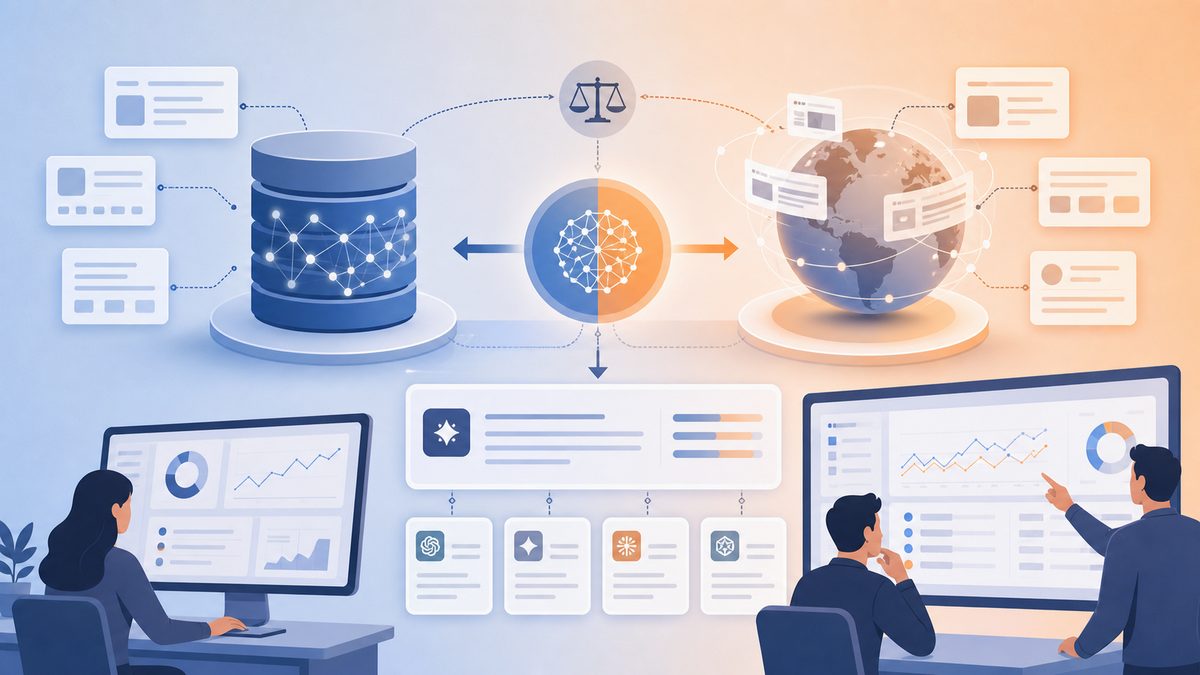
AI training data is information encoded into a model before release through pretraining, post-training, and provider updates. Live web data is information fetched at answer time from search indexes, crawlers, APIs, connectors, or browsing tools. Most AI answers blend both: memory frames the answer; retrieval supplies current evidence.
The practical rule is simple:
| If the AI answer is… | It is probably relying more on… | First fix |
|---|---|---|
| Uncited, stable, category-level, and similar across repeated prompts | Training memory | Strengthen entity facts across durable sources |
| Cited, current, local, newsy, or tied to a search mode | Live web retrieval | Improve crawlable source pages and citation candidates |
| Cited but still partly wrong | Hybrid synthesis | Fix source wording, claim clarity, and answer structure |
| Different every day or different by surface | Retrieval selection plus model synthesis | Track prompts, citations, and answer changes over time |
This is why the same brand can be described correctly in ChatGPT Search but incorrectly in a default uncited answer, or cited in Perplexity but absent from Google AI Mode. The systems are not all looking at the same source layer.
What searchers really want to know
A user searching "AI training data vs live web" is usually not asking for a generic AI explainer. They want to know:
- Whether ChatGPT, Gemini, Claude, Perplexity, Copilot, or Google AI Overviews use old training data or current pages.
- Why an AI answer can be outdated even when the correct page is live.
- Whether updating one page can fix a wrong answer.
- Which bots and crawler rules affect AI search visibility.
- How to tell whether a brand visibility issue is caused by memory, retrieval, or synthesis.
- What a marketing or SEO team should do next.
The short answer: you cannot optimize "for AI" as one channel. You have to identify the source path first.
What ranking pages cover, and what they miss
For this article, maxaeo reviewed 10 visible English results for "AI training data vs live web" and close variants on July 3, 2026. The sample included official product documentation, AI-search explainers, technical RAG articles, and SEO-facing posts.
The pattern was consistent: most pages explained the concept, but few gave teams a diagnostic workflow.
| Coverage area in visible results | Pages covering it | Common gap |
|---|---|---|
| Training data, knowledge cutoffs, or static model memory | 7/10 | Treated as a user limitation, not a brand visibility problem |
| RAG or live web retrieval | 6/10 | Explained technically, without source-fix priorities |
| Product examples such as ChatGPT Search, AI Overviews, Claude, and Perplexity | 5/10 | Listed features, but did not map them to actions |
| Crawler controls for search vs training | 2/10 | Collapsed different AI bots into one bucket |
| A repeatable diagnosis workflow | 1/10 | No way to classify memory, retrieval, or synthesis failure |
| Measurement cadence after fixes | 0/10 | No method to prove whether answer changes came from the work |
The missing layer is operational. Teams need to know whether to update entity references, rewrite a cited page, fix robots rules, publish a missing page type, or wait for a model-side refresh.
The two-ledger framework: memory ledger vs retrieval ledger
Use two ledgers for AI visibility work. The memory ledger tracks durable facts that models may learn or infer about the brand. The retrieval ledger tracks pages that AI search systems can crawl, select, cite, and summarize today. Most answer problems belong to one ledger first, even when the final answer is hybrid.
| Ledger | What it tracks | Best for fixing |
|---|---|---|
| Memory ledger | Brand name, category, product names, audience, acquired companies, old names, key executives, official profiles, third-party descriptions, schema consistency | Old descriptors, brand confusion, uncited wrong answers, category misclassification |
| Retrieval ledger | Pages by prompt class, crawl/index status, last updated date, cited URLs, source type, claim wording, internal links, snippet eligibility | Missing citations, outdated citations, competitor-owned answers, wrong source selection |
| Synthesis notes | Whether the cited source actually supports the claim and whether the AI distorted it | Correct URLs with wrong conclusions, partial hallucinations, misleading summaries |
A good AI search program keeps both ledgers open. A weak one publishes more blog posts without knowing which layer is failing.
Which AI answers use training memory, live web, or both?
AI answers lean on training memory when prompts are timeless, uncited, or category-level. They lean on live web retrieval when prompts are current, local, source-heavy, or searched. They blend both when retrieved pages are summarized through the model's existing understanding of the entity and topic.
| AI surface or answer type | Likely source path | Diagnostic clue | What to optimize |
|---|---|---|---|
| ChatGPT, Claude, Gemini, or Copilot answer with no visible search or citations | Model memory plus conversation context | No source panel, no URLs, similar wording across repeated runs | Entity clarity, durable third-party references, consistent category language |
| ChatGPT Search | Live web retrieval plus model synthesis | Inline citations or Sources panel | Allow OAI-SearchBot, publish crawlable evidence, improve source quality |
| OpenAI API web search or Deep Research-style workflows | Tool-based web search plus reasoning | Multiple searches, cited URLs, longer answer path | Primary evidence, original data, documentation, comparison pages |
| Google AI Overviews and AI Mode | Google Search systems, RAG, query fan-out, model synthesis | Supporting links from Search | Indexed pages, snippet eligibility, helpful content, clear source structure |
| Perplexity and Sonar-style answers | Real-time search index plus generated answer | Citations are central to the response | Fresh sources, answer-ready pages, citation quality |
| Claude with web search | Claude model plus web search tool | Search results and citations | Current pages, clear claims, domain-specific source quality |
| Enterprise agents with connectors | Model memory plus private files, SaaS connectors, and sometimes web | Answers cite internal docs or workspace data | Internal documentation quality, permissions, canonical sources |
The provider docs confirm the split. OpenAI says its web search tool lets models access up-to-date information with sourced citations, and its crawler docs separate OAI-SearchBot from GPTBot. Google says AI Overviews and AI Mode are rooted in core Search systems and can use RAG and query fan-out. Perplexity describes its Search API as real-time access to ranked web results from a continuously refreshed index. Anthropic says Claude's web search tool gives access to current web content with cited sources.
The brand implication: do not infer source behavior from the product logo alone. Infer it from the answer path.
How to diagnose a wrong AI answer
A wrong AI answer usually leaves evidence. No citations, stable wording, and old category language point toward memory. Wrong cited pages point toward retrieval. Correct citations with distorted conclusions point toward synthesis. The fastest test is to run the same prompt with and without search, then inspect cited URLs.
Use this workflow:
- Run the exact prompt in a non-search or default mode. Save the answer text, brand mentions, competitor mentions, and wording.
- Run the same prompt in a search-enabled mode. Use ChatGPT Search, Perplexity, Claude with web search, Google AI Mode, or another cited surface.
- Compare the answer state. If search fixes the answer, live sources exist but memory may lag. If search also fails, retrieval or source quality is the priority.
- Inspect every cited URL. Classify it as owned, third-party, competitor, forum, review site, docs, news, or irrelevant.
- Check claim support. The cited page should state the exact claim in visible HTML, not imply it across a PDF, image, accordion, script-rendered tab, or vague paragraph.
- Test source extractability. Ask a searched surface a narrow prompt such as "What does [URL/domain] say about [fact]?" If it cannot extract the fact, rewrite the source page.
- Repeat across surfaces and days. One screenshot diagnoses a moment. Monitoring diagnoses a system.
Use this failure model:
| Failure type | What it looks like | Root cause | First action |
|---|---|---|---|
| Memory lag | AI uses an old category, old pricing, old brand name, or pre-rebrand positioning with no citations | Durable entity facts are stale or inconsistent | Update canonical pages and trusted profiles |
| Source absence | AI does not cite you for prompts where you should be a primary source | No crawlable page answers that prompt class | Build or improve source pages |
| Source selection error | AI cites an outdated blog post, scraped profile, or competitor page | Better source is missing, weak, blocked, or not internally linked | Update, redirect, canonicalize, or supersede the wrong source |
| Synthesis error | AI cites a correct page but draws the wrong conclusion | The page buries the answer or lacks explicit constraints | Add answer-first wording, tables, limitations, and examples |
| Access error | AI search never sees the page | Robots, CDN, auth, rendering, noindex, or snippet controls | Fix crawl, indexing, rendering, and preview eligibility |
For prompt-level source triage, maxaeo's guide to AI citation sources is the closest follow-up because it separates owned, earned, third-party, and competitor citations.
Crawler controls: search access is not the same as training access
Do not treat all AI crawlers as one bot. Some bots are for search visibility, some are for training, and some represent user-triggered browsing. Blocking the wrong bot can remove your site from AI search answers while doing little to address training concerns.
| System | Control that matters | What it affects |
|---|---|---|
| OpenAI ChatGPT Search | OAI-SearchBot in robots.txt and published IP access |
Eligibility to appear in ChatGPT search answers |
| OpenAI model training | GPTBot in robots.txt |
Whether crawled content is indicated as disallowed for training OpenAI foundation models |
| OpenAI user-triggered browsing | ChatGPT-User |
User-initiated page visits; not the Search inclusion control |
| Google AI Overviews and AI Mode | Googlebot crawl, indexing, snippet eligibility, preview controls | Supporting links in Google Search AI features |
| Google non-Search AI uses | Google-Extended | Separate control for some non-Search AI training and grounding uses |
| Google Search visibility | Do not rely on llms.txt |
Google says Search does not use llms.txt or special AI markup for visibility |
OpenAI's crawler documentation says OAI-SearchBot and GPTBot settings are independent. A site can allow search inclusion while disallowing training use. OpenAI also says sites opted out of OAI-SearchBot will not be shown in ChatGPT search answers, though they may still appear as navigational links.
Google's AI features documentation says pages need to be indexed and eligible for a snippet to appear as supporting links in AI Overviews or AI Mode, and that there are no additional technical requirements. Google's generative AI search guide also says Google Search ignores llms.txt for Search visibility.
How to win training-memory answers with entity permanence
Entity permanence is the work of making durable brand facts consistent across sources that models and retrieval systems may use. It matters when answers are uncited, slow to update, or confusing your company with a similarly named product, acronym, location, or competitor.
Start with the facts that should never be ambiguous:
- Official brand name and capitalization.
- One-sentence category definition.
- Primary product or platform name.
- Target audience and use case.
- Old names, acquired brands, discontinued products, and redirects.
- Executive, founder, location, and legal entity details when relevant.
- Official social, app marketplace, review, directory, and partner profiles.
- Organization schema that matches visible page text.
A strong memory ledger has one canonical source for each durable fact. For most SaaS brands, that means:
- About page: "What is this company?" in plain language.
- Product page: "What does the product do?" without slogan-only copy.
- Category page: "What market does it belong to?" with buyer language.
- Docs or help center: "How does it work?" with precise product terms.
- Trust page: Security, compliance, data processing, and support facts.
- Third-party profiles: Accurate descriptions on G2, Capterra, marketplaces, partner directories, GitHub, LinkedIn, Crunchbase, and relevant ecosystem pages.
This is not a reason to manufacture fake mentions. Google warns against inauthentic mentions for generative Search. The better route is to create real reference points that deserve to exist: customer stories, integration listings, technical docs, changelogs, partner pages, research notes, and support pages.
If the issue is brand confusion, use a direct disambiguation page and consistent sameAs signals. The maxaeo brand name collision playbook covers that workflow.
How to win live-web answers with source pages
Live web answers reward pages that are easy to crawl, select, quote, and verify. The goal is not more blog volume. The goal is source coverage for the prompts buyers actually ask when AI systems build shortlists, comparisons, integrations, and recommendations.
Build pages around prompt classes, not keyword variants.
| Prompt class | Page type that helps | What the page must state plainly |
|---|---|---|
| "Best tools for…" | Category, use-case, or solution page | Who the product is best for, who it is not for, proof, and differentiators |
| "Does X work with Y?" | Integration page | Supported workflows, setup steps, limits, authentication, and data flow |
| "X vs Y" | Comparison page | Side-by-side criteria, tradeoffs, fit, pricing logic, and migration notes |
| "Alternatives to X" | Alternatives page | When to switch, which alternatives fit which use cases, and honest exclusions |
| "Is this secure?" | Security and compliance page | Certifications, controls, data retention, subprocessors, and policy links |
| "What changed recently?" | Changelog or release page | Dated updates, affected users, feature names, and version history |
| "Can I trust this claim?" | Research or methodology page | Sample size, data source, definitions, limitations, and date range |
| "How do I implement this?" | Docs, API, or help center page | Steps, examples, prerequisites, and troubleshooting |
A page that AI systems can use usually has these traits:
- The answer appears in crawlable HTML near the top.
- The page has a visible date when freshness matters.
- The primary claim is repeated in a table, list, or definition block.
- Internal links point to it from related product, docs, and comparison pages.
- Structured data matches visible text.
- PDFs, images, JavaScript tabs, and gated forms are not the only place the fact exists.
- The page includes limitations, not only promotional claims.
For SaaS teams, the highest-use source pages are often not blog posts. See maxaeo's analysis of page types AI actually cites, plus the playbooks for integration pages and comparison pages for AI search.
How to split effort between memory and retrieval
Split effort by symptom. Old brand descriptions need entity work. Missing citations need source pages. Wrong citations need source repair. Volatile answers need monitoring. Hybrid systems need all three, but the first fix should match the most likely failure path.
| Symptom in AI answers | Likely source path | Best first fix | KPI |
|---|---|---|---|
| AI calls the company by an old category | Training memory | Update canonical pages, schema, and trusted profiles | Descriptor accuracy |
| AI omits the brand from "best tools" shortlists | Retrieval gap or authority gap | Build stronger category, comparison, and proof pages | AI share of voice |
| AI cites an outdated article | Live retrieval | Update, redirect, canonicalize, or supersede the page | Citation freshness |
| AI confuses two similar brands | Entity memory | Add disambiguation signals and consistent naming | Collision rate |
| AI links to competitors for your integration | Retrieval gap | Publish a specific integration page and link it from product/docs | Citation ownership |
| AI gives no citations for factual claims | Product behavior or source weakness | Test searched mode and improve source clarity | Cited answer rate |
| AI cites you but misstates the conclusion | Synthesis issue | Add answer-first definitions, constraints, and comparison tables | Claim fidelity |
| AI changes rankings daily | Retrieval volatility | Track prompts, surfaces, locations, citations, and competitors | Prompt-level stability |
A useful rule: fix pages already being cited before publishing new pages. If AI systems are already selecting a stale or weak URL, improving that URL often beats adding another uncited article.
What to measure every week
Weekly AI search monitoring should measure both answer presence and source quality. A brand can be mentioned but misdescribed, cited but outranked, recommended with old proof, or absent from one surface while strong in another. Measurement must separate those failure modes.
Track these fields:
- Prompt cluster: category, comparison, alternatives, integration, security, pricing, reputation, and current-event prompts.
- Surface: ChatGPT, ChatGPT Search, Perplexity, Claude, Gemini, Copilot, Grok, Google AI Mode, and Google AI Overviews.
- Location and language when results may vary.
- Brand outcome: mentioned, ranked, recommended, excluded, confused, or negatively framed.
- Competitors mentioned and their order.
- Cited URLs and source type: owned, third-party, forum, review site, docs, news, competitor, or marketplace.
- Citation freshness: publication date, modified date, and whether the page still supports the claim.
- Answer wording: exact descriptor, category, pros, cons, and caveats.
- Fix history: page updates, redirects, schema changes, crawl changes, PR, new pages, and profile updates.
Independent research reinforces why citation monitoring needs to be separate from traditional rank tracking. A 2026 study of Google AI Overviews issued 55,393 trending queries over 40 days and found that 11.0% of generated atomic claims were unsupported by cited pages, while nearly 30% of cited domains did not appear in co-displayed first-page organic results. Another 2026 benchmark of 11,500 real-user queries found source overlap between Google Search, Gemini, and AI Overviews was low, with under 0.2 average Jaccard similarity.
That means classic rankings are useful context, but they are not enough. You need prompt-level answer records and citation records.
A 30-day action plan for B2B SaaS teams
The fastest path is diagnose first, then fix the ledger with the highest use. Do not start by publishing 20 AI-targeted articles. Start by finding which prompts matter commercially and which source path is failing.
- Days 1-3: Build the prompt set. Include 30-50 prompts across category, alternatives, comparisons, integrations, pain points, security, pricing, and "who is best for" questions.
- Days 4-7: Capture baseline answers. Run prompts across the surfaces your buyers use. Record answer text, brand mentions, competitors, rank position, sentiment, and citations.
- Days 8-10: Classify every failure. Label each issue as memory lag, source absence, source selection error, synthesis error, access error, or volatility.
- Days 11-15: Repair cited sources first. Update stale pages, add direct answer blocks, fix redirects, improve internal links, and make claims explicit.
- Days 16-20: Build missing source pages. Prioritize integration, comparison, category, security, docs, and methodology pages tied to commercial prompts.
- Days 21-24: Strengthen entity permanence. Normalize About copy, product copy, schema, official profiles, partner profiles, and third-party descriptions.
- Days 25-27: Check crawler controls. Verify Google indexing and snippet eligibility, OAI-SearchBot access, CDN behavior, noindex tags, rendered HTML, and canonical signals.
- Days 28-30: Re-test and report. Compare answer text, citations, competitor displacement, and prompt-cluster movement against the baseline.
Report movement by prompt cluster, not vanity totals. "Brand appeared in 18 more AI answers" is less useful than "brand moved from absent to cited in 6 of 10 integration prompts, but remains miscategorized in 4 uncited comparison prompts."
Common mistakes that weaken both paths
Most AI visibility failures come from treating AI search as a shortcut. The durable work is still clear content, accessible pages, trustworthy evidence, and consistent entities. Hacks rarely improve source selection or answer quality.
Avoid these mistakes:
- Blocking OAI-SearchBot while expecting to appear in ChatGPT Search.
- Assuming GPTBot and OAI-SearchBot control the same thing.
- Relying on
llms.txtfor Google AI Overviews or AI Mode visibility. - Creating doorway pages for every fan-out query variation.
- Hiding important product facts behind JavaScript, images, PDFs, or gated forms.
- Updating dates without materially updating the content.
- Publishing "best" or "vs" pages that never state tradeoffs.
- Using claims such as "best-in-class" or "enterprise-grade" without evidence.
- Treating all citations as wins, even when the cited page does not support the claim.
- Measuring only brand mentions and ignoring source quality, competitor order, and answer wording.
Common questions
Do AI tools use training data or the live web?
They use both, depending on the product, prompt, settings, and interface. A default uncited answer may rely heavily on model memory. A search-enabled answer may retrieve live pages and cite them. A research agent may run multiple searches and synthesize many sources. Assume hybrid behavior unless the answer path clearly shows otherwise.
Can changing one page fix a wrong ChatGPT answer?
Yes, but only for some answer paths. If ChatGPT Search cites that page, updating it can change searched answers after recrawling and reselection. If the wrong answer is uncited and memory-led, one page is rarely enough. You need consistent entity facts across durable sources.
Can blocking GPTBot hurt ChatGPT Search visibility?
Blocking GPTBot is not the same as blocking ChatGPT Search. OpenAI separates GPTBot for training from OAI-SearchBot for search. A site can choose different robots rules for each. If you want ChatGPT Search inclusion, OAI-SearchBot access matters.
Is llms.txt required for AI search visibility?
No for Google Search. Google says Search does not use llms.txt or special AI markup for visibility in AI Overviews or AI Mode. Other systems may use different discovery mechanisms, so treat llms.txt as optional infrastructure, not a replacement for crawlable source pages.
How long does it take for AI answers to update?
There is no universal timeline. Live retrieval systems can change after crawling, indexing, and source reselection. Google says recrawling can take days to months depending on the page. Model-memory answers may take longer because they depend on provider-side updates. Measure by prompt and surface.
Do citations mean the AI answer is accurate?
No. A citation proves a source was attached, not that the generated claim is fully supported. Always check whether the cited page states the exact claim. If the source is right but the answer is wrong, rewrite the page with clearer answer-first language and constraints.
What is the best first step for a brand?
Run the same commercial prompts across search-enabled and non-search surfaces. Then classify each failure as memory, retrieval, synthesis, or access. That one step prevents wasted work because it tells you whether to fix entity facts, source pages, crawler controls, or answer wording.
The practical answer
AI training data vs live web is not an academic distinction. It is the routing layer for AI visibility work. If the answer is memory-led, build entity permanence. If it is retrieval-led, improve crawlable evidence. If it is hybrid, measure both.
The teams that win AI search will not be the ones publishing the most content. They will be the ones that know which facts AI systems remember, which pages they retrieve, which sources they cite, and which fixes change the answer.