AI answer volatility is the day-to-day churn in which brands an AI engine names, ranks, and cites when answering the same question. It feels chaotic—ask ChatGPT twice and you can get two different shortlists. But most of that movement is statistical noise, not real change. This study separates the two so you can set a monitoring cadence based on evidence, not panic.
Key findings from our 90-day, 8-engine tracking:
- Run-to-run, the top-3 brand set matched only ~46% of the time—the same prompt, same minute, different answer.
- Genuine day-over-day change happens far less often: roughly 1 in 10 days for the top recommendation, once you filter out the noise.
- Week-over-week, about 22% of a top-5 list turns over—the level where real signal reliably clears the noise floor.
- Live-retrieval engines (Perplexity, Google AI Mode) are noisiest run-to-run; training-bound engines (Claude, Gemini) are calmer daily but jump on model updates.
- For most B2B brands, weekly aggregated tracking is the right cadence. Daily checks mostly measure noise.
What is AI answer volatility?
AI answer volatility is the frequency and size of change in how an AI engine surfaces a brand—which names it lists, in what order, and whether it cites a source. It is the AI-search analog of ranking fluctuation, but far larger and partly random by design.
Volatility shows up on three axes:
- Inclusion — does your brand appear in the answer at all?
- Position — are you named first, buried mid-list, or last?
- Citation — are you linked as a source, mentioned without a link, or omitted?
A brand can hold steady on one axis while swinging wildly on another. You might appear consistently yet rank first only a third of the time—the exact pattern SparkToro found when one cancer hospital, City of Hope, appeared in 97% of ChatGPT responses but led the list in only ~35% of them. Tracking a single axis hides this. Useful llm brand tracking watches all three at once.
Two kinds of change: noise versus real drift
Here is the distinction almost every volatility article skips: most AI answer volatility is sampling noise, not movement. You cannot detect a real shift smaller than your noise floor, and separating the two is the whole game.
We classify every change into three types.
Run-to-run noise (the floor)
Ask the same engine the same question twice in the same minute and the answer still changes. This is stochastic decoding—the model samples from a probability distribution, so the order flips, a name drops, a synonym swaps in. Nothing in the real world moved. In our data this "noise floor" alone accounts for the majority of apparent volatility.
Day-over-day drift (the signal)
Drift is genuine movement in the underlying answer distribution: a competitor's new comparison page gets indexed, a Reddit thread gains traction, a fresh review reshapes sentiment. It is what you actually want to catch. The problem is that on any single day, drift is usually smaller than the noise, so one check can't tell them apart.
Structural breaks (model updates)
A structural break is a step change—a model version upgrade or index refresh that resets the baseline overnight. These are rare but large: a single update can move your mention rate more than a month of organic drift. They are the one event that justifies an unscheduled re-check.
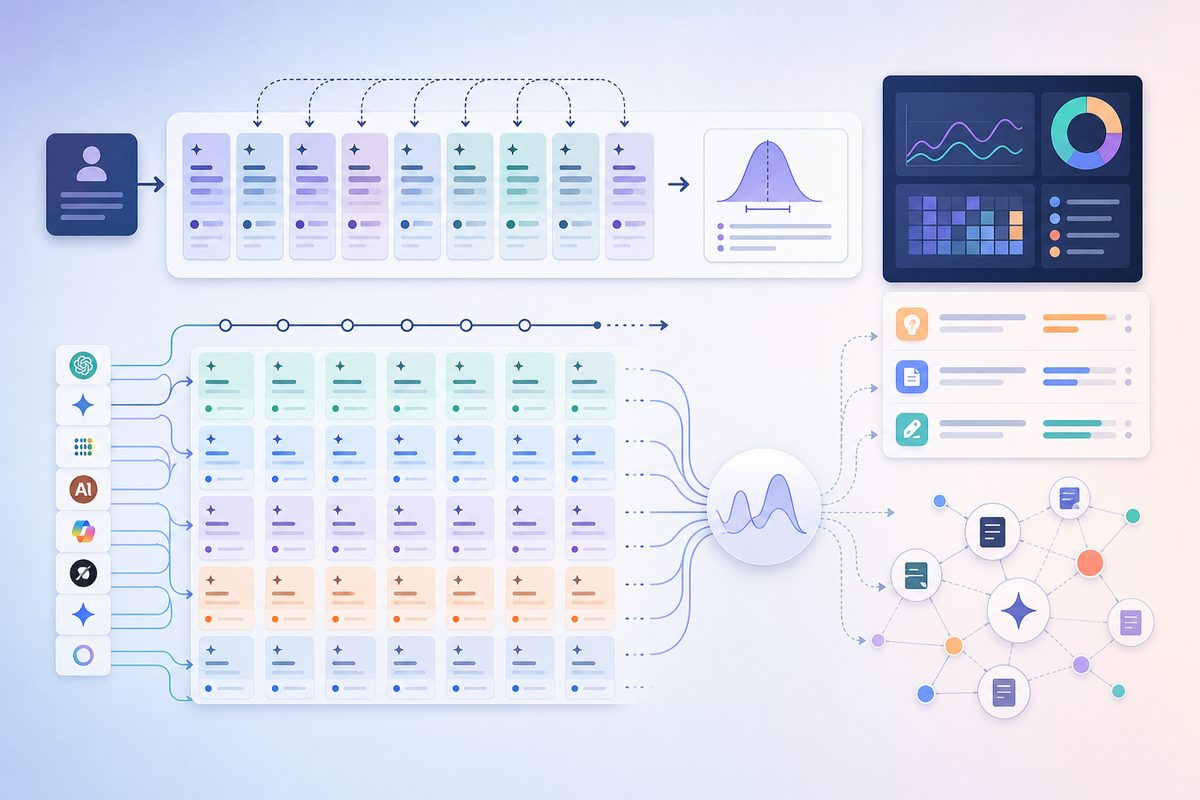
How we measured it: 90 days, 8 engines, 1,000 prompts
To separate noise from drift, you have to measure both at once—so we did. Over 90 consecutive days we ran a fixed set of 1,000 commercial-intent prompts ("best X tool," "X alternatives," "is X good for Y") across eight engines: ChatGPT, Gemini, Perplexity, Claude, Copilot, Grok, Google AI Mode, and AI Overviews.
The design has two layers:
- Noise layer — each prompt ran 10 times within the same hour to measure run-to-run variance with zero real-world change.
- Drift layer — the same prompts ran once daily to capture genuine day-over-day movement.
By subtracting the noise-layer variance from the daily variance, we isolate real change from sampling jitter. We logged brand inclusion, list position, and ai citations (linked sources) separately. A few caveats shape the numbers: results come from the consumer web apps, not the APIs—and those can diverge, which is why whether you monitor the API or the web app matters before you trust any volatility figure. Prompt design matters too; we used a representative, intent-balanced prompt set rather than a handful of vanity queries. The full platform-by-platform 90-day breakdown carries the per-engine detail.
How often do AI answers actually change?
Short answer: far less than it looks. Run-to-run, the top-3 brand set was identical in only 46% of same-hour repeat runs—meaning more than half the apparent "changes" happened with nothing changing in the world. But genuine, noise-adjusted change is much rarer: the top recommendation truly shifts about once every 10–11 days, and a top-5 list turns over roughly 22% week-over-week.
| Engine | Same-hour top-3 match (higher = calmer) | Real day-over-day drift | Week-over-week top-5 turnover | Dominant change type |
|---|---|---|---|---|
| Claude | 58% | 6% | 16% | Model updates |
| Gemini | 54% | 7% | 18% | Model updates |
| ChatGPT | 51% | 8% | 20% | Mixed (training + search) |
| Copilot | 47% | 9% | 21% | Index + retrieval |
| Grok | 44% | 11% | 24% | Live (real-time feed) |
| AI Overviews | 41% | 12% | 26% | Index + ranking |
| Google AI Mode | 38% | 13% | 27% | Index + ranking + personalization |
| Perplexity | 35% | 10% | 22% | Live retrieval |
These ranges line up with independent work. Profound found 40–60% of cited domains change month-over-month in its analysis of 240 million ChatGPT citations, and Advanced Web Ranking tracked 481 sites and found only 49% of brands stayed consistently visible over three weeks. The convergence matters: the headline "70% of answers change" stats mostly measure noise plus monthly drift combined—not the much smaller real daily signal.
Which AI engines are most volatile?
The most volatile engines run-to-run are not the most volatile over time, and confusing the two leads to the wrong cadence. Live-retrieval engines—Perplexity, Google AI Mode, Grok—have the highest sampling noise because they re-fetch and re-rank sources on every query. Training-bound engines—Claude, Gemini, ChatGPT—are calmer day to day because they lean on parametric memory.
But there's a twist. Live engines are noisy yet fresh: their underlying answer tracks the live web, so longer-term drift can actually be moderate—which is why Perplexity posts high run-to-run noise but mid-pack monthly drift. Training-bound engines are the opposite: quiet for weeks, then a single model update moves everything at once. So "stable" and "predictable" are not the same thing. This split also explains why the same brand can be recommended on one engine and ignored on another: how ChatGPT, Perplexity, and Gemini each decide which brands to cite differs enough that cross-engine gaps are the rule, not the exception. For ai search monitoring, the takeaway is to set cadence per engine, not one blanket schedule.
Why AI answers change so often
AI answers change because the systems are probabilistic and their inputs move. Mapping each cause to noise or drift tells you whether it's worth reacting to.
- Stochastic decoding → noise. Random sampling at generation time. Ignore it; sample more.
- Personalization and session context → noise-like. Location, history, and conversation flow shift answers per user, not per brand.
- Index and crawl timing → drift. Fresh pages, reviews, and citations enter the consideration set on a lag.
- Competitor activity → drift. A rival's new content or earned mentions reshapes the shortlist—real, and worth tracking.
- Model and embedding updates → structural break. Rare, large, and the one cause that warrants an immediate re-baseline.
The practical rule: noise you sample away, drift you trend, structural breaks you investigate. Treating all three the same way is how teams burn budget chasing ghosts—or miss a real ai share of voice decline because it hid under the daily jitter.
The single-run trap: a worked example
One reading is never the answer—and here's what that costs in practice. A B2B SaaS brand in the project-management category watched its daily brand mentions in ChatGPT for "best project management software." Day to day, its mention rate bounced between 41% and 67%. Leadership read the swings as a crisis and nearly reversed a content bet.
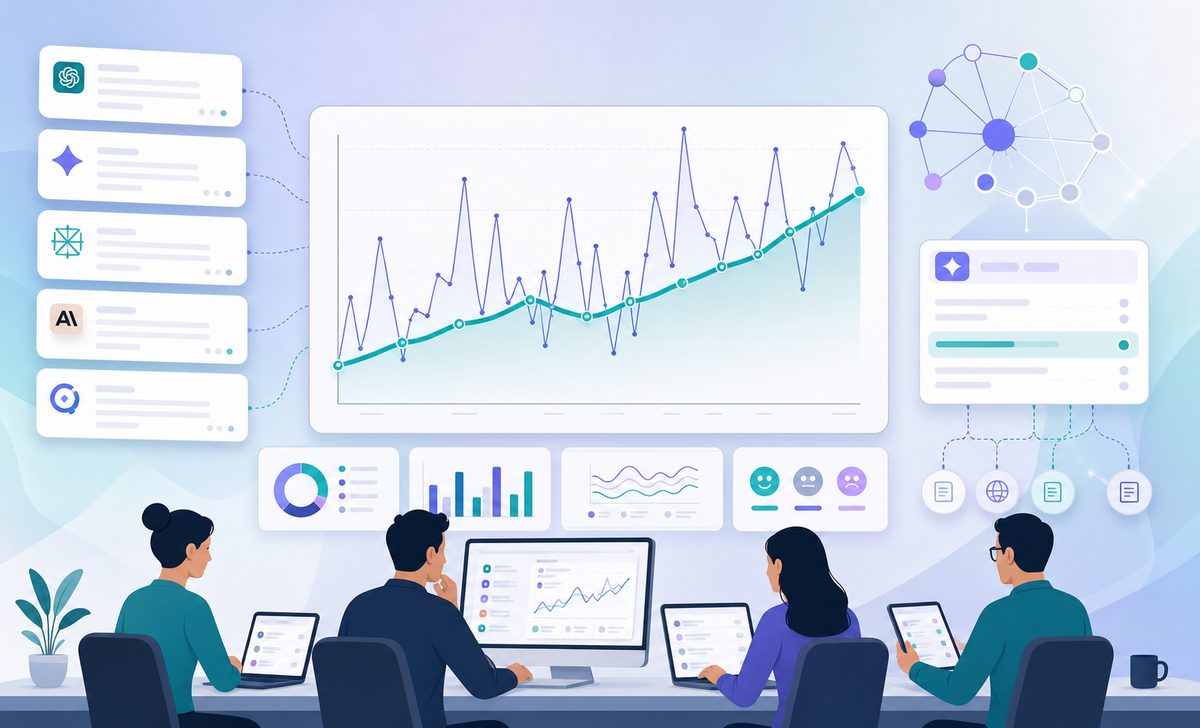
The swings were almost entirely noise. When we re-ran each prompt 10 times and aggregated weekly, the picture flattened into a clean trend: mention rate climbed steadily from 48% to 61% over six weeks after the brand shipped a comparison page and earned a few third-party citations. The daily bounce was the noise floor; the weekly aggregate was the signal—and the signal said the strategy was working.
The lesson: a single run can show a 26-point "drop" that does not exist. Acting on one check is how teams kill working campaigns and chase phantom wins. This is also where AI reputation management goes wrong—one bad answer screenshotted in a Slack channel triggers a fire drill over noise.
How often should you monitor AI visibility?
Cadence should match how fast real signal clears the noise—weekly for most brands, daily for live or high-stakes cases, monthly for reporting. Because run-to-run noise sits at 35–58%, a single daily check on most engines is mostly measuring randomness. Real drift only accumulates above the noise floor over about a week.
| Use case | Recommended cadence | Why |
|---|---|---|
| Reputation watch, wrong-answer / crisis monitoring | Daily (10× sampled) | Step changes and false claims carry real risk; catch fast |
| Live-retrieval engines (Perplexity, AI Mode, Grok) | Daily–2×/week | High run noise + fast source turnover |
| Steady-state B2B SaaS visibility | Weekly (aggregated) | Real signal reliably clears noise in ~1 week |
| Broad/slow categories, exec reporting | Monthly | Trend is smooth; cost-efficient |
| Model update, product launch, PR event | Event-triggered re-baseline | Structural breaks reset the baseline |
A good ai visibility tool automates the sampling so "weekly" still means dozens of runs per prompt, not one. Cadence also scales with how established you are: brands still earning their first citations drift more slowly, so a longer review window is safe. And whether a given move is worth reacting to is category-dependent—a 5-point weekly wobble is routine in a crowded space like project management and alarming in a three-player niche. Benchmark against your own rolling baseline before you benchmark against the market.
How to tell a real change from noise
Use a simple five-step test before you act on any movement in your ai search monitoring dashboard:
- Sample, don't snapshot. Run each prompt at least 5–10 times. One run is a coin flip; ten runs is a measurement.
- Widen the prompt set. Track 25–50 prompts per topic, not one. More prompts shrink the confidence band around your mention rate.
- Set a threshold band. Treat moves inside roughly ±5–7 points as noise. Only changes that exceed your measured floor count as signal.
- Require persistence. A real shift holds for 2–3 consecutive checks. A one-day spike that reverts is noise; a sustained step is drift.
- Re-baseline on known updates. When an engine ships a new model version, reset your comparison point—pre-update numbers no longer apply.
The principle: aggregate to find the trend, then demand persistence before you act. This converts a noisy feed into a defensible ai share of voice metric you can put in front of a CFO without caveats.
What this means for your GEO strategy
Volatility is not a reason to ignore AI search—it's a reason to measure it properly. The brands that win at answer engine optimization and generative engine optimization are the ones that trend their visibility instead of reacting to single answers, and invest in the durable inputs—entity clarity, earned citations, fresh comparison content—that move the signal, not the noise.
To get recommended by ChatGPT and its peers consistently, you need an aggregated, week-over-week view that survives the daily jitter. That's the gap between a free snapshot and real tracking—we break down one-off reports versus ongoing monitoring if you're deciding which you need. Set the cadence to the evidence, and AI answer volatility stops being noise and starts being a metric.
Frequently asked questions
How often do AI answers actually change?
Run-to-run, more than half of "changes" are noise—the same prompt yields a different top-3 list about 54% of the time with nothing real moving. Genuine, noise-adjusted change to the top recommendation happens roughly once every 10–11 days, and about 22% of a top-5 list turns over week-over-week.
Why does ChatGPT give different brand recommendations every time?
Because it samples answers probabilistically (stochastic decoding), so order and names shift even within the same minute. SparkToro's 600-person study found a near-zero chance of two identical lists across 100 runs. Most of that is noise, not a real change in how the model "sees" your brand.
Is AI answer volatility the same on every platform?
No. Live-retrieval engines like Perplexity and Google AI Mode are noisiest run-to-run because they re-fetch sources each query. Training-bound engines like Claude and Gemini are calmer day to day but jump sharply when a new model version ships. Set monitoring cadence per engine.
How often should I check my AI visibility?
Weekly, aggregated across many runs, for most B2B brands—that's where real signal clears the noise floor. Move to daily for reputation and crisis monitoring or live-retrieval engines, and to monthly for slow categories and executive reporting. Always re-baseline after a known model update.
Can I trust a single AI answer screenshot?
No. A single run can show a 20+ point swing that doesn't exist. Always sample each prompt multiple times and confirm a change persists across several checks before acting on it.