AI search tracking by market means measuring how AI answer engines mention, recommend, cite, rank, and describe a brand separately for each buying context where the answer can change: geography, language, buyer role, category maturity, product availability, and local competitor set.
A single global prompt set is useful for a baseline. It is not enough when the same query means different things to a U.S. founder, a German procurement lead, a Japanese startup marketer, and a French-speaking Canadian security buyer.
The goal is not to create dashboards for every country. The goal is to split tracking where market context changes the answer enough to affect pipeline, positioning, or brand risk.
Quick Answer: How to Track AI Search by Market
To run AI search tracking by market:
- Define markets by buying context, not just country.
- Score each market for revenue exposure, answer variance, language difference, competitor variance, and brand risk.
- Build a shared core prompt set so markets can be compared.
- Add localized prompts for native language, local competitors, regulations, proof points, and buyer roles.
- Run repeated measurements across the AI platforms your buyers use.
- Report segment-level metrics such as mention rate, recommendation rate, rank, AI share of voice, citations, sentiment, and description accuracy.
- Turn gaps into fixes: localized content, comparison pages, third-party citations, entity updates, review profiles, or PR.
The useful unit of analysis is not the global average. It is the market segment where the buyer, source pool, and competitor shortlist change.
What Is AI Search Tracking by Market?
AI search tracking by market is the practice of grouping AI monitoring prompts by the real buying context behind the question. Each group has its own prompt set, language, locale, competitors, measurement rules, and reporting view so teams can see where AI systems recommend, ignore, or misdescribe the brand.
Traditional SEO already separates language targeting from country targeting. Google’s guidance for multi-regional and multilingual sites explains that a multilingual site serves more than one language, while a multi-regional site targets users in different countries or regions. AI search tracking needs the same distinction, with one extra layer: buyer context.
A market segment is not always a country. In AI monitoring, a market can be:
| Market segment | Why it may need separate tracking |
|---|---|
| U.S. mid-market RevOps buyers | Different buying committee, proof needs, and competitors |
| German-language enterprise software buyers | Native-language sources, GDPR concerns, and regional vendors |
| French-speaking Canadian cybersecurity buyers | Bilingual source pool and local compliance language |
| APAC startup founders evaluating AI SEO tools | Different category maturity and comparison behavior |
| Agencies reporting AI visibility for clients | Different use case, reporting needs, and buying criteria |
If those groups receive materially different AI answers, they deserve separate measurement.
Why One Global Prompt Set Breaks Down
One global prompt set breaks down because AI answer engines synthesize responses from different signals depending on wording, language, location, implied buyer needs, and available sources.
The same brand can have strong AI share of voice in one market and almost no visibility in another, even when the traditional SEO keyword looks identical. A dashboard that says "32% global mention rate" can hide the real issue: the brand is visible in English comparison prompts but absent from German-language procurement prompts.
This matters because AI answers are not stable snapshots. The April 2026 paper “Don’t Measure Once: Measuring Visibility in AI Search” argues that AI search visibility should be measured as a distribution across runs, prompts, and time, not as one observation.
A second April 2026 study, “How Generative AI Disrupts Search”, compared Google Search, Gemini, and AI Overviews across 11,500 user queries. It found that AI Overviews appeared for 51.5% of the representative queries in its dataset, that source overlap between systems was low, and that AI Overview outputs were less consistent across repeated runs and minor query edits.
Market segmentation adds another dimension: visibility varies not only by prompt and time, but also by who the answer is for.
When Should You Segment AI Search Tracking?
Segment AI search tracking when a market difference changes the answer, the competitor set, the cited sources, or the business decision. Do not segment only because a CRM field exists.
Use this rule: if two buyer groups expect different proof, different sources, or different alternatives, they need different monitoring views.
| Split signal | Segment when this changes | Example |
|---|---|---|
| Geography | Laws, availability, reviewers, analysts, partners, or competitors differ | U.S. vs. EU data privacy tools |
| Query language | Native vocabulary, source pool, sentiment, or brand recall changes | English vs. German procurement queries |
| Buyer persona | Decision criteria and proof needs differ | Founder vs. IT security leader |
| Category maturity | Buyers ask different questions by market education level | "What is AEO?" vs. "best AEO platform" |
| Local competitor set | AI shortlists include regional vendors | U.K. agency tools vs. U.S. enterprise tools |
| Product availability | Pricing, support, integrations, features, or partners differ | English-only support vs. multilingual support |
| Reputation risk | AI systems describe the brand differently by source pool | Old acquisition, outdated pricing, wrong category |
This is the core principle: market segmentation should be driven by answer variance, not by organizational charts.
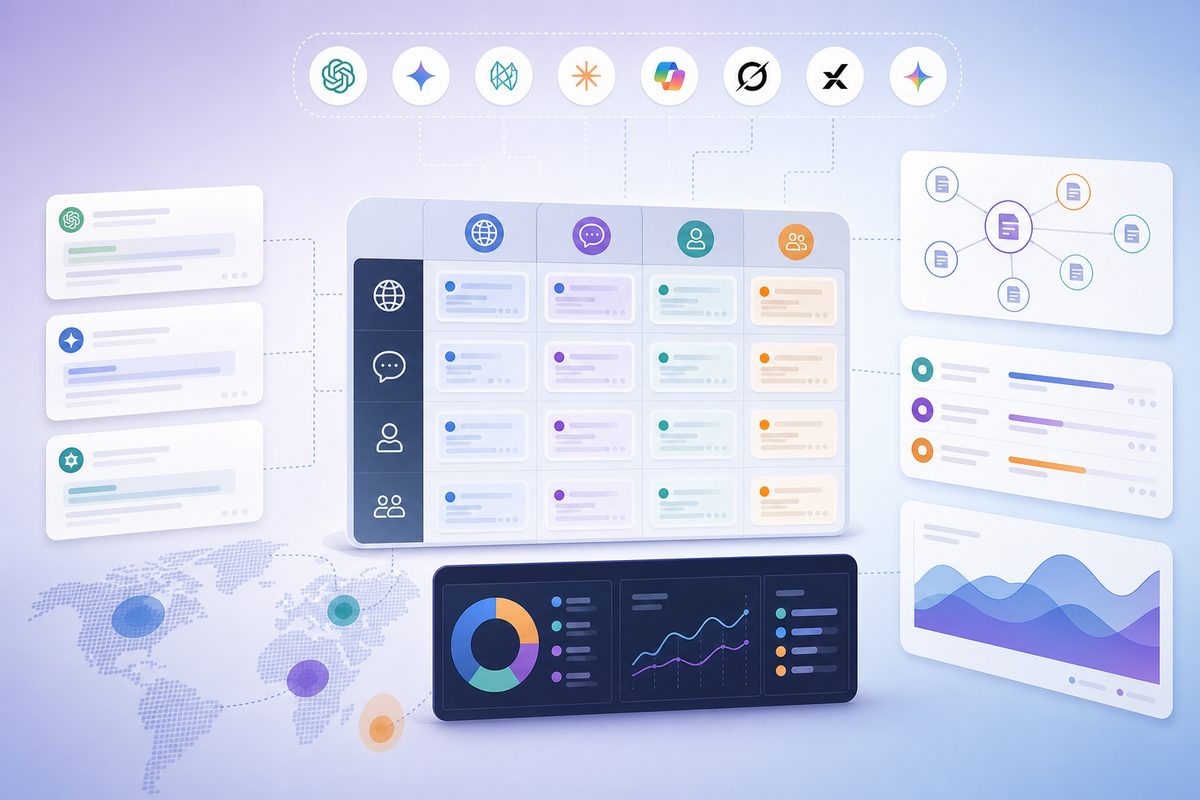
The Market Split Score Framework
The Market Split Score helps decide whether a segment deserves its own AI search monitoring view. Score five factors from 0 to 3.
| Factor | 0 | 1 | 2 | 3 |
|---|---|---|---|---|
| Revenue exposure | No active pipeline | Small audience | Meaningful pipeline | Strategic market |
| Answer variance | Same answers | Minor wording changes | Different rankings | Different recommendations |
| Language difference | Same language | Same language, local terms | Translated queries | Native-language buying journey |
| Competitor variance | Same competitors | One local player | Several regional vendors | Mostly different shortlist |
| Brand risk | Low | Minor omissions | Wrong positioning | Incorrect or damaging claims |
Use the total score this way:
| Score | Decision | Action |
|---|---|---|
| 0-4 | Keep global | Track in the shared prompt set only |
| 5-7 | Test | Run a two-week variance test before splitting |
| 8-11 | Split | Create a market view and local prompt layer |
| 12-15 | Prioritize | Track separately with higher cadence and named owners |
Example: a B2B SaaS company entering Germany might score 3 for revenue exposure, 2 for answer variance, 3 for language difference, 2 for competitor variance, and 2 for brand risk. Total: 12. That market should not be hidden inside a global average.
A small English-speaking expansion market with the same competitors and low pipeline may score 4. Keep it global until search behavior or sales priority changes.
The Two-Week Market Variance Test
If the score is uncertain, run a short variance test before creating a permanent segment.
Use 10 to 15 prompts per suspected market. Keep the intent consistent, but adapt the language and buyer context. Run each prompt several times across the AI platforms that matter to your buyers. Track whether the answer changes in ways that would affect marketing or sales.
Split the market if at least two of these are true:
| Variance signal | Split threshold |
|---|---|
| Brand inclusion | Mention rate differs by 20 percentage points or more |
| Recommendation quality | One market recommends the brand and another only mentions it |
| Competitor set | More than 40% of recurring competitors differ |
| Citation pool | The cited domains or source types are materially different |
| Description accuracy | One market produces wrong category, pricing, feature, or availability claims |
| Buyer fit | The answer recommends the brand for the wrong segment or use case |
These thresholds are operating heuristics, not industry benchmarks. Their value is practical: they prevent teams from either over-segmenting every market or averaging away important local losses.
Start With Buyer Context, Not Keywords
Buyer context is the job, constraint, and evaluation stage implied by the prompt. In AI search, context often matters more than the exact keyword because answer engines infer what kind of answer the user needs before generating a shortlist, explanation, or recommendation.
A keyword like "AI visibility tool" can become several different monitoring prompts:
- "What is an AI visibility tool, and when does a SaaS team need one?"
- "Best AI visibility tools for a B2B SaaS company expanding into Europe"
- "Which AI search monitoring platforms track ChatGPT, Gemini, Perplexity, and AI Overviews?"
- "How should an agency report AI share of voice across multiple clients?"
- "What tools help brand teams monitor inaccurate brand mentions in ChatGPT?"
Those are not duplicates. They represent different buyers and stages. The first is education. The second is market expansion. The third is platform coverage. The fourth is agency reporting. The fifth is AI reputation management.
If the team already has keyword research, convert those terms into monitoring questions, then tag each prompt by market, persona, and stage. The maxaeo guide to converting SEO keywords into AI monitoring questions gives a cleaner starting point than copying keyword phrases directly into AI tools.
Build Market Prompt Sets in Layers
A market prompt set should have a shared core and local layers. The shared core lets teams compare markets. The local layers reveal what global averages hide.
| Layer | Purpose | Example prompt |
|---|---|---|
| Core category | Compare every market on the same baseline | "Best platforms for AI search monitoring" |
| Localized category | Capture regional wording and source pools | "Best AI search monitoring tools for U.K. B2B SaaS teams" |
| Buyer persona | Reflect different decision criteria | "What should a CMO use to track brand mentions in ChatGPT?" |
| Competitor shortlist | Track recommendation battles | "Compare maxaeo with [competitor] for AI visibility tracking" |
| Risk and accuracy | Find harmful or outdated descriptions | "What are the limitations of maxaeo?" |
For most B2B SaaS companies, 20 to 40 prompts per high-priority market is enough for a first segmentation pass. Start smaller if the category is narrow. Expand only when the prompt set misses a recurring sales objection, a common AI answer, or a local competitor.
For a broader prompt count model, use the maxaeo guide on how many AI search prompts to track.
Segment by Geography Without Overfitting to Country Names
Geography matters when local market signals affect the answer. It does not matter simply because a country exists.
The best geographic splits reflect buying conditions:
| Geographic factor | Why it affects AI answers |
|---|---|
| Regulation | AI systems may surface compliance-specific vendors or sources |
| Analyst and media coverage | Local publications can influence citations and recommendations |
| Review platforms | Some review sites are stronger in specific countries |
| Partner ecosystem | Regional agencies, resellers, or implementation partners may appear |
| Product availability | Pricing, support, data residency, or features may differ |
| Local competitors | Regional vendors can dominate shortlists in their home market |
For example, a cybersecurity SaaS company may need separate views for the U.S., U.K., Germany, and Australia even though three of those markets use English heavily. The U.S. answer may emphasize enterprise proof. The U.K. answer may mention public-sector frameworks. Germany may emphasize GDPR, data residency, and German-language sources. Australia may surface regional service partners.
Google says AI Overviews and AI Mode may use query fan-out, issuing multiple related searches across subtopics and data sources to develop a response. That matters for market tracking because a localized prompt can pull from different sources even when the visible prompt looks close to the global one.
Do not create a separate country dashboard until one of these is true:
- The country has meaningful pipeline or strategic priority.
- The language or source pool changes.
- The AI shortlist changes.
- Local legal, pricing, support, or product claims create risk.
- Regional competitors appear repeatedly.
Segment by Language Because Translation Is Not Localization
Language segmentation is necessary when native-language queries produce different vocabulary, sources, sentiment, or citations. A translated English prompt rarely captures how local buyers ask for vendors, categories, and proof.
A direct translation of "answer engine optimization" may not match how marketers in another market discuss generative engine optimization, AI SEO, LLMO, AI visibility, or AI search monitoring. Even within English, U.S. and U.K. buyers may use different phrasing around procurement, vendors, agencies, platforms, and solutions.
Google’s multilingual guidance says page language should be obvious and that visible content is used to determine language. The same principle applies to AI search tracking: a language segment should use native phrasing, native competitors, and native proof sources.
A practical rule: if the sales team would localize a demo deck for that language, the AI prompt set should be localized too. The same applies to customer stories, analyst quotes, support documentation, pricing pages, and trust pages.
Segment by Buyer Persona and Decision Stage
Buyer persona segmentation shows whether AI systems recommend the brand for the right reasons to the right people.
A founder, CMO, SEO lead, procurement manager, PR director, and agency owner may all ask about the same category. They do not need the same answer.
| Buyer context | Example prompt | What to measure |
|---|---|---|
| Problem aware | "Why are our brand mentions in ChatGPT inconsistent?" | Explanation accuracy |
| Category aware | "What is AI search monitoring?" | Category association |
| Solution aware | "Best AI visibility tool for B2B SaaS" | Shortlist inclusion |
| Vendor comparison | "maxaeo vs alternatives for AI share of voice tracking" | Rank, sentiment, feature accuracy |
| Executive validation | "Is AI search monitoring worth budget for a SaaS CMO?" | Business case quality |
| Agency reporting | "How can agencies track AI citations for clients?" | Multi-client reporting fit |
This is where many dashboards underperform. They show a total mention rate but miss that the brand is visible to SEO leads and invisible to PR teams, or recommended to startups but absent from enterprise buying prompts.
For teams building a first prompt library, start with a controlled set rather than ad hoc questions. The guide on creating a prompt set for AI brand monitoring explains how to keep prompts consistent enough for reporting.
Segment by Category Maturity
Category maturity changes what buyers ask and what AI systems explain.
In mature markets, users ask for comparisons, pricing, integrations, migration risk, procurement fit, and proof. In emerging markets, users ask definitions, use cases, frameworks, and whether the category is real.
Generative engine optimization and answer engine optimization are still unevenly mature across markets. Some English-speaking marketing teams already compare AI visibility platforms. In other markets, buyers may still ask "how to get recommended by ChatGPT" or "how to monitor AI answers about my brand."
That changes the prompt mix.
| Category maturity | Prompt mix | Content needed |
|---|---|---|
| Early | Definitions, problem prompts, executive education | Clear category pages, examples, glossary, business case |
| Developing | Use cases, process questions, platform coverage | Guides, workflows, comparison criteria |
| Mature | Vendor comparisons, pricing, integrations, proof | Comparison pages, customer stories, technical documentation |
| Competitive | Alternatives, migration, risk, governance | Third-party citations, analyst proof, objection handling |
A low-maturity market should not be judged only by "best tool" prompts. It needs education prompts. A mature market needs competitor prompts.
Google’s helpful, reliable, people-first content guidance emphasizes original information, complete coverage, and value beyond what appears elsewhere. For market-based AI visibility, that means local examples and proof are not optional. They are the evidence AI systems can cite.
Segment by Local Competitor Set
Local competitor segmentation reveals whether a brand is losing to vendors that never appear in global reporting.
AI shortlists often reflect local availability, language coverage, reviews, media mentions, and familiar regional brands. A company can look strong globally and still lose in France, Japan, or Brazil because AI systems repeatedly recommend local agencies, regional platforms, or broader adjacent tools.
Start with three competitor lists:
| List | Included competitors | Use case |
|---|---|---|
| Global competitors | Vendors that appear across most markets | Board-level AI share of voice |
| Regional competitors | Vendors strong in one geography or language | Local expansion planning |
| Adjacent competitors | SEO suites, PR tools, social listening tools, analytics platforms | Category boundary tracking |
Track co-mentions too. If an AI answer says "maxaeo is similar to X" in one market and "maxaeo is an alternative to Y" in another, that is positioning data. It tells marketing which comparison pages, proof points, and third-party citations need work.
What Metrics Should Be Reported by Segment?
Segment-level AI search tracking should report recommendation quality, not just visibility. The minimum set is mention rate, recommendation rate, average rank, AI share of voice, citation rate, sentiment, and description accuracy.
| Metric | Definition | Why it matters |
|---|---|---|
| Mention rate | Share of prompts where the brand appears | Basic visibility |
| Recommendation rate | Share of prompts where the brand is actively suggested | Stronger than a passive mention |
| Average rank | Average position in AI shortlists | Competitive visibility |
| AI share of voice | Brand share of all brand mentions in the segment | Market-level benchmark |
| Citation rate | Share of answers citing owned or earned sources | Evidence and attribution |
| Description accuracy | Whether the answer describes the brand correctly | AI reputation management |
| Competitor gap | Prompts where competitors appear and the brand does not | Content and PR priorities |
| Source overlap | Which domains influence answers across segments | Digital PR targeting |
| Prompt volatility | How much answers change across runs | Confidence level for decisions |
A brand can have a high mention rate and still have a poor result if AI systems describe it as the wrong category, omit a key feature, or cite outdated sources.
For teams aligning marketing, PR, and leadership around definitions, the maxaeo guide to AI mention rate gives a useful formula and reporting vocabulary.
A Worked Example: Three Markets, Same Category, Different Answers
A practical segmentation audit can start with 36 prompts: 12 for the U.S., 12 for Germany, and 12 for Japan.
Use six prompts with the same intent across markets. Localize the other six for native wording, buyer role, compliance language, and local competitors. Run them across the AI platforms that influence your buyers, such as ChatGPT, Gemini, Perplexity, Claude, Copilot, Google AI Mode, and AI Overviews.
A clean reporting table might look like this:
| Segment | Mention rate | Recommendation rate | Top recurring competitor type | Main issue found |
|---|---|---|---|---|
| U.S. English SaaS buyers | 58% | 33% | AI visibility platforms | Missing enterprise proof |
| German German-language buyers | 21% | 8% | SEO agencies and EU analytics tools | Weak German-language citations |
| Japanese startup buyers | 17% | 6% | Broad marketing automation tools | Category wording mismatch |
These numbers are a worked example, not an industry benchmark. The pattern is the point. A global average would show a 32% mention rate and hide the actual work: enterprise proof in the U.S., localized citations in Germany, and category education in Japan.
This is the second core principle: segmentation turns AI visibility from a vanity score into a fix list.
How to Run an AI Search Tracking by Market Audit
An AI search tracking by market audit should follow a repeatable workflow. The output should be a prioritized action plan, not a larger spreadsheet.
- Define business markets. Start with active revenue markets, expansion markets, and brand-risk markets.
- Score each market. Use the Market Split Score to decide whether to split, test, or keep global.
- Build the core prompt set. Include category, problem, solution, comparison, and executive validation prompts.
- Localize prompts. Adjust language, buyer role, compliance terms, local competitors, and category wording.
- Run repeated measurements. Do not rely on one answer. Track variance over time and across platforms.
- Tag answer content. Mark brand mention, rank, recommendation, citation, sentiment, and incorrect claims.
- Compare source pools. Identify which pages, publishers, review sites, communities, and competitors shape answers.
- Separate signal from noise. Look for recurring gaps, not one-off wording changes.
- Turn gaps into fixes. Assign work to content, SEO, PR, product marketing, partnerships, or legal.
- Report by segment. Show market-level trend, strongest competitors, highest-risk claims, and next actions.
- Review cadence. Track strategic markets more often and stable markets less often.
The most important quality control is prompt stability. If prompts change every week, trend reporting becomes unreliable. Use separate test prompts for exploration and keep the reporting set stable.
What Data Should Be Captured for Each AI Answer?
Market-based AI search tracking needs enough metadata to explain why answers differ. At minimum, capture:
| Field | Why it matters |
|---|---|
| Prompt text | The exact question determines comparability |
| Segment tag | Market, language, persona, and stage |
| Platform | ChatGPT, Gemini, Perplexity, Claude, Copilot, AI Mode, AI Overviews, or another system |
| Date and time | Answers vary over time |
| Run number | Repeated runs reveal volatility |
| Brand mention | Whether the brand appears |
| Recommendation status | Whether the brand is actively suggested |
| Rank or position | Where the brand appears in a shortlist |
| Cited sources | Which URLs or domains support the answer |
| Competitors mentioned | Who appears instead of or alongside the brand |
| Sentiment | Positive, neutral, negative, or mixed |
| Accuracy notes | Wrong features, pricing, audience, category, or availability |
| Action owner | Content, SEO, PR, product marketing, sales, legal, or regional team |
For Google AI Overviews, also record whether an AI Overview appeared at all. Google notes that AI Overviews appear only when its systems determine they add value beyond classic Search, and that AI Overviews and AI Mode may use different models and techniques.
What Fixes Usually Improve Segment Visibility?
The most common fixes are entity clarity, localized proof, comparison content, third-party citations, and correction of outdated brand facts. AI systems need consistent evidence across sources before they can recommend a brand confidently.
| Problem found | Likely fix | Owner |
|---|---|---|
| Brand absent from local shortlist | Local comparison page, local PR, regional customer proof | SEO + PR |
| Brand mentioned but not recommended | Stronger use-case pages and buyer-specific proof | Product marketing |
| Wrong category label | Entity updates, schema alignment, About page clarity | SEO |
| Outdated features or pricing | Update owned pages and high-citation third-party profiles | Product marketing |
| Competitor dominates citations | Digital PR, review-site coverage, expert commentary | PR |
| Weak native-language visibility | Localized content and native-language citations | Regional marketing |
| Negative or inaccurate descriptions | AI reputation monitoring and correction workflow | Comms + legal |
| Low executive confidence | ROI page, buyer guide, benchmark, or business case content | Product marketing |
Do not respond to every weak answer with a new blog post. Match the fix to the source of the problem. If the issue is missing local proof, publish a local case study or earn a regional citation. If the issue is wrong entity understanding, fix the About page, product pages, schema, and third-party profiles.
How Often Should Market Segments Be Tracked?
Track high-priority AI search segments daily or weekly, and track lower-priority segments monthly. Frequency should follow volatility, revenue exposure, and brand risk.
| Segment type | Recommended cadence | Reason |
|---|---|---|
| Strategic revenue market | Daily | High budget and competitive risk |
| Active expansion market | 2-3 times per week | Fast learning loop |
| Stable core market | Weekly | Trend visibility |
| Early test market | Monthly | Directional signal |
| Crisis or reputation risk | Daily until resolved | Brand accuracy risk |
Increase frequency during launches, rebrands, funding announcements, category shifts, competitive campaigns, pricing changes, or public reputation issues.
The detailed maxaeo guide to AI search monitoring frequency can help teams set cadence by volatility, prompt count, and reporting cost.
How Market Tracking Fits Google’s AI Search Guidance
Market segmentation supports people-first content when it helps teams answer real buyer questions with specific, verifiable information. It should not create thin pages, doorway pages, or repetitive local content that only swaps country names.
Google’s guidance on AI features and your website says existing SEO fundamentals still apply to AI Overviews and AI Mode. It also says pages must be indexed and eligible for snippets to appear as supporting links, and that there are no special AI files or special schema required for those features.
For AI search tracking by market, the practical takeaway is clear:
- Make important content crawlable and available in text.
- Keep structured data consistent with visible content.
- Build internal links to market-specific proof.
- Use native-language pages when native buyers matter.
- Publish evidence that answers the exact buyer questions AI systems summarize.
A German-language market gap should lead to German-language proof, local examples, and authoritative regional citations. It should not lead to a generic translated article that says the same thing as the global page.
Common Mistakes in Market-Based AI Search Monitoring
The biggest mistake is treating segmentation as a dashboard filter instead of a measurement design choice. A filter can slice weak data. It cannot fix prompts that were never written for the buyer, language, or market being analyzed.
Avoid these mistakes:
- Using English prompts for non-English buying journeys. Native-language buyers often use different category terms and sources.
- Averaging strategic and low-priority markets. Global averages hide urgent local losses.
- Tracking only brand mentions in ChatGPT. ChatGPT matters, but market tracking should include the AI platforms your buyers actually use. For ChatGPT-specific reporting, use a workflow like tracking ChatGPT brand mentions without screenshots.
- Ignoring local competitors. Regional vendors can dominate AI recommendations without appearing in global SEO reports.
- Counting any mention as a win. A mention with wrong positioning can be a reputation problem.
- Changing prompts too often. Frequent prompt changes destroy trend quality.
- Acting on one answer. Repeated runs and time-based tracking are required because AI answers vary.
- Creating local content without local proof. AI systems and human buyers both need evidence.
- Assuming location controls are precise. Some AI systems do not expose reliable location targeting. When in doubt, use explicit buyer-context wording and native-language prompts.
- Reporting metrics without fixes. Visibility data only matters when it leads to content, PR, entity, sales, or product marketing action.
Frequently Asked Questions
What is the minimum viable setup for AI search tracking by market?
A minimum setup is three to five priority segments, 15 to 30 prompts per segment, repeated tracking across the AI platforms that matter to your buyers, and reporting on mention rate, recommendation rate, rank, citations, sentiment, and accuracy. Start with business-critical markets, not every possible country.
Should prompts be translated or rewritten by native speakers?
Prompts should be rewritten by native speakers or local marketers when the market matters. Direct translation is acceptable for early testing, but serious tracking needs native category terms, local competitors, local buying roles, and local trust signals. Translation preserves wording; localization preserves search intent.
How many competitors should be tracked per market?
Track five to ten competitors per market: three to five global competitors, two to four local competitors, and one or two adjacent-category tools that AI systems often recommend instead of direct vendors. Expand only when answers repeatedly surface new competitors that influence buyer perception.
Is market segmentation only useful for international companies?
No. A company selling in one country may still need segmentation by language, industry, buyer persona, company size, or local competitor cluster. For example, U.S. SaaS companies often need separate views for founders, enterprise IT, agencies, and PR teams because AI systems answer each group differently.
How does market tracking help a brand get recommended by ChatGPT?
It shows where the brand is missing from the exact prompts, sources, and contexts that shape recommendations. To get recommended by ChatGPT and other answer engines, teams need to fix entity gaps, publish buyer-specific proof, earn credible citations, and monitor whether those changes improve segment-level visibility.
What is the difference between AI search tracking by market and traditional rank tracking?
Traditional rank tracking usually measures where a URL ranks for a keyword in a search engine result page. AI search tracking by market measures whether an answer engine mentions, recommends, ranks, cites, and accurately describes a brand for a specific buyer context. It tracks answer quality, not just page position.
Which markets should be tracked first?
Track markets with the highest combination of revenue exposure, answer variance, competitor variance, language difference, and brand risk. A small but volatile launch market may deserve more attention than a large stable market if AI systems are giving inaccurate or competitor-heavy answers.
The Bottom Line
AI search tracking by market is the difference between knowing a brand is "visible somewhere" and knowing where it is recommended, where it is misdescribed, and where competitors are winning.
For B2B SaaS and tech teams, the best workflow is direct: score each market, split only when variance matters, localize prompts, track repeated answers, and turn segment gaps into specific fixes. That is how AI search monitoring becomes a revenue and reputation system rather than another reporting layer.