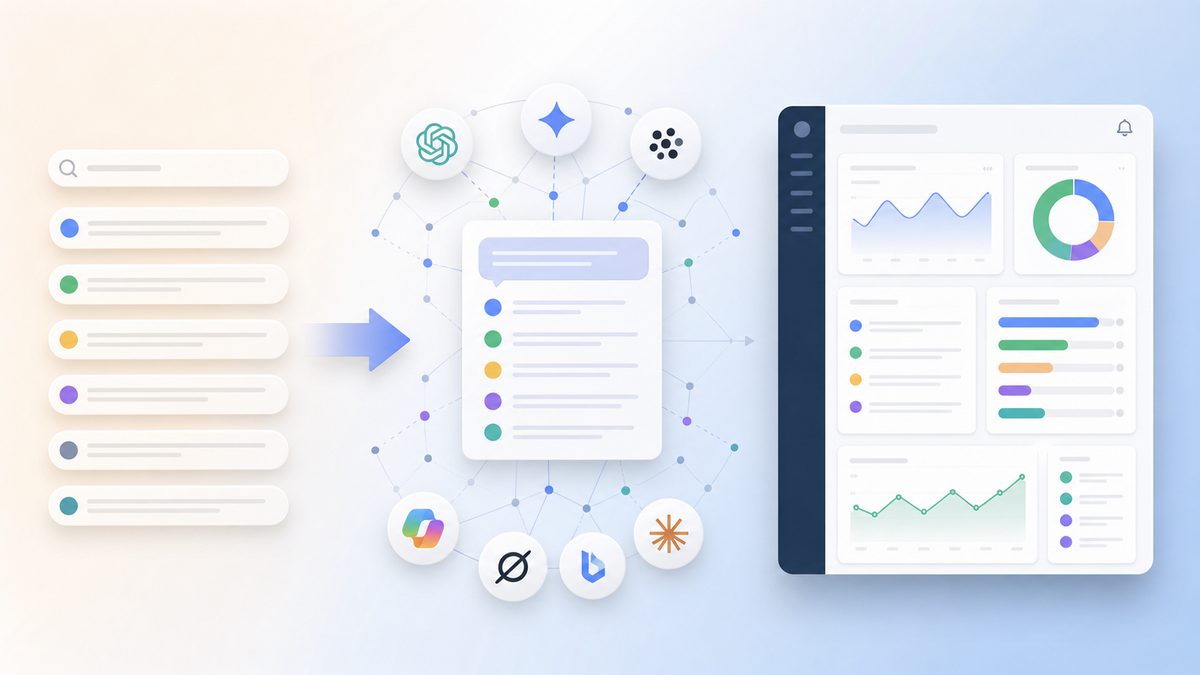
SEO keywords to AI prompts is the process of turning a keyword list into realistic buyer questions for AI answer engines. Instead of monitoring only “CRM software” or “best data warehouse,” you track prompts like “What are the best CRM platforms for a 200-person B2B SaaS team that needs Salesforce integration?”
That shift matters because AI search monitoring is not classic rank tracking with a new label. ChatGPT, Gemini, Perplexity, Claude, Copilot, Grok, Google AI Mode and AI Overviews respond to tasks, constraints, comparisons and follow-up intent. A keyword tells you the topic. A prompt tells you the buyer situation.
This guide shows how to convert head terms, comparisons, pain points, alternatives, branded searches and long-tail SEO queries into prompts you can monitor for brand mentions, recommendation rank, citations, description accuracy, competitor co-mentions and AI share of voice.

Quick Answer: How Do You Convert SEO Keywords to AI Prompts?
To convert SEO keywords to AI prompts, group keywords by intent, choose the right prompt archetype, rewrite each keyword as a neutral buyer question, add realistic context, define the expected answer format and track the same prompt repeatedly across AI engines.
Use this sequence:
- Export SEO keywords with ranking URL, funnel stage, persona and topic cluster.
- Merge close variants so one intent does not create duplicate prompts.
- Label each cluster as category, comparison, alternative, pain point, branded or long-tail.
- Pick a prompt archetype that matches the buyer decision.
- Add context such as role, company size, industry, integration, compliance need or budget range.
- Keep non-branded prompts neutral so the answer is not biased toward your brand.
- Track the prompt across engines and record mentions, rank, sentiment, citations and competitors.
- Refresh the prompt set on a schedule without rewriting core prompts so trends remain comparable.
What Does “SEO Keywords to AI Prompts” Mean?
SEO keywords to AI prompts means translating compressed search terms into complete questions or tasks that an AI answer engine can answer. The goal is to measure whether your brand appears in AI-generated recommendations, how it is described, which competitors appear beside it and which sources support the answer.
A traditional keyword is compressed: “enterprise password manager.”
A monitoring prompt expands the intent: “Which enterprise password managers are best for a 1,000-employee SaaS company that needs SSO, SCIM and SOC 2 controls?”
That expanded version is more useful for answer engine optimization and generative engine optimization because it forces the AI system to produce the kind of output buyers actually use: a shortlist, comparison, recommendation, implementation path or risk summary.
Why Keywords Alone Fail in AI Search Monitoring
Keywords fail as AI monitoring units because answer engines respond to tasks and context, not only exact-match phrases. A two-word keyword can map to multiple buyer situations, and each situation may trigger a different answer.
Google’s guide to optimizing for generative AI search explains that Google’s generative AI features can use retrieval-augmented generation and query fan-out, where related queries are generated to gather more information from the search index. That means one user question can behave like a bundle of searches.
For AI visibility tracking, the monitored unit should be the buyer’s question, not the SEO team’s shorthand. SEO keywords still matter, but they are source material. The prompt is the measurement unit.
What Most Keyword-to-Prompt Advice Misses
Most advice stops at prompt templates: “turn your keyword into a question.” That is not enough for monitoring.
A serious SEO keywords to AI prompts workflow needs four extra layers:
| Missing layer | Why it matters |
|---|---|
| Intent clustering | Prevents one keyword variant from creating five duplicate prompts |
| Neutral wording | Keeps non-branded visibility measurement clean |
| Prompt governance | Lets teams compare results over time instead of rewriting prompts every week |
| Fix mapping | Turns answer data into content, PR, entity and positioning actions |
Google’s people-first content guidance asks whether content provides original information, research or analysis. For this topic, the useful information is not another prompt list. It is a repeatable conversion system that connects SEO data to AI search monitoring decisions.
The Keyword-to-Prompt Translation Framework
A strong prompt has three parts: source intent, buyer context and answer format.
| Layer | Question to answer | Example |
|---|---|---|
| Source intent | What did the keyword reveal? | “customer success software” = category discovery |
| Buyer context | Who is asking and what constraint matters? | “B2B SaaS company with 80-person CS team and Salesforce” |
| Answer format | What should the engine return? | Shortlist, comparison, pros and cons, implementation steps or citation-backed answer |
The simplest formula is:
Prompt = buyer role + task + category/problem + constraint + expected answer type
Example:
“Which customer success platforms should a VP of Customer Success at a 300-person B2B SaaS company evaluate if the team needs Salesforce integration, churn risk scoring and renewal forecasting?”
That prompt is better than “customer success software” because it creates a measurable buyer scenario. You can now track whether your brand appears, how it ranks, which competitors appear and whether the answer understands the use case.
Step 1: Export Keywords With Intent Signals
Start with the keyword data you already trust. Do not begin with a blank prompt brainstorm.
Your export should include:
| Field | Why it matters |
|---|---|
| Keyword | Source language from search demand |
| Ranking URL or target URL | Connects the prompt to an existing page or content gap |
| Search intent | Prevents informational, commercial and navigational terms from being mixed |
| Funnel stage | Helps balance discovery, evaluation and reputation prompts |
| Topic cluster | Supports deduplication |
| Persona | Makes prompts sound like real buyer questions |
| Competitors | Helps build comparison and alternative prompts |
| Region or market | Prevents global prompts from hiding local visibility issues |
| Product line | Useful for multi-product companies |
Do not convert every keyword row. Convert keyword clusters. If your export contains “best customer success software,” “top customer success platforms” and “customer success tools,” those may become one or two category prompts, not three nearly identical prompts.
When your keyword data is thin, enrich it with sales calls, support tickets, demo notes, community threads and customer interview language. MaxAEO’s guide to prompt research for AEO covers how to find the questions buyers actually ask before they appear in keyword tools.
Step 2: Map Keyword Types to Prompt Archetypes
Each keyword type should become a different kind of monitoring prompt. If every keyword becomes “What is X?”, you will measure definitions instead of buying behavior.
| Keyword type | SEO keyword example | Strong AI monitoring prompt | What it reveals |
|---|---|---|---|
| Category | “customer success software” | “What are the leading customer success software platforms for B2B SaaS companies?” | Default shortlist inclusion |
| Comparison | “Gainsight vs ChurnZero” | “Compare Gainsight and ChurnZero for a 150-person SaaS company with a small CS ops team.” | Recommendation order and tradeoff framing |
| Alternative | “Gong alternatives” | “What are the strongest alternatives to Gong for a mid-market SaaS sales team?” | Competitor displacement opportunities |
| Pain point | “reduce churn risk” | “What tools help SaaS teams detect churn risk before renewal conversations?” | Problem-solution association |
| Long-tail | “customer success platform Salesforce integration” | “Which customer success platforms work best for a Salesforce-led revenue team?” | High-intent fit and integration visibility |
| Branded | “Acme reviews” | “What are the common pros and cons of Acme according to public sources?” | AI reputation and description accuracy |
A balanced prompt set keeps all six. Category prompts show whether AI systems know you exist. Comparison, alternative and pain-point prompts show whether you are recommended when buyers are closer to a shortlist.
Step 3: Rewrite Keywords as Buyer Questions
A good monitoring prompt sounds like a buyer, not a keyword fragment. It includes a role, decision, constraint or outcome.
Use these patterns:
- “What are the best [category] for [company type] that needs [constraint]?”
- “Which [category] should a [persona] evaluate for [use case]?”
- “Compare [tool A] and [tool B] for [buyer context].”
- “What tools help with [pain point] without [common drawback]?”
- “What are the strongest alternatives to [brand] for [specific use case]?”
- “If a team is moving from [old process], which [category] should it consider?”
- “What do public sources say are the pros and cons of [brand]?”
Preserve the commercial intent. “Marketing attribution software” should not become “What is marketing attribution?” unless you intentionally want top-of-funnel education. A better prompt is: “Which marketing attribution platforms should a B2B SaaS team evaluate if it needs multi-touch reporting across Salesforce, HubSpot and paid media?”
Step 4: Add Context Without Biasing the Answer
Context improves prompt quality. Leading language corrupts measurement.
| Prompt type | Example | Use it for |
|---|---|---|
| Neutral non-branded | “What are the best AI search visibility tools for a B2B SaaS marketing team tracking ChatGPT, Perplexity and Google AI Overviews?” | AI share of voice and recommendation tracking |
| Biased non-test prompt | “Why is MaxAEO the best AI visibility tool?” | Do not use for non-branded monitoring |
| Branded reputation | “What are the common strengths and weaknesses of MaxAEO according to public sources?” | Description accuracy and reputation risk |
| Competitive comparison | “Compare MaxAEO and Semrush AI Visibility Toolkit for a brand tracking AI search visibility across multiple engines.” | Decision-stage positioning |
Use branded prompts separately. They are valuable for brand mentions in ChatGPT, AI reputation management and description accuracy. They should not be mixed into the same share-of-voice score as neutral category prompts.
Step 5: Create Prompt Variants Deliberately
One keyword cluster usually needs two to four prompts, not ten. The best variants change the buyer situation, not just the wording.
For each priority cluster, create:
| Variant | Purpose | Example |
|---|---|---|
| Broad | Measures default category awareness | “What are the best AI visibility tools?” |
| Buyer-contextual | Measures fit for a real persona | “What are the best AI visibility tools for a B2B SaaS marketing team?” |
| Constraint-heavy | Measures specific fit | “Which AI visibility tools track ChatGPT, Perplexity, Gemini and Google AI Overviews with citation-level reporting?” |
| Comparison or alternative | Measures shortlist pressure | “What are the best alternatives to [competitor] for AI search monitoring?” |
Avoid micro-variants like “best,” “top” and “leading” unless they produce materially different answer behavior. Prompt volume should expand coverage, not noise.
Step 6: Balance the Prompt Set by Funnel Stage
A useful prompt set should cover discovery, evaluation, selection and reputation. If all prompts sit at the top of the funnel, your dashboard will look active but will not explain pipeline influence.
For a 100-prompt B2B SaaS monitoring set, use this mix as a starting point:
| Funnel stage | Prompt share | Example prompt type |
|---|---|---|
| Category discovery | 25% | “Best tools for…” |
| Use-case fit | 20% | “Which platforms help with…” |
| Comparison | 20% | “Compare X vs Y…” |
| Pain point | 15% | “How can we solve…” |
| Alternatives | 10% | “Alternatives to…” |
| Branded reputation | 10% | “What are the pros and cons of…” |
This mix helps executives see where the brand is absent, where competitors dominate and where cited sources shape the narrative. For sizing decisions, use MaxAEO’s guide on how many AI visibility audit prompts to track.
Step 7: Define Metrics Before Tracking
Every prompt should have a measurement purpose. Otherwise, AI search monitoring becomes a folder of screenshots.
Track these fields:
| Metric | What it measures | Why it matters |
|---|---|---|
| Mention rate | Whether your brand appears | Baseline AI visibility |
| Recommendation rank | Where your brand appears in a shortlist | Buyer shortlist strength |
| Description accuracy | Whether the answer explains your brand correctly | AI reputation management |
| Citation presence | Whether sources are cited | Evidence behind the answer |
| Citation domain | Which URLs support the answer | Content, PR and digital authority priorities |
| Competitor co-mentions | Which brands appear with yours | Market positioning |
| Sentiment or framing | Positive, neutral or negative language | Message risk and opportunity |
| Answer format | List, paragraph, table, pros and cons or steps | Helps compare outputs fairly |
| Prompt volatility | How much answers change over repeated runs | Identifies unstable topics |
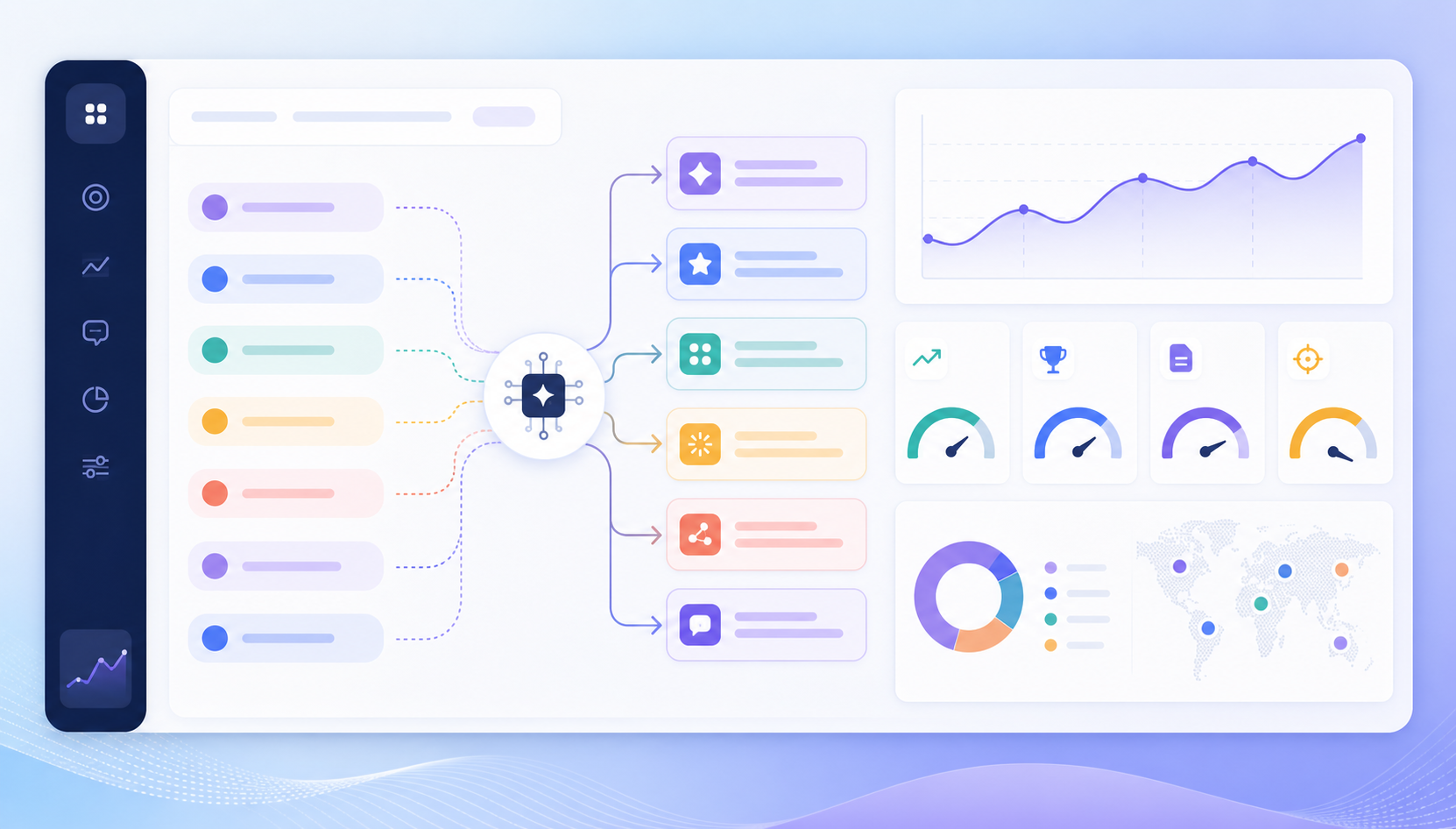
This turns SEO keywords to AI prompts from a writing task into an operating system for AEO reporting.
Original Field Test: 84 Keywords Became 252 Prompts
MaxAEO reviewed an anonymized sample from three B2B SaaS categories: security operations, revenue intelligence and customer success. The sample started with 84 SEO keywords grouped by category, comparison, alternative, pain-point and long-tail intent.
Each keyword cluster was converted into three variants: broad, buyer-contextual and constraint-heavy. The resulting 252 prompts were tested across six AI answer surfaces over seven daily runs, producing 1,764 answer observations. The goal was not to create a universal benchmark; it was to identify which prompt formats exposed the most actionable visibility gaps.
| Finding from the sample | Observed result | Practical takeaway |
|---|---|---|
| Buyer-contextual prompts surfaced more vendor shortlists than bare keyword prompts | 1.8x more shortlist-style answers | Add persona, company type and use case |
| Comparison prompts produced the clearest ranking differences | 73% returned an ordered or implied preference | Track X vs Y and alternatives separately |
| Pain-point prompts exposed missing category associations | 41% omitted at least one known vendor from the category | Use pain prompts to find positioning gaps |
| Branded prompts had the highest description-risk rate | 22% included outdated or incomplete descriptions | Monitor AI reputation separately |
| Citation-bearing answers showed recurring source gaps | 36% of cited sources were third-party lists, reviews or media pages | Improve owned pages and earn external proof |
The strongest insight was that prompt wording changed the competitive set. In several cases, a brand appeared for a broad category prompt but disappeared when the prompt added an integration, team size or compliance requirement. That is the information gain most keyword rank reports cannot provide.
How to Turn Head Terms Into Discovery Prompts
Head terms should become category discovery prompts. Their job is to answer: when an AI system names the category leaders, are we present?
| SEO head term | Weak prompt | Strong monitoring prompt |
|---|---|---|
| “AI visibility tool” | “What is an AI visibility tool?” | “What are the best AI visibility tools for a B2B SaaS marketing team tracking AI search results?” |
| “data catalog software” | “List data catalog software.” | “Which data catalog software should an enterprise data team evaluate for governance and discovery?” |
| “customer onboarding platform” | “Best onboarding platform?” | “What customer onboarding platforms are best for B2B SaaS companies with high-touch implementation?” |
Head-term prompts are usually non-branded. They are best for measuring category awareness, competitor lists and whether AI systems understand your market category.
How to Turn Comparison Keywords Into AI Prompts
Comparison keywords should become decision prompts, not generic “X vs Y” definitions. A buyer rarely asks for a comparison in the abstract. They want to know which option fits their situation.
Example:
“HubSpot vs Marketo” becomes “Compare HubSpot and Marketo for a B2B SaaS company with a lean marketing ops team, complex lead scoring needs and Salesforce as the CRM.”
Track comparison prompts when keywords include:
- “vs”
- “alternative”
- “competitor”
- “reviews”
- “pricing”
- “best”
- “top”
- “compare”
Comparison prompts are valuable because answer engines often make direct recommendations. They may say one tool is better for startups, another for enterprises and another for technical teams. That framing can influence shortlists before the buyer visits your site. MaxAEO’s guide to how AI answers X vs Y queries in ChatGPT and Perplexity goes deeper on this pattern.
How to Turn Pain-Point Keywords Into Diagnostic Prompts
Pain-point keywords should become problem-solving prompts. These prompts reveal whether AI systems associate your brand with the problem your buyer is trying to fix.
| Pain-point keyword | Monitoring prompt |
|---|---|
| “reduce cloud costs” | “What tools help engineering teams find and reduce wasted cloud spend?” |
| “improve sales forecast accuracy” | “Which revenue intelligence platforms help sales leaders improve forecast accuracy?” |
| “monitor AI brand mentions” | “How can a marketing team monitor brand mentions in ChatGPT and other AI answer engines?” |
| “reduce manual security reviews” | “What platforms help security teams automate vendor security reviews without losing audit evidence?” |
Pain prompts often surface different competitors than category prompts. If your brand appears for “AI search monitoring” but not for “how to know whether ChatGPT recommends my company,” you have a positioning gap, not just an SEO gap.
How to Turn Long-Tail Keywords Into Implementation Prompts
Long-tail keywords should become implementation prompts with constraints. They often match how operators ask AI tools for help.
A long-tail keyword like “SOC 2 vendor risk management software for startups” can become:
“Which vendor risk management platforms are practical for a 50-person startup preparing for SOC 2 for the first time?”
These prompts usually have lower volume in classic SEO tools, but high diagnostic value in AI search monitoring. They reveal whether AI systems understand your integrations, compliance needs, team size, deployment model and budget fit.
This is where SEO keywords to AI prompts produces better sales intelligence than keyword rank tracking alone.
How to Turn Branded Keywords Into Reputation Prompts
Branded keywords should not be treated as normal visibility prompts. They measure accuracy, risk and narrative control.
| Branded keyword | Reputation prompt |
|---|---|
| “[Brand] reviews” | “What are the common strengths and weaknesses of [Brand] according to public sources?” |
| “[Brand] pricing” | “What does public information say about [Brand] pricing and packaging?” |
| “[Brand] competitors” | “Which companies are usually compared with [Brand], and why?” |
| “[Brand] security” | “What public information is available about [Brand] security, compliance and data handling?” |
Branded prompts help you find outdated descriptions, missing product lines, incorrect pricing assumptions, weak entity information and third-party pages shaping the answer.
For a broader setup, use MaxAEO’s guide to building an AI search prompt set for brand monitoring.
Worked Example: A 12-Prompt Cluster
Here is a compact example for a fictional B2B SaaS category: AI meeting intelligence software. The source keyword cluster contains a head term, comparison terms, pain points and long-tail queries.
| Source keyword | Prompt type | AI monitoring prompt |
|---|---|---|
| AI meeting intelligence software | Category | “What are the best AI meeting intelligence platforms for B2B sales teams?” |
| call recording software | Use case | “Which tools help sales teams record, summarize and search customer calls?” |
| sales coaching software | Pain point | “What platforms help frontline sales managers coach reps using real call data?” |
| Gong alternatives | Alternative | “What are the strongest alternatives to Gong for a mid-market SaaS company?” |
| Gong vs Chorus | Comparison | “Compare Gong and Chorus for a 100-rep sales organization using Salesforce.” |
| meeting notes AI | Use case | “Which AI tools create reliable meeting notes and follow-up actions for revenue teams?” |
| forecast accuracy software | Pain point | “What tools help sales leaders improve forecast accuracy from conversation data?” |
| sales call transcription | Long-tail | “Which sales call transcription tools support searchable transcripts and CRM sync?” |
| best revenue intelligence tools | Category | “Which revenue intelligence tools should a Series B SaaS company evaluate?” |
| conversation intelligence reviews | Reputation | “What do public sources say are the common pros and cons of leading conversation intelligence tools?” |
| sales enablement AI | Adjacent category | “What AI tools help sales enablement teams identify coaching themes from calls?” |
| brand name reviews | Branded | “What are the common strengths and weaknesses of [Brand] for sales teams?” |
This is the practical shape of SEO keywords to AI prompts: one keyword cluster becomes a monitored view of category awareness, problem ownership, competitive positioning and reputation risk.
How to QA a Prompt Before Tracking It
A monitoring prompt is good when it is answerable, neutral, durable and mapped to a business decision. It is weak when it is vague, leading, overloaded or likely to age out within a week.
Use this QA checklist:
| QA question | Pass standard |
|---|---|
| Is the prompt written like a real buyer would ask it? | It uses natural language, not keyword fragments |
| Does it contain one clear intent? | It asks for one answer type |
| Is it neutral? | It does not force your brand into the answer unless it is a branded prompt |
| Is it durable? | It can be tracked for weeks without becoming stale |
| Is the expected output clear? | Shortlist, comparison, explanation, steps or citation set |
| Is it tagged? | Funnel stage, persona, keyword source and topic cluster are stored |
| Is it measurable? | It can produce mention, rank, citation or sentiment data |
| Is it distinct? | It is not a near-duplicate of another prompt |
A simple scoring model works well: give each prompt one point for buyer realism, neutrality, durability, measurable output and business relevance. Prompts scoring below 4 out of 5 should be rewritten or retired.
How Often Should You Refresh AI Prompts?
Track priority prompts daily, but do not rewrite core prompt wording too often. If the wording changes every week, trend data becomes unreliable.
Use this cadence:
| Activity | Recommended cadence |
|---|---|
| Track core prompts | Daily |
| Review AI share of voice | Weekly |
| Audit description accuracy | Weekly |
| Add prompts from sales calls and SERPs | Monthly |
| Retire stale prompts | Quarterly |
| Rebuild prompt taxonomy | Twice per year |
Do not chase every new phrase. The purpose of LLM brand tracking is to detect meaningful visibility movement, not to create endless dashboards. Add prompts when the market changes because of a launch, category shift, acquisition, competitor campaign, regulatory change or repeated sales objection.
What to Do After You Track the Prompts
Prompt monitoring is useful only when it creates a fix backlog. The prompt tells you where you appear. The answer explains how you are framed. The citations show which sources influence the narrative.
| Finding | Likely cause | Fix |
|---|---|---|
| Brand absent from category prompts | Weak category association | Improve category pages, comparison pages and third-party mentions |
| Brand appears but ranks low | Competitors have stronger proof or clearer positioning | Add use-case proof, customer evidence and direct comparison content |
| Brand described incorrectly | Outdated public sources or unclear entity information | Update owned pages, profiles, schema and third-party listings |
| Competitor cited from review lists | External proof gap | Earn credible mentions in relevant review, media and partner sources |
| Pain-point prompts omit the brand | Messaging does not connect product to problem | Create problem-solution content with specific workflows |
| Long-tail prompts miss the brand | Integration or compliance content is too thin | Publish pages that answer specific fit questions |
Google’s generative AI search guidance says SEO fundamentals still matter because generative AI features on Google Search are rooted in core Search ranking and quality systems. In practice, that means AI visibility work should not replace SEO. It should make your SEO, PR, product marketing and content priorities sharper.
For a deeper primer on converting buyer questions into prompt sets, see MaxAEO’s guide to AI search prompts.
Common Mistakes to Avoid
The most common mistake is tracking keyword-shaped prompts. “Best CRM software” is better than nothing, but it is still thin. A buyer-contextual prompt will produce richer visibility data.
Avoid these mistakes:
- Mixing branded and non-branded prompts in one share-of-voice score.
- Changing prompt wording every week and destroying trend continuity.
- Tracking only one engine while buyers use multiple AI answer surfaces.
- Measuring mentions without checking rank, sentiment, citations or competitors.
- Treating AI citations as only an owned-content problem when third-party sources often shape answers.
- Creating ten prompts from one keyword without changing the buyer context.
- Using leading prompts that force your brand into the answer.
- Reporting screenshots without business interpretation.
- Ignoring prompts where your brand appears but is described incorrectly.
The better approach is stable: governed prompt sets, clear tags, repeated tracking and a fix backlog tied to observed gaps.
Frequently Asked Questions
Should every SEO keyword become an AI prompt?
No. Every important keyword cluster should become prompts, but not every keyword variant deserves tracking. Merge close variants, preserve distinct intent and prioritize prompts tied to buying decisions, competitive comparisons, use-case fit and reputation risk.
How many prompts should a B2B SaaS company start with?
Most B2B SaaS teams should start with 50 to 150 prompts. Use fewer if the category is narrow and more if you sell multiple products, regions or personas. Quality matters more than raw prompt count because each prompt should map to a decision.
Should prompts include our brand name?
Use your brand name only in branded, comparison or reputation prompts. For non-branded visibility, leave your brand out so you can measure whether AI systems recommend you without being asked directly.
What is the difference between keyword rank and AI share of voice?
Keyword rank measures where a page appears in search results. AI share of voice measures how often a brand appears in AI-generated answers across monitored prompts, engines and competitors. It should include mention rate, recommendation position and answer framing.
Can this workflow help us get recommended by ChatGPT?
Yes, indirectly. The workflow shows which prompts mention your brand, which competitors win, what sources are cited and where descriptions are wrong. The fixes usually involve clearer content, stronger proof, better comparison coverage, consistent entity information and credible third-party mentions.
How many prompt variants should one keyword cluster produce?
Use two to four variants for important clusters: broad, buyer-contextual, constraint-heavy and comparison or alternative. More variants are useful only when they represent different buyer situations, not minor wording changes.
How often should AI monitoring prompts be refreshed?
Track core prompts daily, review results weekly and refresh the prompt set monthly or quarterly. Keep stable wording for priority prompts so you can compare trends over time.
What makes a prompt bad for AI search monitoring?
A bad prompt is vague, leading, overloaded, too temporary or disconnected from a business decision. “Tell me about CRM” is too broad. “Why is our CRM the best?” is biased. “Which CRM platforms fit a 200-person SaaS company using Salesforce and needing renewal forecasting?” is trackable.
Final Takeaway
SEO keywords still matter, but they are raw material. AI answer engines respond to buyer questions, constraints, comparisons and tasks. The practical move is to convert keyword clusters into stable, neutral, context-rich prompts and track how your brand appears across engines over time.
SEO keywords to AI prompts is not a one-time content task. It is the translation layer between SEO strategy, answer engine optimization and measurable AI visibility.