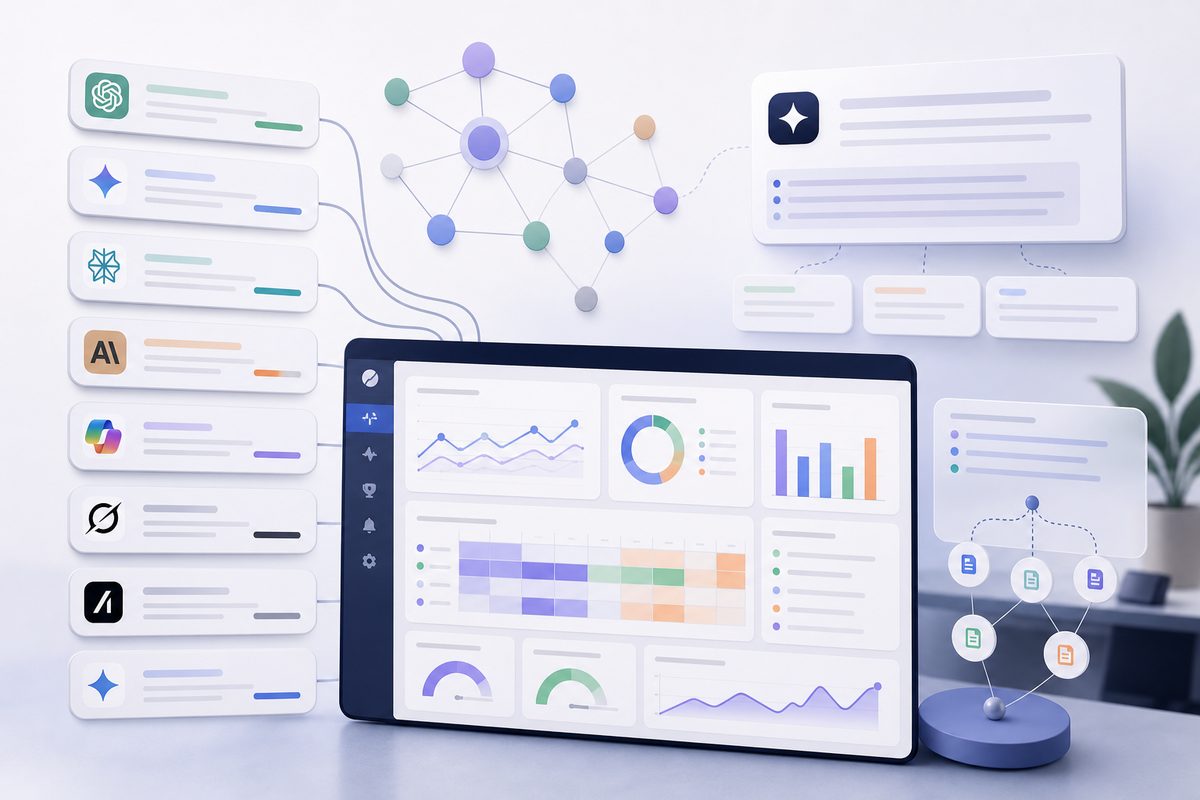
AI search competitors are the entities that appear when buyers ask AI systems for recommendations, comparisons, shortlists, and implementation advice. They are not limited to the vendors in your CRM. They can include direct rivals, substitute workflows, review sites, consultants, open-source projects, marketplaces, and publishers that AI answers cite as evidence.
The practical goal is to stop guessing. Build your competitor set from real buyer prompts, measure who gets recommended, inspect which sources support those answers, and prioritize the gaps that change buyer perception before a demo request ever happens.

What Are AI Search Competitors?
AI search competitors are entities an AI answer engine recommends, cites, or uses as evidence when a buyer asks purchase, comparison, or implementation questions in your category. They can be direct vendors, substitutes, publishers, marketplaces, consultants, communities, or open-source projects, even if they never appear in your sales pipeline.
A useful competitor set includes four types of entities:
| Entity type | Example | Why it matters in AI answers |
|---|---|---|
| Direct vendors | Products with the same ICP and use case | They take shortlist positions and comparison mentions. |
| Workflow substitutes | Agencies, spreadsheets, open-source tools, platforms in adjacent categories | They solve the same job with different language. |
| Authority sources | Review sites, analyst pages, industry media, partner directories | They provide citations that support recommendations. |
| Category educators | Blogs, communities, frameworks, standards pages | They shape the terms AI systems repeat back to buyers. |
This is why AI search competitors should be measured at the prompt level. A brand can dominate “enterprise AI visibility platform” prompts and be absent from “affordable ChatGPT brand monitoring tool” prompts.
Two Search Intents Behind “AI Search Competitors”
People use the phrase in two different ways. A page that only answers one meaning leaves search intent partially unmet.
| If the searcher means… | Short answer |
|---|---|
| “Which products compete in AI search?” | The main AI search surfaces include Google AI Overviews and AI Mode, ChatGPT, Perplexity, Gemini, Copilot, Claude, Grok, Brave Search, and You.com. |
| “Who are my competitors inside AI answers?” | Your competitors are the entities AI systems recommend, cite, compare, or use to define your category when buyers ask real purchase questions. |
For marketers, founders, and agencies, the second meaning is usually the higher-value problem. The real question is not “Which AI search engine is winning?” It is “When my buyer asks an AI system what to buy, who gets recommended instead of us?”
Why Traditional Competitor Lists Fail in AI Search
Sales competitor lists usually reflect late-stage deals. AI assistants influence buyers earlier, while they are still naming the problem, comparing categories, and deciding which options belong on the shortlist.
A sales team may know three vendors that appear in procurement. An AI answer may recommend those vendors plus an integration platform, an open-source project, a marketplace app, and a consulting firm. Those extra entities can shape the buyer’s frame before sales is involved.
This risk is already showing up in marketer data. A Semrush study reported by Business Insider surveyed 481 US marketers in April 2026 and found that 37% said competitors appeared more often than their brand in AI results, 30% reported inaccurate brand descriptions, and 29% said their positioning was unclear or generic.
For B2B teams, that means AI search monitoring is not only about brand mentions in ChatGPT. It is about measuring recommendation overlap, citation support, and category narrative across the prompts that buyers actually ask.
Which AI Search Platforms Should You Check?
Do not treat every AI platform as equally important. Track the surfaces your buyers use for research, procurement, technical evaluation, or category education.
| AI surface | Include it when… | What to record |
|---|---|---|
| Google AI Overviews and AI Mode | Organic search is a major discovery channel in your category | Cited domains, answer wording, source overlap with organic results |
| ChatGPT | Buyers ask shortlist, comparison, and “best tool for” questions | Brand mentions, recommendation rank, citations when available |
| Perplexity | Your buyers value citation-heavy research answers | Cited pages, publisher influence, source freshness |
| Gemini | Your audience works heavily in Google’s ecosystem | Recommendation wording, links, category descriptions |
| Copilot | You sell to Microsoft-heavy teams or enterprise buyers | Bing-linked sources, work-oriented phrasing |
| Claude | Your buyers use AI for long-form research and evaluation | Narrative framing, comparison depth, missing citations |
| Grok | Your category is shaped by news, social discussion, or X visibility | Social and news references, recency-sensitive mentions |
Google’s own guidance says generative AI features on Search rely on core Search systems, retrieval-augmented generation, and query fan-out, so classic SEO foundations still matter, but the prompt and answer format change what gets surfaced. See Google’s guide to optimizing for generative AI features on Search.
The Buyer-Prompt Competitor Set Method
The buyer-prompt method identifies AI search competitors by running real purchase questions across AI surfaces, recording every entity mentioned, and scoring each entity by recommendation overlap, rank, citation support, and answer context.
Use this five-step process:
- Build a prompt set from real buying situations.
- Run prompts across multiple AI engines and repeat them.
- Normalize every mentioned entity into a clean table.
- Score each entity with a recommendation matrix.
- Classify competitors by threat type and required action.
The method works because AI answers are variable. A 2026 empirical study of Google Search, Gemini, and AI Overviews analyzed 11,500 queries and found that AI Overview sources differed substantially from both traditional Google results and Gemini results, with low average source overlap and sensitivity to repeated runs and small query edits. The study is available on arXiv as How Generative AI Disrupts Search.
Step 1: Turn Buying Situations Into Prompts
A strong competitor set starts with prompts that sound like a buyer, not a keyword spreadsheet. The prompt should include the job, constraint, company type, category, and decision stage closely enough that the AI must make a recommendation.
Use five prompt families:
| Prompt family | Example buyer prompt |
|---|---|
| Category shortlist | “Best tools for monitoring AI search visibility for a B2B SaaS company” |
| Use-case prompt | “How should a Series B SaaS company track brand mentions in ChatGPT?” |
| Constraint prompt | “Affordable AI visibility tool for a small marketing team” |
| Switch prompt | “Alternatives to our SEO rank tracker for answer engine optimization” |
| Comparison prompt | “Which platforms help agencies report AI share of voice for clients?” |
Good prompt sources include sales call transcripts, closed-lost notes, demo form questions, Search Console queries, support tickets, community threads, review-site language, and product comparison pages.
The mistake is asking only branded prompts. “What is Acme?” tests brand recall. “Best tools for enterprise log monitoring” tests market inclusion. For a deeper workflow, use high-intent AI search prompts for product recommendations and separate your branded vs non-branded AI prompts.
Step 2: Run Prompts Across Engines More Than Once
A single AI answer is an example, not a measurement. Results vary by model, retrieval system, location, timing, prompt wording, and whether the surface uses live web citations.
A practical baseline setup:
| Variable | Starter setup |
|---|---|
| Prompt count | 30 to 50 prompts |
| AI surfaces | ChatGPT, Gemini, Perplexity, Claude, Copilot, Google AI Overviews or AI Mode |
| Repeats | 2 to 3 runs per prompt |
| Baseline frequency | Weekly for core prompts |
| High-risk frequency | Daily during launches, PR spikes, or category shifts |
| Fields captured | Entity, rank, citation URL, answer wording, sentiment, prompt, engine, date |
The number of runs is simple:
total runs = prompts × AI surfaces × repeats
A 40-prompt set across 5 surfaces with 3 repeats creates 600 answer observations. That is enough to separate recurring competitors from one-off mentions in many B2B categories.
Before changing content, build an AI search visibility baseline. Baselines protect you from mistaking normal answer volatility for real competitive movement.
Step 3: Normalize Brand Entities Before Scoring
Entity cleanup prevents false competitor data. AI answers often mix parent companies, product names, old names, abbreviations, marketplace listings, open-source projects, and unrelated companies with similar names.
Create one normalized entity table:
| Field | Example |
|---|---|
| Canonical entity | HubSpot |
| Product aliases | Marketing Hub, Sales Hub |
| Parent or owner | HubSpot, Inc. |
| Category label used by AI | CRM platform, marketing automation platform |
| Entity type | Vendor, marketplace, publisher, community, agency |
| Website or citation domain | hubspot.com, g2.com, analyst domain |
| Description notes | Wrong category, outdated feature, hallucinated claim |
Do not score “Brand,” “Brand AI,” and “Brand Platform” as three rivals if buyers experience them as one company. Also flag description quality. If AI says your competitor is “best for enterprise governance” and describes your brand as “a content tool,” the issue is not only visibility. It is category clarity.
Step 4: Score Competitors With a Recommendation Matrix
A recommendation matrix turns scattered AI answers into a prioritized competitor set. It should combine visibility, shortlist power, citation strength, and buyer relevance.
Use these metrics:
| Metric | Formula | Why it matters |
|---|---|---|
| Mention coverage | Prompts where entity appears / total prompts | Measures visibility breadth |
| Top-3 rate | Runs where entity appears in the first three recommendations / total runs | Measures shortlist power |
| Average recommendation rank | Sum of visible ranks / ranked appearances | Shows whether the entity leads or trails |
| Citation support | Entity mentions with a supporting source / entity mentions | Separates sourced claims from unsupported mentions |
| Segment strength | Coverage inside a prompt cluster | Reveals use-case dominance |
| Description accuracy | Correct statements checked / total statements checked | Protects positioning and trust |
| AI share of voice | Entity mentions / all tracked entity mentions | Gives leadership a single competitive metric |
A simple inclusion rule: treat an entity as an AI search competitor if it appears in at least 10% of non-branded prompt runs, appears across two or more AI surfaces, or ranks in the top three for any high-intent buying prompt.
For citation-heavy systems, review source quality too. A 2026 controlled study, What Gets Cited: Competitive GEO in AI Answer Engines, ran 252,000 trials and found that topical relevance and list position were major drivers of citation selection, with price information and recent timestamps also helping in the tested setup.
A Practical Scoring Framework: POCI
Use a Prompt-Overlap Competitor Index, or POCI, to turn observations into a 100-point score. The goal is not mathematical perfection. The goal is to make competitor prioritization repeatable.
| Component | Points | How to score |
|---|---|---|
| Mention coverage | 30 | Higher score for appearing across more prompts |
| Top-3 recommendation rate | 25 | Higher score for appearing in shortlist positions |
| Rank strength | 15 | 15 for average rank 1, 12 for rank 2, 9 for rank 3, 5 for lower visible ranks |
| Citation support | 15 | Higher score for strong, relevant, non-owned citations |
| Segment concentration | 10 | Higher score for dominance in high-intent clusters |
| Message strength | 5 | Higher score when AI describes the entity specifically and favorably |
Suggested interpretation:
| POCI score | Meaning | Action |
|---|---|---|
| 60 to 100 | Strategic AI search competitor | Prioritize content, citation, and positioning response |
| 35 to 59 | Watchlist competitor | Monitor trend and fix cluster-level gaps |
| 10 to 34 | Incidental competitor | Track only if it appears in high-intent prompts |
| Below 10 | Noise | Archive unless it grows across surfaces |
This framework is more useful than a raw mention count because it distinguishes a frequently named publisher from a top-ranked vendor and a niche substitute from a broad category rival.
Step 5: Classify Competitors Into Four Buckets
Not every competitor requires the same response. Classification shows whether the problem is positioning, product proof, third-party authority, category education, or citation coverage.
| Bucket | Signal | Recommended response |
|---|---|---|
| Direct AI rivals | High mention coverage, same ICP, same category | Build comparison content, sales enablement, proof pages, and review coverage |
| Hidden substitutes | High inclusion in use-case prompts, different category | Publish jobs-to-be-done content, switch guides, and “platform vs point solution” pages |
| Authority competitors | Publishers or review sites that shape citations | Earn mentions, refresh profiles, provide quotable evidence, and correct outdated listings |
| Narrative competitors | Entities AI uses to define the market | Publish original research, definitions, frameworks, and category POV content |
This classification matters because AI search competitors include influence sources, not just vendors. If Perplexity cites a buyer guide that omits your brand, the publisher is part of the competitive surface even if it does not sell software.
Worked Example: Buyer Prompts Reveal Hidden Rivals
The table below shows a sample 72-run audit format for a B2B SaaS category: 12 buyer prompts, 3 AI surfaces, and 2 repeated runs. Replace the numbers with your own data, but keep the structure.
| Entity role | On sales competitor list? | Mention coverage | Top-3 rate | Citation support | POCI | Action |
|---|---|---|---|---|---|---|
| Known enterprise vendor | Yes | 58% | 28% | Strong | 72 | Defend with comparison and proof pages |
| Integration platform | No | 42% | 19% | Strong | 61 | Create “platform vs point solution” content |
| Analyst/review site | No | 39% | 0% | Very strong | 48 | Improve profile and earn category mentions |
| Open-source project | No | 25% | 11% | Strong | 41 | Explain when paid software is needed |
| Your brand | Yes | 22% | 6% | Mostly owned sources | 33 | Build third-party evidence and clearer positioning |
The key finding is not simply who ranks first. Two major AI search competitors were missing from the sales list: one substitute category and one authority source controlling citations.
That is the advantage of prompt-based competitor discovery. It reveals entities shaping buyer perception before the buyer reaches a website, review page, or demo form.
What To Do When a Competitor Keeps Getting Recommended
When AI recommends a competitor instead of you, diagnose the reason before publishing more content. The cause is usually one of five gaps: relevance, proof, citations, category clarity, or freshness.
| Diagnosis | What the answer shows | Fix |
|---|---|---|
| Relevance gap | Your brand is not mentioned for the use case | Create specific use-case pages with examples, constraints, and implementation details |
| Proof gap | Competitor gets “best for” claims while you get generic mentions | Add customer segments, integrations, outcomes, screenshots, and decision criteria |
| Citation gap | Competitor has third-party sources while you have only owned pages | Earn review, partner, analyst, community, and media citations |
| Category gap | AI puts you in the wrong market | Tighten homepage, About page, schema, comparison language, and product taxonomy |
| Freshness gap | AI cites old positioning or retired features | Update core pages and correct stale third-party profiles |
Google’s people-first content guidance emphasizes original information, substantial value, clear sourcing, and content that is useful beyond what is already available. The same standard applies when you are trying to influence AI answers. See Google’s documentation on helpful, reliable, people-first content.
For a focused response plan, use the guide on what to do when AI recommends your competitor instead of you.
How Agencies Should Report AI Search Competitors
Agencies should report AI search competitors by prompt cluster, not only by total mentions. A useful client report explains where each competitor wins, what evidence supports the answer, and which action should change the next measurement period.
A strong report includes:
| Report section | What to show |
|---|---|
| Prompt coverage | Which buyer questions were tested |
| Engine coverage | Which AI surfaces were included |
| Competitor movement | New, rising, falling, and stable entities |
| AI share of voice | Mention share across all tracked answers |
| Recommendation rank | Average rank and top-3 rate by prompt cluster |
| Citation sources | Domains that support each recommendation |
| Message quality | How accurately AI describes the client |
| Action queue | Content, citation, technical, and PR tasks |
This format is easier to defend than a screenshot deck. Screenshots show examples. A competitor matrix shows patterns.
How Often Should You Refresh the Competitor Set?
Refresh the competitor set whenever buyer behavior, product positioning, or AI answer patterns change. For most B2B SaaS teams, monthly competitor discovery plus weekly tracking of core prompts is enough to maintain a reliable view.
| Scenario | Recommended cadence |
|---|---|
| New category entry | Weekly discovery for 8 weeks |
| Mature category | Monthly discovery, weekly core tracking |
| Product launch | Daily tracking for launch prompts for 2 weeks |
| Funding, merger, or major PR event | Daily brand and category prompt tracking |
| Agency client reporting | Monthly summary with weekly anomaly alerts |
Do not rebuild the list from scratch every week. Keep a stable competitor table and mark entities as new, active, declining, or archived. If you are unsure about sample size, start with the guide on how many AI search prompts to track.
Common Mistakes When Building an AI Search Competitor Set
The most common mistake is tracking the brands leadership already knows and calling it AI search monitoring. That misses substitutes, citation sources, and emerging shortlists.
Avoid these errors:
- Using only branded prompts. Branded prompts measure recognition, not market inclusion.
- Running one answer per prompt. One run can mislead because AI answers vary.
- Ignoring rank. A brand mentioned tenth is not equivalent to a brand recommended first.
- Treating publishers as irrelevant. Citation sources can shape the final recommendation.
- Mixing all prompts together. Competitor strength is usually segment-specific.
- Reporting only sentiment. Positive mentions have limited value if the brand is rarely recommended.
- Skipping source checks. AI citations can be outdated, weak, or misaligned with the claim.
- Overreacting to one engine. A competitor that appears only once on one surface may be noise.
- Ignoring substitutes. Buyers may accept a workflow alternative even when it is not a direct product rival.
The best competitor set is operationally boring: consistent prompts, clean entities, repeatable scoring, source review, and a visible action queue.
Frequently Asked Questions
Are AI Search Competitors the Same as SEO Competitors?
No. SEO competitors are pages or domains competing in traditional search results. AI search competitors are entities competing for recommendation, citation, and description inside AI-generated answers.
There is overlap, but it is incomplete. A company can rank poorly in classic SEO and still appear in AI recommendations because it has strong third-party mentions. Another company can rank well in Google and be absent from AI shortlists because its content does not answer buyer prompts directly.
Who Are the Main AI Search Engine Competitors?
The main AI search and answer surfaces to watch are Google AI Overviews and AI Mode, ChatGPT, Perplexity, Gemini, Copilot, Claude, Grok, Brave Search, and You.com.
For brand visibility work, these platforms are measurement surfaces, not necessarily your business competitors. The competitors that matter are the entities those systems recommend when buyers ask questions in your category.
How Many Prompts Are Needed to Find Real Competitors?
Use 30 to 50 prompts for a reliable baseline in most B2B SaaS categories. Smaller tests can reveal obvious rivals, but they often miss segment-specific competitors.
Include category, use-case, constraint, comparison, and switching questions. If the same entity appears across multiple prompt families and engines, it belongs in the competitor set.
Which AI Engines Should B2B SaaS Teams Track?
Track the engines your buyers are likely to use: ChatGPT, Gemini, Perplexity, Claude, Copilot, Grok, Google AI Mode, and AI Overviews are common starting points.
Do not assume one platform represents the whole market. Each engine retrieves, cites, and summarizes differently. That is why AI search competitors should be measured across surfaces, not from a single answer.
What Is the Fastest Way to Improve Against an AI Competitor?
Find the prompt cluster where the competitor wins, inspect the cited sources, and identify the missing proof. Then publish or earn the evidence the answer needs: comparison pages, customer examples, integration documentation, analyst profiles, review coverage, or original data.
The goal is not to get recommended once. The goal is to become the most consistently relevant, cited, and accurately described option for the buyer prompts that create pipeline.
Should Competitor Tracking Include Brand Mentions in ChatGPT?
Yes, but brand mentions in ChatGPT should be one field in a broader measurement system. Track mention presence, recommendation rank, answer wording, citations, and prompt intent together.
A mention without a recommendation may have low commercial value. A top-three recommendation with strong citations is a stronger buying signal and should be prioritized.