
I’ll verify the cited external sources before rewriting so the finished article keeps only defensible links and claims. Then I’ll tighten the structure around informational intent and replace the draft’s placeholder internal links with the approved maxaeo URLs.—
title: "AI Product Recommendation Prompts: Examples, Templates, and Tracking Framework | maxaeo"
description: "Learn what AI product recommendation prompts are, see B2B examples, and build a tracking set for shortlist, alternative, comparison, and proof queries."
slug: "ai-product-recommendation-prompts"
keywords: ["AI product recommendation prompts", "AI product recommendation prompt templates", "AI search monitoring", "answer engine optimization", "generative engine optimization", "AI share of voice", "LLM brand tracking", "AI citations", "get recommended by ChatGPT"]
intent: "informational"
author: "maxaeo"
schema: "Article"
datePublished: "2026-06-17"
dateModified: "2026-06-17"
AI Product Recommendation Prompts: Examples, Templates, and Tracking Framework
AI product recommendation prompts are the questions buyers ask ChatGPT, Gemini, Perplexity, Claude, Copilot, Grok, Google AI Mode, and AI Overviews when they want a shortlist, comparison, alternative, or product-fit recommendation.
For B2B marketers, these prompts are early buying moments. The AI may name your brand, rank a competitor above you, cite weak sources, describe your product incorrectly, or leave you out completely.
The hard part is that buyers rarely ask one clean keyword-style query. They ask specific prompts such as "best SOC 2-ready customer support tools for a 40-person SaaS team," "alternatives to Intercom with better onboarding analytics," or "which AI search visibility platform should a B2B agency use for multiple clients?"
That wording matters. It changes the shortlist, the order of recommendations, the cited sources, and the reasons the model gives for each brand. If you only track head terms, you miss the prompts closest to a buying decision.
What Are AI Product Recommendation Prompts?
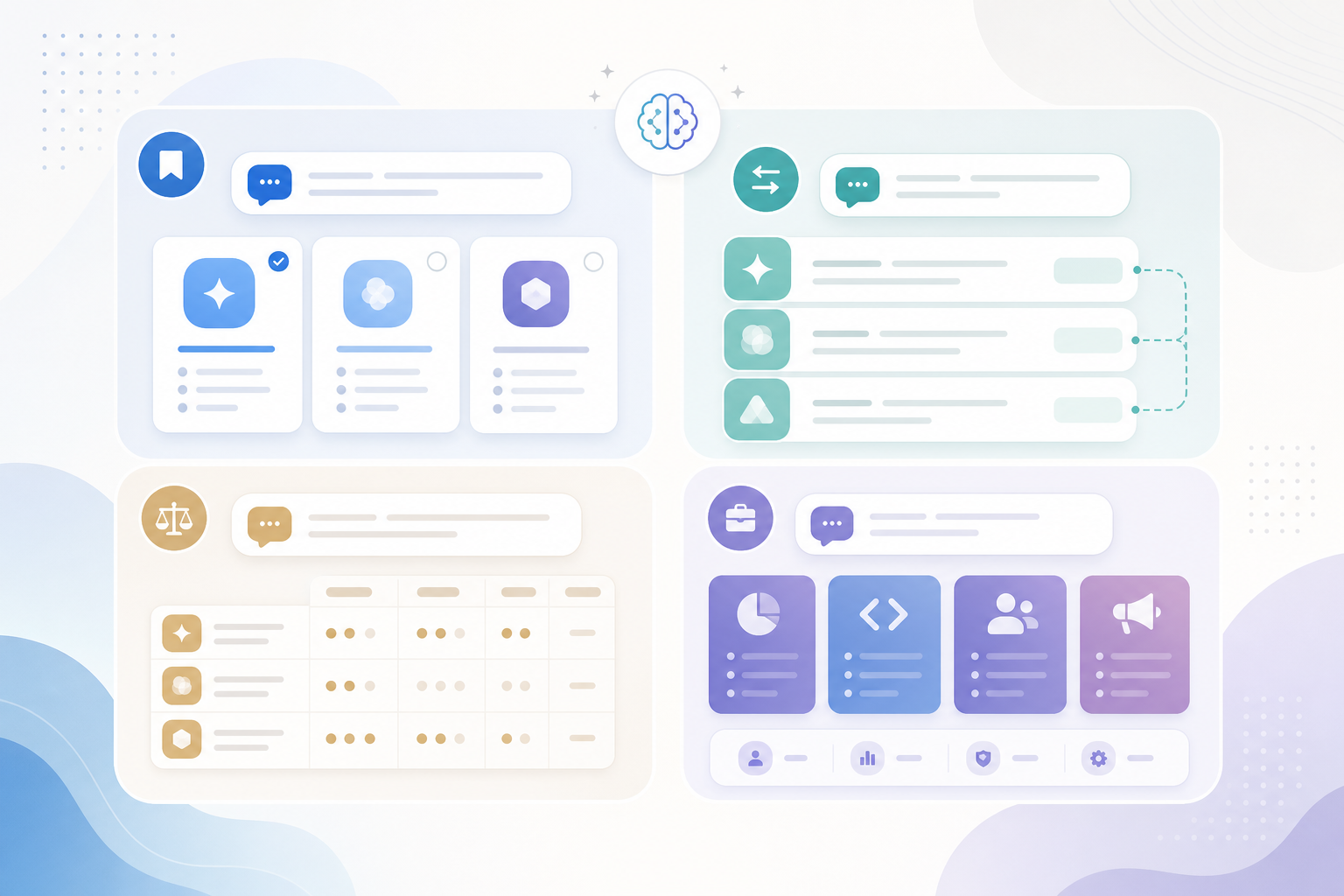
AI product recommendation prompts are conversational queries that ask an AI system to choose, rank, compare, or justify products for a buying scenario. They usually combine a category, task, buyer context, constraints, and proof request, so the answer becomes a shortlist or recommendation instead of a list of pages.
A normal SEO keyword might be "best CRM software." A recommendation prompt is more specific:
Recommend a CRM for a 25-person B2B SaaS team moving from spreadsheets, with HubSpot integration and simple pipeline reporting.
The second query gives the AI a job to do. It must interpret the buyer's context, decide which products fit, explain tradeoffs, and often cite supporting sources.
A prompt has recommendation intent when it asks the AI to do one of five things:
- Shortlist products or vendors.
- Compare products, categories, or approaches.
- Find alternatives to a named tool or incumbent.
- Match a product to a use case with constraints.
- Justify a recommendation with evidence, sources, or pros and cons.
That is why AI product recommendation prompts sit at the center of answer engine optimization and generative engine optimization. They reveal how buyers move from "what exists?" to "what should we evaluate?" inside conversational search.
Why Recommendation Prompts Matter Now
AI systems are becoming product discovery surfaces, not just answer boxes. OpenAI's March 2026 product discovery update says people are starting shopping in ChatGPT to explore, compare, and figure out what to buy, with side-by-side product details such as price, reviews, and features (OpenAI).
Consumer shopping gets most of the attention, but the same pattern affects B2B software discovery. A buyer can now ask an AI system for:
- "best AI search monitoring tools for a B2B SaaS marketing team"
- "alternatives to Profound for agencies"
- "compare AI visibility tools vs traditional rank trackers"
- "which tools cite sources when tracking brand mentions in ChatGPT?"
The answer may influence which vendors the buyer researches next. That makes prompt tracking a practical measurement layer for AI share of voice, citation strength, positioning accuracy, and competitor overlap.
It also creates risk. In a WIRED product-recommendation test, ChatGPT linked to relevant buying guides but named products that were not actually the publisher's recommendations (WIRED). The lesson for B2B teams is simple: do not treat a cited answer as automatically accurate. Track the answer, the citation, and whether the source actually supports the claim.
What Current Search Results Usually Miss
A June 17, 2026 SERP snapshot for "AI product recommendation prompts" and adjacent queries showed three common content patterns:
| What current pages cover | What buyers still need |
|---|---|
| Consumer shopping prompts | B2B vendor-shortlist prompts with roles, budgets, integrations, and procurement constraints |
| Generic prompt templates | A taxonomy that separates shortlist, alternative, comparison, use-case, and proof prompts |
| AI shopping risks | A workflow for measuring brand visibility, citation quality, and answer accuracy over time |
| Product cards and AI commerce news | Guidance on how marketing teams should build prompt sets for AI search monitoring |
The missing layer is B2B intent. Consumer prompts often look like "best espresso machine under $200 for a small kitchen." B2B prompts include incumbent tools, security requirements, integrations, reporting needs, team maturity, and switching risk.
That is the information gap this guide fills: how to build, group, test, and optimize around AI product recommendation prompts that real B2B buyers would use.
The 120-Prompt Pattern Study Behind This Guide
This guide uses a 120-prompt editorial pattern study built for B2B SaaS recommendation scenarios. It is not a survey of private user logs and should not be read as a market-wide frequency claim. The purpose was to identify the prompt patterns marketers should monitor.
Each prompt included at least one buying signal: category need, named competitor, use case, constraint, proof request, or role-specific context. We then tagged each prompt by the action the buyer asked the AI to perform.
| Prompt family | Sample count | Buyer action | Example wording pattern |
|---|---|---|---|
| Shortlist prompts | 36 | Build a vendor list | "Best tools for…" "Recommend platforms that…" |
| Alternative prompts | 26 | Replace an incumbent | "Alternatives to…" "Competitors to…" |
| Category comparison prompts | 20 | Understand market options | "Compare X vs Y vs Z…" |
| Use-case fit prompts | 18 | Match a scenario | "Best option for a team that…" |
| Constraint prompts | 12 | Filter by requirement | "SOC 2-ready…" "Works with Salesforce…" |
| Proof and citation prompts | 8 | Validate claims | "Show sources…" "Which tools are cited by…" |
Four patterns stood out:
- High-intent prompts usually include context. The strongest prompts name a buyer type, company stage, workflow, stack, or risk.
- Alternative prompts are closer to revenue than generic category prompts. The buyer has already named a current tool or competitor.
- Proof prompts expose citation gaps. The AI may mention a brand but fail to cite a strong page near that mention.
- The task verb changes the answer. "Recommend," "compare," "replace," "rank," and "cite" produce different answer structures.
The Anatomy of a Strong Recommendation Prompt
A strong AI product recommendation prompt has six parts:
Task verb + category + buyer identity + buying trigger + constraints + proof or output format
Use this structure when turning SEO keywords into AI search monitoring prompts.
| Prompt part | Example |
|---|---|
| Task verb | Recommend, compare, shortlist, rank, find alternatives |
| Category | AI search monitoring tools, CRM software, customer support platforms |
| Buyer identity | B2B SaaS marketing team, RevOps lead, agency operator |
| Buying trigger | replacing spreadsheets, switching from a competitor, preparing board reporting |
| Constraints | SOC 2, Salesforce integration, under $500/month, multi-client reporting |
| Proof or output format | cite sources, include pros and cons, show a comparison table |
Weak prompt:
Best AI visibility tools
Better prompt:
Recommend AI search visibility tools for a 30-person B2B SaaS marketing team that wants to track brand mentions in ChatGPT, Gemini, and AI Overviews. Include pros, cons, pricing signals, and sources for each recommendation.
The better prompt gives the AI a real decision context. It also gives your team a clearer result to score.
For a fuller workflow on finding buyer questions before you write prompts, use maxaeo's guide to Prompt Research for AEO.
Prompt Quality Rubric
Before adding a prompt to your tracking set, score it from 0 to 10.
| Criterion | 0 points | 1 point | 2 points |
|---|---|---|---|
| Decision action | No clear action | Implied action | Clear task verb |
| Buyer context | None | Generic role or company type | Specific role, stage, or segment |
| Constraint detail | None | One broad constraint | Stack, risk, budget, workflow, or timing constraint |
| Recommendation value | Too vague to score | Produces a partial list | Produces a shortlist, comparison, or tradeoff answer |
| Evidence request | No proof requested | Mentions reviews or sources | Asks for citations, reasoning, or support for each recommendation |
Prompts scoring 7 or higher are usually worth tracking. Prompts under 5 are often just SEO keywords rewritten as questions.
Shortlist Prompts
Shortlist prompts ask the AI to narrow a market into a small set of products. They often include "best," "top," "recommend," "shortlist," "which tools," or "what platforms should we evaluate."
For B2B SaaS, the useful version is not a broad "best software" question. It includes the role, company type, workflow, and buying trigger.
| Weak prompt | Higher-intent prompt |
|---|---|
| "Best SEO tools" | "Best AI search monitoring tools for a B2B SaaS marketing team tracking ChatGPT and Gemini mentions" |
| "Recommend CRM software" | "Recommend a CRM for a 30-person B2B SaaS company moving from spreadsheets with HubSpot integration" |
| "Best customer support tools" | "Best support platforms for a SaaS startup that needs AI triage, Slack alerts, and simple onboarding" |
| "Top analytics tools" | "Top product analytics tools for a PLG SaaS company with Segment and Salesforce data" |
Use shortlist prompts to answer one business question: Do AI systems include us when buyers ask for the category without naming us?
If you are converting existing keyword research into prompts, follow the process in AI Search Prompts: How to Turn SEO Keywords Into Buyer Questions.
Alternative and Competitor Prompts
Alternative prompts are high-intent because the buyer already has a reference point. They ask the AI to compare your brand against an incumbent, market leader, disliked tool, or competitor already in the buyer's stack.
Common wording includes:
- "alternatives to"
- "competitors to"
- "tools like"
- "instead of"
- "replace"
- "switch from"
- "compare against"
Track alternative prompts separately from generic shortlist prompts because the answer logic is different. The AI may discuss switching reasons, migration risk, feature gaps, price assumptions, and product-fit tradeoffs.
| Alternative prompt type | Example |
|---|---|
| Direct competitor | "What are the best alternatives to Profound for AI search visibility tracking?" |
| Pain-led switch | "What should we use instead of a traditional rank tracker to monitor brand mentions in ChatGPT?" |
| Segment-specific alternative | "Alternatives to enterprise SEO platforms for a lean B2B SaaS team adding GEO reporting" |
| Agency use case | "Tools like Profound that let agencies monitor AI share of voice across multiple clients" |
| Feature-specific replacement | "Alternatives to manual prompt testing for tracking LLM brand mentions daily" |
Alternative prompts expose positioning gaps. If AI repeatedly says a competitor is stronger for agencies, enterprises, startups, compliance, or reporting, the issue may not be the model. It may be that your website, third-party mentions, and product pages do not make your fit clear enough.
For a response workflow, see maxaeo's guide on what to do when AI recommends your competitor.
Category Comparison Prompts
Category comparison prompts ask the AI to explain the difference between products, platforms, or approaches. They are common when buyers know the market exists but do not know how to frame the buying criteria.
Common wording includes:
- "compare"
- "versus"
- "difference between"
- "which is better"
- "pros and cons"
- "what should I choose?"
| Comparison angle | Prompt example | What to inspect |
|---|---|---|
| Platform vs workflow | "Compare AI search monitoring tools vs traditional SEO rank trackers" | Does the AI understand the category shift? |
| Brand vs brand | "Compare MaxAEO vs Profound for B2B SaaS AI visibility tracking" | Are strengths and weaknesses accurate? |
| Category vs category | "Answer engine optimization vs generative engine optimization: which matters for SaaS demand gen?" | Does the answer collapse distinct terms? |
| Tool stack fit | "Should an agency use an AI visibility tool or build prompt tracking in spreadsheets?" | Does the AI recommend a scalable path? |
| Channel mix | "How should B2B SaaS teams compare SEO, paid search, and AI search visibility?" | Does the AI connect prompts to pipeline? |
A good comparison prompt set includes your brand, direct competitors, adjacent tools, and the old way of solving the problem. Many AI answers recommend familiar incumbents unless your owned and third-party evidence explains why the newer category exists.
For branded and non-branded monitoring, use the structure in How to Build an AI Search Prompt Set for Brand Monitoring.
Use-Case Fit Prompts
Use-case fit prompts tell the AI what "best" means. Without use-case language, answers often default to popular tools, high-authority review pages, or generic category leaders.
| Use-case angle | Prompt example |
|---|---|
| Team size | "Best customer onboarding tool for a 15-person B2B SaaS team with no dedicated ops role" |
| Workflow | "Recommend AI search monitoring software for weekly executive visibility reports" |
| Market segment | "Best product analytics platform for a PLG SaaS company selling to mid-market customers" |
| Agency delivery | "Which AI visibility tools work best for an agency managing 20 client workspaces?" |
| Compliance | "Recommend support platforms for a healthcare SaaS company that needs audit trails and SOC 2 evidence" |
Use-case prompts are especially useful for finding mismatch between how you position your product and how AI systems interpret your fit.
Constraint and Filter Prompts
Constraint prompts add buying requirements. These requirements often change which brands appear and how each recommendation is justified.
| Constraint type | Buyer wording | Why it changes the answer |
|---|---|---|
| Role | "for a VP Marketing" "for a RevOps team" "for a PR lead" | Shifts the answer toward reporting, governance, or workflows |
| Stage | "seed-stage startup" "Series B SaaS" "enterprise team" | Changes pricing, implementation, and support assumptions |
| Workflow | "weekly board reporting" "multi-client agency reporting" | Changes dashboard, export, and collaboration requirements |
| Integration | "works with HubSpot" "uses Salesforce" "Slack alerts" | Filters the shortlist by stack fit |
| Risk | "SOC 2" "brand safety" "citation accuracy" | Forces trust and evidence language |
A strong prompt set should include constraints your sales team hears repeatedly. If buyers ask about Salesforce, SOC 2, agency reporting, white labeling, or budget limits in sales calls, those constraints belong in AI search monitoring prompts.
Proof and Citation Prompts
Proof prompts ask the AI to show why it recommended a product. They include wording such as "with sources," "cite reviews," "based on recent comparisons," "show evidence," or "explain why each tool is included."
This matters because AI answers can be confident and wrong. A 2026 preprint measuring 55,393 Google AI Overview queries found that AI Overviews appeared on 13.7% of sampled queries and 64.7% of question-form queries. The authors also reported that 11.0% of atomic claims were unsupported by cited pages in their analysis (arXiv).
Product recommendations have the same trust problem. A model may cite a real page, but the written answer may still summarize it incorrectly, omit a caveat, or blend older information with current data.
Track these proof prompt variations:
- "Recommend the best [category] tools and cite sources for each."
- "Which [category] platforms are mentioned by trusted third-party sources?"
- "What evidence supports recommending [brand] for [use case]?"
- "Show recent comparisons of [brand] and [competitor]."
- "Which tools are recommended by reviewers, not just vendor websites?"
- "For each recommendation, explain what source supports the claim."
When the AI cannot cite strong evidence for your brand, the fix is rarely another generic blog post. The fix is usually a clearer comparison page, integration page, customer proof page, documentation page, or credible third-party mention.
Brand Description Prompts
Brand description prompts ask the AI to explain what a product does and who it is for. They are not pure recommendation prompts, but they affect recommendations because they reveal how the AI understands your positioning.
Use prompts such as:
- "What does [brand] do?"
- "Who is [brand] best for?"
- "What are the main alternatives to [brand]?"
- "Is [brand] better for agencies, startups, or enterprise teams?"
- "What are the limitations of [brand]?"
- "What sources describe [brand] most clearly?"
If the AI cannot describe your product accurately when asked directly, it is unlikely to recommend you accurately in non-branded shortlist prompts.
Copyable AI Product Recommendation Prompt Templates
Use these templates as starting points. Replace the bracketed fields with your category, competitors, buyer segment, and constraints.
| Prompt family | Template |
|---|---|
| Shortlist | "Recommend the best [category] tools for a [buyer type] that needs [workflow], [integration], and [constraint]." |
| Shortlist | "What [category] platforms should a [company stage] [team] evaluate before buying?" |
| Shortlist | "Create a shortlist of [number] [category] tools for [use case]. Include who each is best for." |
| Alternative | "What are the best alternatives to [competitor] for [buyer type]?" |
| Alternative | "Which tools should we consider if we are switching from [incumbent] because of [pain point]?" |
| Alternative | "Compare [brand] against alternatives for [specific workflow]." |
| Comparison | "Compare [brand] vs [competitor] for [buyer segment]. Include strengths, weaknesses, and ideal users." |
| Comparison | "What is the difference between [category A] and [category B] for [business goal]?" |
| Use-case fit | "Which [category] tool is best for a [team size] company that needs [workflow]?" |
| Use-case fit | "Recommend [category] software for an agency managing [number] clients." |
| Constraint | "Which [category] products support [integration] and [security requirement]?" |
| Constraint | "Best [category] tools under [budget] for [buyer segment]." |
| Proof | "Recommend [category] tools and cite a source for each recommendation." |
| Proof | "What evidence supports recommending [brand] for [use case]?" |
| Brand description | "What does [brand] do, who is it best for, and how is it different from [competitor]?" |
Do not track every possible variation. Track prompts that represent real buying paths.
A Practical Prompt Map for B2B SaaS Teams
A prompt map is a structured list of buyer questions that covers how AI systems recommend, compare, and describe products in your category. It turns scattered prompt testing into repeatable AI search monitoring.
Start with five layers.
| Layer | Business question | Prompt example |
|---|---|---|
| Category discovery | Are we included in generic shortlists? | "Best AI search visibility tools for B2B SaaS teams" |
| Use-case fit | Are we recommended for our ideal customer? | "Best AI search monitoring tool for an agency managing 20 SaaS clients" |
| Competitor alternative | Are we named when buyers switch? | "Alternatives to [competitor] for tracking brand mentions in ChatGPT" |
| Proof and citations | Are our sources strong enough? | "Recommend [category] tools with citations explaining each choice" |
| Brand description | Are we described accurately? | "What does [brand] do, who is it best for, and how is it different?" |
For most B2B SaaS teams, 40 to 80 prompts is enough to start. Larger brands and agencies may need several hundred across markets, personas, and clients. The point is not volume. The point is coverage of recommendation paths that a real buyer would use.
A simple 50-prompt starter set can look like this:
| Prompt group | Count | Purpose |
|---|---|---|
| Category shortlist | 10 | Measure non-branded discovery |
| Use-case fit | 10 | Test ideal-customer visibility |
| Competitor alternatives | 10 | Capture switching demand |
| Comparisons | 8 | Check positioning and tradeoffs |
| Proof and citation prompts | 6 | Audit source strength |
| Brand description prompts | 6 | Check accuracy and reputation |
For more detail on sizing an audit set, read AI Visibility Audit Prompts: How Many to Use and How to Build Them.
What to Measure When You Track These Prompts
Tracking AI product recommendation prompts should produce decision data, not screenshots in a folder. The output should tell you whether your brand is visible, accurately described, well cited, and improving over time.
Measure these fields for each prompt and engine.
| Metric | What it means | Why it matters |
|---|---|---|
| Mention rate | Percentage of prompts where your brand appears | Baseline visibility |
| Recommendation rank | Position in the shortlist | Shows whether you are a leading or secondary option |
| AI share of voice | Your mentions vs competitor mentions | Category-level competitive visibility |
| Description accuracy | Whether the answer explains your product correctly | Prevents sales and PR confusion |
| Citation presence | Whether the AI cites a source near your mention | Shows evidence availability |
| Citation quality | Whether cited pages are current, relevant, and trustworthy | Prevents weak-source dependence |
| Sentiment and caveats | Pros, cons, and risk language attached to the brand | Reveals positioning friction |
| Fit alignment | Whether the AI recommends you for the right buyer | Separates useful visibility from irrelevant mentions |
| Volatility | How often results change across runs or engines | Shows whether a result is stable enough to act on |
Manual prompting is useful for diagnosis. Ongoing tracking is better for proving movement, spotting answer volatility, and showing whether content fixes changed how AI systems describe the brand.
How to Optimize for Recommendation Prompts Without Gaming the System
Optimizing for recommendation prompts means publishing clearer evidence for real buyer decisions. It does not mean stuffing pages with prompt variants or creating doorway pages for every possible question.
Google's quality guidance emphasizes helpful, reliable, people-first content rather than content made primarily to capture search traffic (Google Search Central). The same principle applies to AI search. Models need retrievable, specific, well-supported information that helps them answer buyer questions accurately.
Prioritize these assets:
- Use-case pages that state who the product is best for and who it is not best for.
- Comparison pages that explain tradeoffs without pretending every competitor is bad.
- Integration pages that show how the product works in the buyer's actual stack.
- Proof pages with customer examples, screenshots, quantified outcomes, and current details.
- Documentation pages that define features in precise, crawlable language.
- Third-party evidence from review sites, analyst coverage, partner pages, podcasts, communities, and customer stories.
A useful rule: every content fix should map to a repeated prompt failure.
| Prompt failure | Likely evidence gap | Better content fix |
|---|---|---|
| Brand absent from shortlist prompts | Category relevance is unclear | Category page, use-case page, third-party mentions |
| Competitor ranked above you for agencies | Agency fit is under-documented | Agency page, multi-client reporting proof, pricing clarity |
| AI says you lack an integration | Integration page is missing or vague | Dedicated integration page with setup details |
| AI cites outdated information | Old pages are still prominent | Update documentation, changelog, comparison pages |
| Brand mentioned but not recommended | Positioning is broad or unsupported | Sharper ICP language and customer proof |
| AI gives weak caveats | Objections are not addressed publicly | FAQ, security page, implementation details |
The goal is simple: when a buyer asks an AI for a recommendation, the model should find enough trustworthy evidence to include your brand for the right reason.
Common Mistakes in AI Prompt Tracking
The most common mistake is tracking prompts that sound like SEO keywords with question marks added. Buyers do not ask AI tools that way when they are close to a decision.
| Mistake | Why it fails | Better approach |
|---|---|---|
| Only tracking head terms | Misses use-case and constraint prompts | Add persona, stage, stack, pain, and risk |
| Ignoring alternatives | Misses switching demand | Track competitor and incumbent prompts |
| Treating mentions as success | A mention can be negative or inaccurate | Score rank, sentiment, description, and citations |
| Running prompts once | AI answers shift by day, model, and source availability | Track consistently over time |
| Fixing content blindly | You may publish pages that do not address the actual gap | Tie each fix to a prompt failure pattern |
| Asking leading prompts only | Inflates visibility with unrealistic questions | Include neutral buyer prompts and competitor prompts |
| Tracking one engine | Misses different answer behavior across systems | Compare ChatGPT, Gemini, Perplexity, Claude, Copilot, and Google surfaces |
Do not overreact to one answer. One surprising result is a signal to investigate, not a strategy. Look for repeated absence, repeated misdescription, repeated competitor preference, or repeated citation gaps across prompt families and engines.
A Simple 30-Day Workflow
A 30-day workflow helps teams move from curiosity to measurable improvement.
- Days 1-3: Build the prompt set. Start with 40 to 80 prompts across category, use case, alternatives, comparisons, proof, and brand description.
- Days 4-7: Run the baseline. Test across the AI systems your buyers are likely to use. Record mention rate, rank, description, sentiment, and citations.
- Days 8-12: Cluster failures. Group issues into absence, wrong positioning, weak citations, outdated claims, competitor dominance, or poor fit alignment.
- Days 13-21: Fix the evidence. Update use-case pages, add comparison clarity, improve integration detail, and strengthen customer proof.
- Days 22-27: Retest the same prompts. Keep the prompt set stable so you can compare results.
- Days 28-30: Report by prompt family. Show movement in shortlist prompts, alternative prompts, comparison prompts, and proof prompts separately.
This makes LLM brand tracking defensible. Instead of saying "we need GEO because AI is important," you can show which buyer prompts exclude your brand, why the answer excludes it, and what changed after a specific fix.
Frequently Asked Questions
What makes AI product recommendation prompts different from SEO keywords?
AI product recommendation prompts are conversational buying questions, while SEO keywords are usually compressed search phrases. A keyword might be "best AEO tools." A prompt adds context: "best answer engine optimization tools for a B2B SaaS team tracking ChatGPT, Gemini, and AI Overviews."
That extra context changes the answer. It gives the AI enough detail to rank products by fit, constraints, and evidence rather than general popularity alone.
How many recommendation prompts should a brand track?
Most B2B SaaS teams should start with 40 to 80 prompts. That is enough to cover category discovery, use-case fit, competitor alternatives, comparisons, proof requests, and branded description prompts.
Agencies and larger companies may need more because they track multiple regions, personas, products, and competitors. The best prompt set is not the largest one. It is the one that matches real buying scenarios.
Should prompts include the brand name?
Yes, but only for part of the set. Branded prompts show how AI describes your company, whether it understands your positioning, and which sources it uses. Non-branded prompts show whether you appear when buyers ask for the category without knowing you.
A healthy monitoring setup includes both. Branded prompts help with accuracy and reputation. Non-branded prompts help measure discovery and demand capture.
What should we do if AI recommends a competitor instead of us?
Record the exact prompt, engine, answer, competitor rank, explanation, and citations. Then identify whether the issue is absence, weak evidence, poor positioning, or a real product-fit gap.
If the competitor is cited because it has stronger comparison pages, clearer use-case content, or more third-party evidence, your next step is content and proof work. If the AI is wrong, create clearer public evidence that corrects the misunderstanding.
Can content alone get a brand recommended by ChatGPT?
Content can help, but it is not the whole system. To get recommended by ChatGPT and other AI answer engines, a brand needs clear owned content, credible third-party mentions, accurate citations, consistent positioning, and enough category relevance for the model to connect the brand to the buyer's use case.
Visibility without evidence is fragile. Evidence without measurement is hard to defend. Prompt tracking and citation auditing should happen together.
Are AI product recommendation prompts only for ecommerce?
No. Ecommerce prompts are the most visible examples because AI systems can show product cards, prices, and buying links. B2B buyers also use AI product recommendation prompts to shortlist software, compare vendors, evaluate alternatives, and understand which tools fit a specific workflow or company stage.