
AI search engine monitoring tools help teams measure how brands, products, and pages appear inside AI-generated answers. They track mentions, citations, sentiment, source usage, competitor presence, and answer accuracy across systems such as ChatGPT, Perplexity, Gemini, Copilot, Claude, and Google AI experiences.
That matters because AI search is not a blue-link ranking environment. A buyer may ask for “best SOC 2 automation software for startups,” “alternatives to X,” or “which vendor integrates with Salesforce,” and receive a short synthesized answer where only a few brands are named. Traditional rank tracking does not show whether your brand was recommended, misdescribed, omitted, or cited through a third-party marketplace instead of your own site.
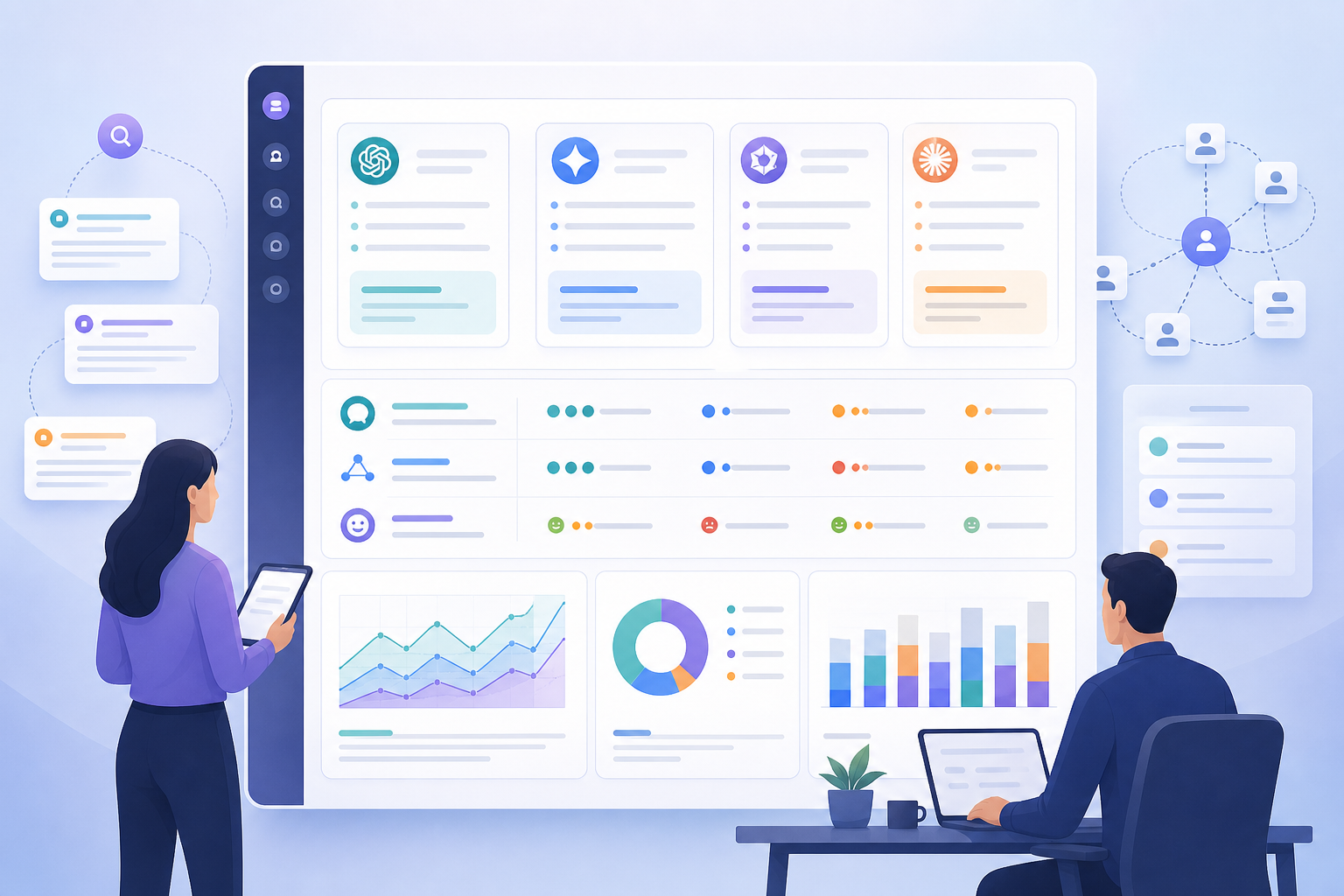
What are AI search engine monitoring tools?
AI search engine monitoring tools are platforms that run repeatable prompts across answer engines, collect the resulting answers, and convert them into metrics such as brand mention rate, citation rate, share of voice, sentiment, and source quality.
The best tools do more than say “you appeared.” They show where the answer came from, which competitor won the recommendation, whether the statement was accurate, and what content or technical blocker likely caused the gap. That makes them closer to a combined SEO, brand monitoring, and answer engine optimization workflow than a classic keyword tracker.
A useful platform should answer five operational questions:
- Are we mentioned for the questions buyers actually ask?
- Are we cited from our own properties or from third-party pages?
- Are answer engines describing our product correctly?
- Which competitors appear beside or above us?
- What change is most likely to improve future answers?
For measurement design, maxaeo.ai’s guide to AI visibility metrics, formulas, and benchmarks provides a deeper KPI framework.
Why AI search monitoring is different from rank tracking
Rank tracking measures positions in a relatively stable search results page. AI search monitoring measures probabilistic answers that can vary by prompt wording, model, location, freshness, citations, user context, and retrieval behavior.
That creates three differences.
First, the unit of analysis changes. Instead of a keyword and URL position, the unit is often a prompt-answer-source set. One prompt can produce a paragraph, a shortlist, citations, and a recommendation hierarchy.
Second, visibility is not binary. A brand may be mentioned negatively, mentioned but not linked, cited through a reseller, or recommended only for a narrow use case. These outcomes need separate labels.
Third, technical accessibility becomes part of measurement. If answer engines cannot crawl product pages, documentation, pricing pages, or comparison content, your content may be missing even when it ranks well in Google. Google’s own documentation on controlling crawling and indexing is still relevant, but AI crawlers and retrieval systems introduce additional monitoring needs.
For that reason, AI monitoring belongs in the same operating system as crawl diagnostics. maxaeo.ai’s analysis of robots.txt rules for GPTBot, OAI-SearchBot, and ChatGPT-User explains how crawler rules can affect answer-engine visibility.
The core features that actually matter
A strong AI search monitoring platform should combine prompt coverage, engine coverage, citation analysis, competitor benchmarking, sentiment scoring, and technical diagnostics. A long feature list is less useful than reliable repeatability and clear next actions.
| Capability | What it should show | Why it matters |
|---|---|---|
| Prompt monitoring | Answers for tracked buyer, category, and comparison prompts | Reveals real recommendation coverage |
| Engine coverage | ChatGPT, Perplexity, Gemini, Copilot, Claude, Google AI surfaces | Prevents overfitting to one answer engine |
| Citation tracking | URLs cited, source type, owned vs third-party | Shows whether your site is the evidence source |
| Share of voice | Your mentions divided by total relevant brand mentions | Turns visibility into a comparable metric |
| Sentiment and accuracy | Positive, neutral, negative, incorrect, outdated claims | Protects brand trust |
| Competitor gaps | Who appears when you do not | Prioritizes content and PR work |
| Historical trend lines | Prompt-level changes over time | Separates noise from movement |
| Crawler diagnostics | Blocked bots, 403s, consent walls, rate limits | Finds technical causes of invisibility |
| Export/API | Raw answer logs and structured metrics | Supports BI, reporting, and audits |
The most commonly missed feature is answer evidence quality. A citation is not always a win. If an AI answer cites an outdated directory, a thin affiliate article, or a marketplace listing with incorrect product details, the brand may be visible but not in control of the narrative.
A practical evaluation framework: the 6-layer monitoring stack
The strongest selection method is to evaluate tools by workflow layer, not by vendor category. The 6-layer stack below separates vanity dashboards from systems that can drive action.
1. Prompt universe
The tool should support prompts that match buying behavior, not only head terms. Include category prompts, “best for” prompts, comparison prompts, problem-solution prompts, pricing prompts, integration prompts, and alternative prompts.
A weak prompt set produces false confidence. For example, “best CRM software” may show one result, while “best CRM for a 20-person B2B SaaS team using HubSpot and Slack” may produce a different shortlist.
2. Engine and mode coverage
Different answer engines cite differently. Perplexity often foregrounds sources, ChatGPT may synthesize from a broader memory and retrieval mix, and Google AI experiences may blend traditional search signals with generated summaries. Coverage should include the engines your buyers use, not every engine for its own sake.
3. Citation and source graph
Citation analysis should classify sources as owned pages, review sites, marketplaces, media, forums, documentation, social pages, or competitor pages. This reveals whether you need SEO content, digital PR, review management, product feed cleanup, or crawler fixes.
For a deeper treatment of citations in research-style answers, see maxaeo.ai’s guide to how multi-step AI research agents assemble cited reports.
4. Entity accuracy
Monitoring should capture whether the model knows who you are, what you sell, whom you serve, and what has changed. Entity errors are common when a brand has similar names, recently repositioned, merged products, or relies on JavaScript-heavy pages.
5. Technical accessibility
The tool should flag when AI crawlers encounter bot challenges, consent interstitials, login walls, 403 responses, or aggressive rate limits. These issues are often invisible in marketing dashboards but decisive for answer engines.
maxaeo.ai’s technical guide on WAF rules blocking answer engines covers this problem in detail.
6. Action recommendations
A monitoring tool is only valuable if it supports decisions. Useful recommendations name the affected prompts, missing evidence, competing sources, blocked pages, and likely remediation path. Generic advice such as “create better content” is not enough.
Original benchmark: what a 40-prompt audit reveals
In an anonymized maxaeo.ai field review of 40 commercial-intent prompts across four answer environments, the most common visibility issue was not total absence. It was fragmented evidence: the brand appeared, but the cited source did not support the claim the buyer cared about.
The review used 10 prompts per intent type:
- Category recommendations
- Brand comparisons
- Use-case fit questions
- Pricing or implementation questions
Each prompt was checked for mention, citation, sentiment, accuracy, and owned-source control. The pattern was consistent enough to inform a practical scoring model.
| Finding from the 40-prompt review | Share of prompts affected | Operational meaning |
|---|---|---|
| Brand mentioned but not cited to an owned page | 38% | Visibility existed, but proof came from third parties |
| Competitor cited with more specific use-case evidence | 31% | Competitor pages answered the prompt more directly |
| Answer included outdated positioning or feature language | 22% | Entity data and public descriptions were stale |
| Owned page was available but technically hard to retrieve | 16% | Crawl or rendering friction reduced source control |
| Brand absent while category competitors appeared | 14% | Content or authority gap existed for that prompt class |
The key lesson: AI visibility work should not start with “How do we get mentioned more?” It should start with “Which answer claims need better evidence, and where should that evidence live?”
That is the information gap many generic tool lists miss. Monitoring is not just a scorecard. It is an evidence-control system.
How to choose the right tool for your team
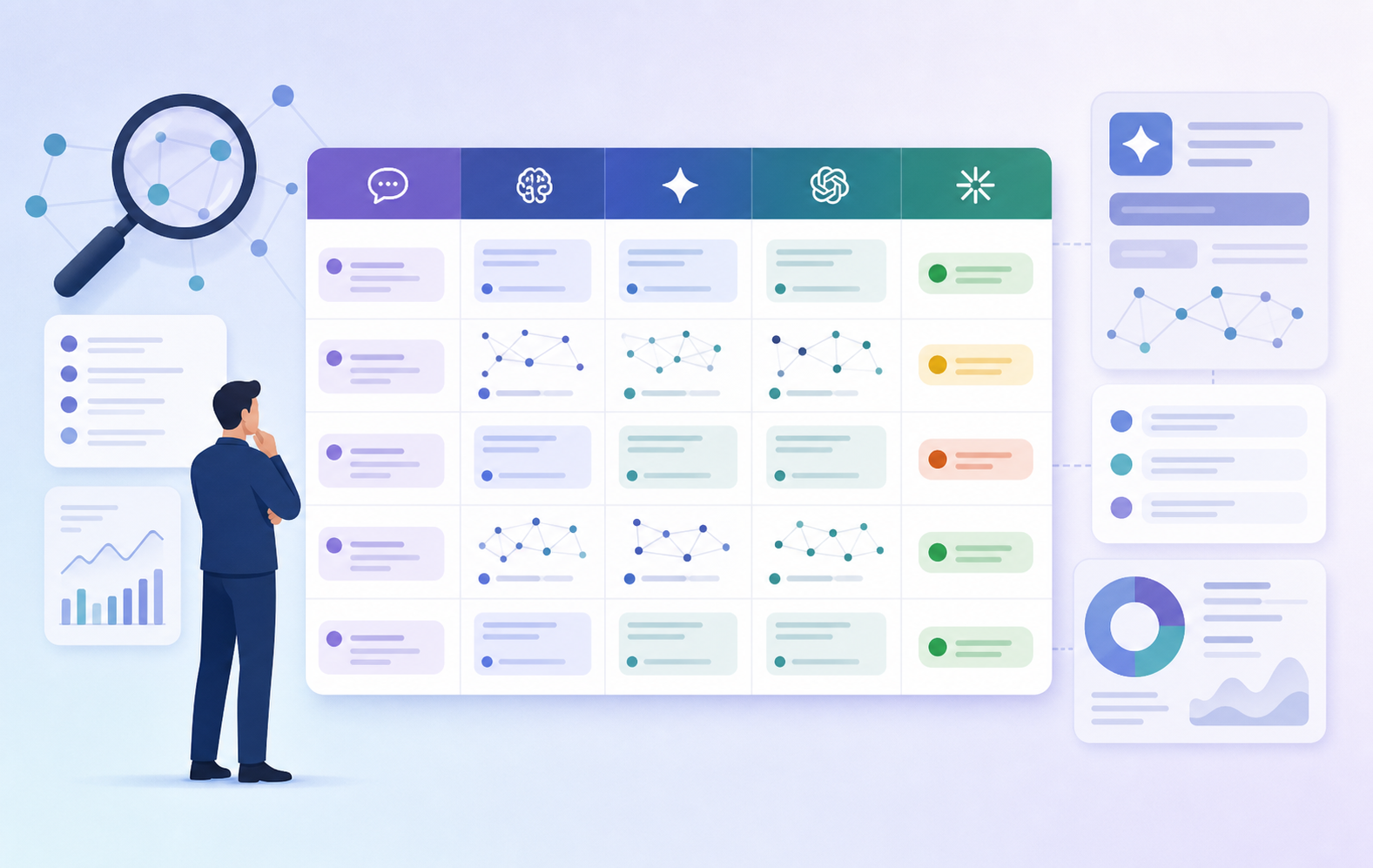
Choose AI search monitoring software based on the decision you need to make. A founder, SEO manager, PR lead, and enterprise analytics team do not need the same depth of data.
For early-stage teams
Start with a lightweight tracker that covers core engines, stores answer history, and exports raw prompt results. Prioritize clarity over complex dashboards. A small team should know which five to ten pages or third-party profiles need improvement first.
For SEO and content teams
Look for prompt clustering, citation analysis, competitor gap reports, and content recommendations. The tool should connect prompts to pages and show where owned content lacks specificity, schema clarity, crawlability, or topical depth.
For brand and communications teams
Prioritize sentiment, misattribution, media-source analysis, and comparison prompts. PR teams need to know whether answer engines quote outdated articles, review snippets, or analyst-style summaries that no longer reflect the brand.
For enterprise teams
Require reproducibility, API access, raw answer logs, role-based permissions, custom engine coverage, and technical diagnostics. Enterprise teams also need governance: when an AI answer is wrong, who owns the fix—SEO, product marketing, legal, engineering, or PR?
Metrics to track weekly, monthly, and quarterly
The right cadence prevents overreaction. AI answers can fluctuate, so a single prompt result should not trigger a strategy change. Track short-term movement weekly, evidence quality monthly, and business impact quarterly.
| Cadence | Metrics | Best use |
|---|---|---|
| Weekly | Mention rate, citation rate, negative sentiment alerts, critical prompt changes | Detect sudden visibility shifts |
| Monthly | Share of voice, owned-source ratio, competitor citation gap, answer accuracy | Prioritize content and technical work |
| Quarterly | AI-referred traffic, assisted conversions, branded demand, win/loss insight | Connect AI visibility to business outcomes |
A practical formula for AI share of voice is:
AI Share of Voice = Your relevant brand mentions ÷ Total relevant brand mentions across tracked answers × 100
This should be segmented by prompt cluster. A single aggregate score can hide the fact that a brand is strong in “enterprise” prompts but absent from “small business” prompts.
Common mistakes when buying AI monitoring software
The biggest mistake is treating AI search monitoring as a cheaper version of rank tracking. That leads teams to buy dashboards without changing the content, entity, or technical systems that influence answers.
Avoid these six mistakes:
- Tracking only brand-name prompts. These usually look better than category prompts and hide acquisition gaps.
- Ignoring citations. A mention without a credible source may not influence a buyer.
- Overvaluing one engine. Different audiences use different answer environments.
- Accepting opaque scores. A useful score must decompose into mention, source, sentiment, and accuracy signals.
- Skipping technical checks. A blocked crawler can make excellent content invisible.
- Reporting without ownership. Every issue should map to an owner and remediation path.
For teams focused specifically on mentions and brand context, maxaeo.ai’s guide to AI brand mention tracking tools expands on monitoring workflows.
A 30-day implementation plan
A good rollout starts narrow, validates the measurement model, and then expands. The goal is not to track every possible prompt on day one; it is to build a reliable operating loop.
- Define 30–50 prompts. Include category, comparison, use-case, alternative, and buying-objection prompts.
- Group prompts by intent. Separate awareness, evaluation, and purchase-stage questions.
- Select target engines. Choose the answer engines most likely used by your market.
- Label baseline answers. Record mentions, citations, sentiment, accuracy, and competitors.
- Audit cited sources. Identify owned, third-party, outdated, and low-control sources.
- Check technical access. Review robots rules, WAF behavior, consent banners, and blocked assets.
- Prioritize fixes. Start with prompts that combine high commercial intent and poor evidence.
- Re-measure after changes. Compare prompt clusters, not isolated answer snapshots.
- Create an executive view. Report share of voice, owned-source ratio, and critical answer errors.
- Build a monthly governance loop. Assign content, PR, product, and engineering owners.
This workflow turns AI monitoring into a repeatable growth system rather than a one-time visibility audit.
What makes maxaeo.ai different
maxaeo.ai approaches AI search monitoring at the property level: the brand, its owned web properties, and its answer-engine evidence are evaluated together. That matters because many visibility gaps come from the connection between entity clarity, crawlability, content evidence, and citations.
The platform’s AEO-oriented model is designed to help teams understand not only whether a brand appears, but why it appears, where the answer is sourced, and what prevents stronger representation. For organizations that need to monitor brand presence across answer engines and diagnose the reasons behind weak visibility, maxaeo.ai provides a focused answer engine optimization workflow.
Frequently asked questions
What is the difference between AI visibility tools and AI search engine monitoring tools?
AI visibility tools usually emphasize brand presence and share of voice. AI search engine monitoring tools are broader: they track prompts, answers, citations, competitors, sentiment, accuracy, and technical access across AI-powered search experiences.
How many prompts should a company monitor?
Most teams should start with 30–50 high-intent prompts. Larger brands may monitor hundreds, but the first set should cover category discovery, comparisons, alternatives, use cases, integrations, pricing concerns, and post-purchase support questions.
Can Google Search Console show AI search visibility?
Google Search Console is useful for traditional Google performance, but it does not provide complete prompt-level visibility across ChatGPT, Perplexity, Claude, Gemini, Copilot, and other AI answer engines. AI monitoring tools fill that gap by collecting answer-level data.
How often should AI answers be checked?
Weekly checks are enough for most prompt clusters. Daily monitoring is useful for crisis management, fast-moving categories, product launches, or prompts with high revenue impact. Strategic reporting should focus on trends, not one-off answer changes.
What is the most important AI monitoring metric?
Owned-source citation rate is often the most actionable metric. It shows how often answer engines support claims about your brand using your own pages instead of third-party summaries, marketplaces, directories, or competitor-controlled sources.