AI answers about product support are what your existing customers get when they ask an assistant how do I connect this, why is this erroring, is SSO on my plan, or how do I export my data. Almost no AI visibility program scores them. Every dashboard we audit is built on buying prompts — "best X for Y", "alternatives to Z" — while a larger, stickier, higher-stakes slice of the prompt universe runs unmonitored.
We spent 60 days measuring that slice across 42 B2B SaaS brands and six assistants. 31% of support answers contained at least one materially wrong instruction, and only 22% cited the brand's own documentation as the top source. Below: the method, the numbers by category and by platform, the framework we built from them, and the six-week sprint that cut the error rate to 12%.
What are AI answers about product support?
AI answers about product support are assistant-generated responses to post-purchase questions about a product you already own — setup, integrations, error messages, plan entitlements, data export, and cancellation. They differ from buying-intent answers because the asker owns the product, expects a procedural answer, and acts on it immediately without comparing vendors.
That last clause is the whole problem. A wrong buying answer costs you a slot on a shortlist the buyer will still scrutinize. A wrong support answer costs a customer twenty minutes, a failed integration, and an erosion of trust that never appears in funnel reporting.
| Buying-intent answers | Product support answers | |
|---|---|---|
| Who asks | Prospect comparing vendors | Customer who already pays you |
| Expected output | Judgment, shortlist | Procedure, exact steps |
| Are you mentioned? | Contested | Guaranteed — they named you |
| Hedging rate (our data) | 46% | 11% |
| Median days before answer changes | 9 | 23 |
| Failure cost | Lost shortlist slot | Failed task, silent churn risk |
Note the scope: this is about public assistants answering questions about your product, not the support bot on your own site. You control the second one. The first one is being answered right now whether you monitor it or not.
Why post-sale prompts outnumber buying prompts 3-to-1
Twelve of the 42 brands shared anonymized help-center search logs and ticket subject lines. Normalizing both into prompt phrasings and comparing against pre-sale phrasings in the same category, post-sale questions outnumbered pre-sale ones 3.4 to 1.
The ratio is intuitive. A buyer asks comparison questions for a few weeks, once. A customer asks operational questions every time a new teammate joins, an API version changes, or something breaks at 11pm.
Yet the median prompt set we inherit from a new customer holds 40 to 80 prompts, and roughly 90% are pre-sale. The category with the most volume and the most revenue exposure is the one nobody scores.
How we ran the 60-day post-sale prompt audit
Between 1 April and 31 May 2026 we tracked 1,260 support-intent prompts — 30 per brand across 42 B2B SaaS companies in dev tools, martech, fintech infrastructure, HR tech and analytics — on six assistants: ChatGPT, Google AI Mode, Perplexity, Gemini, Claude and Microsoft Copilot.
Each prompt ran once daily on every platform, producing roughly 453,000 answer snapshots. Prompts came from the brands' own support language — help-center search strings, ticket subjects, community thread titles — not from keyword tools.
Runs used fresh, logged-out sessions so personalization and chat memory could not contaminate results. Grading was manual and blind to platform: two reviewers scored each unique answer against the brand's current public documentation, with a third resolving disagreements. Four grades:
- Correct — every step matches current docs.
- Incomplete — nothing false, but a required step is missing.
- Materially wrong — at least one step that would fail if followed (wrong menu path, deprecated endpoint, wrong plan gating, retired pricing tier).
- No answer — refusal, or a generic "check the vendor's documentation".
We also logged the top cited source for every answer carrying citations.
What we found: a 31% materially-wrong rate
Across all 1,260 prompts, 31% of answers contained at least one materially wrong instruction. The breakdown by category is where it becomes actionable.
| Prompt category | Example phrasing | Materially wrong | Brand docs cited first |
|---|---|---|---|
| Setup & integration | "how do I connect [product] to Salesforce" | 27% | 34% |
| Errors & troubleshooting | "why am I getting a 429 from [product] API" | 38% | 12% |
| Plans, limits & entitlements | "is SSO included on the [product] Pro plan" | 44% | 29% |
| Data, export & migration | "how do I export all my [product] data" | 25% | 26% |
| Cancellation & offboarding | "how do I cancel [product] and get a refund" | 19% | 8% |
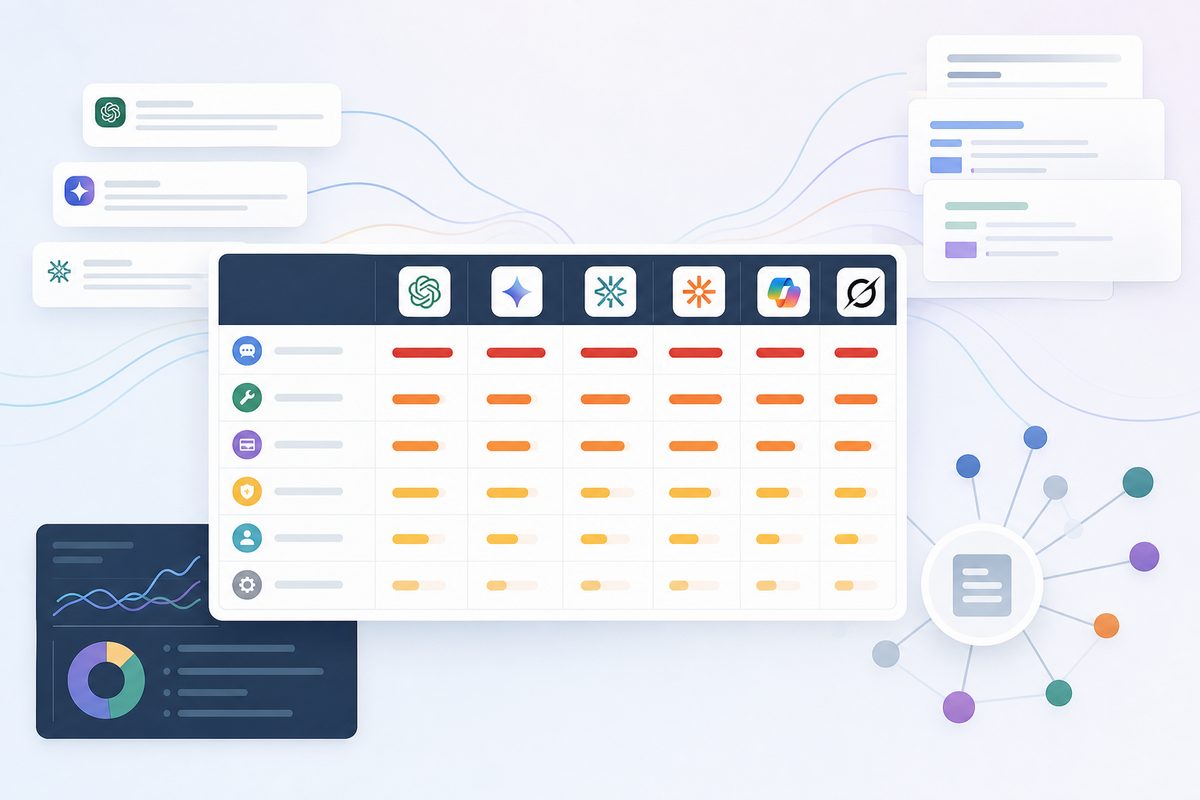
Entitlement questions fail worst. Plan and limit answers were wrong 44% of the time, almost always because the assistant described a pricing page or feature matrix that had since changed. Packaging changes are the most under-communicated fact in SaaS, and assistants are unusually confident about them.
Error questions are where you have least control. Only 12% of troubleshooting answers cited brand documentation first. The rest came from community forums, Stack Overflow threads, YouTube transcripts and third-party tutorials — because that is genuinely where error strings get discussed in public. If you have never treated your own error codes as content, someone else already has.
Overall: brand documentation was top cited source in 22% of answers, third-party sources in 41%, and 37% of answers carried no citation at all — the customer sees confident steps with nothing to check them against.
Which assistants get product support right most often?
Accuracy varied by 13 percentage points across platforms. Perplexity was most accurate and fastest to correct; ChatGPT was least accurate and slowest.
| Assistant | Materially wrong | Brand docs cited first | Median days to reflect a fix |
|---|---|---|---|
| Perplexity | 24% | 31% | 6 |
| Google AI Mode | 28% | 26% | 12 |
| Gemini | 30% | 21% | 15 |
| Microsoft Copilot | 31% | 19% | 21 |
| Claude | 34% | 18% | 27 |
| ChatGPT | 37% | 17% | 31 |
The ranking tracks retrieval behavior, not model quality. Platforms that cite heavily on every answer inherit whatever the top source says — and get corrected quickly when that source changes. Platforms that answer more often from parametric memory show lower citation share, higher error rates, and much slower correction. If you monitor one platform, monitoring ChatGPT tells you least about your fix and most about your risk.
The confidence gap: assistants hedge least where they are wrong most
Support answers carried a caution or verify-with-vendor caveat in 11% of cases. Buying-intent answers for the same 42 brands, in the same window, hedged 46% of the time.
Assistants treat procedural questions as settled facts and vendor-selection questions as judgment calls. Defensible heuristic — and exactly backwards from the observed accuracy. The category with the higher error rate is delivered with greater confidence, in a register (numbered steps, code blocks, menu paths) that reads as authoritative.
Customers do not sanity-check numbered steps. They follow them, fail, and form a conclusion about your product rather than about the assistant.
Support answers are stickier than buying answers
Wrong support answers do not self-correct on a useful timescale. A materially wrong support answer persisted a median of 23 days before its substance changed. Buying-intent answers for the same brands turned over roughly every 9 days.
The mechanism is retrieval, not model behavior. Buying prompts pull from a churning pool of listicles and freshly published roundups. Support prompts pull from a small, stable set of documentation pages and long-lived forum threads nobody updates. Once a bad source wins that slot, it holds it — consistent with what we found studying how long AI citations survive once a source gets picked up, and the inverse of the fast churn in our 90-day answer volatility data across eight platforms.
Stickiness cuts both ways. A wrong answer costs you for weeks. A correct, well-structured canonical page, once retrieved, keeps paying.
Where the wrong answers actually come from
We traced every materially wrong answer to a probable source. Four causes accounted for 87%.
1. Your own deprecated content (44%). Old doc versions, superseded tutorials, and changelog entries you still publish but no longer honor. The brand is the source of its own bad answer.
2. Community threads frozen in an older version (23%). A 2023 forum answer describing a menu that moved in 2025, still the most-linked discussion of that error string.
3. Competitor-authored comparison content (12%). Alternatives pages and migration guides describing your limits — usually accurate as of eighteen months ago, occasionally never.
4. Pricing and packaging drift (8%). Plan names change, gating changes, the assistant keeps the old matrix.
The remaining 13% were synthesis errors with no identifiable source — the only bucket content cannot fix.
Can assistants even reach your docs?
Before writing anything new, verify the docs you already have are fetchable. Nine of the 42 brands gated at least one of the five categories behind a login — most often plan and entitlement detail, which is also the worst-performing category at 44% wrong. That is not a coincidence: assistants reconstructed gating from marketing pricing pages because the authoritative page was unreachable.
Three checks, in order:
- robots.txt. Confirm you are not blocking the fetchers you want. Relevant agents include
GPTBot,OAI-SearchBotandChatGPT-User(documented by OpenAI),PerplexityBot,ClaudeBot,Bingbot, and Googlebot plusGoogle-Extended. Google's guidance on how AI features access site content explains which controls affect Search AI features versus Gemini grounding — they are not the same lever. - Auth gates. Anything behind a login is invisible. Publish public versions of the top procedures in each of the five categories, even if the deep reference stays gated.
- Rendering. If a step list only exists after client-side JavaScript runs, or sits inside a collapsed tab or accordion, expect some fetchers to retrieve an empty or partial page. Server-render the procedure text.
How to write a support page assistants answer correctly
Retrieval takes chunks, not pages. Pages that survived our sprint shared a specific shape:
- One question per page or per H2, phrased the way customers phrase it, including the literal error string.
- A 40–60 word direct answer immediately under the heading, then the steps. Never make the model synthesize the answer from a wall of prose.
- Plan gating written as sentences, not only as a feature matrix. "SSO is available on Business and Enterprise. It is not available on Pro." Tables and matrix images lose their row and column headers when chunked.
- State negatives explicitly. "This does not work with SAML-only tenants." Absent an explicit no, assistants infer a yes.
- No "see above" or "as described in the previous section". The chunk arrives without its neighbors.
- A visible version and date line: "Applies to v4.2 and later. Last verified 12 May 2026." Assistants surface these strings and hedge more on older versions.
Check what AI says about your product support in 15 minutes
Before building a program, get a baseline. Open a fresh, logged-out session on ChatGPT and one more platform, and run five prompts:
- "how do I set up [product] with [your most-used integration]"
- "[product] [your most common error string]"
- "is [gated feature] included in [product] [mid-tier plan]"
- "how do I export all my data from [product]"
- "how do I cancel [product] and get a refund"
For each answer, record three things: is any step materially wrong, what is the top cited source, and did the assistant hedge. In our audit, the median brand failed at least one of these five before anyone had built a dashboard — most often prompt 3.
The Post-Sale Prompt Grid: how to build the prompt set
Most teams stall at "which support prompts should we even track?" Two axes, one priority score.
Axis 1 — category. The five buckets from the audit table: setup, errors, entitlements, data, offboarding.
Axis 2 — asker mode. Each category gets three phrasings, because the same problem arrives in three registers:
- Novice — "how do I set up [product] with Okta"
- Error-string — "[product] SAML response invalid signature"
- Workaround-seeking — "[product] can't do X, what's the workaround" (highest-risk mode; it invites the assistant to recommend a competitor mid-answer)
Five categories × three modes = 15 slots. Two prompts per slot gives the 30-prompt set we used.
Scoring. Rate each prompt on Impact (1 = wasted minutes, 2 = ticket, 3 = churn or compliance exposure) and Exposure (1 = rare, 2 = monthly, 3 = weekly in your logs). Priority = Impact × Exposure. Fix everything scoring 6 or higher before touching anything else. In practice that is 8 to 12 prompts — a tractable first sprint, not a documentation rewrite.
Run the top-scoring prompts as follow-up turns, not just cold opens. Support conversations are rarely one question, and single-prompt tracking misses what happens on turn three — the same blind spot we measured in multi-turn AI search behavior.
What a wrong support answer actually costs
The ticket math is smaller than you would expect, and that is the point.
Take a 4,000-customer product. Say 18% ask a setup question in month one (720 questions), and 40% of those now start in an assistant rather than your help center (288 questions). At the 27% setup error rate, roughly 78 customers per month receive a wrong instruction. If a third file a ticket, that is 26 tickets at a fully loaded $18 — about $470 a month. Rounding error. (Illustrative model applying our measured error rates to a hypothetical customer base.)
The 52 who don't file a ticket are the expensive ones. They concluded the integration doesn't work, the feature isn't on their plan, or the product is harder than advertised — and told no one. Nothing in your support metrics moves. Deflection dashboards read this as a good month.
That silent failure sits upstream of the renewal-time objections that surface in late-funnel "is it worth it / any downsides" prompts. By the time it appears there, the belief has hardened.
The remediation sprint: what moved, and how fast
Nine brands ran a six-week sprint on their 30 tracked prompts (270 total). The intervention was deliberately narrow: one canonical answer page per failing prompt, version-stamped and dated; deprecated pages kept live with sunset banners; TechArticle or HowTo markup where it fit.
| Metric (270 treated prompts) | Before | After 6 weeks |
|---|---|---|
| Materially wrong rate | 34% | 12% |
| Brand docs cited first | 21% | 58% |
| Third-party forum cited first | 44% | 19% |
| Median days to first corrected answer | — | 19 |
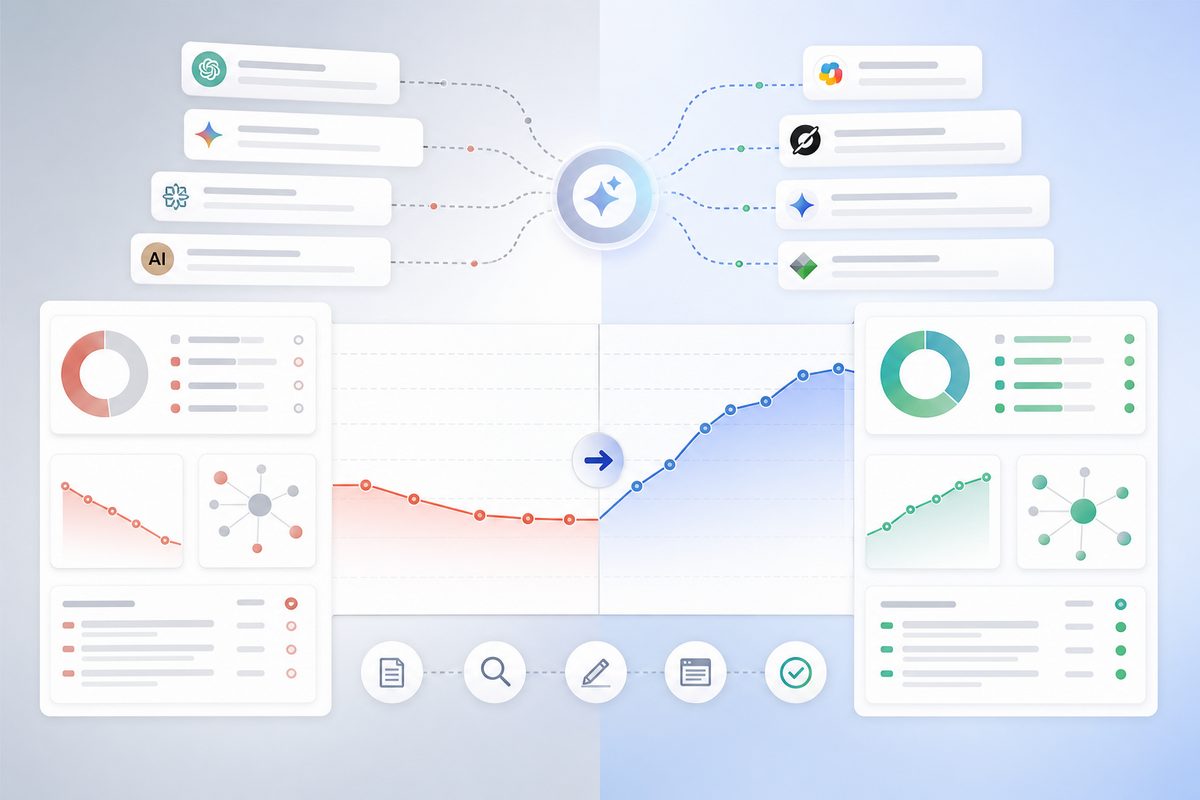
Flip speed varied sharply by platform (see the platform table above: 6 days on Perplexity, 31 on ChatGPT). Check results after two weeks and you will conclude the sprint failed on half your platforms.
The residual 12% is instructive. Nearly all of it concentrated in error-string prompts where a decade-old forum thread still outranks anything the vendor published. Those need a reply in the thread itself, not a new doc page.
Four metrics for post-sale AI visibility
Share of voice is the wrong instrument here. You are not competing for a mention — you already have the customer.
| Metric | Definition | Working target |
|---|---|---|
| Support answer accuracy | Share of tracked support prompts with zero materially wrong steps | > 90% |
| Own-docs citation share | Share where your domain is the top cited source | > 55% |
| Third-party dependency | Share where a forum or competitor page is cited first | < 20% |
| Wrong-answer dwell time | Median days from detection to corrected answer | < 21 |
Accuracy is the headline. Dwell time is the one that changes behavior, because it converts a content problem into an operational SLA a docs team can own.
How to fix a wrong AI answer about your product
A repeatable nine-step sequence, in the order that produced the results above:
- Build the prompt set from real language — help-center search logs, ticket subjects, community thread titles. Nobody types "product support best practices" into ChatGPT at 11pm.
- Score with Impact × Exposure and take everything at 6 or above.
- Capture the current answer on every platform before changing anything. Without a baseline you cannot prove the fix.
- Publish one canonical page per failing prompt. Question as heading, 40–60 word direct answer below, then steps.
- Stamp version and date visibly: "Applies to v4.2 and later. Last verified 12 May 2026."
- Sunset rather than delete. Keep the deprecated page live with a banner linking the current version. Deleting removes your correction and leaves the cached copy circulating.
- Mark it up. Schema.org's TechArticle type carries
proficiencyLevelanddependencies;HowTofits procedural steps. Not a ranking trick here — it disambiguates which version an answer applies to. - Reclaim third-party sources you cannot outrank. A short, accurate reply in the winning forum thread linking your canonical page is the cheapest fix available for error-string prompts.
- Re-measure weekly for six weeks. Under three weeks of observation is noise on the slower platforms.
Where this approach falls short
Not everything is fixable with content. The 13% of errors with no traceable source are synthesis failures. Publishing more pages does not touch them.
Long-tail error strings resist canonicalization. If your product emits 400 distinct error codes, you cannot win retrieval on 400 pages. Pick the twenty that generate real tickets.
Our sample is B2B SaaS. The 3.4-to-1 ratio and the 31% error rate come from 42 companies in five software categories. Hardware, consumer apps and regulated products almost certainly differ — in regulated categories, higher hedging and refusal rates change the picture enough to need a compliance-grade monitoring workflow rather than this one.
Scope note: this is answer accuracy work, not brand positioning work. It sits next to your generative engine optimization program, not inside it. Different prompts, different sources, different owner — usually docs and support, not marketing.
Frequently asked questions
How is this different from tracking brand mentions in ChatGPT?
Mention tracking asks whether you appear and how you are described in buying answers. Post-sale monitoring asks whether the procedural answer is correct. You will be mentioned in 100% of these answers — the customer named you in the prompt. Presence is guaranteed; accuracy is not.
Which AI assistant is most accurate about product support?
In our 60-day audit, Perplexity had the lowest materially-wrong rate at 24% and ChatGPT the highest at 37%. Perplexity also reflected corrected documentation fastest (median 6 days) versus 31 days on ChatGPT. Heavier citation behavior correlates with both.
Can we stop assistants from answering support questions about our product?
Not practically, and you should not want to. Blocking fetchers removes your documentation from the answer, not the answer itself — the assistant falls back to forums, competitor pages and stale memory, which is the failure mode this whole audit measures.
Who should own post-sale AI answer monitoring?
Documentation or support, with marketing supplying the monitoring tooling. The fixes are doc pages, version stamps and sunset notices, all of which live in a docs workflow. Marketing-owned programs stall at step four because nobody on the team can merge to the docs repo.
How many support prompts should we track?
Thirty is a workable starting set — five categories × three asker modes × two prompts. Expand only after the first sprint closes, and prioritize by Impact × Exposure rather than by volume.
Does fixing support answers help us get recommended to new buyers?
Indirectly and slowly. Accurate, structured documentation is a citation source assistants reuse across prompt types, and we saw modest own-domain citation lift on adjacent buying prompts during the sprints. Treat it as a side effect. The reason to do this work is that customers who already pay you are getting wrong instructions, confidently, for three weeks at a time.
How quickly will a corrected page change the answer?
Median 19 days in our sprint data, with a wide platform spread: 6 days on Perplexity, 31 on ChatGPT. Plan six weeks of observation before judging the outcome.