When AI drops brand in follow-up answers, the brand was visible during discovery but failed to survive buyer qualification. The next step is not simply to pursue more mentions. It is to identify the constraint that caused the loss and determine whether the underlying problem is product fit, missing evidence, stale information, or answer volatility.
In short:
- Track complete conversations, not isolated prompts.
- Separate demotion, exclusion, and disappearance.
- Test realistic constraints such as total price, integrations, security, and geography.
- Compare the assistant’s explanation with verified product facts.
- Fix public evidence only when the product genuinely qualifies.
- Repeat matched conversations before treating one answer as a trend.
Methodology note: The four brands and counts in the worked example below are fictional. They illustrate a reproducible measurement method and are not market benchmarks or claims about real products.
What Does “AI Drops Brand in Follow-Up” Mean?
“AI drops brand in follow-up” describes a conversational search failure in which an assistant recommends a brand in an early reply, then demotes, excludes, or omits it after the buyer adds a constraint such as price, team size, integration, security, or geography. The drop can signal either genuine product misfit or missing evidence.
A brand can lose shortlist status in three distinct ways:
| Outcome | What appears in the answer | What it may indicate |
|---|---|---|
| Demotion | The brand moves from “recommended” to “also consider” | Weaker fit, incomplete proof, or a stronger competitor |
| Explicit exclusion | The assistant says the brand fails a requirement | A genuine mismatch, inaccurate information, or stale evidence |
| Disappearance | The brand is no longer mentioned | Candidate-set pruning, weak retrieval evidence, or response volatility |
These outcomes require different responses. An accurate exclusion because the product exceeds the buyer’s budget is not an SEO problem. Silent disappearance despite a qualifying product warrants an evidence and retrieval audit.
Why Does an AI Assistant Drop a Brand After a Follow-Up?
A follow-up question changes the recommendation task. “Best CRM for consultants” asks for category relevance; “best CRM for five users under $50 per month with native QuickBooks integration” asks the assistant to verify several constraints simultaneously.
OpenAI states that ChatGPT can use the context of a conversation when answering follow-up questions in its official ChatGPT Search announcement. Google similarly describes AI Mode as supporting nuanced questions and further exploration in its official AI Mode overview.
The drop usually comes from one of five causes:
| Cause | Observable signal | Correct response |
|---|---|---|
| True product mismatch | Current first-party facts confirm the requirement is not met | Change targeting or improve the product |
| Missing public evidence | The product qualifies internally, but the fact is absent or inaccessible online | Publish a canonical, crawlable answer |
| Ambiguous evidence | Pages use vague claims such as “affordable” or “enterprise-grade security” | Replace general language with scoped facts |
| Stale or conflicting sources | The assistant cites an old review, marketplace listing, or comparison | Update first-party pages and correct priority third-party profiles |
| Model or retrieval volatility | Matched conversations produce inconsistent states and sources | Increase repetitions and monitor before changing content |
Do not treat the assistant’s explanation as access to its private reasoning. Record only what the response explicitly says, which sources it displays, and how its recommendation state changes.
Why First-Answer Visibility Overstates Buyer Visibility
A first-answer mention measures discovery. It does not show whether a brand remains qualified after the buyer reveals budget, implementation, integration, security, or procurement requirements.
A realistic B2B journey might be:
- “What are the best CRMs for a consultancy?”
- “Which ones suit a five-person team?”
- “Keep the total cost below $50 per month for all five users.”
- “We need native QuickBooks Online and Slack integrations.”
- “We also require SOC 2 Type II coverage and EU-region hosting.”
- “What are the main drawbacks of the remaining options?”
Every turn can change the eligible candidate set. Monitoring only the opening prompt therefore rewards awareness while hiding decision-stage losses. This is the central problem with single-prompt AI visibility monitoring.
Google rankings and first-turn brand mentions in ChatGPT may improve the chance of discovery, but neither guarantees that the brand will survive a narrower follow-up.
How to Audit a Follow-Up Drop
A reliable audit reproduces the same buyer journey across fresh conversations, assigns one recommendation state per brand at every turn, captures visible evidence, and repeats the test under matched conditions.
1. Define the Buyer and Decision
Start with a specific buyer rather than a generic category prompt. Record:
- Company type and size
- Intended use case
- Total budget and billing period
- Required features and integrations
- Security, privacy, and data-location requirements
- Implementation or support constraints
- Geographic availability
- Acceptable trade-offs
“Under $50” is ambiguous. “No more than $50 per month in total for five users, billed monthly” is testable.
2. Build a Realistic Refinement Path
Use the language buyers employ in sales calls, support tickets, site search, paid-search queries, comparison pages, and procurement questionnaires. Arrange those requirements in the order they normally emerge.
The sequence matters. A shortlist filtered for compliance before price may differ from one filtered for price first. Begin with the dominant journey, then test one alternate order to detect major sequence effects. The query refinement path framework shows how a broad category query becomes a decision-ready request.
3. Control the Test Conditions
For each test batch, keep the following fixed:
- AI product or search surface
- Model version when visible
- Account or personalization state
- Language and region
- Opening prompt and follow-up wording
- Constraint order
- Evaluation rubric
- Test period
Each path should begin in a fresh chat. Follow-ups must remain inside that chat so the assistant retains the preceding context.
4. Assign One Status per Brand per Turn
Use four mutually exclusive codes:
| Code | Status | Recording rule |
|---|---|---|
| R | Recommended | Included in the primary shortlist or presented as a strong fit |
| M | Mentioned | Named but not recommended for the stated requirements |
| X | Excluded | Explicitly described as failing a requirement |
| A | Absent | Not mentioned in the response |
Record citations separately. A brand can be recommended without a displayed citation or excluded using a cited source.
Also capture:
- Exact response text
- Brand position
- Assistant’s stated reason
- Displayed source URL and publication date
- New competitors introduced
- Test date, surface, model, region, and language
- Whether the brand later returns
5. Repeat Before Diagnosing
Use repetitions according to the decision being made:
- Three matched conversations: a smoke test for obvious failures
- Ten to twenty conversations per path and surface: a practical directional baseline
- Larger samples: required when small changes will drive significant investment
These are operational tiers, not statistical guarantees. Three identical answers can still represent substantial uncertainty. When reporting rates, publish the numerator and denominator and avoid false precision.
How Should Shortlist Survival Be Measured?
The unit of analysis is the continuous conversation, not a collection of independent prompts.
Core Metrics
| Metric | Calculation | What it answers |
|---|---|---|
| Initial inclusion rate | Threads with R at turn 0 ÷ eligible threads | Are buyers discovering the brand? |
| Turn retention | Prior-turn recommendations that remain R ÷ prior-turn recommendations | Does the brand survive this constraint? |
| Final survival rate | Initial recommendations still R at the final turn ÷ initial recommendations | Does the brand remain qualified end to end? |
| Demotion rate | First R→M transitions ÷ prior recommendations | How often does the brand lose shortlist status without exclusion? |
| Explicit exclusion rate | First R→X transitions ÷ prior recommendations | How often is a reason given for removal? |
| Disappearance rate | First R→A transitions ÷ prior recommendations | How often does the brand vanish silently? |
| Resurrection rate | Dropped brands that later return to R ÷ dropped brands | How unstable or conditional is the recommendation? |
| Evidence-gap rate | First-loss events classified as evidence gaps ÷ all diagnosed first-loss events | How much attrition appears fixable through evidence? |
| Cited survival rate | Final survivors with a supporting displayed citation ÷ final survivors | How much durable visibility has visible source support? |
Count each brand’s first loss once when calculating loss reasons. Otherwise an R→M→A path can be double-counted.
Track entrants separately. A brand introduced at the integration turn may finish as the top recommendation, but it did not survive from the opening shortlist.
Use a Constraint Survival Matrix to Find the Fix
A Constraint Survival Matrix connects each observed drop to product truth, public evidence, and an accountable next action. It prevents teams from treating every lost mention as a content problem.
Use one row per material buyer constraint:
| Field | Question to answer |
|---|---|
| Buyer constraint | What exact requirement was added? |
| Internal product truth | Does the product currently satisfy it? |
| Qualification scope | On which plan, region, contract, or configuration? |
| Observed transition | Did the brand move R→M, R→X, or R→A? |
| Stated reason | What did the assistant explicitly say? |
| Displayed evidence | Which source, if any, appeared in the answer? |
| Canonical first-party page | Where should the verified fact live? |
| Evidence condition | Is the page current, crawlable, specific, and consistent? |
| Diagnosis | Mismatch, missing evidence, conflicting evidence, or volatility? |
| Owner and action | Who must fix the product fact, page, listing, or test? |
Example Diagnostic Rows
| Constraint | Product truth | Public evidence | Observed result | Diagnosis | Action |
|---|---|---|---|---|---|
| Five users for less than $50 total | Lowest qualifying plan costs $75 | Pricing page is accurate | Explicit exclusion | True mismatch | Stop targeting this path |
| Native QuickBooks Online integration | Supported on Pro plan | Mentioned only in a gated PDF | Disappearance | Missing evidence | Publish an integration page |
| SOC 2 Type II | Current report covers the product | Trust page says only “secure and compliant” | Explicit exclusion | Ambiguous evidence | State certification type and scope |
| EU-region hosting | Not available | Blog implies “global data support” | Continued recommendation | Inaccurate qualification | Correct the claim; do not optimize for the requirement |
The final row matters as much as the others. A false positive is not a win: it can create buyer disappointment, sales friction, and reputational risk.
A Worked 20-Thread Example
This fictional example uses 20 fresh conversations, four brands, and the same five-turn path in every thread:
- Turn 0: Broad category recommendation
- Turn 1: Five-person team
- Turn 2: Total monthly cost below $50
- Turn 3: Native QuickBooks Online and Slack integrations
- Turn 4: SOC 2 Type II plus EU-region hosting
The language, region, surface, evaluation rules, and constraint order remain fixed. Counts include only brands marked R at the opening turn and continuously retained as R afterward.
A brand that disappears and later returns is recorded as a resurrection, not continuous survival.
Turn-by-Turn Survival Counts
| Fictional brand | Initial shortlist | After team size | After price | After integrations | After compliance | Final survival |
|---|---|---|---|---|---|---|
| Brand A | 18 | 16 | 9 | 7 | 6 | 33.3% |
| Brand B | 14 | 14 | 13 | 11 | 7 | 50.0% |
| Brand C | 12 | 9 | 4 | 4 | 2 | 16.7% |
| Brand D | 8 | 7 | 6 | 5 | 5 | 62.5% |
| All brands | 52 | 46 | 32 | 27 | 20 | 38.5% |

What the Example Reveals
The opening shortlists contained 52 brand-thread recommendations. Only 20 remained after all four constraints, producing a descriptive 38.5% final survival rate.
| Added constraint | Recommendations before | Survivors after | Turn retention | Attrition |
|---|---|---|---|---|
| Team size | 52 | 46 | 88.5% | 11.5% |
| Price | 46 | 32 | 69.6% | 30.4% |
| Integrations | 32 | 27 | 84.4% | 15.6% |
| Compliance | 27 | 20 | 74.1% | 25.9% |
Price caused the largest single-turn decline in this defined test. That does not establish price as the dominant constraint in other categories or markets.
Brand A earned the most opening recommendations but retained only one-third. Brand D entered fewer initial shortlists yet had the strongest survival rate. A first-turn visibility dashboard would favor Brand A; a decision-stage dashboard would reveal Brand D as the more durable recommendation.
The totals are descriptive rather than inferential. Recommendations are clustered within brands and conversations, so the 52 initial brand-thread observations should not be treated as 52 fully independent buyer studies.
Is the Drop a Product Mismatch or an Evidence Gap?
Verify the product fact first. If the product does not meet the buyer’s requirement, the drop is accurate. If it qualifies but the fact is missing, vague, inaccessible, or contradicted online, the brand has an evidence problem.
Use this sequence:
-
Verify the requirement internally.
Confirm the current price, plan limits, feature behavior, integration type, security scope, geography, and contract terms with the responsible owner. -
Read the answer literally.
Record the stated exclusion reason without inferring hidden reasoning. -
Inspect displayed sources.
Determine whether the response used current documentation, an outdated review, a marketplace listing, or no visible source. -
Find the canonical public evidence.
A buyer should be able to reach the qualifying fact without signing in, requesting a sales deck, or interpreting an unsupported superlative. -
Check for conflicting claims.
Compare first-party pages with priority review profiles, app marketplaces, partner directories, and high-ranking comparisons. -
Repeat the matched path.
Determine whether the loss is persistent, intermittent, or isolated.
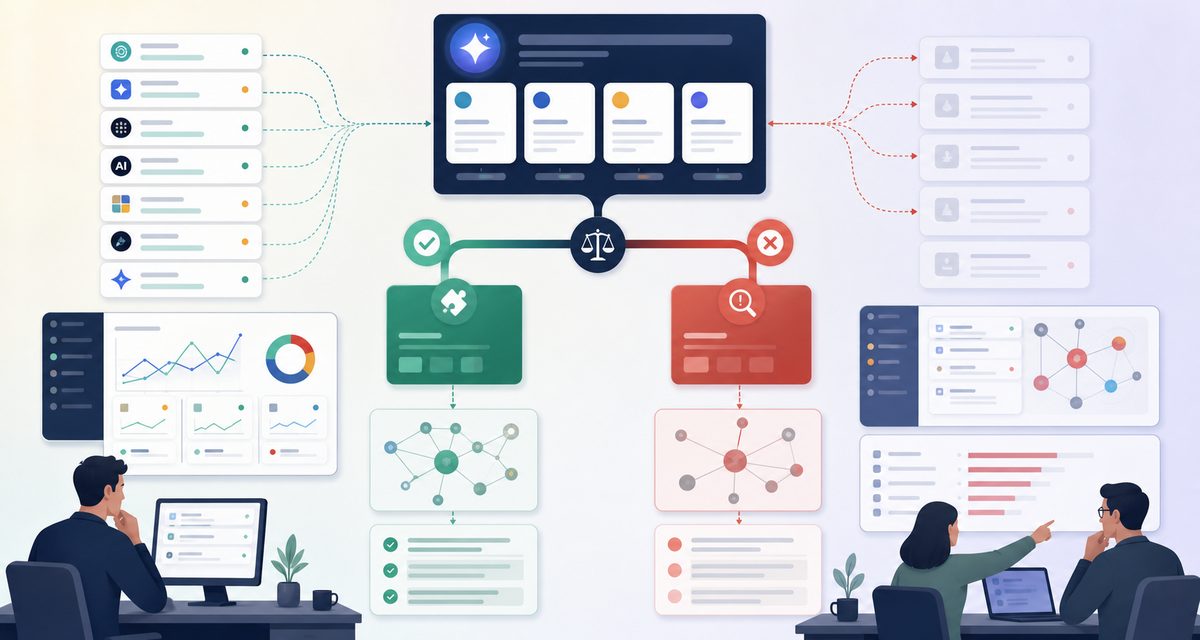
Classify the outcome:
- True mismatch: Change the target query, positioning, or product.
- Missing evidence: Publish or improve the canonical qualifying page.
- Conflicting evidence: Correct stale first- and third-party descriptions.
- Volatile result: Continue controlled testing before attributing the loss to content.
- Ambiguous buyer constraint: Rewrite the test so eligibility can be judged objectively.
Which Constraints Most Often Expose Evidence Problems?
Different constraints require different proof. One generic product page rarely answers all of them.
| Constraint | Evidence the assistant may need | Strong public asset |
|---|---|---|
| Total price | Per-seat cost, minimum seats, billing period, required plan, add-ons | Pricing page with worked totals |
| Team fit | Setup time, admin burden, onboarding, user limits, support | Segment page and implementation guide |
| Integration | Native or third-party status, direction of sync, plan availability, limits | Dedicated integration page and documentation |
| Feature capability | Exact workflow, prerequisites, exclusions, release status | Feature page and technical documentation |
| Security | Certification type, scope, audit period, controls | Public trust center |
| Privacy and geography | Hosting regions, DPA, subprocessors, transfer mechanism | Privacy and data-residency documentation |
| Support | Hours, channels, response targets, plan restrictions | Support policy or service-level page |
| Procurement | Contract term, invoicing, SSO, insurance, vendor review | Procurement or enterprise FAQ |
Price Requires a Calculable Total
“Starts at $9” does not prove that five users can buy the required feature for less than $50. Publish:
- Per-user or flat-rate price
- Minimum seat count
- Monthly and annual billing differences
- Required plan for the relevant feature
- Mandatory add-ons
- Taxes or usage charges where applicable
- Worked totals for representative team sizes
- A visible verification date
Integration Claims Need Scope
An integration directory logo does not show whether the connection is native, bidirectional, available on the buyer’s plan, or dependent on an automation platform.
A useful evidence statement is specific:
Illustrative format: “The product connects natively to QuickBooks Online on Pro and Business plans. It syncs approved invoices one-way every 15 minutes. Payroll records are not supported. Details verified July 2026.”
Every fact in that statement should be true, maintained, and supported on the canonical page. Dedicated integration and documentation pages are among the SaaS page types AI systems can cite.
Compliance Claims Must Separate Different Requirements
“Enterprise-grade security” does not prove any of the following:
- SOC 2 Type II coverage
- ISO 27001 certification
- HIPAA eligibility
- GDPR contractual support
- EU-region data hosting
- A specific data-retention period
These are not interchangeable. State the exact certification or control, covered product, audit period, hosting location, exceptions, and verification route. A public summary can provide these facts even when the full report requires an NDA.
How Can a Brand Survive More Follow-Up Turns?
The goal is not to force a recommendation. It is to make accurate qualification easy.
-
Map high-value buyer paths.
Build conversation sequences from real sales, support, search, and procurement language. -
Create a constraint inventory.
Record the verified fact, scope, canonical URL, owner, last review date, and known limitation for each important requirement. -
Assign one canonical page to each fact.
Pricing belongs on the pricing page, integration behavior in documentation, and certification scope in the trust center. -
Write extractable evidence.
Use descriptive headings, direct definitions, short paragraphs, tables, exact product names, visible dates, and HTML text. -
Put scope next to the claim.
State the relevant plan, region, product edition, contract type, prerequisite, and limitation in the same section. -
Publish material limitations.
Honest boundaries help assistants distinguish supported from unsupported use cases. They also prepare the brand for the buyer’s “What are the downsides?” follow-up. -
Align priority external profiles.
Correct outdated app marketplaces, partner listings, review profiles, and company descriptions. Do not manufacture consensus or suppress legitimate criticism. -
Connect related proof.
Link plan prices to feature availability, integration pages to setup guides, and security summaries to detailed policies. -
Retest the exact loss path.
Preserve the original surface, region, language, prompts, constraint order, and rubric. -
Keep an unchanged control path.
If both the edited path and the control change at the same time, model drift or retrieval volatility may be a better explanation than the content update.
This approach supports answer engine optimization without creating unsupported claims. It also aligns with Google Search Central’s people-first content guidance: content should help users evaluate the product, not exist solely to influence a ranking system.
How to Test Whether an Evidence Change Worked
External AI assistants do not provide a clean website A/B-testing environment. Use a matched pre/post design instead:
- Save the original page, prompts, responses, citations, and recommendation states.
- Change one material evidence asset at a time where practical.
- Confirm that the revised page is public, indexable, internally linked, and free of conflicting claims.
- Repeat the same conversations under matched conditions.
- Run an unchanged control path during the same period.
- Compare first-loss rates, stated reasons, citations, and final survival.
- Report the result as an association unless the evidence supports a stronger causal conclusion.
Do not promise an immediate response after publication. Search engines and AI retrieval systems discover and refresh sources on different schedules, and a page being indexed does not guarantee that a particular assistant will retrieve it.
What Should an AI Search Monitoring Program Test?
A useful program monitors conversation events rather than weekly mention counts.
A practical starting matrix could include:
- Two priority AI surfaces
- Three buyer segments
- Three refinement paths per segment
- Three matched repetitions
- Five turns per conversation
That produces 54 conversations and 270 responses. It is an example workload, not a universal minimum. Add platforms, personas, or repetitions only when they affect a real decision.
Choose surfaces according to audience behavior. ChatGPT may dominate one buyer group, while Claude, Copilot, Gemini, Perplexity, or Google AI Mode may be more relevant to another.
An AI visibility tool should preserve:
- Exact prompts and turn order
- R, M, X, or A status by turn
- Brand position and wording
- First-loss constraint
- Explicit exclusion reason
- Displayed citations and domains
- Entrants and resurrections
- Surface, model, region, language, and date
- Evidence changes between test periods

Use conversation-level visibility metrics to distinguish a short-lived mention from a brand that remains recommended through the decision journey.
How Should Shortlist Survival Be Reported?
A useful report shows where the brand was lost, whether the loss was accurate, and which team owns the response.
| KPI | Executive question |
|---|---|
| Initial inclusion rate | Are relevant buyers discovering us? |
| Final survival rate | Do we remain qualified after key constraints? |
| Largest first-loss constraint | Where do we exit most often? |
| Evidence-gap rate | How much loss appears addressable through public evidence? |
| True-mismatch rate | Where does the product or target segment not fit? |
| Cited survival rate | Are durable recommendations visibly supported? |
| Resurrection rate | How conditional or volatile are the results? |
| Qualified path coverage | Are tests aligned with real target accounts and use cases? |
Report absolute counts beside percentages. “Survival rose from 40% to 50%” is incomplete; “survival rose from 4 of 10 to 5 of 10 matched conversations” shows how limited the evidence is.
Connect changes to branded search, AI referral traffic, assisted pipeline, sales-call mentions, and win-loss research. Treat those relationships as supporting evidence, not proof that an AI answer caused revenue.
What Should Teams Avoid?
Avoid tactics that inflate apparent visibility while making qualification less reliable:
- Publishing thin pages for every target prompt
- Claiming that the product fits every buyer
- Describing third-party automation as a native integration
- Using “compliant” without naming the standard and scope
- Hiding seat minimums, required plans, or billing conditions
- Counting mentions and recommendations as equivalent
- Treating one response as a stable trend
- Editing several evidence sources at once, then claiming one caused the change
- Removing legitimate limitations from comparisons
- Targeting irrelevant segments to raise AI share of voice
- Adding structured data that contradicts visible page content
A recommendation the product cannot defend is not successful AI reputation management. It is inaccurate qualification.
Limits of Turn-by-Turn Tracking
Turn-by-turn tracking identifies when shortlist attrition occurs. It cannot reveal a model’s private reasoning or prove that a specific page caused an answer change.
Results may vary because of:
- Model and retrieval updates
- Location, language, and personalization
- Prompt wording and conversation history
- Constraint order
- Source freshness
- Candidate-set changes
- Random response variation
Measure volatility alongside survival. A loss in one of ten matched conversations means something different from a loss in nine of ten.
Preserve response text and screenshots so another reviewer can audit the classification. Do not use the fictional example in this article as an industry benchmark; establish a controlled baseline for the brand, market, and buyer path being evaluated.
Frequently Asked Questions
What Does “AI Drops Brand in Follow-Up” Mean in a Visibility Report?
It means a brand that was initially recommended changed to mentioned, excluded, or absent after the buyer added another requirement. The report should identify the exact turn, new constraint, state transition, stated reason, displayed source, and whether the brand later returned.
This is more specific than a falling mention count because it records a loss inside one continuous buyer journey.
Why Does ChatGPT Mention a Brand and Then Stop Recommending It?
The follow-up may introduce a requirement the product cannot meet, or ChatGPT may lack clear and current evidence that it does meet it. Conflicting sources, candidate-set pruning, conversation context, and response variation can also cause the change.
Audit the current product fact and displayed sources before assuming the problem is content.
How Many Follow-Up Turns Should a Brand Test?
Test the turns that reproduce the real qualification journey. For many B2B purchases, useful constraints include team fit, total price, integrations, security, geography, implementation, and objections.
Do not add turns merely to increase test volume. Each question should represent a requirement that affects consideration, procurement, or adoption.
Can a Brand Return After Being Dropped?
Yes. A brand may return when the buyer relaxes a constraint, changes priorities, asks for alternatives, or accepts a trade-off. Record this as a resurrection, not uninterrupted survival.
A high resurrection rate can indicate volatile recommendations, unclear positioning, or a product that fits only under specific conditions.
Do AI Citations Guarantee Shortlist Survival?
No. A citation can support a recommendation, provide neutral context, or document a reason for exclusion. The cited source may contain an outdated price, missing integration, limitation, or negative comparison.
Track the citation’s purpose and the claim it supports, not only the URL.
Is a Follow-Up Drop the Same as an AI Hallucination?
No. A drop can be accurate if the product fails the added requirement. It becomes a factual accuracy problem when the assistant states an incorrect product fact, invents a limitation, or relies on obsolete information.
Verify the underlying requirement before applying the hallucination label.
Can Content Help a Brand Get Recommended by ChatGPT?
Content can make accurate product fit easier to find and verify. Transparent pricing, scoped integration documentation, precise compliance evidence, audience guidance, balanced comparisons, and visible limitations can reduce evidence gaps.
Content cannot guarantee a recommendation, control model output, or overcome a genuine product mismatch.
How Soon Should a Brand Retest After Updating Evidence?
Retest after the revised page is publicly accessible, indexable, internally linked, and no longer contradicted by priority sources. Continue monitoring over multiple test periods because retrieval refresh timing varies by platform.
A single changed answer immediately after publication does not demonstrate that the page caused the result.