AI visibility alerts are rules that notify marketing, SEO, brand, and PR teams when AI answer engines materially change how they mention, recommend, cite, or describe a company. A useful alert explains what changed, how large the change was, whether it is unusual, and who should act next.
The hard part is not collecting AI answers. The hard part is separating an actual business incident from normal model variance. ChatGPT, Gemini, Perplexity, Claude, Copilot, Grok, Google AI Overviews, and AI Mode can change answers because of retrieval shifts, prompt wording, location, source freshness, model updates, and randomness.
This guide gives a practical alerting model for AI visibility alerts: what to monitor, which thresholds to use, when to escalate, and when to log the change without waking the team.
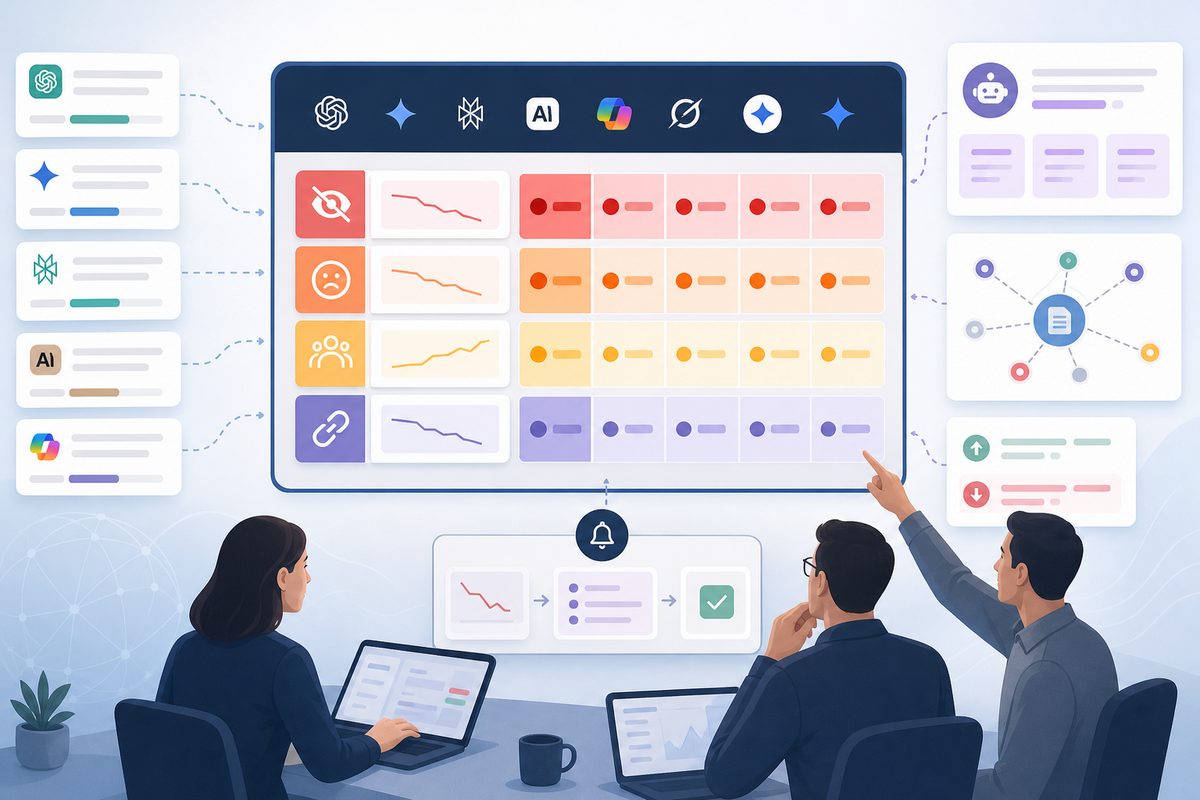
Quick Answer: What Should AI Visibility Alerts Track?
AI visibility alerts should track six event types: lost brand mentions, harmful or false claims, competitor gains, citation shifts, crawl or indexing problems, and AI referral anomalies. The alert should compare the new result with a rolling baseline and assign severity based on risk, commercial intent, persistence, and source evidence.
Use this rule of thumb:
| Alert type | Same-day action? | Why |
|---|---|---|
| False security, legal, privacy, pricing, or product claim | Yes | Reputation and sales risk can happen from one answer |
| Brand disappears from a bottom-funnel shortlist across engines | Yes | High purchase intent and material visibility loss |
| Competitor gains first recommendation across high-intent clusters | Usually | Competitive displacement risk |
| Citation changes to outdated or unsupported source | Sometimes | Depends on whether the answer meaning changed |
| One low-intent prompt changes wording once | No | Normal AI answer variance |
| One citation order change with no claim change | No | Monitoring signal, not an incident |
Why AI Visibility Alerts Need Different Rules Than SEO Rank Alerts
SEO rank alerts usually compare a URL's position in a search result. AI visibility alerts monitor a synthesized answer. That means the unit of analysis is not just a rank. It includes:
- Whether the brand is mentioned.
- Whether the brand is recommended.
- Whether it appears first, top three, or only in passing.
- Which sources are cited.
- Whether the answer repeats accurate claims.
- Whether competitors gain share of voice.
- Whether source pages are crawlable and indexable.
Google's own guidance for AI features says AI Overviews and AI Mode may use query fan-out, may show different responses and links, and require pages to be indexed and eligible for a snippet to appear as supporting links in Search AI features. Google also says there are no special schema files or AI text files required for those features, so crawlability, accessible text, useful content, and source quality still matter most. See Google Search Central's AI features guidance.
For ChatGPT search visibility, OpenAI documents separate crawlers. OAI-SearchBot is for search, while GPTBot is for training. OpenAI says sites that block OAI-SearchBot will not be shown in ChatGPT search answers, although they may still appear as navigational links. See OpenAI's crawler documentation.
The implication: AI search monitoring must combine answer analysis, citation analysis, and technical access checks.
Why One Answer Change Is Usually Not Enough
AI visibility measurement is noisy. A 2026 arXiv preprint by Ronald Sielinski on AI visibility uncertainty found that repeated runs across Perplexity Search, OpenAI SearchGPT, and Google Gemini produced substantial citation variability. The paper argues that single-run citation share and prevalence can create a misleadingly precise view of visibility. See Quantifying Uncertainty in AI Visibility.
For alerting, that means a single changed answer is a sample, not proof.
| Pattern | Treat as noise | Treat as signal |
|---|---|---|
| One prompt changes in one engine | Yes | No |
| One low-intent prompt omits the brand | Yes | No |
| A high-intent prompt cluster drops for two daily runs | No | Yes |
| A harmful false claim appears once | No | Yes |
| A competitor moves up once in one answer | Yes | No |
| A competitor becomes first recommendation across engines | No | Yes |
| A priority page becomes noindexed | No | Yes |
The exception is reputation risk. A false breach, compliance, legal, pricing, or product availability claim should escalate immediately even if it appears once.
The Six AI Visibility Alerts Worth Setting Up
1. Lost Mention Alerts
Lost mention alerts fire when your brand disappears from answers where it previously appeared. They should be based on prompt clusters, not isolated prompts.
A practical threshold:
| Alert condition | Severity |
|---|---|
| Brand disappears from all tracked engines for a bottom-funnel cluster where it previously appeared in 30% or more of answers | P0 |
| Brand mention rate drops by 40% or more for two consecutive daily runs in a high-intent cluster | P1 |
| Brand falls out of the first three recommendations in two or more engines | P1 |
| Brand mention rate drops by 15% to 40% in a medium-intent cluster | P2 |
| One answer omits the brand with no cluster-level movement | P3 |
The first investigation should not be "publish more blog posts." Start with evidence:
- Did citations change?
- Did a competitor gain a stronger source?
- Did an owned page change, redirect, or become less accessible?
- Did the prompt cluster shift from informational to comparison intent?
- Did the answer still solve the same user problem?
For same-day handling, use a dedicated AI search alert triage workflow so the team moves from notification to evidence without debating process.
2. Negative Claim Alerts
Negative claim alerts should fire when an AI answer makes a new harmful, false, outdated, or unsupported claim about the brand. These alerts need stricter escalation rules than visibility drops because one answer can affect sales calls, renewals, analyst research, investor diligence, or customer trust.
Escalate as P0 when the claim touches:
- Security incidents
- Privacy or data handling
- Legal status
- Compliance
- Pricing
- Product availability
- Safety
- Acquisitions, layoffs, or shutdowns
- Medical, financial, or regulated use claims
Examples:
| New AI claim | Severity | First owner |
|---|---|---|
| "The company had a data breach in 2026" with no valid source | P0 | Comms, legal, security |
| "The product has been discontinued" | P0 | Product marketing |
| "Pricing starts at $499/month" when pricing is not public | P1 | Growth, sales ops |
| "The tool lacks SOC 2" when SOC 2 is current | P1 | Security, SEO |
| "Some users report slow support" from a cited review page | P2 | Customer marketing |
The evidence pack should include the prompt, engine, timestamp, location, answer text, cited URLs, screenshot, and classification: false, outdated, unsupported, misleading, or fair criticism.
3. Competitor Gain Alerts
Competitor gain alerts should measure AI share of voice, first recommendation rate, and shortlist inclusion. A competitor moving from third to second once is not urgent. A competitor becoming the default answer across buying prompts is.
Use cluster-level thresholds:
| Competitive movement | Severity |
|---|---|
| Competitor becomes first recommendation in three or more high-intent clusters | P1 |
| Competitor gains 15 percentage points or more of AI share of voice over the 7-day baseline | P1 |
| Competitor appears in answers where no competitor previously appeared | P2 |
| Competitor gains citations from a newly influential third-party page | P2 |
| Competitor swaps one position once in a low-intent prompt | P3 |
The useful question is not "Why did they outrank us once?" The useful question is: Which source, proof point, category label, or entity signal made the answer engine trust them for this job-to-be-done?
Compare cited pages, claim language, review coverage, third-party validation, documentation freshness, and comparison-page clarity.
4. Citation Shift Alerts
Citation shift alerts matter when AI engines stop citing the pages that best support accurate claims about your brand. Citation count alone is not enough. A source can be cited without shaping the final answer.
A 2026 arXiv preprint on citation selection and citation absorption analyzed 602 prompts across ChatGPT, Google AI Overview/Gemini, and Perplexity, including 21,143 valid search-layer citations and 18,151 successfully fetched pages. It found that citation breadth and answer-level influence are different outcomes. See From Citation Selection to Citation Absorption.
A citation alert should answer five questions:
| Question | Why it matters |
|---|---|
| Did the cited URL change? | A weaker source may introduce outdated facts |
| Did the answer's claim language change? | The new source may be shaping the answer |
| Is the cited page accessible and indexable? | Inaccessible pages reduce future eligibility |
| Is the source owned, earned, partner, forum, or competitor-controlled? | Source type determines the fix |
| Does the citation support the exact claim? | Unsupported citations create trust risk |
A strong GEO citation tracking process maps every citation shift to a source fix: update owned content, improve documentation, correct third-party data, pitch earned media, or clarify entity facts.
5. Crawl and Indexing Alerts
Crawl and indexing alerts should fire before the content team starts rewriting. If the source cannot be accessed, the best paragraph on the page will not help.
Watch for:
- Priority URLs returning 4xx or 5xx errors.
- Accidental
noindextags. - Robots.txt changes blocking Googlebot, OAI-SearchBot, PerplexityBot, or other relevant crawlers.
- CDN or firewall rules blocking known crawler IPs.
- Canonical tags pointing to the wrong URL.
- JavaScript rendering changes hiding core text.
- Removed Organization, Product, Review, or Article structured data.
- Pricing, comparison, security, or documentation pages removed during redesigns.
Escalate as P1 when the affected page supports a high-intent prompt cluster. Escalate as P0 when the technical issue coincides with a launch, pricing change, funding announcement, security update, or category campaign.
6. AI Referral and Demand Anomaly Alerts
AI visibility is not only in-answer visibility. Teams should also watch downstream signals:
- Referral sessions from ChatGPT, Perplexity, Claude, Copilot, and other AI surfaces.
- Brand search changes after AI recommendation gains or losses.
- Direct traffic changes to cited pages.
- Sales-call mentions of AI-sourced claims.
- Demo form text that references an AI answer.
- Support tickets asking about a false or outdated claim.
Treat these as supporting evidence, not the alert trigger by itself. Referral data is incomplete because many AI-influenced visits arrive as direct, organic, or branded search.
A 2026 observational arXiv preprint on AI brand recommendations found that when a conversational assistant recommended a brand to users with no recent observed engagement, same-name Google search rose by 4.3 percentage points and visits to the brand's own site rose by 2.4 percentage points over matched backward placebos. The study is observational and did not observe transactions, but it is a useful reminder that AI recommendations can influence demand outside standard referral reports. See From Prompt to Purchase.
Build the Baseline Before Turning Alerts On
An AI visibility alert without a baseline is just a notification. The baseline should group prompts by intent, engine, market, persona, and business value.
For a B2B SaaS brand, start with 50 to 150 prompts across these clusters:
| Cluster | Example prompt | Business role |
|---|---|---|
| Category discovery | "best customer onboarding software" | Early shortlist formation |
| Use case | "tools to reduce SaaS churn during onboarding" | Problem-solution mapping |
| Comparison | "Product A vs Product B for mid-market SaaS" | Vendor evaluation |
| Alternative | "alternatives to Product A for enterprise teams" | Competitive displacement |
| Pricing and packaging | "how much does Product A cost?" | Sales friction |
| Risk and compliance | "is Product A SOC 2 compliant?" | Trust validation |
| Brand validation | "is Product A good for enterprise onboarding?" | Bottom-funnel confidence |
Use at least 14 days of daily observations before firing automated P1 or P2 alerts. For volatile clusters, 28 days is better. P0 negative-claim alerts can go live immediately because risk outweighs statistical confidence.
Track each observation with the same fields:
| Field | Example |
|---|---|
| Prompt cluster | Enterprise security comparison |
| Exact prompt | "best security questionnaire automation tools for enterprise SaaS" |
| Engine | ChatGPT search |
| Persona or market | US, enterprise buyer |
| Baseline value | 46% brand mention rate over 28 days |
| New value | 24% over two daily runs |
| Cited URLs | Owned security page replaced by 2024 third-party list |
| Claim change | SOC 2 proof point removed |
| Severity | P1 |
| Owner | SEO and security marketing |
| First action | Validate crawl access and update proof source |
For dashboard setup, connect alert thresholds to the same weekly scorecard used by leadership. The AI visibility dashboard metrics should show trend, severity, owner, and status, not only screenshots.
Use a Four-Level Severity Model
A four-level system keeps alerts readable. The severity should combine harm, commercial intent, persistence, and confidence.
| Severity | Meaning | Response time | Example |
|---|---|---|---|
| P0 | Direct reputation risk or severe revenue risk | Same day | False breach claim appears in ChatGPT and Perplexity |
| P1 | Material commercial risk | 1 business day | Brand drops from top-three recommendations across a bottom-funnel cluster |
| P2 | Optimization opportunity | Weekly review | Citation shifts from owned page to weaker third-party source |
| P3 | Monitoring noise | No immediate action | One low-intent prompt changes wording once |
This model prevents two common mistakes: overreacting to random movement and underreacting to one high-risk false claim.
The Alert Routing Matrix
An alert routing matrix turns AI visibility alerts into an operating process. Every alert should have an evidence rule, severity, owner, and first action.
| Event | Evidence required | Severity | Owner | First action |
|---|---|---|---|---|
| Lost brand mention | 40%+ drop across high-intent cluster for two runs | P1 | SEO | Compare citations, crawl status, and competitor movement |
| False high-risk claim | One confirmed answer in a key engine | P0 | Comms, legal | Capture evidence and approve correction path |
| Competitor first recommendation gain | Three or more high-intent clusters | P1 | Product marketing | Compare proof points and source language |
| Citation source downgrade | New source is outdated, weak, or unsupported | P2 | SEO, content | Map claim to stronger owned or earned source |
| Crawl or indexing issue | Priority URL blocked, noindexed, or inaccessible | P1 | Technical SEO | Restore access and validate crawling |
| AI referral anomaly | Referral spike or drop plus answer change | P2 | Growth | Match referral path to prompt and cited page |
| Low-intent wording change | One prompt, one engine | P3 | None | Log only |
Severity should stay editable. A prompt about "best tools for enterprise security compliance" may be P1 for a cybersecurity vendor and P3 for a design tool. Intent controls urgency.
Worked Example: SaaS Launch Week
A launch week alert setup should suppress expected movement while escalating unplanned claims. Create a temporary watchlist for launch prompts, approved facts, product names, pricing language, competitor comparisons, and priority citations.
Example: a B2B SaaS company launches a new analytics module. The team tracks 120 prompts across eight engines for 14 days before launch. That creates 13,440 answer observations. During launch week, 31 raw changes appear. Only five deserve action.
| Raw event | Classification | Severity | Why |
|---|---|---|---|
| New module appears in 19 more answers | Expected movement | P3 | Planned launch visibility |
| Brand drops from 38% to 21% in "best analytics tools for SaaS CFOs" | Lost mention | P1 | High-intent cluster, two-day persistence |
| AI answer says the module includes "automated tax filing" | False claim | P0 | Unsupported regulated claim |
| Competitor earns first recommendation in one low-intent prompt | Competitor movement | P3 | Single answer, low commercial value |
| Citation changes from launch page to outdated partner page | Citation shift | P2 | Source freshness risk |
| Pricing answer shows old package names in two engines | Outdated claim | P1 | Sales enablement risk |
The useful metric is not raw alert count. It is severity-filtered workload. In this example, 31 changes became one P0, two P1s, one P2, and 27 logged observations.
How to Write Alert Messages People Trust
An alert message should be short, specific, and evidence-rich. If it does not show the baseline, new value, affected prompt set, confidence, and recommended first action, the team will either ignore it or overreact.
Use this format:
P1: Lost mention in enterprise security cluster
Brand mention rate dropped from a 46% 28-day baseline to 24% across 18 high-intent prompts. The change repeated in ChatGPT, Gemini, and Perplexity across two daily runs. Main citation changed from the owned security overview page to a third-party comparison page last updated in 2024. Recommended action: validate crawl access, update security proof points, and review competitor citation gains.
Good alert copy includes uncertainty. Say "two daily runs," "three engines," or "one answer only." Confidence language builds trust because it shows the alert is not pretending to be more precise than the data supports.
What Not to Alert On
Most AI visibility changes should not wake the team. Treat these as noise unless they repeat or affect a commercially important cluster:
| Event | Why it can wait |
|---|---|
| One low-intent prompt no longer mentions the brand | Not enough evidence |
| The brand moves from second to third once | Normal answer volatility |
| Citation order changes but claims stay accurate | No clear harm |
| A competitor appears in an educational prompt | Not necessarily buying intent |
| The answer paraphrases positioning without changing meaning | No factual issue |
| One AI referral session appears from a new surface | Too small for action |
This is alert hygiene. Teams that chase every movement burn out before the real incident arrives.
What Needs Same-Day Action?
Same-day action is required when an AI answer can mislead buyers, damage trust, or erase the brand from a commercially important shortlist.
Escalate immediately when:
- A false legal, security, privacy, compliance, safety, or financial claim appears.
- A product is described as discontinued, unavailable, breached, unsafe, or materially limited when that is untrue.
- The brand disappears from a bottom-funnel shortlist across multiple engines.
- A competitor becomes first recommendation across high-intent prompts during an active campaign.
- A priority page becomes blocked, noindexed, deleted, or inaccessible.
- A cited source is wrong and appears to drive the answer.
- Pricing, packaging, or availability claims conflict with the sales team's approved language.
Same-day does not always mean public correction. It means same-day evidence capture, source verification, owner assignment, and decision logging.
Turn Alerts Into a Prioritized Backlog
P0 and P1 alerts are incidents. P2 alerts are backlog candidates. P3 alerts are trend history.
A weekly AI visibility review should ask:
- Which P0 or P1 incidents were resolved?
- Which P2 issues repeated enough to promote?
- Which source pages need updates?
- Which competitor gains reveal missing proof points?
- Which prompt clusters need better segmentation?
- Which alerts fired too often and need threshold tuning?
- Which fixes changed mention rate, citation quality, or claim accuracy?
For leadership, do not send every answer screenshot. Use a concise AI visibility report template that shows severity, affected prompt cluster, business impact, action taken, and recovery status.
Build, Buy, or Use a Hybrid Alerting System?
Teams usually choose one of three setups:
| Setup | Best for | Limits |
|---|---|---|
| Spreadsheet plus manual checks | Small prompt sets, early learning | Hard to scale, weak evidence history |
| Workflow automation | Teams with stable prompt clusters and internal data pipelines | Requires maintenance and QA |
| AI visibility platform | Multi-engine monitoring, executive reporting, competitor tracking | Requires data privacy and methodology review |
Before signing up for a platform, ask how it handles prompt sampling, locations, personalization, screenshots, citation extraction, data retention, and customer data access. For a buyer-side checklist, see AI visibility tool data privacy.
A hybrid setup often works best: use automated AI search monitoring for daily detection, then keep human review for P0 and P1 classification.
Common Questions
What are AI visibility alerts?
AI visibility alerts are notifications that detect meaningful changes in how AI answer engines mention, recommend, cite, or describe a brand. They are useful when they include baseline comparison, severity, affected prompt cluster, cited sources, business impact, and the next owner.
How many prompts do AI visibility alerts need?
Most B2B teams should start with 50 to 150 prompts grouped by intent, use case, persona, market, and buying stage. Fewer prompts are easier to review but can overfit to wording. More prompts improve coverage but require stronger clustering and threshold rules.
Should AI visibility alerts run daily or weekly?
Run daily checks for branded, bottom-funnel, launch, pricing, risk, and competitor clusters. Run weekly checks for low-priority informational prompts. Daily monitoring catches incidents faster, but weekly reviews are better for backlog planning and threshold tuning.
Are AI visibility alerts the same as SEO rank alerts?
No. SEO rank alerts track search result positions. AI visibility alerts track mentions, recommendations, citations, claim accuracy, sentiment, source influence, and competitor share inside AI-generated answers. The two overlap because AI systems retrieve web sources, but the output is not a traditional ranked SERP.
What is the best first AI visibility alert to set up?
Start with a P0 negative-claim alert for branded and high-intent prompts. It protects reputation before the team optimizes for more visibility. The second alert should be a lost-mention alert for bottom-funnel category, alternative, and comparison prompts.
Can Google Search Console show AI visibility alerts?
Not directly. Google says traffic from AI features such as AI Overviews and AI Mode is included in Search Console's Web search type reporting, but Search Console does not provide prompt-level answer text, citations, or mention share. Use Search Console for supporting traffic evidence, not complete AI answer monitoring.
Which AI visibility alerts should agencies report to clients?
Agencies should report severity, affected prompt cluster, engine coverage, screenshots, source changes, recommended fixes, owner, status, and recovery trend. Avoid sending every raw answer change. Clients need a decision log: what happened, why it matters, what was done, and whether visibility recovered.
How do you reduce false positives in AI visibility alerts?
Use prompt clusters, rolling baselines, two-run persistence for ordinary visibility changes, severity rules, and manual review for high-risk claims. Do not alert on one low-intent prompt changing once. Do alert immediately on false legal, security, privacy, compliance, or pricing claims.