An AEO reporting template should answer one executive question: are AI answer engines recommending, citing, and describing the company in ways that help buyers choose it?
The best monthly report is not a keyword ranking deck with AI labels. It is a short management document that shows AI visibility, competitive position, citation quality, answer accuracy, execution progress, and the one decision the business needs to make this month.
Use this template for reporting across ChatGPT, Gemini, Perplexity, Claude, Copilot, Grok, Google AI Mode, and Google AI Overviews.
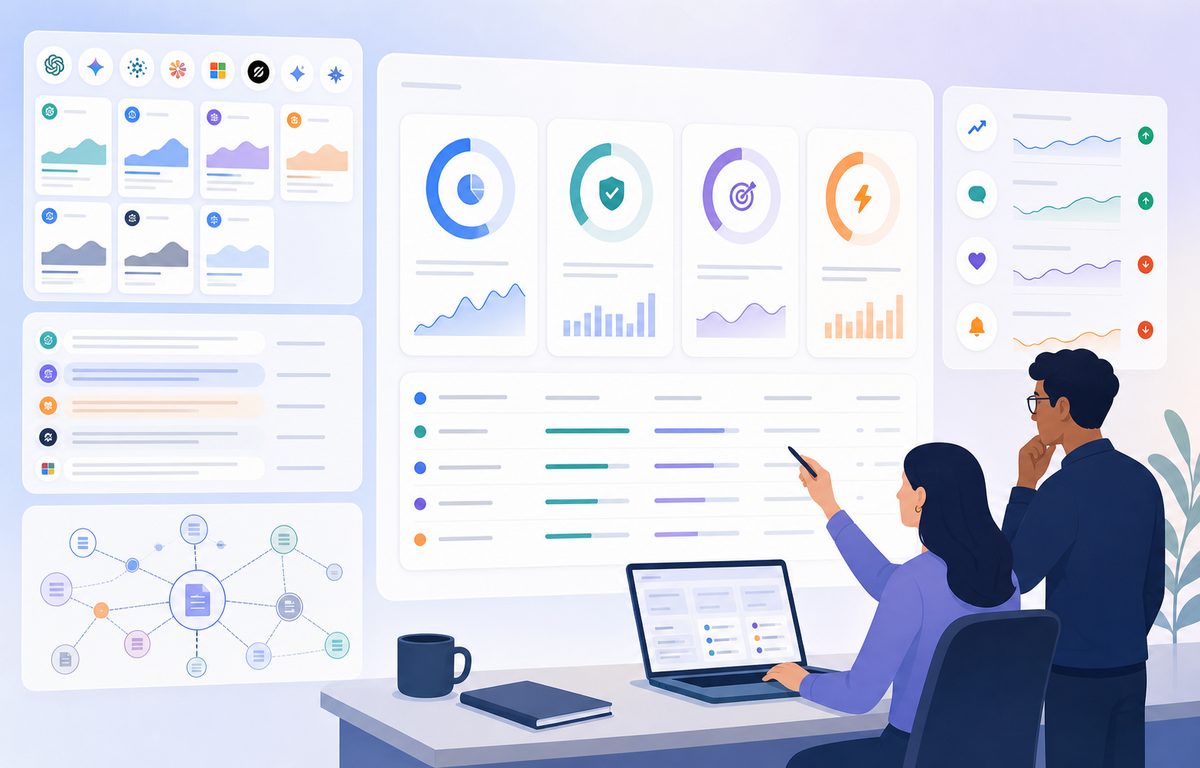
Copy-ready AEO reporting template
Use this structure when the audience is a CMO, founder, VP marketing, communications leader, or board member. Put raw prompts, full screenshots, and tool exports in the appendix.
# Monthly AEO Executive Report

Period:
Business unit, product, or market:
Tracked prompt set:
AI engines monitored:
Primary competitors:
Measurement cadence:
Report owner:

## 1. Executive Readout
What changed:
Why it changed:
Decision needed this month:

## 2. Five-Metric Scorecard
Recommendation coverage:
AI share of voice:
Citation health:
Answer accuracy and sentiment:
Fix velocity:

## 3. Competitive Shortlist Movement
Prompt clusters where we gained:
Prompt clusters where we lost:
Competitors gaining visibility:
Competitors losing visibility:

## 4. Citation and Source Risks
Top cited sources:
Outdated sources:
Missing proof points:
Third-party source gaps:
Sources to update or replace:

## 5. Accuracy and Reputation Risks
Critical issues:
High-risk issues:
Recurring misconceptions:
Owner and escalation path:

## 6. Fix Backlog
Priority:
Owner:
Fix type:
Expected impact:
Due date:
Retest date:

## 7. Appendix
Prompt list:
Screenshots:
Citations:
Engine-level exports:
Methodology notes:
Confidence notes:
Keep the first page under 200 words. Executives should not have to inspect every AI answer to understand the business implication.
What is an AEO reporting template?
An AEO reporting template is a recurring report for answer engine optimization. It measures how often AI systems mention, recommend, cite, rank, and accurately describe a brand across buyer prompts, then translates those signals into risks, opportunities, owners, and next actions.
Unlike SEO reporting, AEO reporting measures the generated answer itself: whether the brand appears, where it appears, which competitors appear nearby, what sources are cited, whether the description is correct, and what needs to be fixed in content, PR, product marketing, structured data, or third-party sources.
If your team is still separating AEO, GEO, and SEO terminology, start with the maxaeo guide to AEO vs GEO vs SEO. For reporting, the practical distinction is simple: SEO reports what happens in search results; AEO reports what happens inside the answer.
What ranking pages usually miss
A July 7, 2026 editorial SERP spot check for “AEO reporting template” showed a thin result set. Most visible pages explain AEO definitions, AI search monitoring, GEO measurement, or classic SEO report templates. Few give a board-ready monthly reporting artifact.
That gap matters because executives do not need a prompt dump. They need a defensible answer to four questions:
- Are we being recommended when buyers ask AI systems for options?
- Are competitors being recommended more often or more prominently?
- Are AI systems citing sources that support our desired positioning?
- What fixes should we approve this month?
This article uses maxaeo’s 5-3-1 reporting model:
| Layer | What it means | Why it matters |
|---|---|---|
| 5 metrics | Recommendation coverage, AI share of voice, citation health, answer accuracy, fix velocity | Keeps the report focused |
| 3 narrative lines | What changed, why it changed, what decision is needed | Turns monitoring into management |
| 1 decision | The budget, priority, owner, or tradeoff required this month | Prevents passive reporting |
The five metrics every AEO report should include
The monthly AEO reporting template should include five metrics: recommendation coverage, AI share of voice, citation health, answer accuracy, and fix velocity. Together, they show visibility, competitive position, source quality, reputation risk, and whether the team is acting on the findings.
| Metric | Executive question answered | Primary owner |
|---|---|---|
| Recommendation coverage | Are we appearing in buyer answers? | SEO or growth |
| AI share of voice | Are we gaining or losing against competitors? | Growth or product marketing |
| Citation health | Are the right sources supporting the answer? | SEO, PR, content |
| Answer accuracy and sentiment | Is the brand being described correctly? | Product marketing, comms |
| Fix velocity | Are we turning findings into movement? | Program owner |
1. Recommendation coverage
Recommendation coverage is the percentage of tracked buyer prompts where the brand appears as a relevant option, recommendation, cited source, or shortlist candidate.
Formula:
Recommendation coverage = prompts where the brand appears / total tracked buyer prompts
Segment this by prompt cluster. A blended score can hide the real issue:
| Prompt cluster | Coverage | Readout |
|---|---|---|
| Category discovery | 52% | Buyers can find the brand early |
| Competitor comparison | 18% | The brand is weak in replacement searches |
| Use-case fit | 41% | Good visibility for known pain points |
| Enterprise trust | 9% | Proof and third-party validation are missing |
Use commercial prompts, not random informational prompts. For a B2B SaaS company, useful prompts include “best customer data platforms for mid-market SaaS,” “alternatives to [competitor],” and “tools for reducing support ticket volume with AI.” The maxaeo guide to keyword research for AI search explains how to build prompt sets from buyer language rather than traditional keyword volume alone.
2. AI share of voice
AI share of voice measures how much of the answer space the brand earns compared with named competitors. It is stronger than a mention count because it reflects shortlist strength.
A simple weighting model works for executive reporting:
| Position in answer | Suggested weight |
|---|---|
| First recommendation | 3 |
| Top-three recommendation | 2 |
| Mentioned but not recommended | 1 |
| Not mentioned | 0 |
Formula:
AI share of voice = brand weighted mentions / total weighted mentions for tracked competitors
Report both the overall score and the competitor gap. “We have 17% AI share of voice” is less useful than “we rose from 12% to 17%, but Competitor A still owns 31% of high-intent comparison answers.”
3. Citation health
Citation health measures whether AI systems support brand claims with sources that are accurate, current, authoritative, and commercially useful.
Do not only count citations. A cited page can still be stale, off-message, thin, or less persuasive than a competitor’s source. The 2026 paper “From Citation Selection to Citation Absorption” separates whether a page is cited from whether it actually influences the generated answer, which is the distinction executives need.
Track four citation sub-metrics:
| Sub-metric | What to track |
|---|---|
| Citation rate | Percentage of brand claims with a source attached |
| Source mix | Owned site, earned media, analyst pages, directories, reviews, forums |
| Source freshness | Age of cited pages and whether facts are still current |
| Citation usefulness | Whether the source supports the desired category, use case, or proof point |
Citation health is where SEO, PR, analyst relations, and content teams meet. If AI answers cite old funding news, stale directory profiles, or outdated third-party comparisons, the fix may be earned media, profile cleanup, analyst briefings, or better proof pages rather than another blog post.
4. Answer accuracy and sentiment
Answer accuracy measures whether AI systems describe the brand correctly. Sentiment measures whether the brand is framed positively, neutrally, negatively, or with damaging ambiguity.
Use a severity model:
| Severity | Example | Action |
|---|---|---|
| Critical | Wrong pricing, compliance, security, acquisition, or legal claim | Escalate immediately |
| High | Wrong category, missing core feature, outdated positioning | Fix source material this month |
| Medium | Weak comparison language or incomplete use-case fit | Add clearer proof and examples |
| Low | Minor wording issue with no buyer impact | Monitor |
This metric belongs on page one. A brand can be recommended often and still lose deals if the answer says it lacks a feature, market, certification, or integration that already exists.
5. Fix velocity
Fix velocity measures whether the team is acting on the report and whether fixes are changing AI answers over time.
Track fixes in four stages:
- Diagnosed: the issue is confirmed with prompts, screenshots, citations, and affected engines.
- Shipped: the team updated source content, structured data, third-party profiles, PR assets, or internal links.
- Rechecked: the same prompt set was tested again after crawl and update windows.
- Moved: coverage, share of voice, citation quality, or answer accuracy improved.
Formula:
Fix velocity = fixes that moved / fixes shipped
Fix velocity protects budget. It shows whether AEO is an operating program, not just monitoring.
How to collect defensible AEO data
Defensible AEO reporting requires a fixed prompt set, repeated measurement, engine-level tagging, source capture, and methodology notes. Without that discipline, the report becomes anecdotal.
Start with a prompt universe that reflects real buyer behavior:
| Prompt cluster | Example prompt |
|---|---|
| Category discovery | “What are the best tools for monitoring AI search visibility?” |
| Competitor comparison | “Compare [brand] vs [competitor] for enterprise SaaS teams.” |
| Use-case fit | “Which platform helps PR teams monitor brand mentions in ChatGPT?” |
| Problem-led search | “How do I know whether AI assistants recommend my company?” |
| Risk and trust | “Is [brand] reliable for AI reputation management?” |
| Branded validation | “What are the pros and cons of [brand]?” |
| Regional or language fit | “Best AI visibility tools for German B2B companies.” |
For multilingual markets, do not translate the English prompt set and assume it is equivalent. Buyer wording, competitors, and source pools can change by language. maxaeo’s guide to multilingual AEO covers why AI recommendations can differ across markets.
Capture the same fields every time:
| Field | Why it matters |
|---|---|
| Engine | Shows platform-specific movement |
| Prompt | Keeps the test reproducible |
| Timestamp | AI answers change over time |
| Location and language | Controls for regional variation |
| Brand mention | Basic presence signal |
| Recommendation rank | Shows shortlist strength |
| Competitors mentioned | Powers share-of-voice analysis |
| Citations | Shows source influence |
| Sentiment | Flags reputation direction |
| Accuracy notes | Captures factual risk |
| Screenshot or export | Preserves evidence |
| Methodology note | Prevents overclaiming |
Repeated measurement matters because AI answers are variable. The 2026 paper “Quantifying Uncertainty in AI Visibility” argues that single-run citation metrics can look more precise than they are and should be treated as samples from a response distribution.
A practical cadence:
| Situation | Recommended cadence |
|---|---|
| Stable monthly executive reporting | Weekly captures |
| Product launch or repositioning | Two to three captures per week |
| Acquisition, crisis, or reputation risk | Daily monitoring |
| One-off editorial audit | At least three runs per priority prompt |
How to grade confidence
Every AEO reporting template should include a confidence column. AI search monitoring has more variance than classic rank tracking, so executives need to know which movements are durable and which are directional.
Use this model:
| Confidence | When to use it | How to explain it |
|---|---|---|
| High | Movement appears across multiple engines, prompts, and captures | “Likely a real pattern.” |
| Medium | Movement appears in one major engine or one prompt cluster | “Actionable, but retest next cycle.” |
| Low | Movement comes from a single run, isolated screenshot, or unstable prompt | “Treat as a signal, not a conclusion.” |
Do not average away uncertainty. If Perplexity improves because it cites new owned content, but ChatGPT still cites stale third-party pages, say that directly.
One-page AEO scorecard example
A one-page scorecard should show the current month, prior month, change, confidence, business meaning, and next action.
| Metric | Prior | Current | Change | Confidence | Meaning | Next action |
|---|---|---|---|---|---|---|
| Recommendation coverage | 18% | 26% | +8 pts | Medium | More shortlist inclusion | Expand pages that moved |
| AI share of voice | 12% | 17% | +5 pts | Medium | Still behind two rivals | Improve comparison proof |
| Citation health | 41% useful | 48% useful | +7 pts | High | Better source support | Refresh weak third-party sources |
| Accuracy risk | 9 high-risk answers | 5 high-risk answers | -4 | High | Fewer damaging answers | Escalate remaining feature errors |
| Fix velocity | 14 shipped / 9 moved | 18 shipped / 11 moved | +2 moved | Medium | Execution is producing movement | Continue monthly sprint |
The executive narrative would read:
“AI recommendation coverage improved from 18% to 26% across 80 high-intent prompts, driven by updated comparison content and better citation pickup in Perplexity and Gemini. The main gap is still ChatGPT, where answers cite older third-party sources and understate enterprise readiness. This month’s decision is whether to fund two third-party proof assets and prioritize fixes for the 12 prompts tied to competitor replacement.”
That paragraph is more useful than a 40-slide export.
How to write the executive narrative
Use three lines: what changed, why it changed, and what decision is needed.
- What changed: “Recommendation coverage rose from 18% to 26% across high-intent comparison prompts.”
- Why it changed: “The gain came from Perplexity and Gemini citing the updated comparison page and two new third-party reviews.”
- Decision needed: “Approve two earned-media placements and one product proof page to close the ChatGPT citation gap.”
Avoid vague explanations such as “AI visibility improved.” Name the prompt cluster, engine, source, and business implication.
What to include and what to cut
The executive report should show answer patterns, not every answer instance.
| Cut from the main report | Replace with |
|---|---|
| 50 screenshots of AI answers | Three representative screenshots with business implications |
| Raw prompt exports | Prompt-cluster performance |
| “ChatGPT said something strange” | Severity-tagged accuracy risk |
| AI referral traffic without context | Referral trend plus platform-growth caveat |
| Every citation URL | Source mix and citation-risk summary |
| Generic “AEO is important” slides | One decision request |
Be careful with traffic claims. A 2026 log-based study on ChatGPT referral traffic found that raw ChatGPT referrals rose 5.7x on one domain, while untreated pages on the same domain rose 3.5x; the intervention-aligned estimate was 1.82x with uncertainty noted in the paper (Watanabe and Nakayashiki, 2026). The reporting lesson: do not claim every AI referral increase as an AEO win.
Google also says performance from AI Overviews and AI Mode is included in the Search Console Performance report under the “Web” search type, not broken into a separate AI-only report. That makes AI referral traffic useful, but incomplete.
How AEO reporting connects to execution
AEO reports should create work for the right owners: SEO fixes owned by search teams, source credibility fixes owned by PR, message accuracy owned by brand or product marketing, and commercial prompt gaps owned by growth.
| Issue found | Likely owner | Example fix |
|---|---|---|
| Brand missing from category prompts | SEO/content | Build or update a category explainer with definitions, comparisons, and proof |
| Competitor dominates recommendations | Product marketing | Publish sharper differentiation and evidence |
| AI cites stale third-party pages | PR/comms | Update profiles, secure current coverage, brief analysts |
| Wrong feature claims | Product marketing | Refresh product pages, docs, schema, and comparison pages |
| Weak language or regional coverage | Regional marketing | Build localized source material and citations |
| No source attached to claims | SEO/content | Add quotable evidence, data, examples, and internal links |
AEO reporting also has to account for how answer engines use different source layers. Some answers lean on live web retrieval; others reflect older public knowledge, third-party databases, or cached source material. The maxaeo guide to training data vs the live web explains why fixes may move quickly in one engine and slowly in another.
How to keep the report aligned with Google’s rules
AEO reporting should reward helpful, accurate, visible information, not tricks. Google’s AI features and your website guidance says the same foundational SEO practices apply to AI Overviews and AI Mode, and that there are no additional technical requirements, special schema, or AI text files required to appear.
Use that as a guardrail:
| Fix proposal | Quality question |
|---|---|
| New comparison page | Does it add real decision criteria, proof, and limitations? |
| New FAQ section | Does it answer buyer questions directly and accurately? |
| Digital PR campaign | Does it create credible third-party evidence? |
| Schema update | Does structured data match visible page content? |
| Product proof page | Does it include verifiable facts, examples, and current details? |
| llms.txt update | Is it being used as crawler guidance, not reported as a Google ranking lever? |
Google’s helpful, reliable, people-first content guidance asks whether content provides original information, complete coverage, insightful analysis, and value beyond what already appears in search results. That is the right standard for AEO fixes too.
The foundational GEO paper found that visibility can improve when content adds citations, statistics, and authoritative evidence. The useful interpretation is not “add random numbers.” It is: AI systems and human buyers both need extractable, trustworthy evidence.
For AI crawler policy, maxaeo’s guide to llms.txt and AI visibility is a useful companion, but do not present llms.txt as a substitute for crawlable, useful, well-sourced content.
Agency version of the template
Agencies should keep the same five-metric structure but add portfolio and accountability views. The client should see outcomes and decisions, not tool exports.
| View | Audience | Purpose |
|---|---|---|
| Executive summary | CMO, founder, VP marketing | Budget, risk, competitive movement |
| Operator backlog | SEO, content, PR, product marketing | Fix ownership and deadlines |
| Evidence appendix | Stakeholders who need proof | Screenshots, prompts, citations, methodology |
| Portfolio rollup | Agency leadership | Client health, risk, renewals, resourcing |
Separate monitoring value from execution value. Monitoring shows what AI systems say. Execution improves the sources those systems use.
Monthly AEO reporting checklist
Use this checklist before sending the report:
- Confirm the prompt set still matches current products, ICPs, competitors, and markets.
- Segment prompts by discovery, comparison, use case, risk, branded, and regional intent.
- Capture repeated measurements rather than one-off screenshots.
- Report recommendation coverage and AI share of voice separately.
- Review citations for quality, freshness, and commercial usefulness.
- Tag answer accuracy and sentiment by severity.
- Add confidence levels to every major movement claim.
- Separate platform growth from AEO-driven movement.
- Show fixes shipped, rechecked, and moved.
- End with one decision request.
The last item is the most important. A report without a decision request is monitoring. A report with a decision request is management.
Frequently Asked Questions
How often should an AEO report be sent to executives?
Executives should receive a monthly AEO report. Weekly reporting is useful for operators, launches, and reputation risks, but monthly is the right cadence for budget decisions, competitive movement, citation quality, and fix velocity.
What is the difference between AEO reporting and SEO reporting?
SEO reporting focuses on rankings, impressions, clicks, technical health, and organic conversions. AEO reporting focuses on whether AI systems mention, recommend, cite, rank, and accurately describe the brand inside generated answers.
Should AI referral traffic be in the report?
Yes, but it should not be the lead metric. AI referral traffic is useful when paired with recommendation coverage, citation health, and platform-growth caveats. Many AI answers influence buyers without sending a click.
Who should own the monthly AEO reporting template?
Marketing should own the executive narrative, SEO should own prompt and source analysis, PR should own earned-source gaps, and product marketing should own positioning accuracy. One person should consolidate the final report.
What is the minimum viable AEO report?
The minimum viable report is one page: tracked prompt set, engines monitored, five-metric scorecard, top three movements, top three risks, fixes shipped, and one decision request. The appendix can hold screenshots and prompt evidence.
Can a company get recommended by ChatGPT just by publishing more content?
Publishing more content is not enough. To get recommended by ChatGPT and other answer engines, the brand needs clear positioning, crawlable source material, credible third-party proof, accurate entity information, and repeated monitoring across buyer prompts.