Multimodal AI search optimization is the process of making a brand retrievable, understandable, and cite-worthy when AI search systems answer with text, voice, images, video, product data, screenshots, charts, and agentic actions. It expands GEO from page rankings to answer-surface diagnostics: which evidence the AI uses, how it describes the brand, and what it recommends next.
The practical risk is simple: a company can rank in Google organic results and still disappear when a buyer asks an AI assistant with a voice prompt, uploads a screenshot, compares vendors by constraints, or asks for a sourced deep research report.
Google's May 20, 2025 AI Mode announcement made that shift explicit. Google described Search users asking "longer and multimodal questions," AI Mode using query fan-out, Search Live using the camera in real time, shopping experiences tied to the Shopping Graph, and custom charts for data-heavy queries (Google AI Mode update). The same announcement said Google Lens was used for more than 1.5 billion visual searches per month.
The goal is not just "get mentioned by ChatGPT." The better question is: when a buyer asks with voice, images, product constraints, or visual proof, does AI have enough evidence to include, cite, and accurately recommend your brand?
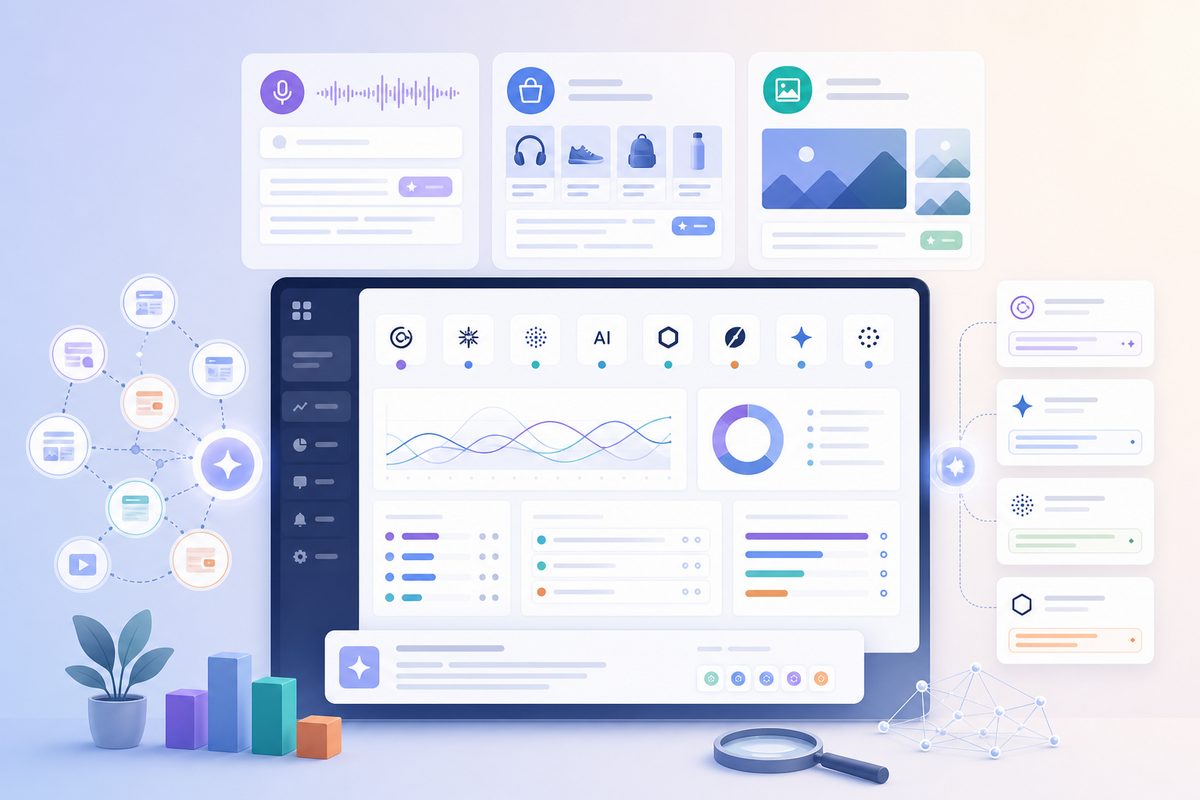
What Multimodal AI Search Optimization Covers
Multimodal AI search optimization covers every answer surface where the input, evidence, or output is not just typed text. That includes spoken questions, image uploads, product feeds, screenshots, videos, charts, reviews, forums, earned media, structured data, and multi-step research agents.
| Surface | Buyer behavior | Evidence AI needs | Main visibility risk | Metric to track |
|---|---|---|---|---|
| Text chat | Asks for definitions, shortlists, comparisons, or recommendations | Clear pages, citations, entity consistency, third-party mentions | Competitors named first or brand omitted | Prompt-level AI share of voice |
| Voice | Asks a compressed question and expects a short answer | Simple entity description, concise proof, unambiguous category fit | One competitor becomes the only answer | Spoken inclusion rate |
| Visual search | Uploads or reviews screenshots, charts, diagrams, or product photos | Alt text, captions, nearby copy, filenames, visible labels, image context | AI cannot connect the asset to the claim | Asset recognition and citation accuracy |
| Shopping-style answers | Compares products by price, use case, integrations, constraints, availability, or reviews | Product facts, structured data, feed data, review evidence, comparison pages | Product filtered out before the shortlist | Shortlist share and reason codes |
| Video-led answers | Learns from demos, tutorials, webinars, or clips | Transcript, chapters, schema, captions, title, surrounding page | Video proof is invisible to retrieval | Video citation and transcript coverage |
| Deep research and agents | Requests a sourced report or delegates a task | Authoritative sources, consistent facts, current pages, earned references | Brand appears in sources but not in the final synthesis | Citation share by source type |
Classic SEO treats the page as the primary unit. Multimodal AI search optimization treats the answer as the primary unit: what the system says, which assets it uses, which sources it cites, which competitors it names, and what action it recommends.
How It Differs From SEO, AEO, and GEO
SEO, AEO, GEO, and multimodal AI search optimization overlap, but they do not solve the same problem.
| Discipline | Primary question | Main unit of work | Typical evidence |
|---|---|---|---|
| SEO | Can the page rank in search results? | Page, site, keyword, technical indexability | Content quality, links, crawlability, structured data |
| AEO | Can the content answer a direct question? | Answer block, FAQ, entity explanation | Concise definitions, lists, schema, featured-snippet structure |
| GEO | Can generative engines cite or recommend the brand? | AI answer, prompt set, citation source | Quotable content, third-party authority, entity consistency |
| Multimodal AI search optimization | Can AI understand the brand across text, voice, visual, shopping, video, and agentic surfaces? | Query, evidence, asset, measurement | Product facts, screenshots, captions, transcripts, feeds, reviews, earned sources |
If you need the broader foundation, start with MaxAEO's guide to what GEO is and how it works. Multimodal optimization is the next layer: it asks whether every answer format has the evidence it needs.
Why This Matters Now
Three shifts make multimodal AI search optimization urgent for SEO and content teams.
First, AI search is becoming more conversational and visual. AI Mode, Lens, Search Live, and other assistant interfaces let users ask questions with a camera, voice, follow-up prompts, and live context. That means images, screenshots, and visual product evidence can influence discovery, not just decoration.
Second, shopping-style reasoning is harder than simple fact retrieval. A 2026 paper, Shopping Reasoning Bench, evaluated 525 shopping missions with 10,863 expert-authored rubric checks. The tested model families reached 57% to 77% overall pass rates, and performance dropped as conversations became more complex. For brands, the implication is practical: assistants need clearer facts for trade-offs, compatibility, pricing logic, and best-fit recommendations.
Third, AI answers compress the market. A search results page might show ten blue links, ads, images, videos, and forums. A voice or AI recommendation may produce three vendors, one source, or one next step. Weak evidence is no longer just a ranking problem; it can become an exclusion problem.
The MaxAEO Q-E-A-M Framework
A practical multimodal program needs four layers: Query, Evidence, Asset, and Measurement. This is the Q-E-A-M framework.
| Layer | What to capture | Example | Why it matters |
|---|---|---|---|
| Query | Prompt, modality, persona, market, intent, device, and surface | "Best AI visibility tool for a B2B SaaS PR team" | The same buyer intent behaves differently in text, voice, visual, and shopping contexts |
| Evidence | Sources, citations, reviews, forums, product data, earned media, and pages used by the answer | Product page, G2 profile, comparison article, documentation, analyst mention | AI recommendations are only as strong as the evidence retrieved |
| Asset | The exact text, screenshot, chart, video, feed, schema, or review supporting the claim | Screenshot of an AI share-of-voice dashboard with caption and method note | Assets become retrieval objects, not just page decoration |
| Measurement | Inclusion, rank, citation, sentiment, accuracy, source type, and fix owner | Mentioned second, cited third-party review, positive sentiment, outdated pricing | Operators need to know what to fix, not just whether the brand appeared |
Most visibility failures fit one of seven states:
- Not retrieved: AI does not find the brand or source.
- Retrieved but not named: A source appears to influence the answer, but the brand is missing.
- Named without citation: The brand appears, but the answer provides no supporting source.
- Cited but misdescribed: The source is used, but the positioning, pricing, or use case is wrong.
- Included with a caveat: The answer mentions the brand but flags uncertainty or limitations.
- Recommended and cited: The brand is included with a useful source.
- Recommended with asset evidence: The answer uses a screenshot, chart, demo, video, or product data to support the recommendation.
That state model makes the work diagnosable. A brand that is named but not cited has a source-quality problem. A brand that is cited but misdescribed has an entity-consistency problem. A brand that loses every shopping-style prompt has a product-evidence problem.
Build a Prompt Set That Matches Real Multimodal Behavior
A useful prompt set should include typed, spoken, visual, shopping, comparison, and research-style queries. Do not build prompts only from your positioning language. Buyers ask with problems, constraints, screenshots, vendor names, budgets, and uncertainty.
Start with 60 to 120 prompts across these categories:
| Prompt type | Example | What it reveals |
|---|---|---|
| Category shortlist | "What are the best AI search monitoring tools for B2B SaaS teams?" | Whether the brand enters the initial consideration set |
| Problem-led | "How can I track when AI tools misdescribe my company?" | Whether the brand maps to the buyer's pain |
| Voice-style | "Give me one tool to monitor brand mentions in ChatGPT and Gemini." | Whether the answer can compress the brand into one clear recommendation |
| Shopping-style | "Compare platforms by daily tracking, citation capture, sentiment, agency reporting, and price transparency." | Whether product facts are comparable |
| Visual-style | "Which dashboard screenshot best proves AI share of voice over time?" | Whether visual evidence is legible and attributable |
| Competitor-led | "Compare MaxAEO with other AI visibility tools for agencies." | Whether AI understands differentiation |
| Deep research | "Create a sourced report on AI search visibility tools for a B2B marketing team." | Which sources survive multi-step synthesis |
| Reputation-risk | "Which vendors in this category have negative AI answer sentiment?" | Whether stale or hostile sources shape perception |
Include no-brand prompts. Branded prompts show whether AI understands you; unbranded prompts show whether AI recommends you. For bottom-of-funnel phrasing, use MaxAEO's guide to high-intent AI search prompts.
Optimize Voice Answers for Entity Clarity
Voice optimization is about winning a scarce answer slot. A spoken result has less room for scanning, source comparison, and nuance. The answer must be clear enough to read aloud and specific enough to build confidence.
For each important page, add a voice-ready answer block that includes:
- Entity: What the brand is in one sentence.
- Category: The exact category the brand belongs to.
- Best fit: Who should use it.
- Primary use case: The problem it solves.
- Proof: One concrete reason to trust the claim.
- Exclusion: Who it is not best for, if relevant.
Example structure:
MaxAEO is an AI search visibility and brand monitoring platform for teams that need to track how tools like ChatGPT, Gemini, Claude, Perplexity, Copilot, and Google AI Mode mention, cite, and describe their brand.
Track voice answers separately from text answers. Record whether the assistant names the brand, pronounces it correctly, describes it accurately, cites a source, and gives a next step that fits the buyer's intent.
Optimize Shopping-Style AI Answers With Comparable Product Evidence
Shopping-style AI answers are not limited to consumer ecommerce. In B2B SaaS, buyers still "shop" by asking assistants to compare vendors by integrations, company size, pricing model, security needs, reporting, service level, and switching cost.
Google's Product structured data documentation says product information can be eligible for richer display across Search, Images, and Lens when Google can understand product facts through structured data, Merchant Center feeds, or both (Google Product structured data). For B2B software, the lesson is broader than schema: product facts must be current, crawlable, and easy to compare.
| Consumer shopping fact | B2B SaaS equivalent |
|---|---|
| Price | Pricing model, plan logic, contract minimums, free trial, usage limits |
| Availability | Sales motion, supported countries, onboarding time, implementation requirements |
| Variants | Plans, modules, seats, agency accounts, enterprise features |
| Compatibility | Integrations, APIs, data sources, CRM/CDP/CMS support |
| Reviews | Review platforms, case studies, customer quotes, analyst mentions |
| Returns | Cancellation, migration, support, service commitments |
| Product identifiers | Brand, product name, category, entity profile, schema where appropriate |
Do not force Product schema onto pages that are not product pages. Instead, make the facts machine-readable where they naturally belong: product pages, pricing pages, comparison pages, documentation, help pages, customer stories, and review profiles.
For each product or platform page, answer five questions directly:
- Who is this product best for?
- Who is it not best for?
- What constraints change the recommendation?
- What proof supports the claim?
- Which facts should an assistant use when comparing it with competitors?
Optimize Visual AI Search, Screenshots, and Charts
Visual AI search is not just image SEO with a new label. A screenshot, chart, or product photo can become answer evidence if the system can connect the asset to a claim.
Google's image SEO guidance says Google uses page content, captions, titles, filenames, alt text, and computer vision to understand images, and recommends placing images near relevant text while avoiding keyword-stuffed alt text (Google image SEO best practices).
Use this asset checklist for important visuals:
- Filename: Describe the asset, product, and context.
- Alt text: State what the image shows, not a keyword list.
- Caption: Explain the claim the image supports.
- Nearby paragraph: Put the conclusion next to the image.
- Visible labels: Make chart axes, legends, UI labels, and product names readable.
- Method note: For benchmarks, include sample size, date range, and measurement method.
- Destination page: Host the image on a crawlable page with relevant copy.
- Freshness: Replace outdated UI screenshots and pricing images before they become stale citations.
A screenshot without context is weak evidence. A screenshot with a caption, method note, and surrounding explanation can support a visual answer, a comparison answer, and a deep research citation.
Optimize for Deep Research and Agentic Answers
Deep research modes change AI visibility because the assistant may run many searches, compare sources, and produce a synthesized report. Google's AI Mode announcement described Deep Search as using query fan-out at a larger scale and issuing hundreds of searches for fully cited reports.
That means one page is rarely enough. A deep research answer may use your site, third-party reviews, forums, documentation, news coverage, comparison pages, and competitor content before deciding whether to cite you. MaxAEO's guide to deep research modes explains why multi-step agents change which brands get cited.
Build source coverage across four evidence types:
| Evidence type | What to create or improve | Why it matters |
|---|---|---|
| Owned evidence | Product pages, documentation, comparison pages, pricing explanations, methodology pages | Establishes the canonical facts |
| Earned evidence | Reviews, customer stories, partner pages, credible media, podcasts, community discussions | Confirms the brand outside your own site |
| Structured evidence | Schema, feeds, tables, APIs, docs, transcripts | Helps systems parse facts consistently |
| Visual evidence | Screenshots, charts, demos, diagrams, annotated product images | Gives AI something concrete to describe or cite |
Earned sources matter because AI answers often trust corroboration. For overlooked source types, see MaxAEO's guide to earned AI citation sources.
Measure AI Share of Voice by Surface
AI share of voice measures how often a brand appears in eligible AI answers compared with competitors. For multimodal optimization, do not rely on one blended number. A brand can win text chat, lose voice answers, appear in visual answers, and be excluded from shopping-style recommendations.
Use this working formula:
AI share of voice = weighted brand appearances / total eligible answer opportunities
Weights should reflect answer quality, not just mention count.
| Answer event | Suggested weight |
|---|---|
| Brand omitted | 0 |
| Brand mentioned negatively or inaccurately | 0.25 |
| Brand mentioned without citation | 0.5 |
| Brand included with neutral citation | 0.75 |
| Brand recommended with positive citation | 1.0 |
| Brand recommended with accurate visual, product, or third-party evidence | 1.25 |
For each prompt, capture:
- Surface: text, voice, visual, shopping, video, or deep research.
- Engine: ChatGPT, Gemini, Claude, Perplexity, Copilot, Grok, Google AI Mode, AI Overviews, or another target.
- Brand inclusion.
- Competitor order.
- Citation source.
- Sentiment.
- Description accuracy.
- Asset used, if any.
- Buyer action recommended.
- Fix owner: SEO, content, PR, product marketing, web, ecommerce, or customer marketing.
For text and citation tracking across major assistants, use MaxAEO's ChatGPT, Gemini, and Claude brand mentions tracking guide.
What to Fix First
Prioritize by answer impact, not content volume. A high-intent prompt where AI recommends three competitors and excludes your brand matters more than a low-intent prompt where your brand is mentioned with a minor wording issue.
| Finding | Likely cause | First fix | Owner |
|---|---|---|---|
| Brand omitted from category shortlists | Weak category association | Add clear category definitions, use cases, and comparison content | SEO and product marketing |
| Brand mentioned but not cited | Evidence is not quotable or source is weak | Create self-contained answer blocks with specific facts and citations | Content |
| Brand cited but misdescribed | Entity conflict across pages and third-party profiles | Align homepage, product pages, About page, review profiles, and partner listings | Brand and web |
| Competitor wins voice answer | Your explanation is too long or vague | Add voice-ready summaries and concise proof | Content |
| Shopping-style prompt excludes product | Missing comparable product facts | Publish best-fit, constraints, pricing logic, integrations, and support details | Product marketing |
| Visual answer ignores screenshots | Images lack context or labels | Add captions, alt text, nearby explanations, and readable labels | Web and design |
| Deep research report omits brand | Earned source footprint is thin | Improve review coverage, partner pages, credible mentions, and customer proof | PR and customer marketing |
| Sentiment is stale or negative | Old sources dominate the answer | Refresh owned facts and address review, forum, and media gaps | Reputation and customer marketing |
The fix is rarely "publish more content." It is usually publish clearer evidence in the format the answer surface can use.
A 30-Day Multimodal AI Search Optimization Plan
The first 30 days should produce a baseline and a fix list.
-
Days 1-3: Select surfaces. Choose the AI engines and answer formats that matter: ChatGPT, Gemini, Claude, Perplexity, Copilot, Grok, Google AI Mode, AI Overviews, voice, visual, shopping-style prompts, and deep research.
-
Days 4-7: Build the prompt set. Create 60 to 120 prompts across category, problem-led, comparison, competitor, voice, visual, shopping, and research intent. Include no-brand and competitor-led prompts.
-
Days 8-10: Capture the baseline. Record inclusion, citations, competitor order, sentiment, description accuracy, assets used, and answer screenshots.
-
Days 11-15: Map evidence gaps. Classify each miss as a query, evidence, asset, or measurement problem.
-
Days 16-24: Ship fixes. Update answer blocks, comparison pages, product facts, screenshots, captions, transcripts, schema, pricing explanations, review profiles, and earned source targets.
-
Days 25-27: Re-run the same prompts. Use the same engines, settings, markets, and surfaces where possible. Compare surface-by-surface movement.
-
Days 28-30: Assign the operating rhythm. Decide which prompts run daily, weekly, and monthly. Assign owners for content, product facts, visual assets, PR, and reputation fixes.
A useful AI visibility tool should make this workflow repeatable. It should not only report that visibility changed; it should show which surface changed, which source changed, and which fix likely caused the movement.
Follow Google's Guidance While Optimizing for AI
Multimodal AI search optimization should not mean inventing artificial tricks for AI crawlers. Google's helpful content guidance emphasizes original information, substantial description, insightful analysis, and value beyond other pages in search results (Google people-first content guidance).
Google's guide to generative AI features also says site owners do not need special markup, special AI text files, or hidden content to appear in Google Search, and that Google Search does not use llms.txt for ranking or visibility in Search (Google generative AI optimization guide).
| Do | Avoid |
|---|---|
| Create original comparisons, tests, screenshots, charts, and examples | Rewriting generic definitions with no new evidence |
| Make product facts crawlable, current, and easy to compare | Hiding key details only in PDFs, images, or sales decks |
| Use descriptive alt text, captions, transcripts, and nearby copy | Stuffing alt text or captions with keywords |
| Track citations, sentiment, and accuracy by surface | Reporting one blended AI visibility number without diagnosis |
| Build earned source coverage from credible places | Chasing low-quality mentions that do not help buyers |
| Use schema where it matches the page | Adding irrelevant structured data for appearances |
| Keep entity facts consistent across owned and third-party profiles | Letting old positioning, old pricing, and stale descriptions persist |
The safest rule is also the most durable: make the best evidence easy for users and machines to understand.
Common Mistakes
The most common mistake is monitoring only text chat. ChatGPT and Perplexity tracking is useful, but it misses voice compression, visual evidence, shopping-style filtering, Google AI Mode, AI Overviews, Copilot, Grok, and deep research behavior.
The second mistake is treating every mention as a win. A brand mention with no citation, stale positioning, or negative framing can create more risk than silence.
The third mistake is leaving screenshots, charts, and demos outside the SEO workflow. Visual assets are now retrieval assets. They need context, labels, captions, and crawlable pages.
The fourth mistake is optimizing only owned pages. AI systems often use earned sources to validate claims. Review platforms, partner pages, podcasts, community discussions, and credible articles can shape the final answer.
The fifth mistake is measuring rank instead of answer usefulness. A second-place mention with a strong citation and accurate proof can be more valuable than a first-place mention with vague or wrong context.
Frequently Asked Questions
What is multimodal AI search optimization?
Multimodal AI search optimization is the process of improving how AI systems retrieve, interpret, cite, and recommend a brand across text, voice, visual, video, shopping, and agentic answer surfaces. It focuses on the answer, the evidence behind it, and the asset used to support it.
Is multimodal AI search optimization different from GEO?
Yes. GEO focuses on visibility in generative answers. Multimodal AI search optimization is a more specific operating layer that covers answer formats using voice, images, screenshots, product data, video, charts, and multi-step agents. A mature GEO program should include multimodal tracking.
Do B2B SaaS companies need shopping-style AI tracking?
Yes, if buyers compare vendors by constraints. In B2B SaaS, shopping-style prompts often ask about integrations, company size, pricing model, reporting, security needs, use cases, and switching cost. If those facts are unclear, AI may recommend a better-documented competitor.
How do you optimize images and screenshots for AI search?
Put each important image on a crawlable page with descriptive alt text, a useful filename, a caption, nearby explanatory copy, and readable labels. For charts, include the method, date range, sample size, and conclusion. The image should support a specific claim.
What is the best first metric to track?
Start with prompt-level AI share of voice by surface. Track whether the brand appears, whether it is cited, how it is described, which competitors appear, and which source or asset influenced the answer. Then add sentiment, accuracy, and fix ownership.
Does Google require llms.txt for AI Overviews or AI Mode?
No. Google says Search does not use llms.txt for Search visibility or ranking. Teams may still maintain llms.txt for other systems, but it should not replace helpful content, crawlable pages, appropriate structured data, and clear evidence.
How often should brands monitor multimodal AI answers?
Daily monitoring is best for competitive categories, product launches, active PR cycles, and agency reporting. Weekly monitoring can work for slower markets. The right cadence depends on how volatile the category is and how much revenue depends on AI-generated recommendations.