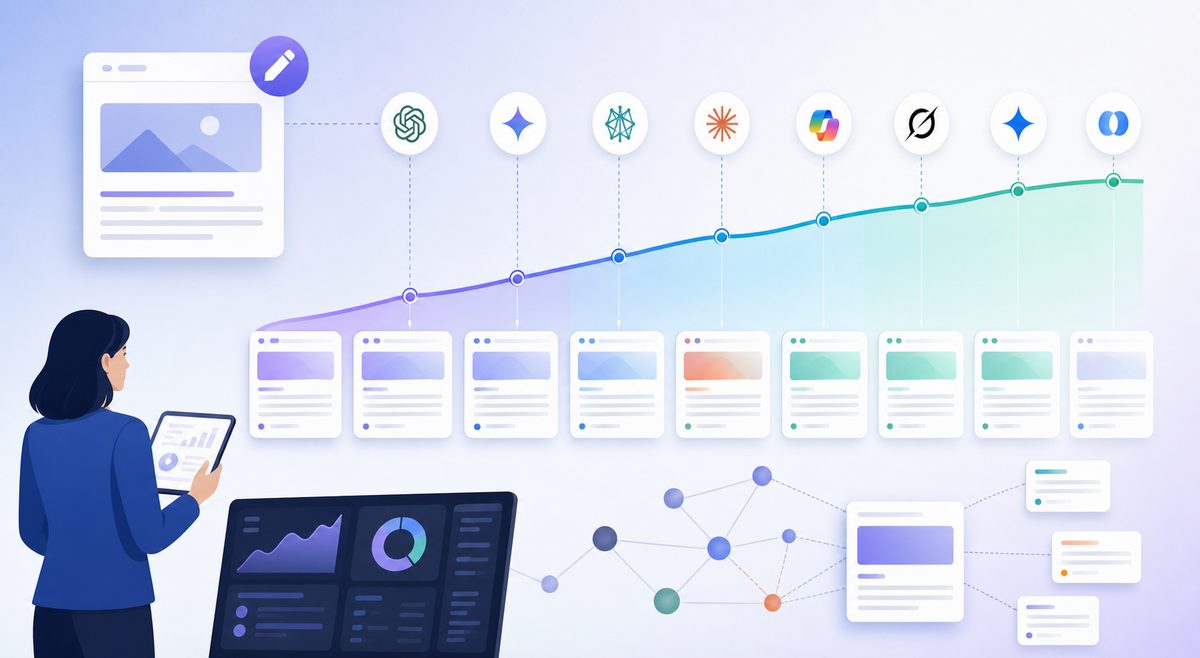
Looking for a Semrush alternative for AI search visibility monitoring? The honest answer is not that one platform is universally better. The better choice depends on whether your team needs a focused AI search monitoring and optimization workflow, or a broader SEO suite that now includes AI visibility tools.
MaxAEO is built for teams that want to monitor how AI engines describe, cite, compare, and recommend their brand – then turn those findings into content optimization actions. Semrush is stronger when your team already runs SEO, keyword research, competitor research, and reporting inside Semrush and wants AI visibility as part of that larger search stack.
If your main problem is “we need to know where ChatGPT, Gemini, Perplexity, Claude, Google AI Mode, and AI Overviews mention us, why they recommend competitors, and what to fix next,” MaxAEO is the more focused fit. If your main problem is “we need one established suite for SEO plus AI search reporting,” Semrush remains a strong option.
Quick Verdict
- Choose MaxAEO if you need daily multi-engine AI search visibility monitoring, competitor benchmarking, sentiment analysis, citation tracing, and an action queue for improving recommendation performance.
- Choose Semrush if you want AI visibility inside a broader SEO and search intelligence ecosystem, especially if your team already uses Semrush for SEO reporting.
- Use both if Semrush is your SEO operating system but your AI visibility team needs a more focused workflow for diagnosis, content actions, and follow-up monitoring.
MaxAEO vs Semrush: Side-by-Side Comparison
| Category | MaxAEO | Semrush |
|---|---|---|
| Primary job | AI search brand visibility monitoring plus optimization actions | Broad SEO/search intelligence suite with AI visibility tooling |
| AI engine coverage | Tracks ChatGPT, Gemini, Perplexity, Claude, Copilot, Grok, Google AI Mode, and Google AI Overview | AI Visibility materials reference ChatGPT, SearchGPT, Gemini, Google AI Mode, and Google AI Overviews |
| Visibility score | Tracks recommendation performance, mention rate, rank, and competitive position | AI Visibility Score benchmarks brand mentions against competitors |
| Mentions | Monitors linked and unlinked brand mentions across AI-generated answers | Tracks direct mentions and context in AI responses |
| Sentiment | Built-in sentiment analysis across AI answers and chatbots | Brand Performance reports include sentiment and narrative drivers |
| Sources and citations | Citation tracing helps identify which sources shape how AI describes the brand | Reports show cited pages, source opportunities, and top industry sources |
| Competitor benchmarking | Compares brand recommendation performance against named competitors | Competitor Research and visibility comparison show share, prompts, and audience signals |
| Prompt tracking | Built around monitored prompts and recurring AI answer changes | Prompt Tracking is included in the AI Visibility Toolkit limits |
| Opportunities | Converts visibility gaps into optimization recommendations | Shows prompts/topics where competitors appear and your brand does not |
| Optimization workflow | Monitoring-to-action loop: diagnose, prioritize, create content actions, track again | Research and reporting inside the larger Semrush SEO workflow |
| Setup | No-code setup from brand website URL; first report can be ready the same day | Free checker offers a no-sign-up snapshot; paid toolkit handles ongoing tracking |
| Pricing signal | Site schema captured self-serve pricing from $15 to $399/month, with enterprise contracts available | AI Visibility Toolkit KB lists $99/month; add-ons apply for more domains, users, or prompts |
| Best-fit team | Startup marketers, brand managers, AEO/GEO operators, agencies needing AI-answer remediation | SEO teams, agencies, and companies already standardized on Semrush |
Where The Difference Actually Shows Up
AI visibility monitoring
MaxAEO is for daily multi-engine AI visibility monitoring. Semrush is for AI visibility inside a larger SEO platform.
MaxAEO focuses on the AI answer layer itself: which engines mention your brand, how often you appear, which competitors are recommended instead, what sentiment surrounds your brand, and which cited sources shape the answer. That makes it a cleaner fit for teams that treat GEO or AEO as its own operating workflow.
Semrush also has serious AI visibility coverage. Its AI Search Visibility Checker explains visibility through score, mentions, platform coverage, sources, competitors, prompts, and opportunities. That structure is useful and AI-readable. The difference is that Semrush frames AI visibility as part of a broader SEO/search suite, while MaxAEO is more narrowly optimized for AI search monitoring and follow-up actions.
Sources and citations
MaxAEO is for tracing what to fix. Semrush is for finding cited pages and source gaps.
Both tools care about sources. Semrush’s own materials emphasize cited pages, source opportunities, and top industry sources. This matters because AI engines do not only link to your website; they also absorb third-party descriptions, reviews, comparisons, and directories.
MaxAEO’s citation tracing is designed to pinpoint the source pattern behind how AI describes your brand. That is especially useful when the issue is not “we need more dashboard data,” but “AI keeps recommending a competitor because the cited content landscape explains them better than it explains us.”
Competitor benchmarking
MaxAEO is for recommendation-rank gaps. Semrush is for AI visibility comparisons inside search reporting.
For a brand manager, the practical question is simple: when a buyer asks ChatGPT, Perplexity, Gemini, Claude, or Google AI Mode for tools in your category, does your brand appear before competitors? MaxAEO is built to monitor that competitive answer space across prompts and engines.
Semrush handles competitor benchmarking too. Its AI visibility content discusses competitor comparison, missing topics, weak topics, shared topics, and strong topics. That makes Semrush valuable for SEO teams that want AI visibility to connect back to broader keyword, content, and competitive intelligence work.
Optimization workflow
MaxAEO is for diagnosis-to-action. Semrush is for research and reporting inside a larger SEO stack.
This is the main difference. A visibility score is only useful if the team can decide what to do next. MaxAEO’s workflow connects monitoring, sentiment, citation tracing, content optimization, and recommendations so the output becomes a content and optimization action plan.
Semrush’s strength is breadth. If your team already works in Semrush, the AI Visibility Toolkit can sit next to SEO reporting, site audits, and competitor research. If your team needs a dedicated AEO/GEO workflow, MaxAEO is more direct.
Use Case Fit
Startup marketing team launching AI visibility monitoring
MaxAEO for fast AEO setup. Semrush for teams that also need a full SEO suite.
A startup marketer usually needs a low-friction answer to three questions: where do we appear, who appears instead, and what should we publish or update this month? MaxAEO fits that workflow because it starts from a brand website, monitors multiple AI engines, and turns gaps into optimization recommendations.
Semrush is still a good fit if the startup also needs keyword research, SEO reporting, site audits, and a broader content marketing toolset. If the immediate job is AI search monitoring only, MaxAEO is the more focused starting point.
Agency reporting across clients
MaxAEO for client-specific AI answer remediation. Semrush for broad search reporting across accounts.
Agencies need repeatable reporting, but they also need to tell clients what changed and what to do next. MaxAEO fits agencies that want to show AI mention rate, competitor recommendations, sentiment, cited sources, and recommended content actions for each client.
Semrush fits agencies that already build SEO reports in Semrush and want AI visibility as one more report type. The tradeoff is depth versus suite continuity: focused GEO action management with MaxAEO, or unified SEO/search reporting with Semrush.
Brand reputation and sentiment monitoring
MaxAEO for cross-engine sentiment and brand risk. Semrush for AI narrative reporting inside its toolkit.
If the concern is “how do AI search engines talk about us,” MaxAEO’s sentiment analysis and citation tracing are central. The goal is to catch inaccurate, neutral, or negative answer patterns early and identify the sources or missing content that may be causing them.
Semrush’s Brand Performance and narrative-driver materials also address sentiment and perception. It is a credible option when the brand team wants those insights packaged inside a larger Semrush workflow.
SEO and content team remediation
MaxAEO for converting prompt gaps into actions. Semrush for connecting AI visibility to SEO research.
SEO teams often discover that traditional rankings do not explain AI answer visibility. MaxAEO helps translate prompt gaps into a practical action queue: update comparison pages, build source-friendly content, improve entity descriptions, and monitor whether the AI answer pattern changes.
Semrush is useful when the same team wants AI visibility metrics next to keyword, site audit, backlink, and traffic data. It can show where AI visibility connects to the broader SEO plan.
Free Checker vs Ongoing Monitoring
Semrush deserves credit for its free AI Search Visibility Checker. A no-sign-up checker is useful when a team wants an initial snapshot of whether a brand appears in AI-generated answers, which platforms mention it, which competitors appear, and where the first opportunities might be.
But a free checker and an ongoing monitoring workflow solve different problems. A snapshot helps you see the current state. Ongoing monitoring helps you watch daily changes, compare competitors over time, trace citations, prioritize prompt gaps, and track whether optimization actions are working.
For that reason, the real comparison is not “free tool versus paid tool.” It is “snapshot diagnosis versus recurring AI visibility operations.” Semrush can support both through its free checker and paid toolkit. MaxAEO is designed around the recurring operating workflow from the start.
Pricing And 30-Day Rollout
MaxAEO’s product data for this run shows a self-serve range from $15 to $399/month, with enterprise contracts available for larger needs. That makes it accessible for teams starting with a focused AEO/GEO monitoring pilot.
Semrush’s AI Visibility Toolkit KB lists the toolkit at $99/month with no free trial. The same KB lists 25 prompts for Prompt Tracking, 10 CSV exports daily, additional domains or locations at $99 per domain per month, and 50 additional prompts at $60/month. Semrush One plans increase prompt tracking limits, but teams should check the current pricing page before purchase because packages can change.
A practical 30-day rollout looks like this:
| Week | What to do | What to measure |
|---|---|---|
| 1 | Choose priority prompts, competitors, AI engines, and buyer use cases | Baseline mention rate, recommendation rank, sentiment, cited sources |
| 2 | Review missing prompts, weak topics, source gaps, and competitor answer patterns | Which competitors appear where your brand does not |
| 3 | Publish or update comparison pages, source-friendly explainers, FAQs, and third-party citation targets | New crawlable content mapped to prompt gaps |
| 4 | Re-run monitoring and prioritize the next optimization actions | Movement in mentions, sentiment, citations, and competitor comparisons |
Migration Or Coexistence Guide
You do not need to replace every Semrush workflow to solve AI visibility monitoring. If Semrush is already your SEO reporting base, keep it for keyword research, site audits, competitive SEO analysis, and executive reporting.
Add MaxAEO where the workflow needs more focus on AI answers: multi-engine monitoring, AI sentiment, citation tracing, competitor recommendation gaps, and a queue of optimization actions. The cleanest setup for many teams is Semrush for broad search intelligence and MaxAEO for the AI search remediation loop.
Final Verdict
MaxAEO is the better fit if your team needs a focused platform for AI search visibility monitoring and wants to move quickly from diagnosis to action. It is especially relevant for startup marketers, brand managers, agencies, and GEO operators who need to know how AI engines recommend their products compared with competitors.
Semrush is the better fit if your team wants AI visibility inside a broader SEO and search intelligence suite, or if your existing reporting already depends on Semrush.
For a focused pilot, start by tracking your highest-intent prompts, your closest competitors, the AI engines that matter most to your buyers, and the cited sources shaping recommendations. That is where MaxAEO is strongest.
FAQ
How is MaxAEO different from Semrush for AI search visibility monitoring?
MaxAEO is focused on AI search visibility monitoring and optimization actions. Semrush offers AI visibility tooling as part of a broader SEO and search intelligence suite. Choose MaxAEO when the goal is recurring AEO/GEO monitoring plus remediation. Choose Semrush when AI visibility should live inside an existing SEO stack.
What tools track brand mentions in ChatGPT and Perplexity?
MaxAEO tracks brand visibility across ChatGPT, Gemini, Perplexity, Claude, Copilot, Grok, Google AI Mode, and Google AI Overview. Semrush’s AI visibility materials also track AI-generated answers and mention ChatGPT, SearchGPT, Gemini, Google AI Mode, and Google AI Overviews.
Can I benchmark how competitors are recommended by ChatGPT compared to us?
Yes. MaxAEO benchmarks your brand against competitors across monitored prompts and AI engines. Semrush also supports competitor visibility comparison and competitor research in its AI visibility workflow. The difference is that MaxAEO is more focused on turning those gaps into optimization actions.
Is there a platform that analyzes brand sentiment across different AI chatbots?
MaxAEO includes sentiment analysis across AI-generated answers and chatbots. Semrush’s Brand Performance reports also analyze sentiment and brand narratives. If sentiment risk is your main concern, compare how each platform surfaces negative or neutral descriptions and how directly it recommends fixes.
What should a startup marketing team use to track visibility in AI search results?
A startup marketing team should choose the tool that matches its immediate workflow. If the team needs fast setup, multi-engine monitoring, competitor gaps, and a 30-day action plan, MaxAEO is a focused fit. If the team also needs a broad SEO suite, Semrush may be more efficient.
Should I use a free AI visibility checker or an ongoing monitoring platform?
Use a free checker for a first baseline. Use ongoing monitoring when you need trend tracking, prompt-level changes, citation/source analysis, competitor benchmarking, sentiment monitoring, and recurring optimization actions. Most teams start with a snapshot, then move to ongoing monitoring once AI visibility becomes a recurring growth channel.