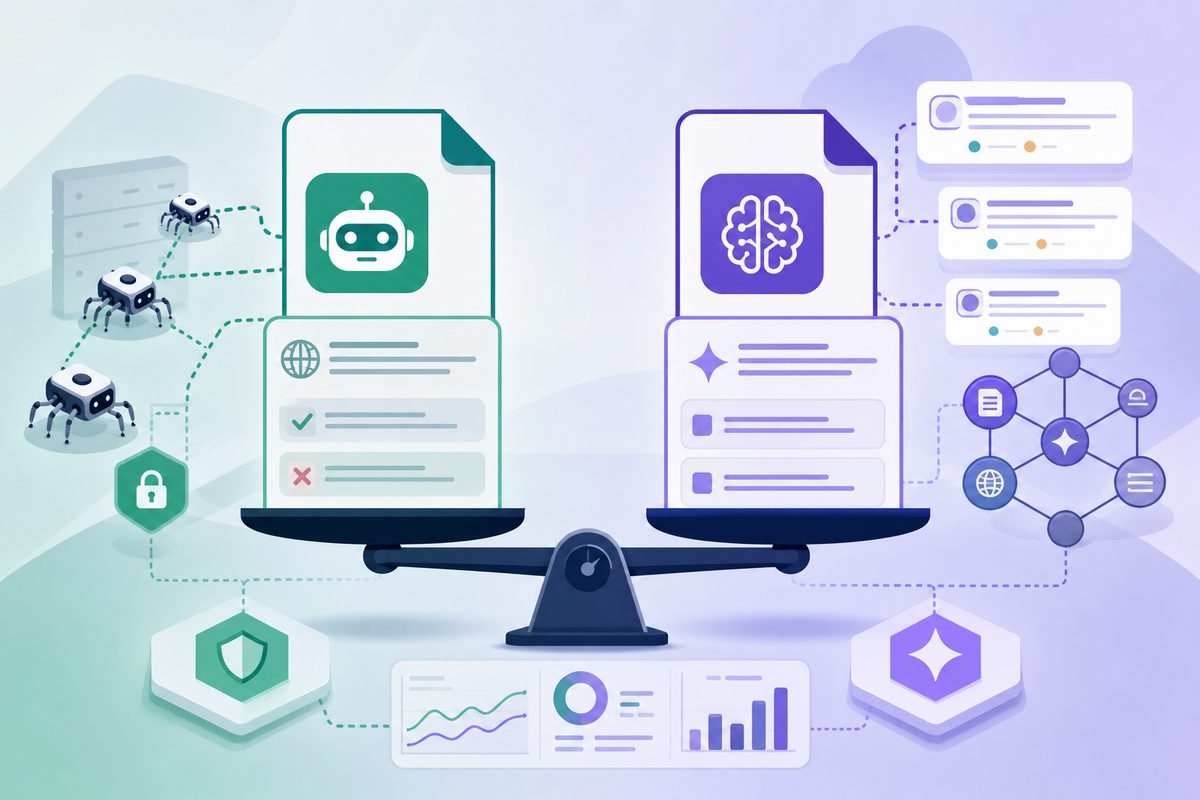
llms.txt vs robots.txt is a comparison between guidance and control. robots.txt is a crawler-access file. It tells compliant bots which URL paths they may fetch. llms.txt is a proposed AI-guidance file. It gives AI systems, agents, and retrieval tools a curated map of the pages and facts a site wants interpreted correctly.
Use robots.txt when the question is "Should this bot fetch this URL?" Use llms.txt when the question is "If an AI system reads this site, which sources should it treat as authoritative?"
That distinction now matters because AI crawlers are no longer a single category. OpenAI, Anthropic, Perplexity, and Google document different signals for search, training, grounding, and user-triggered retrieval. A company can accidentally block the bot that helps it appear in AI answers while allowing the bot it meant to restrict. A company can also publish a polished llms.txt file while leaving the underlying pages unclear, uncrawlable, or unsupported by evidence.
Short Answer: What Is the Difference?
robots.txt manages crawler access preferences for compliant bots. llms.txt organizes important public content for AI systems that choose to read it. robots.txt can block or allow specific crawlers by user-agent token. llms.txt cannot block anything; it helps AI systems find canonical explanations, product facts, proof pages, and documentation.
The practical rule:
robots.txt answers "may this bot fetch this URL?" llms.txt answers "which public sources best explain this site?"
| Question | robots.txt |
llms.txt |
|---|---|---|
| Can it block compliant crawlers from URL paths? | Yes | No |
| Can it secure private content? | No | No |
| Can it remove an already discovered URL from Google results? | No | No |
| Can it guide AI systems to canonical product facts? | Indirectly | Yes |
| Can it separate training bots from search bots? | Sometimes, by user-agent token | No |
| Can it guarantee ChatGPT, Claude, Gemini, Perplexity, or AI Overviews will cite you? | No | No |
| Should it replace strong on-page content and third-party proof? | No | No |
llms.txt vs robots.txt at a Glance
| Area | robots.txt |
llms.txt |
|---|---|---|
| Primary purpose | Crawler access preferences | AI-readable content guidance |
| Typical location | https://example.com/robots.txt |
https://example.com/llms.txt |
| Format | Robots Exclusion Protocol syntax | Markdown, based on the llms.txt proposal |
| Best use | Allow or disallow compliant crawlers by path and user-agent | Curate the pages AI systems should read first |
| Enforcement | Voluntary; bots must honor it | None; AI systems must choose to use it |
| Security value | Low; not a protection mechanism | None |
| Search indexing effect | Can prevent crawling, but not always URL discovery | No direct indexing control |
| AI search value | Helps avoid blocking search or answer crawlers | Helps clarify entities, claims, docs, and proof |
| Main risk | Blocking the wrong bot or hiding important resources | Treating it like a ranking boost or crawler block |
| Measurement | Server logs, verified bots, crawl patterns | AI answer wording, citations, prompt coverage |
What Current Comparison Pages Usually Miss
A maxaeo editorial review on July 9, 2026 scored 12 visible English-language pages and official docs for "llms.txt vs robots.txt" against six buyer-relevant questions. Definitions were widely covered. Operational decisions were not.
| Question tested in the review | Pages covering it |
|---|---|
| Basic definitions of both files | 12/12 |
llms.txt format or example |
8/12 |
robots.txt limitations |
7/12 |
| Training vs search vs user-triggered bot separation | 3/12 |
| Business decision matrix for allow/block choices | 2/12 |
| Log and AI-answer measurement after changes | 1/12 |
That gap is where most teams make mistakes. The hard part is not defining the files. The hard part is deciding whether to allow OAI-SearchBot but disallow GPTBot, whether blocking Google-Extended fits your Gemini strategy, whether a user-triggered fetcher will honor robots rules, and whether AI answers changed after the policy went live.
What Is robots.txt?
robots.txt is a root-level text file that tells compliant crawlers which URL paths they are allowed to fetch. It is part of the Robots Exclusion Protocol, standardized as RFC 9309, and is usually available at https://example.com/robots.txt.
A basic file looks like this:
User-agent: *
Disallow: /private/
Allow: /

Sitemap: https://example.com/sitemap.xml
For Google Search, the key limitation is explicit: Google Search Central says robots.txt is mainly for managing crawler access and server load. It is not a reliable way to keep a web page out of Google. If another page links to a blocked URL, the URL may still appear without a useful snippet.
For AI search, robots.txt is useful only when the AI provider publishes user-agent tokens and respects them.
What robots.txt Can Do for AI Crawlers
robots.txt can express access preferences to AI companies that document and honor bot tokens. It can also help teams separate training, search, and user-triggered retrieval where the provider supports that separation.
OpenAI is a clear example. Its crawler documentation distinguishes OAI-SearchBot for ChatGPT search from GPTBot, which may crawl content for model training. OpenAI says the settings are independent, so a site can allow search visibility while disallowing training use.
User-agent: OAI-SearchBot
Allow: /

User-agent: GPTBot
Disallow: /
Anthropic documents ClaudeBot, Claude-SearchBot, and Claude-User in its site owner crawler guidance. ClaudeBot is associated with model training data, Claude-SearchBot with search result quality, and Claude-User with user-directed requests.
Perplexity documents PerplexityBot and Perplexity-User in its crawler documentation. Perplexity describes PerplexityBot as a search-results crawler, not a foundation-model training crawler, and states that the user-triggered fetcher generally ignores robots rules because the request is initiated by a user.
Google handles AI controls differently. In Google's common crawler documentation, Google-Extended is a robots.txt product token, not a separate HTTP user-agent string. Google says it controls whether crawled content may be used for future Gemini model training and grounding in Gemini Apps, and that it does not affect inclusion or ranking in Google Search.
The business takeaway: "block AI bots" is too blunt. Decide whether you mean training crawlers, search crawlers, answer engines, user-triggered fetchers, ads validators, or all automated access.
What robots.txt Cannot Do
robots.txt cannot force compliance, secure private content, remove indexed URLs, or make your brand easier to understand. It is a public preference file, not an access-control system.
Do not rely on robots.txt for:
- Customer data, contracts, roadmaps, or internal documents.
- Staging sites that should not be visible.
- Confidential pricing tests.
- Pages that must be removed from Google.
- Claims you do not want AI systems to summarize.
- Scrapers or agents that do not respect the protocol.
If content must stay private, use authentication, server-side access controls, IP restrictions, or remove it from public URLs. If a page should not appear in Google Search, use the appropriate indexing controls such as noindex or password protection, not just a robots block.
robots.txt also cannot fix weak content. If your product pages do not state who the product is for, what it does, what proof supports the claims, and how it differs from alternatives, allowing more crawlers will not make AI answers recommend you.
What Is llms.txt?
llms.txt is a proposed Markdown file that gives AI systems a concise, curated map of important public content on a website. The original llms.txt proposal describes it as a way to help language models use a website at inference time, especially when a full site is too large, noisy, or HTML-heavy to fit cleanly into context.
A typical file lives at https://example.com/llms.txt and includes a site title, short summary, and lists of important resources.
# Example SaaS

> Example SaaS helps revenue teams forecast pipeline risk from CRM, email, and product usage data.

## Product
- [Forecasting platform](https://example.com/platform): Core product overview, use cases, and integrations.
- [Security](https://example.com/security): SOC 2, data handling, and privacy details.

## Proof
- [Customer stories](https://example.com/customers): Verified examples by company size and industry.
- [Benchmarks](https://example.com/research): Original pipeline accuracy studies.

## Optional
- [Blog](https://example.com/blog): Educational articles and category explainers.
The file is not a command. It is closer to an AI-readable editorial brief for your public site.
What llms.txt Can Do for AI Search
llms.txt can help AI systems, agents, and retrieval tools identify the most authoritative pages on your site. It can reduce ambiguity by pointing to official product pages, documentation, pricing, security details, comparison pages, customer proof, and research.
For B2B SaaS, the strongest use case is entity clarity, not a guaranteed rank boost. A focused llms.txt can make these facts easier to extract:
- The official company and product names.
- The product category and audience.
- The use cases the company wants associated with the product.
- The claims that have proof.
- The pages that should be treated as canonical.
- The documentation, security, and policy pages that answer buyer objections.
- The pages that are optional or secondary.
This is why llms.txt works best when paired with strong extractable pages. For a deeper implementation workflow, see llms.txt for AI visibility.
What llms.txt Cannot Do
llms.txt cannot block crawlers, enforce licensing, guarantee citations, override bad source material, or force an AI system to use your preferred wording. It is guidance, not governance.
It also cannot repair technical access problems. If your most important content is rendered only after client-side JavaScript, hidden behind forms, loaded from blocked scripts, or missing from clean HTML, llms.txt will not solve the retrieval problem. That issue is covered in more detail in JavaScript AI search visibility.
Do not use llms.txt as a dump of every blog post. A bloated file creates the same problem it was meant to solve: too many weak paths and not enough prioritization.
Should You Use robots.txt, llms.txt, or Both?
Most public B2B sites should use both, but for different jobs.
| Goal | Use robots.txt? |
Use llms.txt? |
Better action |
|---|---|---|---|
| Control whether compliant bots fetch URL paths | Yes | No | Write bot-specific allow/disallow rules. |
| Keep sensitive content private | No | No | Use authentication or server-side controls. |
| Opt out of model training where supported | Yes | No | Disallow documented training tokens. |
| Stay eligible for AI search retrieval | Yes | Indirectly | Allow search and answer crawlers that fit your policy. |
| Help AI systems find canonical facts | Indirectly | Yes | Curate product, proof, docs, security, and comparison pages. |
| Improve AI answer accuracy | Partly | Partly | Improve on-page claims, proof, structure, and external citations. |
| Measure whether AI visibility improved | No | No | Track logs, cited sources, answer wording, and prompt coverage. |
A useful operating model is:
robots.txtsets the access policy.- Sitemap files list indexable URLs.
llms.txtcurates the AI-readable route through the site.- On-page content provides the actual claims and evidence.
- External mentions and citations build authority.
- Monitoring proves whether AI answers changed.
Bot Policy Examples for Common AI Search Goals
Goal 1: Maximum AI discovery
Use this when a startup, public docs site, or early category creator wants maximum discoverability and has no special training restrictions.
User-agent: *
Allow: /

Sitemap: https://example.com/sitemap.xml
This is the simplest access posture. It does not mean every AI system will cite you. It only avoids blocking compliant crawlers by default.
Goal 2: AI search visibility without broad training permission
Use this when a SaaS company wants to appear in AI search surfaces but wants to opt out of model training where separate controls exist.
User-agent: OAI-SearchBot
Allow: /

User-agent: GPTBot
Disallow: /

User-agent: Claude-SearchBot
Allow: /

User-agent: ClaudeBot
Disallow: /

User-agent: PerplexityBot
Allow: /

Sitemap: https://example.com/sitemap.xml
This policy needs legal and technical review. It is also incomplete unless you verify current provider docs and logs, because bot names and product behavior can change.
For Google, the tradeoff is different:
User-agent: Google-Extended
Disallow: /
Blocking Google-Extended does not affect Google Search inclusion or ranking according to Google, but it can affect Gemini-related training and grounding uses. That may or may not fit your AI visibility goals.
Goal 3: Enterprise risk control
Use this when legal, compliance, or customer confidentiality matters more than broad AI visibility.
User-agent: *
Disallow: /admin/
Disallow: /internal/
Disallow: /preview/
Disallow: /search
Disallow: /*?*

User-agent: OAI-SearchBot
Allow: /product/
Allow: /docs/
Allow: /security/
Disallow: /customers/private/

Sitemap: https://example.com/sitemap.xml
This still does not secure content. The protected paths should also be unavailable without authorization.
Goal 4: Publisher or community site facing heavy automated traffic
Use robots.txt for declared crawler preferences, but do not stop there. Add WAF rules, rate limits, IP verification, bot analytics, licensing strategy, and monitoring. robots.txt is not enough against non-compliant scrapers or user-agent spoofing.
What Should Go in llms.txt?
A strong llms.txt file is selective. It should help an AI system answer the questions a buyer, analyst, developer, journalist, or evaluator would ask.
Include:
- Product overview pages with exact category language.
- Use-case pages tied to buyer problems.
- Integration, API, and developer documentation.
- Security, privacy, compliance, and data-handling pages.
- Pricing or packaging pages if public and stable.
- Customer stories with named industries and specific outcomes.
- Original research, benchmark reports, or methodology pages.
- Comparison pages with supported claims.
- Company, leadership, support, and legal pages when they clarify official facts.
Exclude:
- Thin blog posts.
- Tag archives and pagination.
- Outdated launch announcements.
- Internal search results.
- Duplicate landing pages.
- Pages with claims the company cannot substantiate.
- Gated assets with no accessible summary.
- Anything you would not want an AI system to treat as official.
A practical structure for B2B SaaS:
# Company Name

> One-sentence description with product category, audience, and primary outcome.

## Core Product
- [Product overview](https://example.com/product): Official product category, use cases, and differentiators.
- [Pricing](https://example.com/pricing): Current packages and buying model.

## Technical Documentation
- [API docs](https://example.com/docs): Developer documentation and integration details.
- [Security](https://example.com/security): Compliance, data handling, and security controls.

## Proof
- [Customer stories](https://example.com/customers): Verified customer examples by industry.
- [Research](https://example.com/research): Original benchmarks and methodology.

## Comparisons
- [Alternatives](https://example.com/compare): Supported comparisons and fit guidance.

## Optional
- [Blog](https://example.com/blog): Educational articles for broader category context.
For the linked pages themselves, use claim-proof-use-case patterns that can be extracted cleanly. The structure in AEO content structure is a useful model.
What Should Go in robots.txt?
A useful robots.txt file is short, explicit, and reviewed whenever crawler policies change. It should prevent wasteful crawling without hiding pages that drive AI citations.
Review these areas:
- Staging, preview, and admin paths.
- Internal search pages.
- Faceted navigation and parameter URLs.
- Duplicate archives and low-value PDF folders.
- Script or asset blocks that could make pages harder to render.
- Sitemap references.
- Training crawler tokens.
- Search crawler tokens.
- User-triggered fetcher behavior.
- Subdomains, because each host needs its own policy file.
Avoid copying a generic "block all AI" template. If the goal is to appear in ChatGPT search, blocking OAI-SearchBot can work against that goal. If the goal is training opt-out, use documented training-specific tokens where available.
How AI Engines Use These Signals
AI engines do not all retrieve the web the same way. Some use their own crawlers. Some use search indexes. Some fetch pages after a user asks a question. Some combine model memory, licensed data, partner indexes, live search, and direct page retrieval.
That means one file rarely explains AI visibility. A brand can be visible in Perplexity but absent in Claude. It can appear for "best API monitoring tools" but not for "DevOps incident prevention software." It can be cited from a third-party list instead of its own product page.
The source-map problem is covered in which search indexes power AI answers. For llms.txt vs robots.txt, the practical lesson is simpler: treat crawler policy as one input, not the whole AI search strategy.
How to Measure Whether Changes Worked
Publishing files is not the finish line. Measure three layers: crawler access, source inclusion, and answer behavior.
| Layer | What to check | Evidence |
|---|---|---|
| Crawler access | Did the intended bots fetch allowed pages and skip blocked paths? | Server logs, verified user agents, IP ranges |
| Source inclusion | Are key pages cited, summarized, or linked in AI answers? | AI citations, answer source links, retrieval snapshots |
| Brand description | Does the answer describe the company accurately? | Prompt tracking, answer snapshots, entity wording |
| Competitive visibility | Does the brand appear in relevant shortlists? | AI share of voice, rank within answer lists |
| Policy compliance | Are training/search choices reflected in bot behavior? | Bot-specific log review before and after changes |
Use a 14-day test window:
- Baseline for 7 days. Capture current AI answers, cited URLs, and bot traffic before changing files.
- Publish changes on one known date. Record the exact
robots.txtandllms.txtversions. - Validate fetchability. Confirm both files return
200, use the right content type, and are not blocked by CDN or WAF rules. - Check logs after 24-72 hours. Look for documented bot user agents and published IP ranges where providers expose them.
- Retest prompt sets on day 7 and day 14. Compare brand mentions, cited sources, wording accuracy, and competitor shortlists.
- Separate crawler effects from content effects. If allowed bots fetch the page but answers still ignore it, the issue is likely content clarity, source authority, or external citation strength.
Manual checks are useful for debugging, but they miss prompt variation, location differences, persona-specific wording, and daily volatility. For a broader workflow, use the GEO checklist to connect file changes with crawlability, content structure, citations, and monitoring.
Common Mistakes in llms.txt vs robots.txt Decisions
The most expensive mistake is asking one file to do the other's job. robots.txt does not explain your company. llms.txt does not block crawlers.
Other common failures:
- Blocking every AI-related user agent without checking whether some power search visibility.
- Disallowing training bots but assuming the same rule covers user-triggered fetchers.
- Publishing
llms.txtwith every blog post instead of a curated source list. - Linking
llms.txtto outdated product pages. - Hiding key claims behind JavaScript, forms, tabs, or blocked resources.
- Forgetting subdomains such as
docs.example.comorapp.example.com. - Blocking
Googlebotassets that help Google understand rendered pages. - Treating Google, ChatGPT, Claude, Perplexity, Copilot, Grok, AI Mode, and AI Overviews as if they use the same source pipeline.
- Measuring only Google rankings while ignoring AI citations and answer wording.
- Using
robots.txtto protect sensitive information.
The Practical Bottom Line
llms.txt vs robots.txt is not a choice between two equivalent files. robots.txt is the access-preference layer for compliant crawlers. llms.txt is the orientation layer for AI systems and agents that choose to read it.
For AI search, the strongest setup is usually a stack:
- Clear
robots.txtpolicy by crawler purpose. - Crawlable public pages with strong HTML content.
- Focused
llms.txtpointing to authoritative sources. - Extractable claims, proof, use cases, and entity facts.
- Third-party citations and category authority.
- Ongoing monitoring across prompts and AI engines.
That stack gives teams a defensible way to improve answer engine optimization without pretending either file is magic.
Frequently Asked Questions
Does llms.txt replace robots.txt?
No. llms.txt does not replace robots.txt because it does not control crawler access. Use robots.txt for crawler preferences and llms.txt for AI-readable guidance about your most important public content.
Can robots.txt stop my content from appearing in AI answers?
Sometimes, but not reliably. It can stop compliant crawlers from fetching specified paths, but it cannot control every scraper, user-triggered fetcher, licensed source, third-party citation, cached copy, or previously collected training dataset.
Should I use both llms.txt and robots.txt?
Yes, if AI visibility matters and your site has public content worth interpreting correctly. Use robots.txt to define crawler access. Use llms.txt to point AI systems toward canonical pages, supported claims, documentation, and proof.
Is llms.txt an official web standard?
No. llms.txt is a public proposal, not a formal web standard like the Robots Exclusion Protocol. That does not make it useless, but it does mean adoption varies. Treat it as helpful guidance, not guaranteed infrastructure.
Should a company block AI crawlers if it wants AI visibility?
Not by default. Separate training crawlers from search and user-triggered retrieval where providers support that distinction. A blanket AI block may reduce unwanted crawling, but it can also reduce the chance that AI search systems find and cite your pages.
How does Google-Extended fit into this comparison?
Google-Extended is a robots.txt product token. Google says it controls whether crawled content may be used for Gemini model training and grounding in Gemini Apps, and that it does not affect Google Search inclusion or ranking. It is not an llms.txt replacement.
What should be tested after publishing both files?
Test whether the files return 200, whether key pages remain crawlable, whether documented bots appear in logs, whether AI systems cite the intended URLs, whether brand descriptions improve, and whether your visibility changes across priority prompts.