Short answer: for an already crawlable, already discoverable B2B page, AI search systems usually start reflecting a visible content edit in 3-14 days. Use 14-30 days as the main judgment window. For category, reputation, acquisition, or third-party-source corrections, plan for 30-45+ days.
That is different from traditional indexing. A page can be crawled and indexed while AI answers still repeat an old fact, cite an outdated third-party source, or ignore the edited page entirely.
The metric that matters is edit-to-citation lag: how long it takes for AI answers to use the updated claim, source, or brand framing after your page changes.
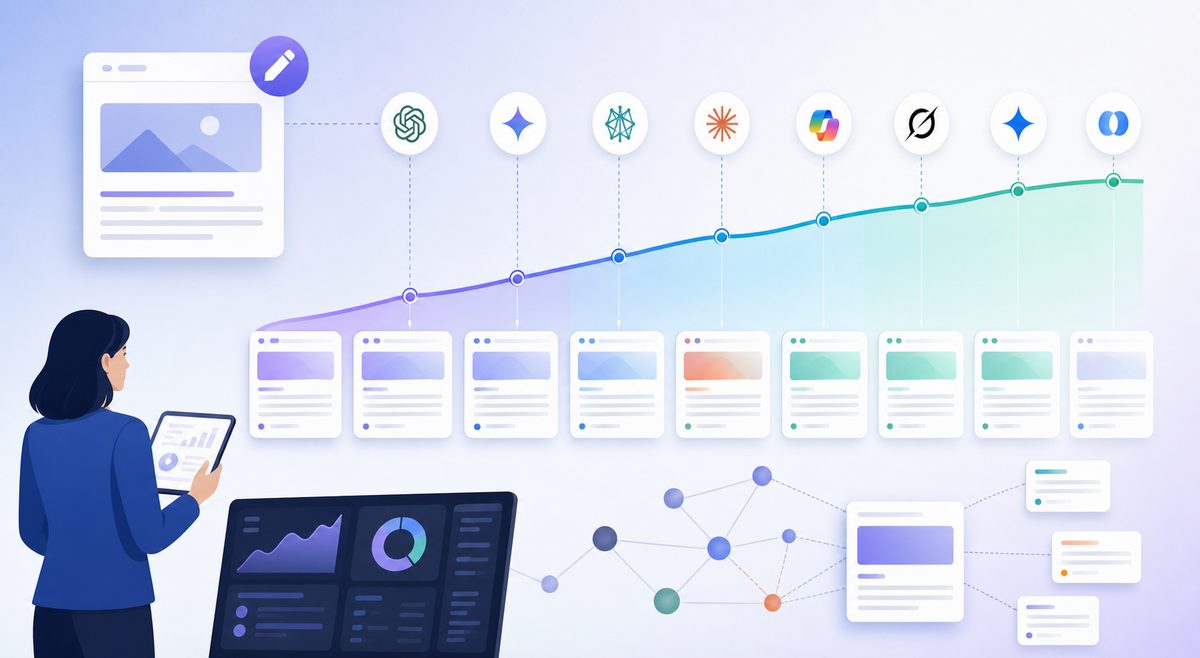
The Fast Answer: How Long for AI to Update Content?
If someone asks "how long for AI to update content," they usually mean one of four things:
| What changed | Typical update window | What it depends on |
|---|---|---|
| A visible edit on an already cited page | 3-14 days | Crawl access, page authority, prompt demand, answer engine freshness |
| A visible edit on a crawlable but rarely cited page | 14-30 days | Whether AI systems retrieve that page for relevant prompts |
| A company fact, category, rebrand, acquisition, or positioning change | 30-45+ days | Consistency across owned pages, third-party profiles, directories, reviews, and news |
| A base model's internal knowledge without live retrieval | Unknown and not controllable | Model refresh schedules, training data policies, and whether the product uses web search |
For reporting, do not call an AI visibility edit a failure on day three. Treat day three to seven as an early signal window, day 14 to 21 as the primary readout, and day 30 as the point where you should escalate from page editing to source repair.
What "AI Updating Content" Actually Means
AI content updates are not one process. They pass through several layers:
- Crawling: a bot can access the edited page.
- Indexing or source processing: the system stores or refreshes the page.
- Retrieval: the AI product selects the page for a prompt.
- Citation selection: the AI answer cites or uses that page instead of another source.
- Answer absorption: the updated fact actually appears in the generated answer.
- Stability: the new answer repeats across prompt variants and checks.
Google says recrawling changed pages can take from a few days to a few weeks, and a recrawl request does not guarantee instant inclusion or inclusion at all. See Google's guidance on asking Google to recrawl URLs.
For AI answers, crawling is only the first gate. Google also says AI Overviews and AI Mode rely on existing Search fundamentals: crawl access, internal links, textual content, page experience, and structured data that matches visible page text. Google says no special AI schema or machine-readable AI file is required for those features. See Google's documentation on AI features and your website.
What Is Edit-to-Citation Lag?
Edit-to-citation lag is the time between publishing a visible content change and seeing an AI answer use the updated claim, source, or brand framing. It starts after the edit is live and rendered, and ends only when monitored prompts consistently show the new answer instead of the stale one.
This matters because an AI answer can look current while still using old evidence. For example, a SaaS company might change its category from "workflow automation software" to "AI operations platform." The edit is not complete when the page goes live. It is complete when buyer prompts stop producing the old category across ChatGPT search, Perplexity, Copilot, Gemini, Google AI Overviews or AI Mode, and other tracked engines.
Use a different metric for brand-new pages. If the page has never appeared in AI answers, benchmark it against cold-start visibility, such as maxaeo's time-to-citation study in AI search.
Maxaeo Field Benchmark: Expect a Week, Plan for a Month
In maxaeo's 216-edit field panel across 38 B2B SaaS and technology websites, the median first reliable reflected change appeared in 9 days. The 75th percentile was 18 days, and the 90th percentile was 31 days. By day 45, 18% of tracked edits still had not been reliably reflected.
The panel counted visible page edits, not metadata-only changes. Examples included feature renames, pricing clarifications, integration additions, category changes, comparison-page updates, and corrected company facts.
| Measurement item | Field panel setup |
|---|---|
| Sites | 38 B2B SaaS and technology sites |
| Verified edits | 216 visible content edits |
| Tracking window | Daily checks for up to 45 days |
| Engines checked | ChatGPT search, Perplexity, Gemini, Google AI Overviews or AI Mode when triggered, Copilot, Claude with web access |
| Success condition | Updated claim appears in the answer and is cited, sourced, or clearly absorbed from an updated source |
| Reliability rule | Updated claim appears across repeated checks or prompt variants, not just one isolated run |
| Failure condition | Old claim persists, wrong source persists, or no answer reflects the edit by day 45 |
Results varied by AI surface:
| AI surface | Median lag | 75th percentile | Practical reporting window |
|---|---|---|---|
| Perplexity | 3 days | 8 days | Check early, then confirm stability |
| ChatGPT search | 6 days | 13 days | Start evaluating after week one |
| Copilot | 7 days | 16 days | Use a two-week readout |
| Google AI Overviews / AI Mode | 11 days | 24 days | Avoid early conclusions |
| Claude with web access | 12 days | 25 days | Treat source choice as variable |
| Gemini app responses | 14 days | 28 days | Use longer observation windows |
These are operating benchmarks, not service-level guarantees. They tell content, SEO, PR, and growth teams when enough time has passed to judge whether a change is moving AI answers.
Why AI Systems Lag After a Content Edit
AI systems lag because a fresh edit must beat older evidence. The edited page may be technically available, but the AI answer may still prefer a directory, competitor comparison, review site, analyst page, community thread, documentation page, or older article.
| Lag layer | What can go wrong | What to check |
|---|---|---|
| Crawl access | Bot blocked by robots.txt, CDN, WAF, login wall, or JavaScript rendering | Server logs, robots.txt, firewall rules, rendered HTML |
| Search eligibility | Page is noindexed, canonicalized away, thin, duplicated, or not refreshed | Search Console, canonical tags, sitemap, status code |
| Retrieval | AI system does not select the page for the prompt | Prompt cluster coverage and cited domains |
| Citation selection | A competitor, directory, review page, forum, or old article wins the citation | Source overlap and repeated citation rank |
| Answer absorption | AI cites the page but repeats the old framing | Claim-level answer diff |
| Stability | One run updates while another remains stale | Repeated prompts, paraphrases, and dates |
OpenAI's crawler documentation is a useful example of why bot rules matter. OpenAI separates OAI-SearchBot, which is used for ChatGPT search visibility, from GPTBot, which is related to training. OpenAI also notes that robots.txt changes for search can take about 24 hours for its systems to adjust. See the official OpenAI crawler documentation.
How Long Different Edit Types Usually Take
The more concrete the edit, the faster it tends to move. AI systems absorb clear facts faster than broad positioning language.
| Edit type | Typical lag pattern | Why it behaves that way |
|---|---|---|
| Corrected business fact | 3-14 days if on authoritative owned pages | Clear old/new contrast and strong entity relevance |
| Pricing or packaging clarification | 3-18 days | High user value, but engines may avoid volatile claims unless the source is clear |
| Feature rename | 7-21 days | Needs consistency across product, docs, support, and comparison pages |
| New integration mention | 7-30 days | Often competes with partner directories and documentation |
| Product category repositioning | 14-45+ days | Requires corroboration beyond owned copy |
| Rebrand, acquisition, or company identity change | 30-45+ days | AI answers reconcile many entity sources |
| Meta title or description only | Often no measurable effect | AI answers need visible evidence, not just snippets |
| Third-party profile correction | 10-45+ days | Depends on the third party's crawl frequency and authority |
| Community or review correction | Highly variable | Freshness, moderation, and access differ by platform |
If the change affects company identity, product category, ownership, or market positioning, treat it as an entity update. The same principle applies when teams need to update business information in ChatGPT: owned-page edits help, but corroborating sources often decide the answer.
What Changes AI Answers Fastest?
The fastest edits share three traits: the updated fact is visible, the page is already part of the AI source graph, and the change matches a prompt people actually ask.
A feature rename buried in a release note tends to move slowly. The same rename repeated on the product page, documentation page, pricing FAQ, comparison page, partner page, and help center tends to move faster.
Practical accelerators:
- Update the page that AI systems already cite for the topic.
- Put the changed fact in visible body text, not only metadata, images, PDFs, or schema.
- Add a concise "current as of" line when the fact is time-sensitive.
- Repeat the fact naturally across the product page, docs, support page, pricing page, and comparison page when relevant.
- Refresh internal links from hub pages and high-authority pages.
- Keep structured data consistent with the visible text.
- Update sitemap timestamps only when they are accurate.
- Use supported submission workflows for search engines.
- Correct third-party sources if AI answers cite them more than your owned page.
IndexNow can help notify participating search engines about changed URLs. Its documentation supports submitting single URLs or batches, but it also makes clear that an HTTP 200 response means the URL was received, not that it will be indexed or reflected in AI answers. See the IndexNow documentation.
If the edited page is not the kind of page AI systems tend to cite, change the source strategy before rewriting the same paragraph again. For SaaS brands, maxaeo's analysis of page types AI actually cites can help decide where the updated evidence should live.
How to Test Whether an AI Content Update Worked
Do not judge from one prompt, one screenshot, or one same-day check. Use a timed readout with controls.
- Before publishing: save the old answer, old cited URLs, prompt set, page screenshot, and exact content diff.
- Day 0: publish one clean edit and record the timestamp.
- Days 1-2: confirm status code, crawl access, canonical status, indexability, rendered text, sitemap inclusion, and bot access.
- Days 3-7: look for early movement in faster engines and already-cited pages.
- Days 8-21: evaluate the main prompt cluster across engines and paraphrases.
- Days 22-30: compare control prompts and unchanged pages before calling the result weak.
- After day 30: escalate to source repair if the same stale citation or third-party source persists.
Use claim-level labels instead of vague pass/fail notes:
| Label | Meaning |
|---|---|
| Old claim | Answer still repeats the pre-edit fact |
| Mixed claim | Answer includes both old and new framing |
| Updated claim | Answer reflects the new fact accurately |
| Updated source, stale synthesis | AI cites the updated page but still says the old thing |
| No relevant answer | Prompt no longer triggers a comparable answer |
| Source shifted | AI switched sources, making attribution analysis necessary |
This discipline prevents false positives. If five tracked prompts improve while five unrelated control prompts also change, the movement may come from model or retrieval volatility rather than your edit.
What to Do If AI Answers Are Still Wrong After 30 Days
A stale answer after 30 days usually means your edited page is not the deciding source. Rewriting the same page again may not help.
Diagnose the source graph:
| Stale-answer cause | Signal | Best next action |
|---|---|---|
| Old third-party source dominates | AI repeatedly cites an analyst page, directory, review site, or partner profile | Request correction or publish a stronger corroborating source |
| Competitor page frames the category | AI cites a competitor comparison or alternatives page | Build a clearer comparison page with verifiable proof |
| Entity ambiguity | AI confuses product, company, acronym, acquired brand, or old brand name | Add entity clarification across site, profiles, schema, and support pages |
| Weak evidence | Your page says the new claim once without examples or support | Add definitions, examples, tables, screenshots, and documentation links |
| Crawl or rendering issue | Updated text is missing from rendered HTML or blocked to bots | Fix robots.txt, CDN, WAF, JavaScript rendering, or noindex/canonical issues |
| Prompt mismatch | Your edit does not answer the buyer question being asked | Add the missing answer section or create a better page type |
| Model-wide volatility | Many unrelated prompts changed at the same time | Annotate volatility and wait for a second readout |
For stale source repair, prioritize the pages AI systems already cite. The maxaeo guide to outdated AI citations covers how to find, prioritize, and fix stale sources without wasting cycles on low-impact edits.
What Research Says About AI Citation Volatility
Independent research supports repeated measurement. AI answer engines do not behave like fixed blue-link rankings.
A 2026 empirical study, How Generative AI Disrupts Search, analyzed Google Search, Gemini, and AI Overviews across a public benchmark of 11,500 queries. The paper reported that AI Overviews appeared for 51.5% of representative queries in its dataset and that source overlap across traditional Google, AI Overviews, and Gemini was low, with average Jaccard similarity under 0.2. See the arXiv paper How Generative AI Disrupts Search.
Another 2026 paper, From Citation Selection to Citation Absorption, separated citation selection from citation influence. Its framework is useful because a page can be cited without strongly shaping the final answer. See From Citation Selection to Citation Absorption.
For marketers, this means AI search monitoring should record more than rank or presence. Track the answer text, cited URLs, citation order, prompt variant, engine, date, stale-claim rate, and whether the updated claim was absorbed.
A 14-Day Playbook for Content Teams
Use this playbook when the edited page is already crawlable and the update is narrow, such as a pricing clarification, feature rename, or corrected product fact.
- Save the baseline: capture the old answer, old citations, prompt variants, and page copy.
- Publish one clear edit: avoid multiple overlapping edits that make attribution messy.
- Make the change extractable: use visible text, a definition, a table, or a short FAQ answer.
- Validate access: check robots.txt, noindex, canonical tags, rendered HTML, and server logs.
- Refresh discovery paths: link from relevant product, docs, comparison, blog, and help pages.
- Submit supported refresh signals: use Search Console, sitemap workflows, and IndexNow where appropriate.
- Run daily checks: test the same prompt set plus paraphrases across target engines.
- Score claim outcomes: old, mixed, updated, updated source with stale synthesis, or no relevant answer.
- Check controls: monitor adjacent prompts that should not be affected.
- Report precisely: label results as early signal, directional movement, confirmed reflection, or unresolved stale source.
For broader monitoring, do not track ChatGPT alone. Buyers may see answers in Google AI Mode, Google AI Overviews, Perplexity, Copilot, Grok, Claude, and vertical tools. The maxaeo guide to AI engines beyond ChatGPT explains why multi-engine tracking matters for B2B brands.
What Not to Do While Waiting
Some "refresh" tactics make measurement worse.
| Mistake | Why it hurts |
|---|---|
| Re-editing the page every few days | Resets the evidence trail and makes causality unclear |
| Changing metadata only | AI answers usually need visible, extractable page evidence |
| Hiding the new fact in an image | Many systems need text they can parse and cite |
| Adding unsupported "AI schema" | Google says no special schema is required for AI Overviews or AI Mode |
| Pinging repeatedly | Submission tools do not force inclusion or citation |
| Reporting one prompt as proof | AI answers vary across prompt wording, runs, and engines |
| Ignoring third-party sources | AI answers may trust external sources more than your page |
The better approach is one clean edit, a fixed prompt panel, control prompts, and a source repair plan if stale evidence keeps winning.
How This Changes GEO Reporting
GEO reporting should answer one question: did AI systems update the answer users see?
A useful report includes:
- AI share of voice by prompt cluster
- Brand mention rate
- Cited URLs and citation order
- Stale-claim rate
- Updated-claim rate
- Source freshness
- Answer sentiment
- Engine-level differences
- Control prompt movement
- Open source-repair tasks
A strong readout sounds like this:
"Before the edit, the old claim appeared in 62% of tracked answers. Fourteen days later it appeared in 29%, while the updated claim appeared in 48%. The remaining stale answers cite two third-party directory pages and one competitor comparison."
That is better than "we updated the page." It separates content production from AI reputation management.
FAQ
How long for AI to update content after a page edit?
For an already discoverable page, expect early signs in 3-14 days and use 14-30 days as the main evaluation window. Concrete facts on already-cited pages update fastest. Category, reputation, acquisition, and third-party-source corrections can take 30-45+ days.
Can you force ChatGPT, Gemini, Perplexity, or Google AI Overviews to update an answer?
No. You can improve crawl access, update visible evidence, refresh discovery signals, and correct cited sources. You cannot force an AI answer engine to cite or absorb a change. Crawling is a prerequisite, not a guarantee.
Why does Perplexity often reflect edits faster than Google AI Overviews?
In maxaeo's field panel, Perplexity reflected edits faster for many prompt clusters because it often surfaced fresh web retrieval more directly. Google AI Overviews and AI Mode depend on Google's Search eligibility, query interpretation, triggering systems, and source selection, so the practical lag can be longer.
Does changing the meta title or description help AI answers update?
Usually not by itself. Metadata can affect snippets and discovery, but AI answers usually need visible, extractable evidence in the page body. Put the corrected fact in body copy, headings, tables, FAQs, documentation, and supporting pages.
How long does it take ChatGPT to update business information?
For business facts that ChatGPT search can verify from current web sources, early movement can appear within days. Reliable correction often takes two to four weeks, especially when third-party profiles disagree. See maxaeo's guide on how to update business information in ChatGPT.
Should teams edit pages every week until AI answers change?
No. Weekly edits can muddy the experiment. Publish one clear edit, monitor it against a fixed prompt set, compare controls, and wait through the reporting window. If stale citations persist after day 30, fix the source graph instead of rewriting the same paragraph.
How is edit-to-citation lag different from time-to-first-citation?
Time-to-first-citation measures how long a new or previously uncited source takes to appear in AI answers. Edit-to-citation lag measures how long AI answers take to reflect a change on a known source or entity. Use edit-to-citation lag for rebrands, feature renames, pricing clarifications, and stale fact fixes.
What is the best way to know whether an AI content update worked?
Track the same prompt set before and after the edit. Record answer text, cited URLs, citation position, engine, date, prompt variant, and claim status. A content update worked when the updated claim appears consistently across relevant prompts, not when one isolated answer changes once.