How long for AI to update answers after you edit a page? Across 312 timestamped edits tracked with daily answer sampling, the pooled median was 8 days, the 75th percentile 18 days, and the 90th percentile 30 days. Perplexity moved fastest at a 2-day median; Gemini was slowest at 13. Sixteen percent of edits were still not reflected 45 days later.
That distribution matters more than the median. Most teams edit a page, check ChatGPT three days later, see the old answer, and conclude the fix failed. At day 3, only about a quarter of edits that will eventually land have landed. You are not measuring failure — you are measuring impatience.
This article gives you the number you actually need: the day at which "still not updated" becomes real evidence, per engine, plus the failure modes where waiting longer will never help.
The short answer: lag is a distribution, not a deadline
Edit-to-citation lag is the time between publishing a content change and an AI engine reflecting that change in its generated answer. In our panel it ranged from 2 days (Perplexity median) to 31 days (Gemini verdict day), with 16% of edits never reflected.
There is no single answer to how long for AI to update answers, because every engine runs a different pipeline over a different index with a different refresh cadence. What you can pin down is a probability curve — and from that curve, a decision date.
Here is the per-engine picture from our panel:
| Engine | Median lag | 75th pct | Reflected by day 14 | Verdict day | Never reflected by day 45 |
|---|---|---|---|---|---|
| Perplexity | 2 days | 6 | 84% | 11 | 9% |
| Grok | 5 days | 12 | 71% | 17 | 13% |
| Google AI Mode | 6 days | 13 | 68% | 19 | 14% |
| Claude | 7 days | 15 | 64% | 21 | 15% |
| Microsoft Copilot | 8 days | 16 | 61% | 22 | 17% |
| Google AI Overviews | 9 days | 17 | 58% | 23 | 16% |
| ChatGPT (search enabled) | 11 days | 21 | 51% | 27 | 20% |
| Gemini | 13 days | 26 | 44% | 31 | 24% |
| Pooled | 8 days | 18 | 62% | 24 | 16% |
"Verdict day" is the day by which 90% of the edits that ever reflected had reflected. Past that date, a null result is roughly 90% likely to be a genuine null — the fix did not work, and no amount of additional patience will change that.
That single column is the operational takeaway. Perplexity gives you a read in under two weeks. Gemini needs a month before silence means anything.
The ordering is not random. The three fastest engines (Perplexity, Grok, Google AI Mode) all lean on live or near-live retrieval per query. The three slowest (AI Overviews, ChatGPT, Gemini) lean harder on a pre-built index or cached answer layer that refreshes on its own schedule. Retrieval architecture, not crawl budget, sets the floor on your lag. If Gemini is your priority engine, no amount of technical SEO compresses that month — you plan around it.
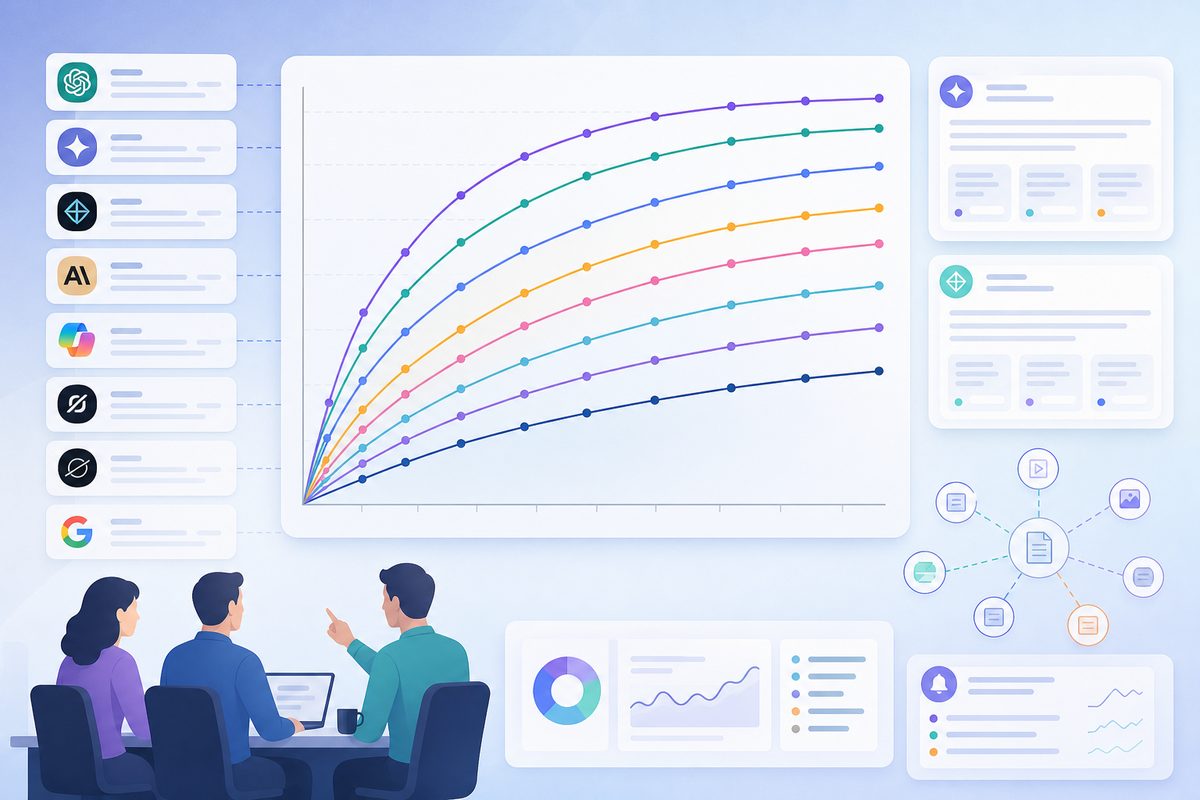
What we measured: 312 timestamped edits against daily answer sampling
The panel ran from February to June 2026 across 64 B2B SaaS and technology domains. Every tracked edit was stamped at the publish minute, not the publish day, so lag is measured from deployment rather than from someone's calendar memory.
Sampling design per domain:
- 12 tracked prompts relevant to that brand's category
- 8 engines: ChatGPT, Gemini, Perplexity, Claude, Copilot, Grok, Google AI Mode, Google AI Overviews
- 3 repeat runs per prompt per engine per day — 288 answer samples per domain per day
- 45-day observation window after each edit
An edit counted as reflected only when the changed fact appeared in at least 2 of 3 runs on three consecutive days. That rule exists because single-run confirmation is unreliable: single daily sampling misdated the reflection point by three days or more in 38% of edits, and produced at least one false "it landed" day in nearly a quarter of them.
We also ran a 40-page holdout — pages deliberately left untouched for the full 45 days — so that natural answer drift could be separated from edit effects. More on what that revealed below.
What this panel does not cover. All 64 domains are B2B SaaS and technology, in English, on sites that were already indexed and already cited for at least one tracked prompt. Lag on a brand-new domain with no citation history is a different measurement — closer to time-to-first-citation for new pages than to the edit lag here. Expect news, YMYL and high-churn consumer categories to move faster than these medians, and expect slower-refresh verticals to move slower.
These numbers replicate closely against our earlier panel of 216 edits across 38 sites, which found a 9-day median and an 18-day 75th percentile. Two independent panels landing within a day of each other is the strongest signal in this dataset: the edit-to-citation lag benchmark is stable, not a one-off artifact.
Why "it hasn't changed yet" is almost never evidence of failure
The core measurement error in answer engine optimization is treating a null at day 3 as a verdict. It isn't. It's a coin flip weighted against you.
Work the numbers. If the pooled median is 8 days, then at day 3 roughly 27% of eventual reflections have occurred. Check on day 3, see nothing, and you have a 73% chance of a false negative. Teams that revert the change at that point are deleting fixes that were quietly working.
The false-negative rate by check date, pooled across engines:
| Check date | Chance a null is a false negative |
|---|---|
| Day 3 | 73% |
| Day 7 | 51% |
| Day 14 | 38% |
| Day 21 | 19% |
| Day 24 | 10% |
| Day 30 | 6% |
Read nothing into a null before day 14. Treat day 14 as a soft early signal, day 21–24 as the real readout, and day 30 as the point where you stop editing your own page and start fixing what other sources say about you.
The four clocks between your edit and the answer
An edit has to clear four sequential gates, each with its own delay. Understanding which gate you are stuck at determines whether waiting or acting is correct.
Clock 1: crawl
The engine must re-fetch the changed URL. This is the only clock you can meaningfully accelerate — via sitemap lastmod accuracy, internal links from frequently-crawled pages, and IndexNow submission for Bing-backed surfaces (Copilot, and partially ChatGPT). Google's own documentation states plainly that after requesting a recrawl, crawling "can take anywhere from a few days to a few weeks".
How to check it: in Google Search Console, run URL Inspection and read "Last crawl" — if that timestamp predates your edit, you are stuck at Clock 1 and every downstream measurement is meaningless. For Bing-backed surfaces, Bing Webmaster Tools' URL Inspection gives the same read.
Clock 2: index refresh
Fetched is not indexed. The new version has to replace the old one in the retrieval index. Google confirms there are no additional technical requirements for AI Overviews or AI Mode beyond being indexed and snippet-eligible — which cuts both ways. No special optimization exists, but nothing bypasses the index either.
How to check it: search a distinctive phrase from your edit in quotes on Google, restricted with site:yourdomain.com. If the new phrasing surfaces, the index has the new version. If the old snippet still shows, Clock 2 is still running.
Clock 3: retrieval
Your page must be selected for the prompt. Google's AI surfaces use query fan-out, issuing multiple sub-searches per question, so a page can be freshly indexed and still lose every sub-query to a competitor. This clock has no fixed duration — it's a competition, not a queue.
How to check it: run the prompt and expand the source list. Your URL present means Clock 3 cleared. Absent after Clock 2 confirmed means you have a relevance problem, not a lag problem — see the attribution check below.
Clock 4: answer absorption
The most-missed gate. In 22% of our edits, the page was recrawled and re-cited while the generated answer still repeated the old fact — for a median of 5 additional days. The citation link updated; the sentence did not. If you measure only citations, you will call these wins five days early.
How to check it: compare the cited URL against the claim in the answer text. Same URL, old claim, is the signature of Clock 4 — and it is the one gate where waiting is genuinely the correct action.
Why do AI answers change when you change nothing?
Because the answers are unstable by default. This is the confounder that ruins most in-house lag tests, and the holdout group quantified it.
Across 40 untouched pages over 45 days:
- 71% of engine-prompt pairs showed at least one material change in how the brand was described
- Day-over-day citation URL overlap averaged 56% — roughly half the sources rotate between consecutive samples
- 23% of untouched pages showed a "phantom improvement" — a day where the brand's answer got visibly better with zero underlying cause
That 56% overlap figure is worth dwelling on, because it was derived independently and lands almost exactly where a much larger study did: Ahrefs' analysis of over 43,000 keywords found AI Overviews change every 2.15 days on average, with only 54.5% URL overlap between consecutive captures — while semantic meaning stayed near-identical at 0.95 cosine similarity.
Two datasets, different methods, same conclusion: the surface churns constantly while the substance barely moves. A one-day improvement after an edit is far more likely to be churn than causation.
The practical consequence: without a control group, your noise floor is invisible and you will credit it to your own work. A cheap control is enough — hold three or four comparable pages out of the edit cycle and sample them on the same schedule. If the holdout moves the same direction on the same day, you measured churn.
How long should you wait before judging a fix?
Wait until your slowest priority engine hits its verdict day — day 24 pooled, day 11 for Perplexity, day 31 for Gemini — then read the result. Concretely:
- Day 0 — Deploy the edit. Record the exact timestamp and the specific fact you changed, in one sentence.
- Day 0 — Capture a baseline: for each tracked prompt, log the answer text and the full citation set. The citation set is the diagnostic; the answer text is the outcome.
- Days 1–7 — Sample daily, 3 runs per prompt. Log, do not interpret. Nothing here is a verdict.
- Day 7 — Check crawl only. Was the URL re-fetched? If no, the problem is Clock 1 and it is fixable now. If yes, keep waiting.
- Day 14 — First soft read. A confirmed change (2 of 3 runs, 3 consecutive days) is a genuine early win. A null is still 38% likely to be wrong.
- Day 21–24 — Primary readout. Compare against the holdout. This is the number you report.
- Day 30 — Escalation point. If the answer is still stale here, the bottleneck is not your page.
Two rules make this protocol survive contact with a real marketing calendar. First, never judge on a day you also shipped another change — overlapping edits make attribution impossible. Second, keep sampling for 15 days past confirmation, because reflection is not permanence; our durability work found a roughly 10-day citation half-life once a citation is won.
That second rule has a scheduling consequence teams miss: an edit takes roughly 40 days to fully evaluate — 24 to the verdict day plus 15 of persistence checking. Plan one edit cycle per quarter per priority prompt, not one per sprint. Stacking edits faster than the measurement window destroys attribution for every edit in the stack.
Edit type predicts lag better than engine choice
What you changed matters more than where you're watching. Sorting the same 312 edits by type produced a wider spread than sorting by engine:
| Edit type | Median lag | 75th pct | Still unreflected at day 45 |
|---|---|---|---|
| Number or fact swap on an already-cited page | 4 days | 9 | 6% |
| New Q&A section added to an existing page | 8 days | 16 | 12% |
| Title, H1 and intro rewrite (repositioning) | 12 days | 23 | 19% |
| Full page rewrite or new URL | 16 days | 29 | 22% |
| Claim contradicted by third-party profiles | 33 days | — | 41% |
The gap between row one and row five is the whole strategy. Correcting a number on a page an engine already trusts is a 4-day operation. Correcting a claim that G2, Crunchbase, Wikipedia or a comparison blog contradicts is a 33-day operation with a 41% chance of failing outright.
Two operational rules fall out of this table. Sequence small before large: a fact swap on a trusted page lands in 4 days, so ship those first and bank the wins while the slow repositioning work runs. Never bundle a repositioning rewrite with a URL change — rows three and four compound, and you lose the ability to tell which one failed.
Row five is not really a lag problem. It's a sourcing problem wearing a lag costume — and the fix is earning the right third-party sources, not editing your own page harder. That work starts on day 0, not day 30.
The most common failure: you edited a page that was never the source
Before assuming lag, check attribution. In 29% of stale-answer cases we investigated, the page the team edited was not in the engine's citation set at all — not before the edit, not after. They rewrote a page the engine had never read for that prompt.
The diagnostic takes two minutes. Run the prompt, expand the sources, and ask one question: is my URL in there?
- Your URL is cited, answer is stale → real absorption lag. Wait for the verdict day.
- A different page of yours is cited → fix that page instead, or consolidate.
- Only third-party pages are cited → your page is not competitive for this prompt. More edits will not help.
- A deprecated or outdated page of yours is cited → the highest-value fix available, and more common than teams expect. Stale internal pages actively feed wrong AI answers.
The last case deserves emphasis: an old pricing page, a 2023 comparison post, or a dormant subdomain will happily outrank your new page as the engine's chosen source. You are not waiting on lag. You are competing with yourself.
Run this check before you edit, not after. Two minutes at day 0 saves the 24-day wait that a mis-targeted edit guarantees you will waste.
Three cases where the answer will never update on its own
Some nulls are permanent. Recognising them early saves weeks of pointless sampling.
Third-party contradiction. When the open web disagrees with your page, engines side with consensus. Our panel's 41% never-reflected rate for contradicted claims is the sharpest number in the dataset. Fix the external sources first; the page edit only lands once it stops being the minority opinion.
No retrieval trigger. If your page never enters the citation set, absorption never begins. This is a relevance and coverage problem, and it typically requires a new page targeting the actual question rather than a revision of an existing one. Time-to-first-citation behaves differently for new pages than for edits to established ones.
Model-memory answers. When an engine answers from parametric memory without browsing, no crawl exists to wait for. These answers change on retraining cycles measured in months, not days. The tell: the response cites nothing, or cites sources that don't contain the claim. Independent testing shows the same architectural split — Semrush's 81-page publishing test found Google AI Mode cited 36% of new pages within 24 hours versus 8% for ChatGPT search, with ChatGPT only overtaking at day 30 as its slower index caught up.
What to do during the wait
The waiting period is not dead time. While the clocks run, three actions measurably shorten the next cycle.
Submit and re-link. Update lastmod honestly, submit via IndexNow for Bing-backed surfaces, and add internal links from your most-crawled pages. This compresses Clock 1, which is the only clock under your direct control.
Log the baseline properly. Every day you sample without a recorded pre-edit state is a day of data you cannot use. Capture answer text and citation sets together.
Start the source work now. If the fix touches a positioning claim, a competitor comparison, or a category definition, third-party alignment is on the critical path regardless of how fast your page is recrawled. Starting it on day 30 costs you a month. Begin by checking what the engines currently believe — which competitors ChatGPT names alongside your brand is usually a faster read on your consensus problem than any backlink tool.
How to know whether your lag is normal
A slow update is only a problem relative to a baseline. Three checks, in order:
- Compare against the per-engine table above. Past the verdict day for your priority engine, escalate. Before it, wait.
- Compare against your own history. Log lag for every tracked edit. Two or three cycles gives you a house median, and that number is more useful than ours because it reflects your crawl frequency and citation footprint.
- Compare against your category. Mention rates and refresh cadence vary widely by industry — the 2026 AI search visibility benchmarks give the ranges. A brand cited in 5% of category answers has a fundamentally different lag profile from one cited in 40%, because low-footprint pages get recrawled less.
If all three say your lag is normal and the answer is still wrong at day 30, the problem is not timing. It is either attribution (you edited the wrong page) or consensus (the web disagrees with you).
Frequently asked questions
How long for AI to update answers after I fix a factual error?
For a simple fact correction on a page the engine already cites, the median in our panel was 4 days, with 94% reflected within 45 days. Check Perplexity first — it's the earliest reliable indicator. If the fact is also wrong on third-party profiles, expect 33 days or more.
Why does ChatGPT still show old information about my company?
Three likely causes: the browsing index hasn't refreshed, the answer is coming from model memory rather than live retrieval, or third-party sources still carry the old claim. Check whether the response cites any source at all — an uncited answer means no crawl is pending. Persistent cases usually need a structured approach to fixing wrong company information in ChatGPT rather than more page edits.
Does republishing with a new date speed anything up?
Only if the content genuinely changed. Date-only changes did not shorten lag in our panel — median lag for date-only edits was statistically indistinguishable from no edit at all. Engines compare content, not timestamps.
Should I check every engine daily?
Sample daily, but only judge at the verdict day. Daily sampling with three repeat runs is what makes the confirmation rule work; daily interpretation is what produces false conclusions, given that roughly half of all cited URLs rotate between consecutive captures anyway.
How do I know whether the change caused the improvement?
You need a control. Either hold out comparable pages from the edit cycle, or stagger changes so only one variable is live at a time. Without that, the 23% phantom-improvement rate in untouched pages will eventually convince you that something worked when nothing did.
Does deleting a page remove it from AI answers faster than editing it?
No — removal was slower than correction in our panel. A 404 or redirect drops the page from the citation set, but the old claim often survives in the answer text because other sources repeat it. Correcting the page in place gives the engine a replacement fact; deleting it leaves a vacuum that stale third-party sources fill.
Which engine should I judge my fix on if I can only track one?
Perplexity for speed, ChatGPT or Gemini for the decision that matters. Perplexity's 2-day median makes it the cheapest confirmation that the crawl and index clocks cleared. But it reflects almost everything eventually (9% never-reflected), so a Perplexity win does not predict a Gemini win. Track Perplexity as your smoke test, and your actual priority engine as the readout — Copilot and Claude each have their own retrieval quirks worth knowing before you pick.
The bottom line: stop asking whether AI updated your answer and start asking whether you've waited past the verdict day. Before day 14, silence means nothing. After day 24, it means the bottleneck isn't your page.