AI answer engines find sources by combining crawler access, search indexes, partner feeds, entity databases, and live web retrieval. They interpret the prompt, expand it into subqueries, retrieve candidate passages, rerank evidence, generate an answer, and attach source links to claims the system treats as supportable.
The practical point for SEO teams is simple: a brand can disappear at several different stages. A missing citation is not always a writing problem. The page may be blocked, absent from the right index, hard to retrieve at passage level, weaker than third-party sources, or cited without shaping the final answer.
This guide explains the source pipeline and gives you a loss map for diagnosing where visibility breaks.
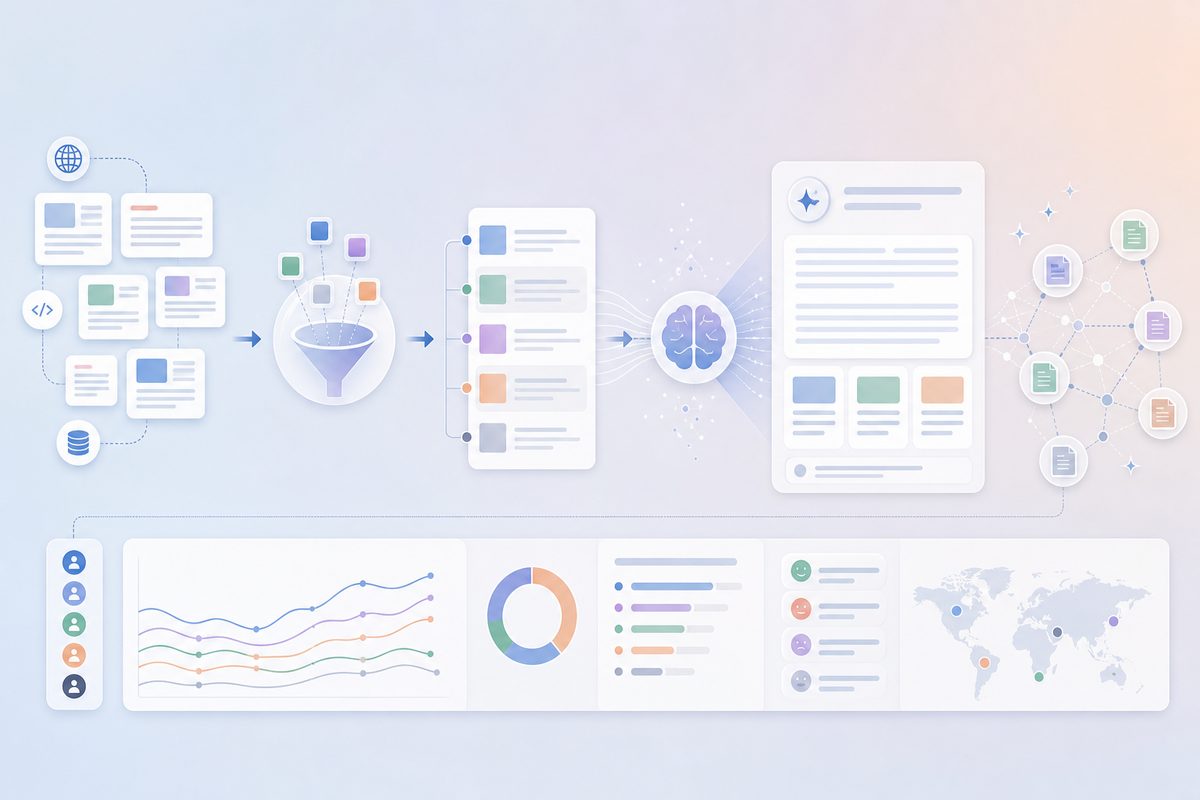
Answer First: The AI Source Pipeline
Most AI answer engines follow six source-discovery jobs:
- Access content. The system, a search partner, or a user-triggered agent must be able to fetch the page.
- Index and chunk it. Pages are converted into searchable documents, passages, entities, or embeddings.
- Interpret the prompt. The engine identifies intent, entities, constraints, and follow-up subquestions.
- Retrieve candidates. Search, semantic retrieval, entity databases, vertical feeds, and partner content produce source candidates.
- Rerank evidence. The system decides which sources are most relevant, current, authoritative, and useful for the answer.
- Generate and cite. The model writes the response, selects source links, and may or may not absorb the claims from the cited pages.
This is why traditional rankings and AI visibility overlap but are not identical. Ranking well can help discovery, but a page can rank and still fail to become a cited or influential source.
Why AI Source Discovery Is Not Just Google Ranking
Google’s own documentation for AI features in Search says AI Overviews and AI Mode can use query fan-out: multiple related searches across subtopics and data sources. Google also says a page must be indexed and snippet-eligible to appear as a supporting link in those features, but that there are no special technical requirements beyond Search eligibility.
Independent measurement shows the difference matters. A 2026 preprint, Measuring Google AI Overviews, analyzed 55,393 trending queries from March 13 to April 21, 2026. It found AI Overviews triggered on 13.7% of all sampled queries and 64.7% of question-form queries. It also found that 29.8% of AI Overview-cited domains did not appear on the co-displayed first page of organic results.
That does not mean organic SEO is irrelevant. It means the source pool for AI answers can be broader, more passage-specific, and more dependent on how the prompt is decomposed.
For a channel-level view of citation selection, rankings, and brand visibility, see AI search engine ranking.
Where AI Answer Engines Get Sources
Different engines expose different details, and many ranking systems are proprietary. But source discovery usually comes from a mix of these layers:
| Source layer | What it contributes | Common SEO implication |
|---|---|---|
| Web crawl and search indexes | Public pages, snippets, canonical URLs, freshness signals | Crawlability, indexability, internal links, and snippet controls still matter. |
| Partner or licensed content | News, reference, publisher, or vertical data feeds | Earned coverage and third-party authority can influence what the engine sees. |
| Entity and knowledge databases | People, companies, products, places, relationships | Entity consistency across your site and external profiles matters. |
| Vertical indexes | Shopping, local, jobs, travel, academic, code, or product data | Structured, complete, current data improves source eligibility in specific contexts. |
| User-triggered browsing | A live fetch after a user asks for current information or a URL | A page may be accessible on request even if it is not part of automatic search discovery. |
| Model memory | Patterns learned during training, not necessarily a citable live source | Memory may shape wording, but citations usually come from retrieval-time sources. |
OpenAI’s ChatGPT search announcement says ChatGPT search uses third-party search providers and partner content. OpenAI’s crawler documentation separates OAI-SearchBot, used for ChatGPT search visibility, from GPTBot, used for training-related crawling. That distinction matters for publishers that want search inclusion without allowing training use.
Stage 1: Access and Eligibility
An AI answer engine cannot cite a page its retrieval layer cannot access. Before rewriting content, verify that important pages can be crawled, rendered, indexed, and previewed.
Start with these checks:
| Check | Why it matters |
|---|---|
| HTTP status | Important URLs should return 200, not soft 404s, redirects to generic pages, or bot-specific errors. |
robots.txt |
Search crawlers and AI search crawlers may be controlled separately. |
noindex |
A noindexed page is usually not eligible for search-based citation. |
| Snippet controls | Overly restrictive nosnippet, data-nosnippet, or max-snippet rules can limit supporting links in Google AI features. |
| Rendered text | Core answer content should be visible as HTML text, not only inside images, gated forms, or client-side states. |
| CDN and WAF rules | Bot protection can block legitimate crawlers even when robots.txt allows them. |
| Internal links | A page with no discovery path is less likely to be found, refreshed, or understood in context. |
For ChatGPT search, OpenAI says sites opted out of OAI-SearchBot will not be shown in ChatGPT search answers, though they can still appear as navigational links. A common policy split looks like this:
User-agent: OAI-SearchBot
Allow: /

User-agent: GPTBot
Disallow: /
That example allows automatic search surfacing while opting out of training-related crawling. It is not a universal recommendation; it is a visibility-policy choice.
Stage 2: Query Interpretation and Fan-Out
AI answer engines rarely treat a complex prompt as one keyword. They decompose it into entities, constraints, comparisons, intent, and implied subquestions.
For example:
“What are the best SOC 2-ready session replay tools for a B2B SaaS product team?”
The engine may need evidence for several fragments:
| Prompt fragment | Retrieval need |
|---|---|
| “best” | Comparison pages, review pages, category roundups, analyst-style summaries |
| “SOC 2-ready” | Security pages, trust centers, compliance docs, procurement pages |
| “session replay tools” | Category pages, feature pages, docs, product pages |
| “B2B SaaS product team” | Use-case pages, case studies, workflows, buyer guides |
| “for” | Fit, tradeoffs, pricing, implementation constraints, alternatives |
A single homepage rarely satisfies all of those jobs. The engine may pull one source for category definition, one for compliance proof, one for pricing, one for reviews, and one for implementation details.
This is why multi-step AI search changes source visibility. Deep research and agentic search workflows can widen the candidate set over several rounds, which favors brands with connected hubs, docs, comparisons, and external proof. See deep research modes and AI citations for the longer version.
Stage 3: Passage Retrieval
Retrieval often happens at passage level. A page can be indexed and still lose if the useful answer is buried under vague copy, hidden behind tabs, or written in internal terminology that does not match the prompt.
The original Retrieval-Augmented Generation paper described models that combine parametric model knowledge with a dense vector index of external passages. Consumer answer engines are more complex than that research setup, but the operational lesson holds: the model needs retrievable evidence at answer time.
A retrievable passage usually has five traits:
| Trait | What it looks like |
|---|---|
| Clear entity | The brand, product, category, audience, and use case are named directly. |
| Direct answer | The first 40-60 words answer one question without throat-clearing. |
| Evidence nearby | Dates, numbers, examples, limitations, methodology, or source links sit next to the claim. |
| Standalone structure | The heading, paragraph, list, or table makes sense if extracted alone. |
| Prompt-language match | The passage uses the terms buyers use, not only internal product language. |
Weak passage:
“Our platform helps teams unlock digital experience intelligence with powerful workflows.”
Stronger passage:
“Acme Replay is a session replay and product analytics tool for B2B SaaS product teams. It is best suited for teams that need account-level session review, bug reproduction, and SOC 2 documentation during procurement.”
The second version gives the engine entities, category, audience, use case, and constraints in one retrievable block.
Stage 4: Candidate Set Formation
The candidate set is the shortlist of pages the answer engine considers before writing. If your brand does not enter this set, it cannot be cited or used as evidence.
For B2B software, candidate sources often include:
- Product pages
- Category pages
- Developer documentation
- Security and compliance pages
- Pricing pages
- Comparison pages
- Review sites
- Partner directories
- Marketplace listings
- Help center articles
- Forum discussions
- Analyst posts
- Customer case studies
- News and funding coverage
This is where many brand sites lose. Their owned pages describe features, while third-party pages describe the buying problem. If the prompt is comparative, evaluative, or objection-led, an engine may prefer sources that already compare tradeoffs.
Typical candidate-set gaps:
| Gap | Result |
|---|---|
| No category page | The brand is not retrieved for generic “best tools” prompts. |
| No comparison content | Competitors and review sites frame the tradeoffs. |
| Thin docs | Developer or implementation prompts retrieve GitHub, Stack Overflow, or competitor docs instead. |
| Hidden pricing | Engines cite sources that can answer cost and plan questions directly. |
| Weak external corroboration | The engine finds your claims but trusts third-party descriptions more. |
| Inconsistent positioning | Different sources describe the brand with different categories, confusing entity matching. |
If competitors keep being cited instead of your page, the issue is often the public evidence footprint, not just on-page copy. The pattern is covered in why AI search engines cite competitor pages instead of yours.
Stage 5: Reranking Evidence
Reranking decides which retrieved sources are strong enough to influence the answer. The strongest sources are not merely keyword-matched. They are relevant, specific, current, extractable, and credible enough to support a claim.
A 2026 controlled preprint, What Gets Cited: Competitive GEO in AI Answer Engines, ran 252,000 trials across six LLMs in a two-document RAG testbed. The study found topical relevance and list position were the largest drivers of first citation. It also found that explicit price information and recent timestamps helped consistently, while formatting-only edits had limited impact.
The limitation is important: the study used a controlled retrieval setup, not the full live source-selection system of every consumer engine. Still, the finding matches a practical SEO lesson: formatting helps extraction, but evidence wins reranking.
A table is useful when it contains real tradeoffs. A “last updated” date is useful when the content actually reflects current facts. Schema is useful when it matches visible content. None of those compensate for a page that does not answer the prompt.
Stage 6: Citation and Absorption
Getting cited is not the same as shaping the answer. A source link can appear in the interface while the answer’s wording, recommendation, or comparison structure comes from another page.
A 2026 preprint, From Citation Selection to Citation Absorption, studied 602 controlled prompts across ChatGPT, Google AI Overview/Gemini, and Perplexity, with 21,143 valid search-layer citations. The paper distinguishes citation selection from citation absorption: whether a page is linked versus whether it contributes language, evidence, structure, or factual support to the generated answer.
That distinction changes the measurement question. Do not only ask, “Were we cited?” Ask:
- Did the brand appear in the answer?
- Did the answer describe the brand accurately?
- Did the cited page support the specific claim attached to it?
- Did the answer use our definition, data, comparison, or steps?
- Did the brand appear before or after competitors?
- Did the answer inherit an outdated or inaccurate third-party description?
The Google AI Overviews measurement paper also found 11.0% of decomposed atomic claims were unsupported by the cited pages. Citations are useful signals, but they are not proof that every claim is grounded.
maxaeo's Source Discovery Loss Map
The most useful diagnostic is to label each prompt failure by pipeline stage. The same missing mention can have different causes.
| Code | Loss stage | Symptom | Evidence to collect | Primary fix |
|---|---|---|---|---|
| C0 | Crawl/access | Owned pages never appear as sources | robots.txt, noindex, snippet controls, server logs, rendered HTML |
Fix access, rendering, indexing, and preview eligibility. |
| I1 | Index/chunk | Page is indexed but the useful answer is not surfaced | Search snippets, cached/rendered text, heading structure | Rewrite key sections into standalone answer blocks. |
| Q2 | Query fan-out | The page answers the head term but misses constraints | Prompt fragments, subtopics, follow-up questions | Build supporting pages for use cases, comparisons, integrations, compliance, pricing, and objections. |
| R3 | Retrieval | Competitors enter the source set but your page does not | Source panels, repeated runs, query variants | Add prompt-matched pages and internal links from relevant hubs. |
| K4 | Reranking | Your page appears sometimes but loses to stronger sources | Citation order, freshness, proof depth, third-party corroboration | Add current evidence, transparent comparisons, and external proof. |
| A5 | Absorption | Your page is cited but the answer ignores your claim | Claim-to-source mapping, wording overlap, cited passage location | Move definitions, numbers, tables, and steps closer to the top and citation target. |
| D6 | Description | The answer mentions the brand incorrectly | Repeated brand prompts, external profile audit | Fix canonical descriptions on owned pages and high-authority third-party profiles. |
This loss map prevents a common mistake: rewriting every page when the real problem is crawl access, source diversity, or external corroboration.
Worked Example: One Prompt, Six Failure Modes
Use this prompt:
“Which customer onboarding platforms are best for a seed-stage B2B SaaS company moving from spreadsheets?”
A generic SEO response would be, “Publish a best tools article.” A pipeline diagnosis is more precise.
| Pipeline stage | What to check | Example failure | Better fix |
|---|---|---|---|
| Access | Can relevant pages be fetched and indexed? | The onboarding template library is blocked by JavaScript and not visible in rendered HTML. | Make templates indexable, text-readable, and linked from the onboarding hub. |
| Passage retrieval | Does the page use buyer language? | The page says “implementation workflows” but never “customer onboarding platform.” | Add a 40-60 word answer block using the buyer’s terms. |
| Fan-out | Are constraints covered? | The site has features but no seed-stage, spreadsheet migration, or time-to-value content. | Add sections or pages for each constraint. |
| Candidate set | Is the brand present across the public footprint? | Review sites and competitor pages define the category better than the brand site. | Build category, comparison, and customer-proof assets. |
| Reranking | Is the evidence strong enough? | Competitors show pricing, integrations, migration steps, and third-party reviews. | Add transparent pricing context, integration details, and corroborated proof. |
| Absorption | Can the answer lift the claim cleanly? | The page is cited, but the answer repeats a review-site description. | Put the category definition, ideal customer, and evidence near the top. |
The fix is not “more content” by default. The fix is the smallest change that repairs the failed stage.
How to Make a Page Easier for AI Answer Engines to Find
A citable page is not a keyword-stuffed page. It is a page with clean, extractable evidence.
Use this pattern for high-value sections:
- Answer the question in the first 40-60 words.
- Name the entity, category, audience, and use case.
- Put proof next to the claim.
- State limits and exceptions.
- Use tables for comparisons and lists for processes.
- Show dates where facts change.
- Match structured data to visible text.
- Link from relevant hubs, docs, and comparison pages.
- Earn corroboration from third-party sources.
A strong source block looks like this:
| Element | Example |
|---|---|
| Direct answer | “Acme Replay is a session replay tool for B2B SaaS product teams that need account-level playback and bug reproduction.” |
| Best-fit audience | “It is strongest for product and support teams that review user sessions by account, plan, or workspace.” |
| Evidence | “As of July 2026, the product lists SAML SSO, SOC 2 documentation, and Jira integration in its public docs.” |
| Limitation | “It is not positioned as a full digital adoption platform.” |
| Freshness | “Last reviewed: July 2026.” |
For developer-led products, documentation is often the most citation-ready asset because it contains concrete procedures, constraints, and implementation details. See developer docs as an AI citation source.
How to Audit Your Own Prompts
A useful AI search audit should be prompt-based, not page-based.
- Build a prompt set. Start with 50-150 prompts across category, comparison, alternative, integration, compliance, pricing, objection, and recommendation intent.
- Run each prompt repeatedly. AI answers vary, so one run is not enough.
- Record sources and answers. Capture cited URLs, brand mentions, recommendation order, wording, and missing competitors.
- Classify every source. Owned, earned, review, marketplace, forum, docs, media, competitor, or unknown.
- Map each failure to the loss map. Assign C0, I1, Q2, R3, K4, A5, or D6.
- Prioritize by revenue intent. Fix late-funnel recommendation and comparison prompts before low-intent informational prompts.
- Change one variable at a time. Rewrite a passage, add proof, open a blocked page, or improve a comparison asset, then retest.
- Measure absorption, not just citation. Check whether the answer uses your claims accurately.
For a source-to-fix workflow, use AI citation tracking to connect each cited URL to a technical, content, or reputation action.
What to Measure Beyond Rankings
Rankings do not show whether an AI answer recommends you, describes you correctly, or uses your evidence.
Track these metrics instead:
| Metric | What it shows | Pipeline stage |
|---|---|---|
| Prompt coverage | Whether the engine produces an answer with sources | Query interpretation |
| Brand mention rate | How often the brand appears in answers | Generation |
| Citation share | How often owned or preferred sources are linked | Retrieval and reranking |
| Source ownership mix | Whether sources are owned, earned, third-party, forum, or competitor pages | Candidate set |
| Answer position | Whether the brand appears first, middle, last, or not at all | Generation |
| Description accuracy | Whether the answer explains the brand correctly | Absorption and reputation |
| Citation freshness | Whether cited pages are current enough for the claim | Reranking |
| Claim support rate | Whether cited pages actually support the answer’s claims | Citation fidelity |
| AI share of voice | Brand presence relative to competitors across prompt groups | Reranking and generation |
A stronger report does not say, “We need more GEO content.” It says, “We lose high-intent comparison prompts at R3 because our category pages are not retrieved, and when we are cited at A5, the answer uses review-site language instead of our positioning.”
Common Questions
How do AI answer engines find sources?
AI answer engines find sources by accessing crawlable pages, search indexes, partner feeds, knowledge databases, and live web results. They interpret the prompt, retrieve relevant passages, rerank candidate sources, generate an answer, and attach citations or source links where the product interface supports them.
Do AI answer engines use Google rankings?
Sometimes, but not as a simple copy of the organic results page. Google AI features build on Search systems, but public research shows AI Overview citations can differ from co-displayed first-page results. ChatGPT search also uses third-party search providers and partner content.
Is RAG the same as AI search?
No. RAG is an architecture that retrieves external information and gives it to a model. AI search products may use RAG-like retrieval plus search indexes, ranking systems, partner feeds, knowledge graphs, shopping data, and proprietary generation layers.
Can robots.txt block ChatGPT search?
Yes, for automatic ChatGPT search surfacing. OpenAI documents OAI-SearchBot as the search crawler. Sites opted out of OAI-SearchBot will not be shown in ChatGPT search answers, though they may still appear as navigational links. User-triggered browsing can behave differently.
Does schema markup make AI engines cite a page?
Schema can help systems understand a page when it matches visible content, but it is not a citation shortcut. Google says no special schema is required for AI Overviews or AI Mode. Clear answers, crawlability, evidence, freshness, and source authority matter more.
Why is my page cited but my brand still missing from the answer?
The page may have passed citation selection but failed citation absorption. That means the engine linked to it but did not use its wording, claims, or evidence in the generated answer. Move the core definition, proof, and comparison data closer to the cited section.
How many prompts should a brand track?
Track enough prompts to represent real buyer intent, not every possible wording. A practical starter set is 50-150 prompts grouped by category, comparison, alternative, integration, pricing, objection, and recommendation intent. Repeat runs over time because answers vary.
How long does it take for fixes to affect AI citations?
Technical access fixes can change after recrawling, but citation behavior depends on platform refresh cycles, retrieval systems, source competition, and prompt variation. Treat each fix as a controlled test with before-and-after prompts rather than an instant ranking update.
The Practical Takeaway
How AI answer engines find sources is a pipeline. A page must be accessible, retrievable, competitive, citable, and influential enough to shape the generated answer.
Start with technical access. Then map prompts to loss stages. Rewrite only the passages that fail retrieval or absorption. Strengthen proof where competitors win reranking. Fix third-party descriptions where reputation signals are wrong. Measure progress by AI share of voice, citation quality, answer position, and description accuracy, not only by organic rankings.