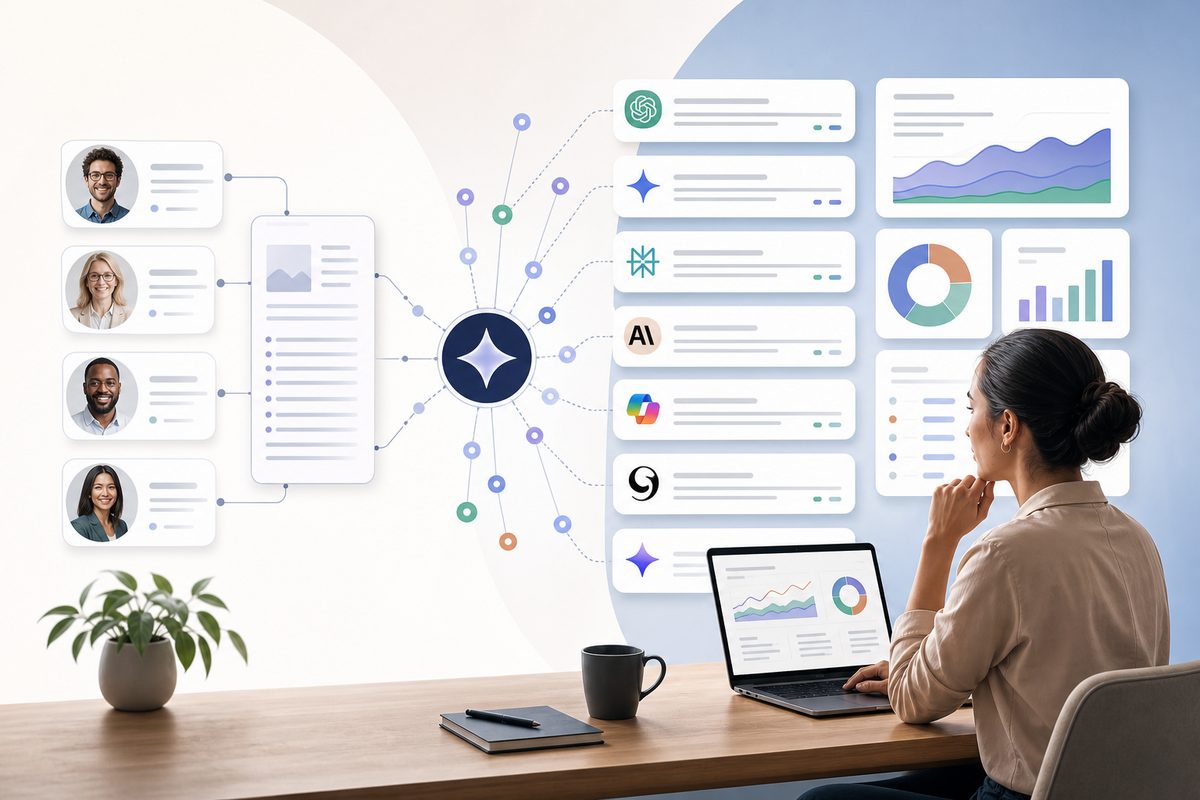
To get experts cited in AI search, you need AI engines to attribute a claim to a named person — "according to [Name], [title] at [company]" — not just to your domain. That means turning your in-house subject-matter experts into quotable, verifiable, well-sourced entities that ChatGPT, Perplexity, Google AI Overviews, and Copilot can recognize and reuse in generated answers.
Most guides stop at the brand or domain level. This one works at the person level and closes a loop the others skip: how to actually measure whether your people get named. You'll get a repeatable framework, a quote-ready writing formula, the 2026 HARO-style sourcing landscape, and a per-engine cheat sheet — with every hard number tied to a named source.

What does "get experts cited in AI search" mean?
It means an AI-generated answer names a specific individual — and often their role and employer — as the authority behind a claim, rather than only linking a website. A domain citation says "Source: acme.com." A person citation says "As Jane Lee, Head of Research at Acme, explains…" The second is stickier: it travels across engines and follows the expert even when the URL changes.
This matters because AI systems increasingly reward entity authority — how well an engine knows and trusts a named thing — over raw domain metrics. A person is an entity. When you make an expert legible to machines, you give the model a reusable, low-risk source to attach opinions and definitions to. That is the whole game.
Why AI answers quote people, not just brands
AI engines prefer named humans because a person carries verifiable credentials, a track record, and cross-web corroboration that a faceless brand claim does not. "Jane Smith, epidemiologist" is easier to trust — and safer to quote — than "XYZ Marketing Corp says."
The data backs the shift toward source-level trust. Ahrefs found that the majority of ChatGPT citations come from domains with a Domain Rating of 80–100, and that AI systems show a recency bias toward fresher content (Ahrefs' analysis of LLM citations). Semrush reports that Google triggered AI Overviews for 13.14% of U.S. desktop searches by March 2025 (up from 6.49% in January) and that 60% of Americans now use AI to find information at least sometimes (per an AP-NORC survey cited in Semrush's AI SEO research).
Translation: more answers are being generated, and they lean on high-trust sources. A recognized expert is a portable trust signal you own — the same entity logic that sits behind broader AI search visibility.
The Named-Expert Citation Loop: a five-step framework
Getting a person cited is not one tactic; it's a loop of five stages you repeat per expert, per topic. Run it end to end, measure, then feed results back into stage one.
- Identify — Pick one expert and the 5–10 questions they should "own" in AI answers. Match the person to queries where their real experience is defensible.
- Package — Create quote-ready material: a tight bio, verifiable credentials, an author byline, and blocks of text written to be lifted (formula below).
- Place — Publish that material on owned pages and earn it on third-party sites through expert commentary and HARO-style sourcing.
- Entity-build — Make the person machine-legible: consistent name and title everywhere, author schema, LinkedIn, and ideally a knowledge-graph presence.
- Measure — Track whether the name appears in AI answers across engines, then return to step one with what worked.
The loop matters because a single placement rarely moves an engine. Repetition of the same person-claim across owned and earned surfaces is what teaches a model that the attribution is stable.
Make your expert "quote-ready"
Quote-ready material is text an engine can extract as a self-contained, attributed claim without editing. If a model has to rewrite your sentence to make it usable, it will often grab a competitor's cleaner version instead.
The anatomy of a liftable quote is specific claim + evidence + attribution + mechanism. Compare:
| Element | Weak version | Quote-ready version |
|---|---|---|
| Claim | "AI search is a big deal." | "AI answers increasingly name a person as the source, not just a URL." |
| Evidence | "Studies show this works." | "One site lifted its AI citations ~40% in 90 days after adding direct answers and original case-study data." |
| Attribution | "Experts say…" | "says Jane Lee, Head of Research at Acme Analytics" |
| Mechanism | "It just works." | "because engines can attach a verifiable claim to a recognized entity" |
That 40% figure is real: Baruch Labunski of Rank Secure reported a ~40% increase in brand citations in AI results within 90 days after adding direct answers and original case-study data — roughly 120 new pages plus ~15 revised, per Semrush's reporting. Notice the format — a named person, a number, a timeframe. That is exactly the shape AI models like to reuse.
Practical rule: end every expert insight with the attribution attached, not floating three paragraphs away. Pair each quote with a visible byline and, where possible, author schema so an engine can trust who wrote it.
HARO-style sourcing in 2026: where experts earn quotes
HARO-style sourcing means responding to journalist and publisher requests so your expert gets quoted in third-party articles — the earned mentions AI engines trust more than your own site. AI systems consistently pull citations from outside brand-owned domains for comparative and evaluative queries, so where your expert appears matters as much as what your own pages say.
The landscape changed. The original HARO was rebranded as Connectively, which shut down; the HARO name was later acquired by Featured.com, and HARO founder Peter Shankman launched a successor, Source of Sources. Here are the platforms worth your experts' time, per BuzzStream's tested comparison of HARO alternatives:
| Platform | Best for | Pricing |
|---|---|---|
| Source of Sources | HARO successor; broad daily requests | Free |
| Qwoted | Tier-1 publisher placements | ~$99/mo Pro |
| Featured | Curated expert roundups for major publishers | Varies |
| Help a B2B Writer | B2B/SaaS-specific requests | Free |
| Dot Star Media | Real-time X/BlueSky alerts | Free (US) |
Qwoted skews toward tier-1 outlets, which maps directly onto the high-DR sources AI engines favor — so a placement there does double duty. Feeding that earned coverage back into your owned content is the core of digital PR built for AI search.
How to respond so you actually get picked
Win rate on these platforms is a function of speed, specificity, and authenticity — in that order. Follow this sequence:
- Respond within the first hour. Journalists work on deadline; the first strong, usable quote often wins.
- Answer the exact question asked — no generic boilerplate, no pivot to a sales pitch.
- Lead with a number or a first-hand example the reporter can't get elsewhere.
- Attach a one-line bio and credentials so the byline writes itself.
- Never send AI-generated pitches. As Source of Sources founder Peter Shankman puts it: "DON'T use AI. We can always tell, and it'll always be terrible." Detectable AI copy gets you skipped and can burn the relationship.
Build the expert as an entity AI recognizes
An expert becomes a machine-readable entity when their name, title, and expertise are consistent and corroborated across the open web. Inconsistency — "J. Lee" here, "Jane Lee, PhD" there, a different employer on LinkedIn — fragments the signal and makes engines hesitant to attribute.
Do three things:
- Standardize the identity. Same name, same current title, same short bio on your site, LinkedIn, conference pages, and every earned placement.
- Ship author schema. Mark up articles with
authoras aPerson, linksameAsto their profiles, and keep bylines visible on the page. - Pursue a knowledge-graph presence. For senior experts and founders, getting the person recognized in Wikidata gives engines a canonical entity to anchor to.
Google's own guidance rewards clearly identified authorship and first-hand expertise — it asks whether pages "carry a byline" and whether content "demonstrate[s] first-hand expertise and a depth of knowledge" (Google Search Central on people-first content). Entity-building is slow, but it compounds: once an engine "knows" your expert, every new mention reinforces the same node.
Optimize per engine: ChatGPT, Perplexity, AI Overviews, Copilot
Each engine sources answers differently, so the lever that gets your expert cited shifts by platform. Use this as a quick map, not a rigid rulebook.
| Engine | Tends to cite | Expert lever that works |
|---|---|---|
| ChatGPT | High-DR domains, web + training data | Earned press on DR 80+ sites; consistent named bylines |
| Perplexity | Fresh web, with inline citations shown | Recent commentary; a quotable stat with clean attribution |
| Google AI Overviews | Content that already ranks | On-page bylines, author schema, front-loaded answers |
| Copilot | The Bing index, heavily | Bing-indexed profiles, LinkedIn, and press coverage |
The pattern is consistent: fresh, well-attributed, high-trust sources win. ChatGPT's tilt toward DR 80–100 domains (per Ahrefs) and Copilot's dependence on the Bing index mean your earned-media strategy — not just your blog — is doing the heavy lifting. This is why answer engine optimization and generative engine optimization increasingly overlap with classic digital PR.
How to measure whether your experts get cited
You measure person-level citation by tracking how often a specific name — not just your domain — appears and is attributed across AI engines over time. Domain-level dashboards miss this entirely; a page can be cited while your expert stays invisible.
Set up three metrics per expert:
- Named-mention rate — the share of relevant AI answers that name the person.
- Person-level share of voice — your expert's named mentions versus rival experts for the same query set.
- Attribution accuracy — whether the engine states the right role, employer, and claim.
Running the same prompts weekly across ChatGPT, Gemini, Perplexity, Claude, Copilot, and Google AI Overviews turns anecdote into a trend line. Platforms like MaxAEO monitor these signals daily and surface exactly which claims and sources drive a mention — the same discipline behind AI citation tracking that finds the sources behind answers. Without this loop, you're placing quotes blind.
A worked example (illustrative)
Here is the loop applied end to end — a composite scenario, with numbers shown only to illustrate method, not as a published study. Say a B2B analytics startup wants its Head of Research cited for "how to measure AI share of voice."
- Baseline: Weekly prompts show her named in 0 of 20 AI answers; the domain is cited twice.
- Package & place: She publishes a bylined methodology post with one proprietary chart, then answers three Qwoted requests on the topic within an hour each — two land on DR 80+ sites.
- Entity-build: Byline, author schema, and a matching LinkedIn title go live; the same 40-word definition appears on the owned post and in the earned quotes.
- Six weeks later: She's named in 6 of 20 answers; Perplexity cites her by name with the correct title.
The mechanism is the repeated, attributed claim across owned and earned surfaces — the model now has a stable person to point to. Your real numbers will differ; the method is what transfers.
Common mistakes that keep experts invisible
Most failures come from treating this as a one-off PR hit instead of a sustained entity-building loop. Avoid these:
- Floating claims. Insights with no attached name give the engine nothing to attribute.
- Identity drift. Different names, titles, or employers across the web split your signal.
- Ghost bylines. "Written by the [Brand] team" wastes the person-level advantage — a visible byline plus author schema is what makes an engine trust who wrote the content.
- Set-and-forget. No measurement means no idea which placements actually moved an engine.
- AI-written pitches. Fast way to get filtered by journalists and lose trust.
Frequently asked questions
Do AI engines actually cite individual people, or just websites?
Both — and increasingly people. Engines attach claims to named experts when the person is verifiable and consistently corroborated, because a credentialed individual is a lower-risk source than an anonymous brand statement.
Is HARO still worth it in 2026?
Yes, in its new form. The original HARO shut down, but successors like Source of Sources, Qwoted, and Featured connect experts with journalists. Qwoted is notable for skewing toward tier-1 publishers — the high-trust sources AI engines favor.
How long until an expert starts getting cited?
Expect weeks to a few months, not days. Case reports like Rank Secure's cite roughly 90 days to see a meaningful lift, and person-level entity signals compound gradually as mentions accumulate.
Can I get experts cited if they have no press history?
Yes. Start with owned bylined content plus author schema, then earn a handful of third-party quotes through HARO-style sourcing. Consistency across those surfaces builds the entity from scratch.
How do I know if a specific person is being cited?
Track named-mention rate and person-level share of voice by running the same prompts weekly across engines, or use an AI visibility tool that monitors named mentions and the sources behind them daily.