A free AI visibility checker is the right first step when you need to know whether answer engines recognize your brand, describe it correctly, cite useful sources, and recommend you against competitors. It is not a substitute for ongoing AI search monitoring, because one-time checks cannot prove trends, volatility, prompt coverage, or ROI.
That distinction matters for commercial teams. A CMO does not need another screenshot from ChatGPT. They need to know whether AI systems consistently include the brand in buyer shortlists, which sources shape the answer, what competitors are winning, and which fixes should be prioritized.
Use this guide to interpret a free report, avoid misleading scores, and decide when to move from a free checker to a monitored AI visibility program.
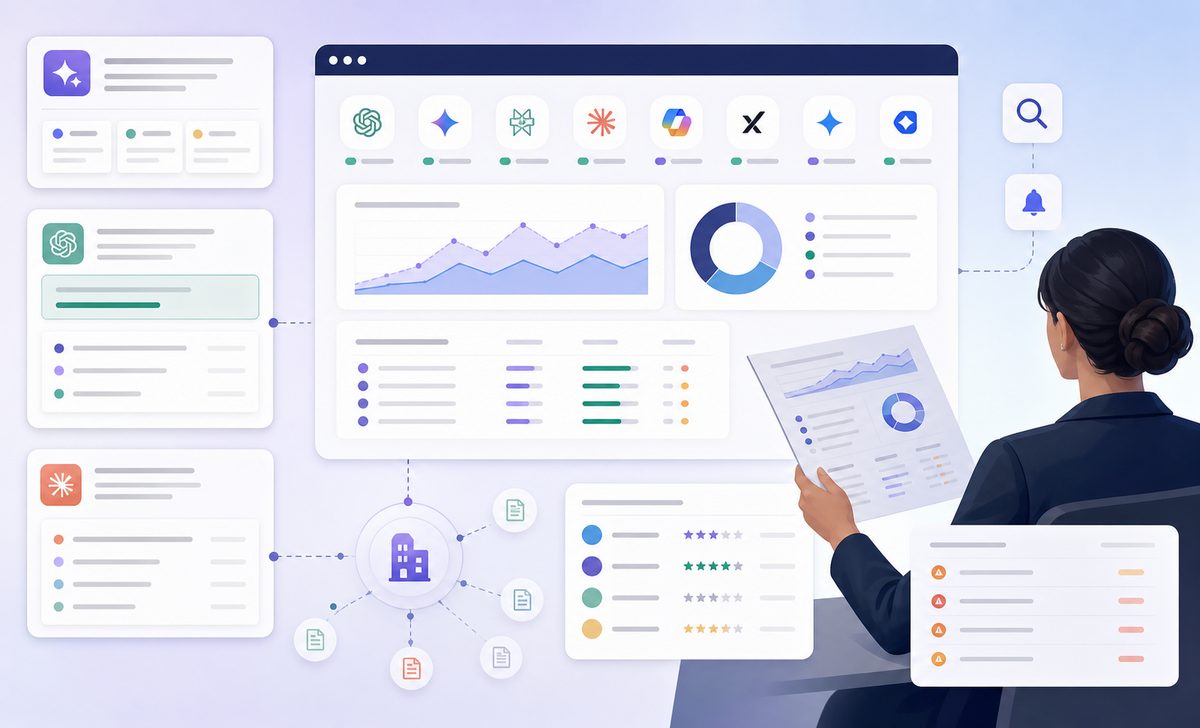
Quick verdict: what a free checker is good for
A free AI visibility checker is best used as triage. It can tell you where the problem probably is. It should not become the monthly KPI you report to leadership.
| Use a free checker when you need to know… | Move to paid monitoring when you need to know… |
|---|---|
| Whether AI systems recognize your brand | Whether recognition is improving over time |
| How your brand is described in sample prompts | Whether descriptions are stable across models and prompts |
| Which competitors appear beside you | Whether competitor share of voice is changing |
| Which sources are cited in a few answers | Which sources are cited repeatedly and why |
| Whether obvious citation gaps exist | Whether content, PR, or technical fixes changed outcomes |
| Whether the channel deserves investigation | Whether AI visibility is affecting pipeline, reputation, or client reporting |
The best free AI visibility checker is not the one with the neatest score. It is the one that shows raw answers, prompt wording, engine names, citations, competitor context, and next steps. If a tool hides the prompts and sources, treat the score as a sales hook, not evidence.
What is a free AI visibility checker?
A free AI visibility checker is a diagnostic report that tests how AI answer engines recognize, describe, recommend, and cite a brand across a small prompt sample. It is best for finding early visibility gaps before buying software, not for proving trend movement, ROI, or campaign impact.
Most tools test some mix of:
- Brand recognition: Does the AI system know who you are?
- Description accuracy: Does it explain your product correctly?
- Recommendation visibility: Are you included in category or use-case shortlists?
- Competitor inclusion: Which alternatives appear when you do not?
- Citation evidence: Which websites, reviews, docs, articles, or directories support the answer?
- Sentiment and risk: Does the answer frame the brand as trusted, niche, expensive, outdated, risky, or incomplete?
For a broader foundation on how this fits into AI search strategy, see What Is GEO? The Complete Guide to Generative Engine Optimization.
What should a free AI visibility checker show?
A useful free checker should show enough evidence for a marketer to act. At minimum, it should reveal the prompt, answer engine, raw response, brand mention, competitor mentions, citations, and recommended fix. A score without those details is hard to audit.
Use this quality checklist before trusting a free report.
| Report element | Minimum acceptable version | Strong version |
|---|---|---|
| Prompt disclosure | Shows at least the tested prompt topics | Shows exact prompts and lets you edit or export them |
| Engine coverage | Names the AI system tested | Separates ChatGPT, Gemini, Perplexity, Claude, Copilot, Google AI Overviews, and Google AI Mode where available |
| Raw answer | Shows a summary | Shows the full answer, wording, citations, and timestamp |
| Competitor context | Lists mentioned competitors | Compares competitors by prompt cluster and buying intent |
| Citation detail | Shows a few cited URLs | Groups citations by owned, third-party, review, community, and media sources |
| Fix recommendations | Gives general advice | Maps each gap to a page, source, or content action |
| Repeatability | One-time scan only | Saves the prompt set so it can be rerun later |
| Export | Screenshot only | CSV, PDF, API, or dashboard export |
For a deeper comparison of one-off diagnostics and recurring reports, read Free AI Visibility Reports vs Ongoing Monitoring: Which Do You Need?.
What can you learn before buying?
A free AI visibility checker can usually identify the type of visibility problem you have: awareness, accuracy, competitiveness, evidence, or volatility. Each problem needs a different fix.
Brand recognition
Brand recognition means the AI system can identify your company and explain what it does without confusing it with another entity.
Check the raw answer for:
- Wrong product category
- Old positioning
- Merged competitors
- Incorrect headquarters or market
- Outdated pricing or packaging
- Missing flagship products
- Hallucinated features
If an AI system cannot describe your brand correctly on a direct brand prompt, category-level recommendation prompts will usually perform worse.
Recommendation visibility
Recommendation visibility is more commercially important than brand recognition. It answers the question: does the AI system recommend you when a buyer asks for solutions?
A company can be recognized on direct prompts and still be absent from prompts such as:
- "Best AI visibility tools for B2B SaaS teams"
- "Which platforms track brand mentions in ChatGPT?"
- "Alternatives to [competitor] for agencies"
- "Best tools for monitoring AI citations"
- "How should an enterprise SEO team measure AI search visibility?"
Direct brand visibility shows that the entity exists. Recommendation visibility shows whether the brand is in the buying conversation.
Positioning and sentiment
Sentiment is the tone of the answer. Positioning is the category frame around the brand.
Look for labels such as:
- Enterprise
- SMB
- Developer-first
- Agency-focused
- Expensive
- Experimental
- Hard to implement
- Strong for reporting
- Weak for technical SEO
- Better for one-time audits than monitoring
The useful question is not "is the sentiment score positive?" It is "does this description match what we want buyers to believe?"
Competitor inclusion
Competitor inclusion shows whether AI systems mention your brand next to the companies your buyers already evaluate. This is where AI share of voice becomes commercially meaningful.
A free report should help you separate three patterns:
| Pattern | What it means | Likely next action |
|---|---|---|
| Your brand appears in direct prompts only | AI systems know the entity but do not recommend it | Build use-case, category, and comparison evidence |
| Competitors appear with citations and you do not | Competitors have stronger public evidence | Improve crawlable proof, comparison pages, reviews, and third-party profiles |
| Your brand appears but is framed narrowly | AI systems have stale or incomplete positioning | Update owned pages and external descriptions |
| Nobody is cited consistently | The prompt set may be too broad or unstable | Test a larger, segmented prompt set |
Citation gaps
Citation gaps show which sources AI systems use instead of your owned content. They are often more actionable than mention scores.
For Google AI features, Google says AI Overviews and AI Mode can use query fan-out and links from Google Search systems, and that foundational SEO practices still apply. Google's documentation also says pages need to be indexed and eligible for a snippet to appear as supporting links in AI features, with no special AI-specific schema required. See Google's official guidance on AI features and your website and optimizing for generative AI features on Google Search.
For broader answer engines, citations may come from product pages, documentation, comparison pages, review sites, directories, community discussions, analyst content, media coverage, and customer proof.
Use the free report to build a source map.
| Citation finding | What to inspect | Likely fix |
|---|---|---|
| Competitors are cited, your site is absent | Category and comparison pages | Publish clearer public evidence for buyer prompts |
| AI cites old third-party profiles | Review sites, directories, partner pages | Update stale descriptions and product categories |
| AI cites blog posts but not product pages | Product pages, internal links, schema | Add concise product definitions and proof blocks |
| AI cites unsupported claims | Source quality and claim accuracy | Replace vague copy with sourced, specific claims |
| No citations appear | Engine and prompt type | Test grounded systems separately from ungrounded chat answers |
What can a free checker not tell you?
A free checker cannot prove whether AI visibility is improving. It cannot separate signal from answer variance, measure enough buyer prompts, track source changes, or connect fixes to outcomes. It is a snapshot; buying decisions require repeatable measurement.
This is not a theoretical limitation. The 2026 arXiv paper Don't Measure Once: Measuring Visibility in AI Search argues that AI search visibility should be treated as a distribution, because answers vary across runs, prompts, and time.
It cannot measure volatility
AI answers are not fixed rankings. The same prompt can return different brand orders, sources, or wording across runs.
A second 2026 arXiv study, How Generative AI Disrupts Search, compared Google Search, Google AI Overviews, and Gemini across 11,500 queries. The authors reported low source overlap between systems and found that generative search results were less consistent across repeated runs and minor query edits.
That means a one-time result like "mentioned in 3 of 10 prompts" can be misleading. It may reflect weak visibility, a poor prompt sample, normal answer variance, or a temporary source mix.
It cannot cover enough buyer prompts
Most free tools test a small set of broad prompts. That is enough for triage, but buyers use many prompt types before they shortlist vendors.
| Prompt type | Example | What it tests |
|---|---|---|
| Direct brand | "What is [brand]?" | Recognition and accuracy |
| Category shortlist | "Best [category] tools for mid-market SaaS" | Recommendation visibility |
| Use case | "How should a B2B SaaS team track brand mentions in ChatGPT?" | Problem-solution fit |
| Comparison | "[Brand] vs [competitor] for agencies" | Competitive positioning |
| Alternative | "Alternatives to [competitor] for enterprise teams" | Replacement demand |
| Risk | "Is [brand] reliable for enterprise reporting?" | Objections and reputation |
| Evidence | "Which vendors publish AI citation data?" | Proof and authority |
| Integration | "Which [category] tools integrate with [platform]?" | Technical fit |
| Budget | "Affordable AI search monitoring platforms" | Price positioning |
| Local or vertical | "Best [category] software for healthcare marketers" | Segment relevance |
A free checker can reveal obvious gaps. It usually cannot tell you which prompt clusters deserve budget.
It cannot prove ROI
A free report can start a business case, but it cannot prove channel impact. For that, you need:
- Baseline prompt performance
- Repeat measurements
- Competitor movement
- Citation history
- Raw answer archives
- Fix logs
- Pipeline or conversion correlation
- Reporting by prompt cluster and buying intent
Google also notes that AI Overviews and AI Mode traffic is reported in Search Console under the overall Web search type, not as a separate AI visibility report. That makes third-party monitoring useful when teams need prompt-level visibility rather than aggregate search traffic.
MaxAEO's free-checker decision model
Use a free AI visibility checker to decide what kind of problem you have, not to decide whether AI search matters. The right next step depends on the pattern.
| Free-check finding | What it means | Next action |
|---|---|---|
| Brand is not recognized | Entity signals are weak or ambiguous | Fix About page, product pages, schema, profiles, and authoritative mentions |
| Brand is recognized but described poorly | Public sources are stale or inconsistent | Update owned messaging and third-party descriptions |
| Brand appears only in direct prompts | Awareness exists, but recommendation visibility is weak | Build category, use-case, comparison, and alternative pages |
| Competitors are cited, you are not | Your public evidence is not strong or accessible enough | Improve crawlable proof, examples, stats, and third-party validation |
| Sentiment is negative or risky | AI systems are repeating objections or old narratives | Audit reviews, media, forums, and source freshness |
| Results vary heavily | Sample size is too small for reporting | Move to repeated monitoring before using KPIs |
| Report creates more questions than answers | The team needs workflow, not a grade | Evaluate paid monitoring and remediation tools |
Starter prompt set for a first AI visibility check
Start with 25 to 50 prompts across five clusters. The point is not to test every possible query. The point is to cover the buying journey well enough to see where your brand disappears.
| Cluster | Prompts to include | Example |
|---|---|---|
| Brand accuracy | 5 direct brand prompts | "What is [brand] and who is it for?" |
| Category discovery | 5 to 10 category prompts | "Best [category] software for B2B SaaS teams" |
| Use-case fit | 5 to 10 problem prompts | "How can a marketing team monitor brand mentions in ChatGPT?" |
| Comparison and alternatives | 5 to 10 competitor prompts | "[Brand] vs [competitor] for enterprise SEO teams" |
| Objection and proof | 5 to 10 risk or evidence prompts | "Is [brand] reliable for agency client reporting?" |
A practical first test for an AI visibility checker:
- Run the same prompt set across at least two answer engines.
- Save raw answers, citations, and timestamps.
- Mark whether your brand is absent, mentioned, recommended, cited, or ranked.
- Classify each citation as owned, earned, review, directory, community, or competitor-owned.
- Rerun the same prompts later before calling any change a trend.
For serious monitoring, segment prompts by buyer type, market, language, geography, and sales stage.
How to grade the quality of a free AI visibility report
Use this 100-point scorecard before making a purchase decision from a free report.
| Evaluation factor | Points | What earns full credit |
|---|---|---|
| Prompt transparency | 15 | Exact prompts are visible and exportable |
| Engine and surface clarity | 15 | The report names the systems tested and separates chat, search, AI Overviews, and AI Mode where relevant |
| Raw answer access | 15 | Full answers, timestamps, and citation details are available |
| Competitor context | 10 | Named competitors are tracked within the same prompt set |
| Citation usefulness | 15 | Sources are grouped, counted, and tied to recommended fixes |
| Prompt coverage | 10 | Prompts cover direct, category, use-case, comparison, risk, and evidence intent |
| Repeatability | 10 | The same test can be rerun and compared later |
| Remediation quality | 10 | Recommendations point to specific page, source, content, or technical actions |
A report below 50 points is useful for curiosity. A report above 70 points can support a buying discussion. A report above 85 points can become the first baseline for an AI visibility program.
Free checker vs ongoing AI search monitoring
A free checker and a paid monitoring platform answer different questions.
| Capability | Free AI visibility checker | Ongoing AI search monitoring |
|---|---|---|
| Baseline diagnosis | Yes | Yes |
| Prompt-level history | Usually no | Yes |
| Competitor trend lines | Limited | Yes |
| Volatility measurement | No | Yes |
| Citation frequency over time | Limited | Yes |
| Alerts for risky answers | Rare | Yes |
| Client-ready exports | Sometimes | Usually |
| Remediation workflow | Light | Should be built in |
| ROI analysis | No | Possible with integrations and fix logs |
| Best use case | Initial audit | Channel management |
If your team is still deciding whether this belongs in the budget, start with the free check. If leadership is asking whether AI visibility improved after specific work, you need monitoring.
For budgeting, see AI Search Monitoring Pricing: 2026 Buyer Guide and Cost Model.
When should you move from free to paid?
Move from a free checker to ongoing monitoring when AI search affects pipeline, reputation, competitive positioning, or client reporting. If the business question changes from "do we show up?" to "are we improving?", a snapshot is no longer enough.
For B2B SaaS teams
Monitor category, use-case, comparison, and integration prompts. SaaS buyers often ask answer engines for vendor shortlists before they visit a pricing page.
Track:
- Brand mention rate
- Recommendation rate
- Average brand position in answer lists
- Competitor share of voice
- Citation frequency
- Accuracy of product descriptions
- Presence in "alternatives to" prompts
For brand, comms, and PR teams
Monitor descriptions, sentiment, risk framing, and source influence. The issue is not only whether AI mentions you. It is whether it repeats old narratives, complaints, acquisition rumors, outdated product names, or inaccurate positioning.
A free report can expose the issue. Monitoring shows whether source cleanup changes the answer over time.
For agencies
Agencies need repeatability, exports, and client-ready reporting. A free checker can help with prospecting, but retainers need proof of work.
The minimum agency setup should include named prompt sets, competitor groups, engine coverage, raw answer archives, citation exports, and change notes. Without those, reporting becomes screenshot collection.
For enterprise teams
Enterprise teams need governance. Before pasting data into any free checker, avoid confidential customer names, unreleased products, private contracts, pricing exceptions, legal issues, regulated data, and non-public roadmap details.
A serious platform should document data retention, access control, export rules, and whether prompts or uploaded data are stored.
How to evaluate a paid AI visibility tool after a free report
The best paid platform should improve three things a free report cannot: measurement reliability, diagnosis quality, and operational follow-through. Do not buy only for a dashboard. Buy for a workflow that helps your team get recommended more often.
Use this demo checklist.
| Buyer question | What to ask in the demo | Why it matters |
|---|---|---|
| Engine coverage | Which systems and surfaces are monitored? | ChatGPT, Gemini, Perplexity, Claude, Copilot, Grok, AI Mode, and AI Overviews behave differently |
| Prompt methodology | How are prompts selected, grouped, localized, and refreshed? | Bad prompt sets create misleading visibility scores |
| Sampling frequency | How often are prompts rerun? | Repeated measurement reduces overconfidence |
| Raw answer access | Can we inspect the exact AI response? | Scores without evidence are hard to trust |
| Citation analysis | Which sources are cited and how often? | Citations guide content, PR, and technical fixes |
| Competitor tracking | Can we compare named competitors by prompt cluster? | Share of voice only matters in the right market set |
| Sentiment and claims | Does the tool flag inaccurate or risky wording? | Brand teams need reputation control, not just mentions |
| Fix recommendations | Does it tell us what page or source to improve? | Measurement without action stalls |
| Data retention | How long is history stored? | Trend reporting needs archives |
| Exports and API | Can agencies and BI teams use the data? | Reporting must fit existing workflows |
A useful demo should include your real brand, competitors, and prompts. Generic dashboards rarely reveal whether the system can handle your market.
For a closer grader-to-monitoring comparison, see MaxAEO vs HubSpot AEO Grader: Which Is Better for Ongoing AI Visibility Monitoring in 2026?.
What fixes usually improve AI visibility?
AI visibility improves when answer engines can find, trust, and reuse clear evidence about your brand. The highest-use fixes are crawlable product explanations, specific use-case pages, third-party validation, comparison content, structured entity signals, and current public descriptions.
Google's helpful, reliable, people-first content guidance asks whether content provides original information, substantial analysis, and value compared with other search results. That same standard is useful for AI search because generic pages give answer engines little reason to cite or recommend you.
Prioritize these fixes after reviewing a free report:
- Clarify the entity. Make the company name, product category, audience, use cases, integrations, and differentiators consistent across the homepage, About page, product pages, schema, directories, and profiles.
- Publish comparison evidence. Answer buyer questions about alternatives, tradeoffs, limitations, migration, integrations, and fit.
- Ungate essential proof. AI systems cannot cite evidence they cannot access. Keep executive summaries, methodology notes, benchmark takeaways, and key screenshots public. For a decision framework, read Gated Content Is Invisible to AI: A Framework for Deciding What to Ungate.
- Add first-hand examples. Screenshots, workflows, benchmarks, customer patterns, implementation notes, and teardown examples create non-commodity content.
- Refresh third-party sources. Review sites, directories, partner pages, media coverage, and community profiles often shape brand descriptions.
- Improve internal links. Connect product, use-case, comparison, case study, pricing, documentation, and glossary pages so crawlers and answer engines can understand entity relationships.
- Track before and after. Do not judge a fix from one prompt. Watch the same prompt cluster over time.
Do not treat llms.txt, special AI markup, or hidden prompt files as a replacement for crawlable, useful content. Google explicitly says no new machine-readable AI files or special schema are required for Google Search generative features.
Worked example: interpreting a weak free report
Suppose a B2B analytics startup runs a free AI visibility checker and sees three findings:
- ChatGPT recognizes the company on direct brand prompts.
- Perplexity cites two competitors for category prompts.
- Gemini describes the product as a generic dashboard tool rather than an AI search monitoring platform.
That result should trigger three workstreams.
First, product marketing should update the homepage and product pages with a tighter category definition, supported use cases, platform coverage, and proof points. Second, SEO should build crawlable comparison and use-case pages for the prompts where competitors appear. Third, PR or partnerships should update high-authority third-party profiles so external descriptions match current positioning.
The KPI is not "the score went up once." The KPI is whether the brand is mentioned more often, described more accurately, cited by stronger sources, and included in more buyer shortlists across repeated prompts.
That is the difference between a checker and a monitoring program.
Common mistakes when using free AI visibility reports
The biggest mistake is confusing a free AI search report with an AI search strategy. The second biggest mistake is optimizing only owned pages while ignoring third-party sources that answer engines use to validate brand claims.
Avoid these traps:
- Reporting the score without the prompts. A visibility score means little unless leadership can see which prompts generated it.
- Testing only direct brand questions. Buyers often ask category, comparison, and problem questions before they know your name.
- Ignoring citations. Mentions matter, but citations show which sources influence the answer.
- Overreacting to one bad answer. Treat odd responses as leads for investigation, not final truth.
- Buying software before defining use cases. An agency, startup, enterprise SEO team, and PR team need different views of the same data.
- Using private data in free tools. Do not paste confidential customer, contract, roadmap, legal, or regulated information into a checker.
- Optimizing for one model only. ChatGPT, Gemini, Perplexity, Claude, Copilot, and Google surfaces use different retrieval and answer behaviors.
The practical rule is simple: run the free check, extract the gaps, define the prompt set, then decide whether ongoing monitoring is worth the budget.
Frequently Asked Questions
Is a free AI visibility checker accurate?
A free checker can be directionally useful, but it is not a complete measurement system. Accuracy depends on the engines tested, prompt sample, run frequency, location assumptions, and whether the tool shows raw answers and citations. Use it for diagnosis, not executive KPI reporting.
What is the best free AI visibility checker?
The best free AI visibility checker is the one that gives you inspectable evidence: exact prompts, raw answers, engine names, citations, competitor mentions, and recommended fixes. A polished score is less useful than a transparent report your team can rerun and challenge.
How many prompts should a brand test?
Start with 25 to 50 prompts across direct brand, category, comparison, use-case, risk, and evidence questions. For serious AI search monitoring, cluster prompts by buying intent and rerun them consistently. The prompt set matters more than the raw number.
Which AI engines should I test?
Test the systems your buyers use. For most commercial teams, that means ChatGPT, Gemini, Perplexity, Claude, Copilot, and Google AI surfaces where available. If your market is technical, developer, local, or industry-specific, add prompts and engines that reflect that buying behavior.
Can free reports help me get recommended by ChatGPT?
They can show why you are not being recommended, but they do not directly make ChatGPT recommend you. To get recommended by ChatGPT and other answer engines more often, improve public evidence, third-party validation, clear positioning, and content that answers buyer prompts directly.
What is the difference between GEO and AEO?
Generative engine optimization focuses on visibility in AI-generated search and answer experiences. Answer engine optimization is a broader term for being selected, cited, or summarized by systems that answer questions directly. In practice, marketers often use GEO and AEO together.
When is paid monitoring worth it?
Paid monitoring is worth it when AI visibility affects pipeline, brand risk, competitive reporting, or client deliverables. If your team needs history, alerts, competitor tracking, prompt-level analysis, and prioritized fixes, a one-time checker will not be enough.
Bottom line
A free AI visibility checker is the right first step when you need a fast read on brand recognition, descriptions, competitors, and citation gaps. It is the wrong tool for proving trend movement, managing volatility, or deciding whether a campaign worked.
Use the free report to identify the problem. Use ongoing monitoring when the business needs to manage AI search as a channel.