Does SEO still matter when AI answers first? Yes — but only if you stop asking it as a yes-or-no question. The honest, data-backed answer in 2026 is that classic search engine optimization still feeds a large share of AI answers, no longer moves the needle on others, and is quietly bypassed on a growing set of zero-click queries. So "is SEO dead?" is the wrong frame. The right frame is an investment question: for which queries does SEO still pay off, and where should that budget move? This piece answers that with citation and click-through data from 2024–2026, plus patterns we see tracking brands across eight AI engines every day.
TL;DR:
- Clicks are down, and it's real. Independent studies put the click-through drop on AI-summary queries between roughly 47% (Pew) and 65% (Seer).
- SEO still gates you in — sometimes. 87% of ChatGPT's search citations match Bing's top results (vs 56% for Google); Google's AI Overviews still lean on the organic SERP.
- SEO stops predicting the citation elsewhere. Only ~12% of URLs cited by ChatGPT, Gemini and Copilot rank in Google's top 10 for the same prompt.
- Treat it as portfolio allocation, not a funeral. Split budget across pages that feed AI, sources that move it, and mentions that win when the click never comes.
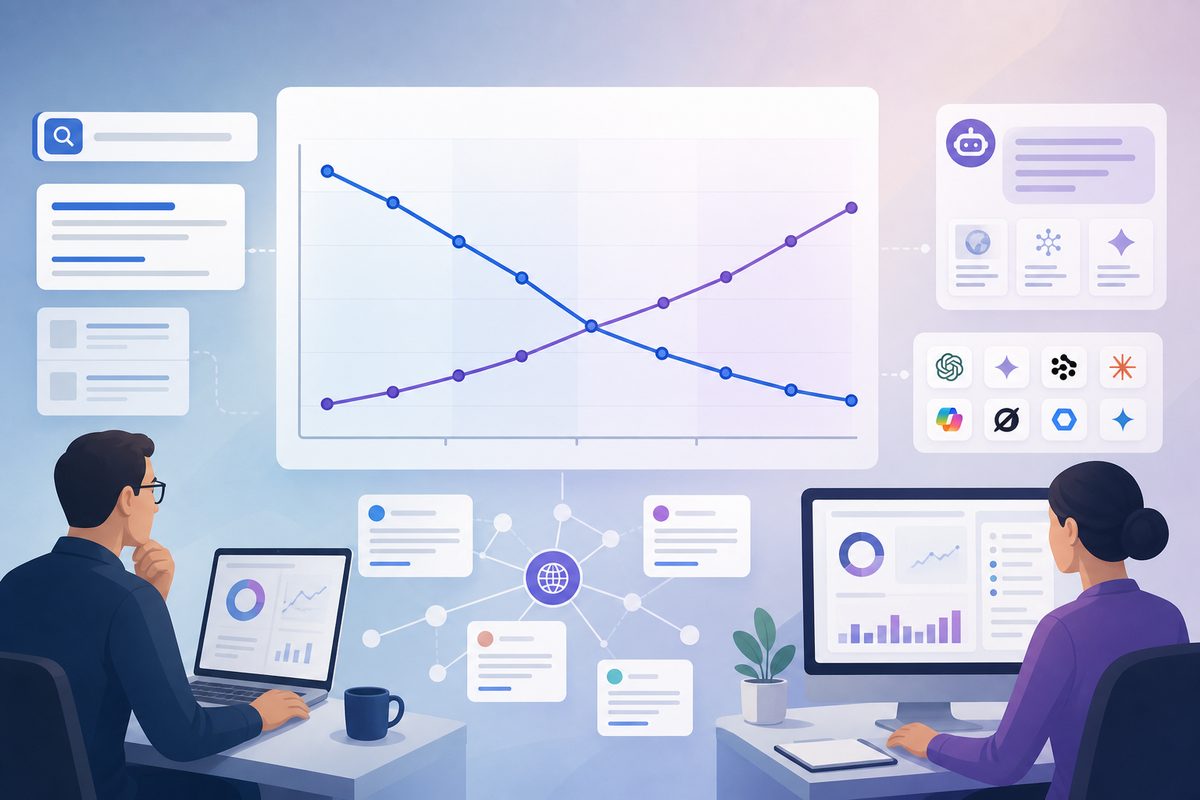
The wrong question: "dead or alive" vs "where does it pay off?"
"Is SEO dead?" is a definitional question with no useful answer. "Where does SEO still return on investment?" is a budget question you can act on. The dead-or-alive framing forces a binary the data refuses to support — every AI answer is assembled from something, and most of that something is still web pages crawled, indexed and ranked by the same machinery SEO has always fed.
The useful lens is a portfolio one. You have a fixed content and link budget. Some of it buys visibility AI engines reuse directly. Some of it buys rankings AI engines now ignore. And some of it needs to buy things classic SEO never targeted — Reddit threads, third-party listicles, analyst mentions, and structured answers an assistant can lift verbatim. The question is not whether the channel lives. It's which slice of it still compounds.
What the 2025–26 data actually shows
Three findings matter, and they pull in different directions — which is exactly why single-number headlines mislead.
Clicks are down, and the drop is real
When an AI summary appears above the results, people click through far less — the measured decline runs from about 47% to 65%. The Pew Research Center's July 2025 analysis of browsing data from 900 U.S. adults (≈68,000 searches) found users clicked a result 8% of the time when an AI summary was present, versus 15% without — a 47% relative drop. Ahrefs' December 2025 update measured a 58% CTR reduction for the top-ranking result on AI Overview queries, with position-1 CTR falling from 0.073% to 0.016% over two years. Seer Interactive's brand-level data put the organic CTR decline on AI Overview queries between roughly 49% and 65%, depending on the brand. Different methods, same direction: the free traffic that justified a lot of SEO spend is thinner now.
Pew found a second, quieter signal: users were more likely to end the session entirely after an AI summary — 26% of those pages versus 16% without. The answer, not the click, is increasingly the destination.
But AI answers still run on indexed, ranked pages
The click may vanish, but the source underneath the answer is usually still a page that earned its place in a traditional index. This is the half of the story the "SEO is dead" posts skip. ChatGPT's web search leans almost entirely on Microsoft's index — Seer Interactive found 87% of SearchGPT citations match Bing's top results, versus just 56% for Google. If your site isn't indexed in Bing, ChatGPT cannot cite it, no matter how it performs on Google. Google's own AI Overviews behave like an extension of the SERP, overlapping heavily with the top organic results. The mechanics that put you in the running — crawlability, indexation, topical authority — are the exact fundamentals Google's Search Essentials still document. AI didn't retire them; it inherited them.
Standalone assistants play by different rules
Here is the twist that reframes the whole question: outside Google's own AI surfaces, ranking no longer predicts the citation. Ahrefs' study of 15,000 prompts found that, on average, only 12% of links cited by ChatGPT, Gemini and Copilot appear in Google's top 10 for the same prompt — and more than 80% come from pages that don't rank in Google at all for that query. Perplexity is the outlier at nearly one in three. Meanwhile, AI Overview citations pulled from top-10 pages fell from 76% in mid-2025 to about 38% by early 2026. Assistants increasingly quote Reddit, Wikipedia, community forums and niche third-party pages that a #1 Google ranking simply doesn't guarantee. Being first stopped being the same thing as being cited.
The Feed / Move / Bypass ledger: where SEO still moves the needle
To answer "does SEO still matter" per query, sort every important query into one of three buckets: Feed, Move, or Bypass. This is the framework we use with brands, and it converts a vague fear into a spreadsheet you can budget against.
| Bucket | What it means | Evidence anchor | SEO's role |
|---|---|---|---|
| Feed | Classic SEO is a prerequisite for the AI answer | ~87% of ChatGPT citations match Bing's top results; AI Overviews overlap heavily with organic top results | High — indexation + ranking still gate you in |
| Move | Ranking no longer predicts the citation | Only ~12% of ChatGPT/Gemini/Copilot citations rank in Google's top 10 | Low alone — needs an AEO/GEO layer and earned third-party sources |
| Bypass | The answer is consumed with no click at all | Clicks fall from 15% to 8% when an AI summary appears | The mention itself is the win, not the visit |
The mistake most teams make is applying one tactic to all three. They keep pouring link budget into pages that live in the "Move" bucket — where a better ranking changes nothing — while ignoring the third-party surfaces that actually feed the citation. Sorting first is what makes the spend rational.
Feed: keep doing SEO, because AI is reading your rankings
For informational and product queries surfaced inside Google AI Overviews and ChatGPT search, classic SEO is still load-bearing. Indexation, clean structure, internal links and topical depth get you into the candidate set the model draws from. If you're wondering how literal this dependency is, we broke down the plumbing in how much of ChatGPT search still runs on Bing's index. For this bucket, "does SEO still matter" isn't rhetorical: neglect it and you disappear from the answer entirely.
Move: SEO gets you nowhere without an answer-engine layer
For conversational, comparison and recommendation queries inside standalone assistants, a top ranking is necessary-at-best and often irrelevant. This is where answer engine optimization earns its keep — structuring content so a model can extract a clean, quotable claim — and where earned mentions decide the shortlist. "X vs Y" prompts are the clearest example; we mapped the specific mechanics in how AI answers comparison queries. Ranking #1 on Google for "best CRM" does not get you named when a buyer asks ChatGPT the same thing.
Bypass: the answer with no click, where the mention is the metric
For definitional and quick-fact queries, the user reads the AI summary and never visits anyone. On these, arguing about position is pointless — the only visibility that exists is whether your brand is named and described inside the answer. That reframes the KPI from sessions to AI share of voice: how often, how prominently, and how positively you appear in generated answers. It's a different scoreboard, and it needs different instrumentation than a rank tracker.
Where classic SEO still directly feeds AI citations
Classic SEO still moves the needle wherever an AI engine retrieves from a search index before it answers — which is most of the time. Four fundamentals still do real work:
- Indexation is table stakes, twice over. Google's AI surfaces read Google's index; ChatGPT and Copilot read Bing's. Submitting sitemaps to both — and confirming crawler access for OAI-SearchBot and Google-Extended — is now a prerequisite, not an optimization.
- Structure decides extractability. The formats models quote most are the scannable ones — direct answers, definitions, tables, ordered steps. Structure often out-predicts raw depth.
- Freshness affects who gets pulled. Citation age skews recent on many query types; setting a deliberate refresh cadence keeps you eligible, as we found analyzing content freshness and AI citations.
- Entity authority carries over. The topical authority and link equity SEO builds are exactly the signals that make a model trust your page enough to quote it.
None of this is new SEO. It's the same discipline, pointed at a new retrieval layer.
Where SEO alone no longer moves the needle
SEO stalls the moment the citation is decided by sources you don't own and can't rank. If more than 80% of assistant citations don't rank in Google, then out-ranking a competitor on your own domain is, for those queries, a rounding error. Three shifts drive this:
- Third-party surfaces dominate. Reddit is the single most-cited source across major AI engines — it leads Perplexity (
47% of citations) while Wikipedia leads ChatGPT (48%), per the study finding Reddit, YouTube and LinkedIn are the most-cited sources in AI answers. Winning here is a sourcing problem, not a ranking one: you earn mentions on the surfaces models actually read, in priority order, rather than treating them as afterthoughts. - Recommendation ≠ ranking. "Get recommended by ChatGPT" is a function of consensus across many pages describing you consistently, not one page ranking #1. Generative engine optimization targets that consensus.
- Sentiment and description matter now. On bypass queries, being mentioned negatively is worse than not appearing. Managing how AI describes you is closer to reputation management than keyword work — see whether ChatGPT is describing you positively, and how to shift the tone. Pure SEO was never built to handle it.
Pretending link-building alone fixes these is how budgets get wasted defending a scoreboard the game stopped using.
How to split your budget: an investment view
Treat the answer to "does SEO still matter" as an allocation, not a verdict — split spend across Feed, Move and Bypass in proportion to where your buyers actually search. There is no universal ratio; there is a starting point you calibrate with your own data. Below is the heuristic we hand teams as a first draft, not a law:
| If your demand is… | Feed (classic SEO) | Move (AEO/GEO + earned sources) | Bypass (brand, PR, sentiment) |
|---|---|---|---|
| Mostly Google, informational | ~60% | ~30% | ~10% |
| Split across Google + assistants | ~40% | ~40% | ~20% |
| Buyers live in ChatGPT / Perplexity | ~25% | ~45% | ~30% |
The point of the table isn't the exact percentages — it's that a rational split is impossible without measurement. You cannot allocate against buckets you can't see. This is the gap an AI visibility tool fills: it turns "we think AI mentions us sometimes" into a tracked, defensible number you can put next to your organic traffic line.
In our own daily tracking — roughly 200 buyer-intent prompts per brand, run across ChatGPT, Gemini, Perplexity, Claude, Copilot, Grok and Google's AI surfaces — the most common pattern is decoupling. We regularly watch a B2B SaaS brand sit outside Google's page one for a core category term while getting named in four of eight assistants for the equivalent conversational prompt — and, just as often, the reverse. If you only measured Google rank, you'd conclude SEO failed. If you only measured AI mentions, you'd conclude SEO was irrelevant. Both readings are wrong; the truth is bucket-specific.
That decoupling is the strongest argument against the "SEO is dead" headline. The channels haven't merged into one scoreboard — they've split into several, and each needs its own line item.
A 30-day way to find your own answer
Don't take our percentages on faith — run a one-month test that produces your own Feed/Move/Bypass split. Marketers defending a budget need their numbers, not ours. Here's the minimum viable version:
- Pick 20–30 buyer-intent prompts. The real questions prospects ask — category terms, "best X for Y," "X vs competitor," and problem-framed queries.
- Baseline both scoreboards. Record your Google ranking and whether you're mentioned in ChatGPT, Perplexity and Google AI Overviews for each prompt. This is where LLM brand tracking and AI search monitoring do the heavy lifting a rank tracker can't.
- Tag each prompt Feed / Move / Bypass. Cited in AI and ranking well → Feed. Cited but not ranking → Move. Answered with no citation opportunity → Bypass.
- Act per bucket. Feed → strengthen indexation and on-page structure. Move → earn third-party mentions and add extractable, quotable answer blocks. Bypass → fix sentiment and pursue the mention itself.
- Re-measure share of voice at day 30. Your AI share-of-voice movement, not your ranking, is the result that tells you where the budget worked.
For one repeatable format that earns citations in the Move bucket, our teardown of statistics pages that AI engines cite shows the pattern. Run this once and the abstract debate evaporates. You'll have a per-query answer to "does SEO still matter" — high for your Feed prompts, low-on-its-own for your Move prompts, and beside-the-point for your Bypass prompts.
The verdict
SEO still matters — as a foundation AI answers are built on, not as a standalone growth engine that guarantees traffic. The falling click-through numbers are real and worth respecting; so is the fact that most AI answers are still assembled from indexed, structured, authoritative pages. The teams that win in 2026 aren't the ones who declared SEO dead, and they aren't the ones who ignored AI. They're the ones who stopped arguing about the obituary, sorted their queries into Feed, Move and Bypass, and moved the money accordingly.
Frequently asked questions
Is SEO dead in 2026?
No. SEO is not dead — it's fragmenting. Its traffic-driving value is down on AI-summary queries (a ~47–65% click drop across independent studies), but its foundational value is intact: AI engines still retrieve, rank and cite from indexed web pages. It changed jobs, from "win clicks" to "feed answers."
Does SEO still matter for ChatGPT and Perplexity?
Partly. ChatGPT's search cites Bing's top results ~87% of the time, so Bing indexation and ranking still gate you in. But only ~12% of assistant citations rank in Google's top 10, so Google SEO alone doesn't predict a citation. You also need answer engine optimization and earned third-party sources.
What's the difference between SEO, AEO and GEO?
SEO optimizes pages to rank in search results. Answer engine optimization (AEO) structures content so AI systems can extract and quote it directly. Generative engine optimization (GEO) shapes the broader consensus of sources so models recommend your brand. They're layered, not rival — GEO and AEO sit on top of SEO fundamentals.
Will AI Overviews kill my organic traffic?
They'll shrink it on affected queries, not zero it out. Studies measure 47–65% CTR declines when AI Overviews appear. The counter-move is to expand what you measure: track brand mentions in ChatGPT and AI share of voice alongside clicks, so a bypassed click still counts as a visibility win.
How do I measure whether SEO is still working in AI search?
Measure two scoreboards at once. Alongside Google rankings and clicks, track how often your brand is cited, ranked and described across AI engines — daily if you can. That combined view of AI citations and share of voice is what tells you which queries SEO still moves and which need a different play.