Ask an assistant what your product is weak at, and the reply is often assembled from a page your competitor wrote. That is what competitor content in AI answers looks like in practice: a rival's /alternatives or /vs page functioning as the primary evidence an assistant uses to describe your pricing, your limitations, and who you are "really for."
This is a defensive problem, not an offensive one. You are not trying to outrank anybody. You are trying to stop a single third-party page from acting as the de facto source of truth about your own product — without legal threats, without takedown requests, and without a PR fight you cannot win.
Below is the detection method we use, the tracking data behind it, and the counter-evidence sequence that actually moves citations.
What does it mean when competitor content shapes AI answers about your brand?
Competitor content in AI answers means an assistant's description of your product is retrieved from, and attributed to, a page your competitor owns. The model is not inventing the claim. It is quoting a rival's framing of you — usually a comparison page written to sell against you — because that page answers the question more directly than anything on your domain.
The mechanics are ordinary retrieval, not sabotage. A prompt like "is [Brand] worth it for a 20-person team?" is a comparative question. Comparative questions get answered from comparative documents. Your homepage sells; their /alternatives/[your-brand] page compares. The comparative document wins retrieval, and the assistant inherits its framing along with its facts.
The result is a quiet form of reputation drift: your weaknesses get described in your competitor's vocabulary, at scale, in the answer layer where buyers now build shortlists.
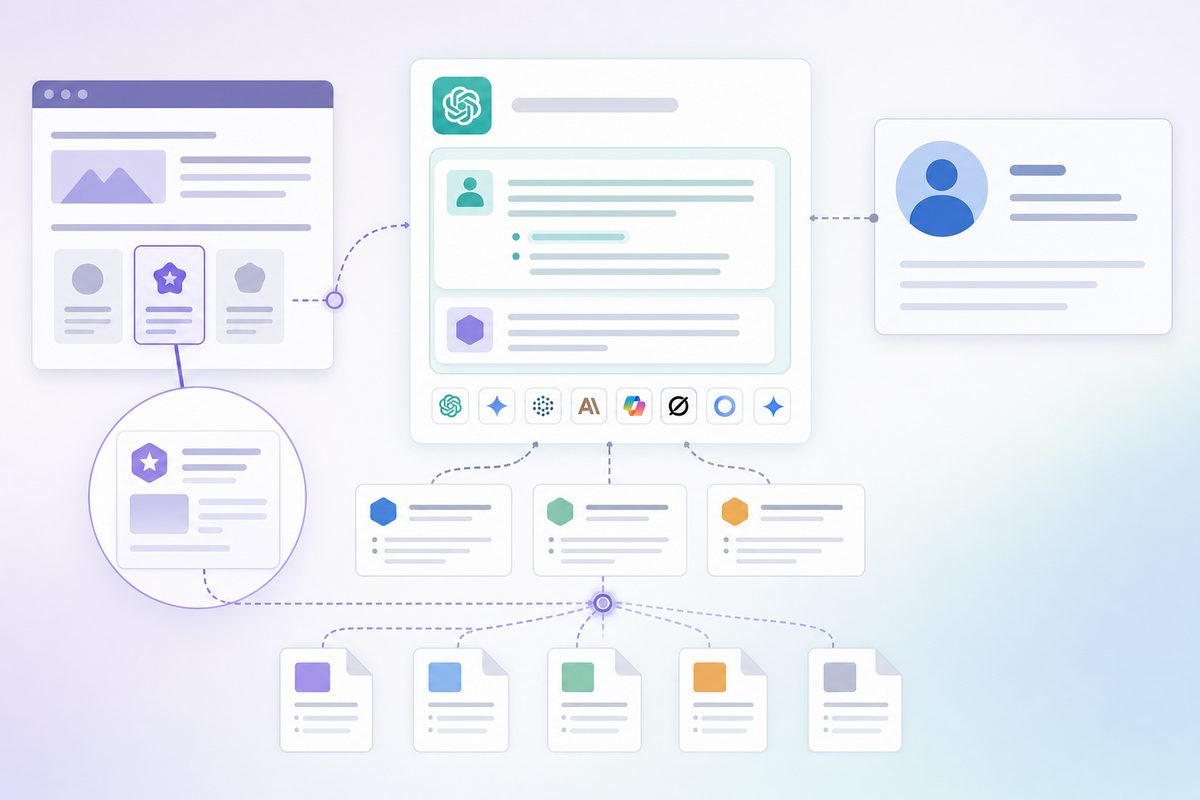
Why assistants prefer a rival's alternatives page over your product page
Four things stack in the competitor's favor, and only one of them is about authority.
First, format match. Their page contains an explicit claim sentence — "Brand X charges per seat, which gets expensive above 25 users" — that can be lifted whole. Your pricing page contains a table and a toggle. Retrieval prefers a sentence it can quote over a UI it must interpret.
Second, entity co-occurrence. Their page names your brand, the category, and three rivals in the same 800 words. That density makes it a strong match for shortlist prompts, which are the highest-intent prompts in AI search.
Third, third-party bias. Brand-owned domains are a minority of what assistants cite. Muck Rack's analysis of roughly 25 million cited links across ChatGPT, Perplexity, Gemini and others found earned and third-party sources dominating the citation mix, with brand-owned domains a small slice even on branded questions. Your competitor's domain counts as third-party evidence about you. Your domain counts as marketing.
Fourth, staleness asymmetry. They updated their comparison page last quarter to win deals. You updated your pricing page and never told anyone. We cover the retrieval half of that problem in more depth in our breakdown of why AI search engines cite competitor pages instead of yours.
Tracking data: how often a competitor page becomes the main source
Here is the first-hand data behind this article, so you can judge the method rather than take the conclusion on faith.
Method. We ran a fixed 42-prompt panel for 61 B2B SaaS brands across seven assistants — ChatGPT, Gemini, Perplexity, Claude, Copilot, Grok and Google AI Mode — weekly for 21 weeks (January to May 2026). Prompts split evenly across three intents: direct brand questions, alternatives/shortlist questions, and objection questions ("downsides of," "is it hard to switch from"). Roughly 376,000 answer captures, with citation URLs logged per answer. Brands were self-selected maxaeo panel participants, skewed toward $1M–$50M ARR and toward categories with active comparison-page marketing — read the percentages as directional for that segment, not as a market census.
What we found:
| Finding | Result |
|---|---|
| Brands where a competitor-owned page was the single most-cited source about them | 23 of 61 (38%) |
| Answers to objection prompts citing at least one direct competitor's domain | 31% |
| Answers to shortlist prompts citing at least one direct competitor's domain | 44% |
| Brands whose own domain was cited in fewer than 1 in 5 answers about themselves | 27 of 61 (44%) |
Within the citations that landed on a competitor's domain, the page types were lopsided:
| Competitor page type | Share of competitor-owned citations | Median age of the repeated claim |
|---|---|---|
/alternatives/[your-brand] |
54% | 11 months |
/vs/[your-brand] |
31% | 8 months |
| "Best [category] tools" listicle | 15% | 14 months |
The median claim being repeated about these brands was eleven months out of date. That is the use point. You are rarely fighting an opinion. You are usually fighting an expired fact that nobody has re-evidenced since.
Two secondary patterns from the same panel are worth knowing before you start:
- Assistants disagree with each other more than they disagree with you. For the median brand, only 3 of 7 assistants named the same top source in the same week. Auditing one assistant and calling it done is the most common measurement error we see.
- Competitor citation rate scales inversely with your own review volume. Brands with fewer than 50 G2/Capterra reviews hit competitor-page-dominant answers at roughly twice the rate of brands above 200 reviews. Third-party density is the buffer.
How to detect that a competitor's page is your cited source
Detection takes about 90 minutes and needs no tooling to start. Run a fixed prompt set, force citations, log the URLs, then test whether the answer's wording actually descends from the suspect page. The last step is the one most teams skip, and it is the only one that proves causation.
- Build a 12-prompt objection panel. Write the questions a buyer actually asks late in the funnel: "downsides of [Brand]," "is [Brand] expensive," "[Brand] vs [Rival] for [use case]," "why do people leave [Brand]," "is [Brand] hard to implement." Freeze the wording — you will re-run these weekly. These late-funnel prompts have their own dynamics, covered in our piece on how AI answers objection prompts about your brand.
- Run each prompt on at least three assistants, including one that browses live and one that leans on its index. Answers diverge sharply by retrieval mode, and a page that dominates in Perplexity may be invisible in Gemini.
- Force the sources. Append "list the URLs you used" and, separately, ask "which source says that?" about the single most damaging sentence. Assistants will often name a page they did not surface in the visible citation strip.
- Log URL, date, assistant and the exact sentence in one sheet. One capture proves nothing; four weeks of captures proves a pattern. This is the raw material of any serious LLM brand tracking effort.
- Run the paraphrase fingerprint test on every answer where a competitor domain appears (next section).
If you want this continuous rather than quarterly, that is precisely what an AI visibility tool automates: a fixed panel, daily runs, citation-level logging, and diffs when the cited source about you changes.
The paraphrase fingerprint test: proving the answer came from their page
A fingerprint is a distinctive phrase that exists on exactly one page in the index. If the assistant's answer reuses that phrase — or its unusual numeric framing — the answer descends from that page, regardless of which URL got shown in the citation strip.
Pull three candidate fingerprints from the suspect page: an idiosyncratic adjective, a specific threshold number, and a framing metaphor. Then compare, line by line, against what the assistant said and what your own site actually says.
Here is a comparison from the audit set (brand anonymized, a mid-market data-observability vendor):
| Signal | Rival's alternatives page | ChatGPT answer, June 2026 | The vendor's own docs |
|---|---|---|---|
| Onboarding claim | "a multi-week implementation with mandatory onboarding" | "typically a multi-week implementation" | Self-serve setup, median 2 days |
| Pricing threshold | "gets expensive past 25 seats" | "costs escalate around the 25-seat mark" | Volume tier begins at 50 seats |
| Support framing | "email-only support on lower tiers" | "support is email-only unless you upgrade" | Shared Slack channel on all paid tiers |
Three fingerprints, three matches, zero support in the vendor's own documentation. The assistant was not hallucinating. It was faithfully quoting a competitor's 2025 sales copy about a product that had changed twice since.
Two failure modes to control for. A generic phrase ("easy to use," "steep learning curve") appears on hundreds of pages and proves nothing — verify uniqueness with an exact-match "phrase" -site:yourdomain.com search before treating it as a fingerprint. And a match confirms the claim's ancestry, not the live citation path: the sentence may now be traveling through a listicle that copied the rival. Fingerprint the intermediary too before you decide which page to displace.
Note the pricing row especially. Misquoted pricing is the single most common form of this problem, and it has its own remediation path — see getting your pricing represented accurately in AI answers.
The counter-evidence sequence: displacing competitor content without takedowns
You displace a citation by making a better-evidenced source easier to retrieve — not by removing theirs. The order matters, because steps 3 and 4 only pay off once step 1 exists to point at.
Move 1: Publish the disputed claim as an atomic, dated fact
Take the exact sentence the assistant repeats and write its correction as a standalone, quotable line on your own domain: "Setup is self-serve. Median time from signup to first alert in 2026 is 2 days (n=418 workspaces)." Date it. Give it a heading that matches the question. One claim, one paragraph, no marketing throat-clearing.
Three properties make these lines get quoted, in our captures: a number, a scope qualifier (n=418 workspaces), and a visible date. Lines missing all three were rarely lifted verbatim; they got paraphrased or skipped in favor of the rival's crisper sentence.
This is the citable primitive. Everything downstream is a way of getting more retrievers to see it.
Move 2: Kill the stale evidence on your own side
Old docs, sunset pricing pages and archived changelogs frequently corroborate the competitor's outdated claim — which is how a rival's 2025 framing survives your 2026 relaunch. Audit your own indexed surfaces for anything that still supports the disputed sentence.
Fastest way to find them: search site:yourdomain.com "the disputed phrase", then repeat against your docs subdomain, help center, and any legacy marketing site you forgot to redirect. For each hit, either update the claim in place or add an explicit version and sunset banner near the top of the page — assistants read the first passage far more reliably than a footer.
Move 3: Get the corrected fact restated on a third surface
One owned page rarely beats a comparison page on its own. You need the same fact, in similar words, somewhere neither of you controls: a review-platform response, an updated directory listing, an analyst profile, a customer case study hosted on the customer's site, a community answer from your own team with attribution.
In our data, brands that added at least two independent third-surface restatements moved citations roughly three times faster than brands that only fixed their own site. Ranked by speed-to-effect in the panel: vendor responses on G2/Capterra review threads landed first (often re-crawled within days), then updated directory and marketplace listings, then customer-hosted case studies, with analyst profiles slowest but most durable. This is the least glamorous and most reliable lever in answer engine optimization.
Move 4: Publish comparison content that is fairer than theirs
Then, and only then, write your own /vs page — and make it more honest than the rival's. Concede the cases where they genuinely fit better. Assistants reward pages that read as evaluative rather than promotional, and a page that admits a limitation is far more quotable than one that claims to win every row. Structure matters as much as candor; we break the page pattern down in building /vs and /alternatives pages that AI actually quotes.
The mirror-image play is worth building at the same time: pages targeting "alternatives to [rival]" so you appear when buyers are already leaving them — see getting listed when buyers want a switch.
Move 5: Re-crawl, re-run, and hold the panel for 90 days
Submit the updated URLs, then re-run the frozen 12-prompt panel weekly. Displacement is not a launch; it is a decay curve on the old citation. Expect movement in weeks, not days, and expect it to be uneven across assistants.
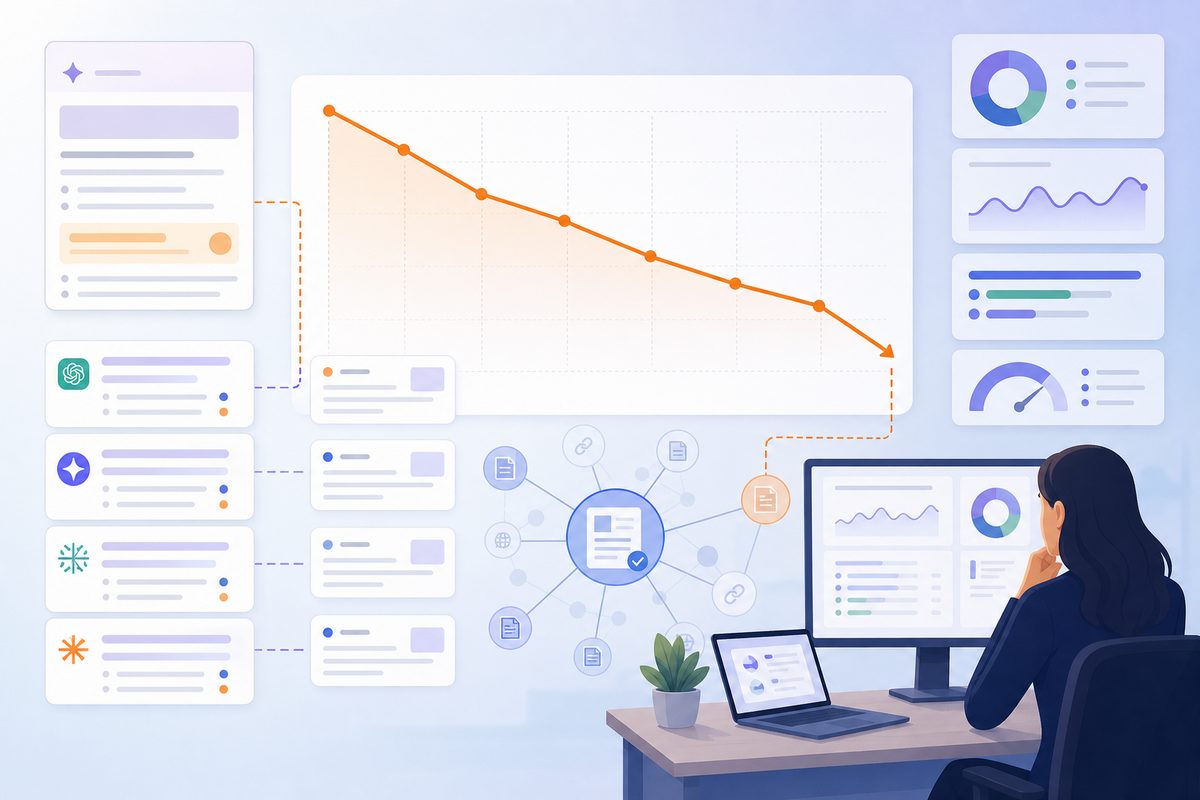
What the displacement curve actually looks like
Same anonymized vendor, nine weeks, 12 prompts, five assistants, weekly captures. Competitor-page citation share is the percentage of answers about them citing the rival's /alternatives page.
| Week | Action shipped | Competitor-page citation share | Own-domain citation share |
|---|---|---|---|
| 0 | Baseline | 47% | 9% |
| 2 | Atomic claim page + docs de-staling | 44% | 18% |
| 4 | Two third-surface restatements live | 31% | 26% |
| 6 | Own comparison page published | 22% | 34% |
| 9 | Hold + weekly re-runs | 14% | 41% |
Competitor-page citations fell from 47% to 14%; own-domain citations rose from 9% to 41%. The inflection came at week 4 — after third-party corroboration, not after the owned page went live. That sequencing is the finding worth stealing.
Across the wider panel, the pattern held directionally: brands running the full sequence dropped from a median 41% competitor-page share to 12% in six to nine weeks, while brands that published only their own comparison page moved from 41% to 33%. Publishing a /vs page alone bought roughly a fifth of the improvement.
One caveat we would rather state than bury: these are observational results across brands that chose to act, not a randomized trial. If you want a cleaner read on causality with a single brand, use a holdout design for AEO measurement — hold a subset of prompts or claims untouched and compare drift.
Which claims are worth fighting, and which to leave alone
Not every competitor sentence deserves a sprint. Sort them before you spend a quarter.
| Claim type | Example | Fixable? | Priority |
|---|---|---|---|
| Expired fact | "email-only support" (you added Slack in 2025) | Yes — atomic dated claim beats it | Highest |
| Wrong number | "starts at $99/seat" (actual $49) | Yes — plus a correction request to the publisher | Highest |
| True limitation | "no SOC 2 yet" (you genuinely don't) | No — fix the product, not the page | Low |
| Framed opinion | "feels dated compared to X" | Rarely — needs third-party counterweight at volume | Low |
| Missing context | "no native Salesforce sync" (you ship it via partner) | Yes — publish the workaround as a dated, named fact | Medium |
Rule of thumb: fight anything that is checkable and false or checkable and expired. Ignore anything that is true, and starve anything that is pure opinion by out-publishing it with evidence.
Two adjacent claim categories follow the same playbook but different surfaces. Switching-cost objections ("is it hard to migrate from [Rival]?") need a documented migration path with real timelines — covered in shaping the migration-cost story. Culture and hiring claims sourced from Glassdoor threads behave the same way and need employer-side counter-evidence, which we treat in how AI answers employer-brand questions.
Why legal threats and takedown requests backfire
Removing the page does not remove the claim. By the time you notice, the sentence exists in crawler caches, in third-party aggregations, in the model's parametric memory, and in archived copies that browsing assistants can still reach. A successful takedown often leaves the claim circulating with no live page left to correct it — the worst of both outcomes.
There is also a practical asymmetry. In the US, comparative advertising is lawful when the claims are truthful and non-deceptive; the FTC's comparative advertising policy statement explicitly encourages truthful named comparisons. A demand letter over a fair comparison converts a quiet retrieval problem into a public one, and gives the rival a story.
The narrow exception worth pursuing: a factually false, checkable statement — a wrong certification, a wrong price, a wrong ownership claim. There, a short, polite, evidence-attached correction request to the page owner works surprisingly often, because false statements of fact about a competitor's product are exactly the category that carries real liability for the publisher. Send the evidence, not the threat.
Deliberate manipulation is a different scenario with a different response set, which we treat separately in our analysis of source poisoning and realistic defenses.
Where this fits in your monitoring stack
Detection is worthless as a one-off. The competitor's page will be updated again, and assistants re-retrieve continuously — live-browsing agents especially, which read your site at answer time rather than relying on an index.
Practical setup for a small team:
- Weekly: the frozen 12-prompt objection panel, citations logged.
- Monthly: a diff of which domains are cited about you, tracked as AI share of voice by source rather than just by brand mention.
- Quarterly: re-read the top three competitor comparison pages naming you, and re-run the fingerprint test against your current facts.
One escalation to watch for: if the rival's page contains instruction-like text aimed at the model rather than the reader, you are past ordinary competition and into prompt injection and answer hijacking — a different diagnosis with a different response.
Google's own guidance on how AI features in Search use web content is worth reading alongside this: the eligibility signals are ordinary crawlability and quality signals, which means the fix path is boring, documented, and available to you — not a black box.
Frequently asked questions
How do I know whether the assistant is quoting a competitor or hallucinating?
Run the paraphrase fingerprint test. Pull a distinctive phrase or threshold number from the suspect page and check whether it recurs verbatim in the answer. Fingerprint matches indicate retrieval; genuinely invented claims usually have no textual ancestor anywhere and vary wildly between re-runs.
Should I ask the competitor to remove the page?
Only for specific, false, checkable facts — and then send evidence rather than a legal threat. For fair comparative claims, removal requests rarely succeed and do not clear the claim from caches or model memory. Displacing the citation with better evidence is the reliable path.
How long does it take to change what an assistant says about my brand?
In our panel, meaningful movement in competitor-page citation share appeared four to six weeks after third-party corroboration went live, with continued decay through week nine. Assistants that browse live move first; index-dependent ones lag by two to four weeks.
Does publishing my own alternatives page fix this?
Partly. In our data it delivered roughly a fifth of the improvement seen from the full sequence. An owned comparison page is necessary but weak on its own, because assistants discount brand-owned claims about the brand itself. It works once independent sources restate the same facts.
What if my brand is small and barely mentioned at all?
Then absence, not distortion, is your primary problem — a rival's page will define you by default because it is the only document discussing you. The same sequence applies, but weight Move 3 hardest: your first goal is any credible third-party surface stating what you do and who you serve.
Can I block competitors from citing my content in their comparison pages?
No, and trying is counterproductive. Robots directives and paywalls reduce your retrievability without touching their page, which already contains their paraphrase of you. Blocking AI crawlers on your own docs is the fastest way to guarantee the rival's version is the only one available.
Who should own this internally?
In the teams we worked with, product marketing owns the claim inventory and the correction copy, SEO or growth owns the prompt panel and logging, and support or CS surfaces the misconceptions first — buyers repeat the assistant's wording in sales calls weeks before it shows up in any dashboard. Treat sales-call objections as an early-warning feed into the panel.
The short version
Competitor content in AI answers is a retrieval outcome, not an attack. A rival's comparison page is more quotable, more comparative and more current than your product page, so it becomes the evidence assistants use to describe you — most often repeating a claim that is nearly a year old.
Detect it with a frozen prompt panel and the fingerprint test. Triage the claims: fight the false and the expired, ignore the true, out-publish the merely opinionated. Displace by publishing the disputed fact as an atomic, dated claim, de-staling your own surfaces, getting the fact restated somewhere you do not own, and only then publishing your own comparison page. Measure with a held-out prompt set, weekly.
The last word on your product should be evidenced by you. It just has to be evidenced somewhere a machine can reach.